
Chef Juliette
John Dory (St. Pierre)
John Dory has the delicacy of sole and the firmness of turbot. A light flouring, a quick butter sauté, and nut-brown beurre noisette show exactly why looks never mattered.
A cooking platform built around craft, culture, and the stories behind what we eat.
Created by Chef Juliette
Based on No. 1221, Ris de Veau Bonne Maman, from Le Guide Culinaire (1907) by Auguste Escoffier
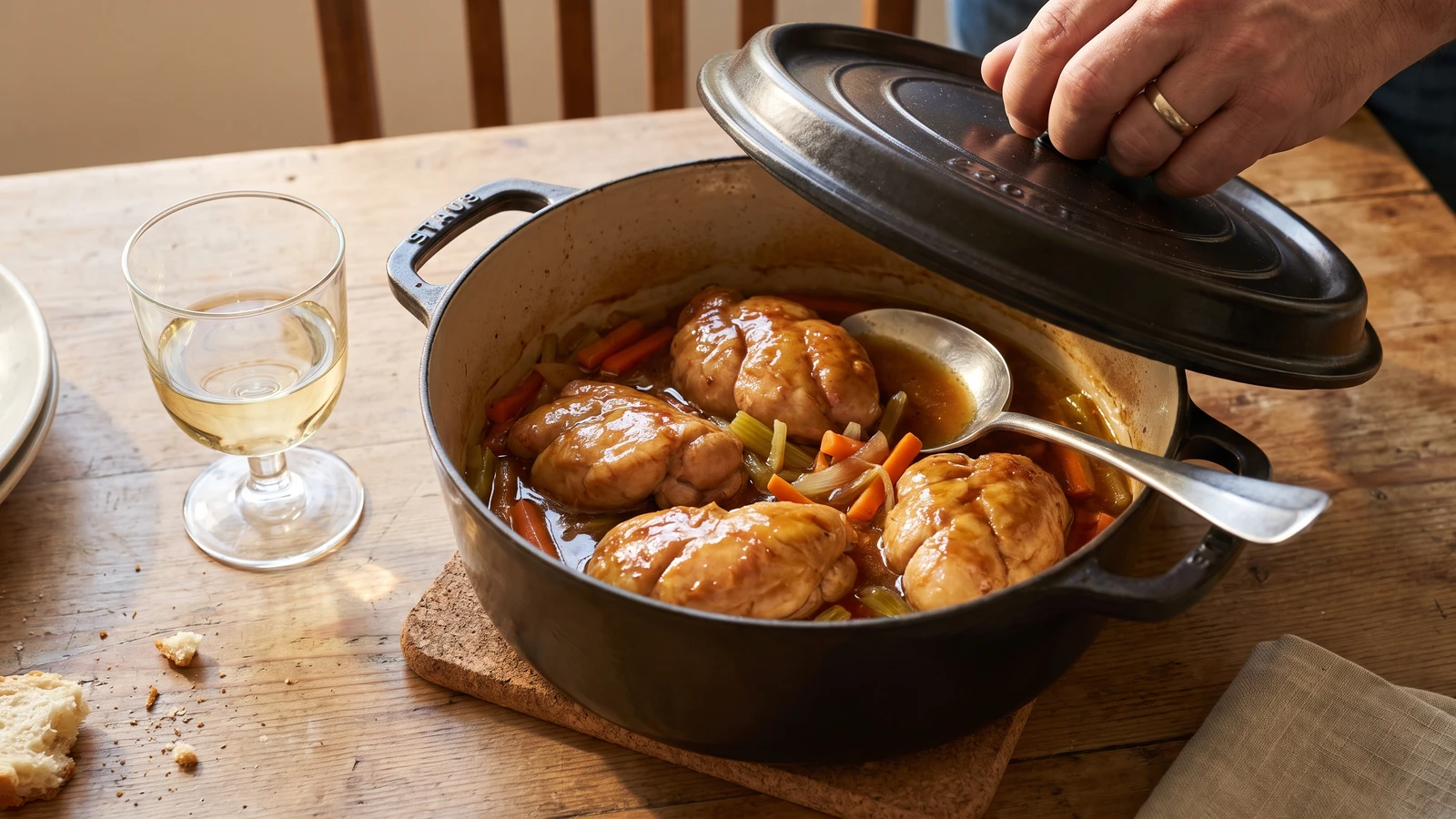
Ris de Veau Bonne Maman teaches white-meat braising: tender sweetbreads, a coarse vegetable julienne, gelatinous veal stock reduced in stages, and a final glaze, all brought proudly to the table in one cocotte.
Ris de Veau Bonne Maman (veal sweetbreads braised home-style) teaches braisage des viandes blanches, braising of white meats, in its most exacting form. Tender lobes are protected by stock reduced in stages, then glazed, while a coarse julienne becomes part of the sauce rather than a garnish. Know one thing before touching the pan: the vegetables may soften and shine, but they must never scorch, because every spoonful of liquor will carry that bitterness to the table.
The original recipe assumed a saucier watching the reductions, gelatinous veal stock drawn from a pot never off the fire, a braiding needle for testing the meat, and a salamander waiting to set the glaze. A home kitchen needs one shallow cocotte, excellent unsalted stock, an instant-read thermometer, and the oven broiler. Three measured additions of stock reproduce the original concentration without a brigade. Only the scale has changed, because those reductions are the dish. One cook, one stove, one evening.
The brigade's extra pans, separate saucier, and folded service napkin are scaffolding and can go. Blanching and pressing the sweetbreads, cutting equal quantities of celery and mixed vegetables, moistening in stages, basting gently, and glazing at the finish must stay. Have the coarse julienne cut and the stock hot before the butter meets the cocotte; from that moment, your attention belongs to the vegetables.
Ris de veau Bonne Maman belongs to cuisine bourgeoise, the well-provisioned French household table, and entered the Parisian classical repertoire when domestic preparations were disciplined for grand service. Bonne Maman is a service designation rather than a claim that one village or grandmother invented the dish: the coarse carrot, onion, and celery julienne gives it its homely character, while the staged stock reductions reveal the classical kitchen. Its journey runs from household cocotte to grand dining room and back again, still served in its cooking vessel with the braising liquor intact.
Quantity
1¾ pounds (800 g)
preferably plump heart sweetbreads
Quantity
1 tablespoon (15 ml / 18 g)
divided
Quantity
1 cup (240 ml / 120 g)
cut julienne-fashion into short, coarse matchsticks
Quantity
1 cup (240 ml / 120 g)
cut julienne-fashion into short, coarse matchsticks
Quantity
2 cups (480 ml / 240 g)
cut julienne-fashion into short, coarse matchsticks
Quantity
2 tablespoons (30 ml / 28 g)
Quantity
3 cups (720 ml / 720 g), used for Braising of White Meats (No. 248)
Quantity
1
Quantity
¼ teaspoon (1 ml / 0.6 g)
| Ingredient | Quantity |
|---|---|
| fresh veal sweetbreadspreferably plump heart sweetbreads | 1¾ pounds (800 g) |
| fine sea saltdivided | 1 tablespoon (15 ml / 18 g) |
| carrotscut julienne-fashion into short, coarse matchsticks | 1 cup (240 ml / 120 g) |
| yellow onioncut julienne-fashion into short, coarse matchsticks | 1 cup (240 ml / 120 g) |
| celery stalkscut julienne-fashion into short, coarse matchsticks | 2 cups (480 ml / 240 g) |
| unsalted butter | 2 tablespoons (30 ml / 28 g) |
| excellent gelatin-rich, unsalted brown veal stock | 3 cups (720 ml / 720 g), used for Braising of White Meats (No. 248) |
| bouquet garni of parsley stems, thyme, and bay | 1 |
| freshly ground white pepper | ¼ teaspoon (1 ml / 0.6 g) |
Put the sweetbreads in a bowl and cover them generously with very cold water. Soak for 30 to 45 minutes, changing the water twice, until the water remains nearly clear. This draws away blood that would otherwise cloud the braising liquor and leaves the flavor clean. Keep the bowl cold throughout.
Place the drained sweetbreads in the cocotte, cover them with fresh cold water by about 1 inch, and add 2 teaspoons of the salt. Bring slowly to a bare simmer, then cook for 5 minutes without boiling hard. Lift them directly into ice water. When cool enough to handle, peel away the loose outer membrane and remove obvious tubes and hard fat, keeping each lobe as whole as possible. If a surface tears, press the loose piece back into place rather than digging farther; the pressing and glaze will hold it. Set the lobes between parchment-lined trays, weight them with about 2 pounds, and press for 30 minutes. Dry thoroughly, then season with the remaining salt and white pepper.
While the sweetbreads press, cut the carrots, onion, and celery julienne-fashion, into match-shaped rods about 1½ inches long and ⅛ inch thick. This is deliberately shorter and coarser than a fine garnish julienne, so the vegetables survive the braise as tender strands rather than dissolving. Weigh them if possible: the celery must equal the combined weight of the carrot and onion.
Heat the oven to 325°F (165°C) and warm the veal stock in a separate small saucepan. Wipe the cocotte dry, melt the butter over low heat, and add the carrot, onion, and celery. Cook for 7 to 10 minutes, stirring from the bottom, until the vegetables soften and glisten without taking color. If a few strands begin to catch, pull the pot from the heat and stir in a spoonful of stock. Ça se rattrape. If anything has gone black, transfer the unburned vegetables to a bowl, wipe the cocotte clean, and begin again with a little fresh butter; black bitterness only grows stronger during reduction.
Spread the vegetables evenly and settle the pressed sweetbreads over them with the bouquet garni tucked alongside. Follow the staged moistening of Braising of White Meats (No. 248): pour in ½ cup (120 ml / 120 g) of the hot veal stock, cover until it reaches a gentle simmer, then set the lid slightly ajar and baste as the stock reduces to a syrupy glaze. Repeat with a second ½ cup (120 ml / 120 g). Keep the heat moderate and move the vegetables gently from the pot floor at every basting; this concentration builds the protective coating around the sweetbreads, but a scorched julienne ruins the liquor.
Add enough of the remaining 2 cups (480 ml / 480 g) hot stock to come halfway up the sweetbreads. Cover the cocotte and place it in the oven for 25 to 35 minutes, basting every 8 minutes and keeping the liquid at the barest tremble. Begin checking early: the sweetbreads are ready when they feel springy, their juices show no pink, and the center reaches 160°F (71°C). The braiding needle of the classical kitchen becomes an instant-read thermometer at home. If the meat is ready before the liquor has body, lift it out at once and reduce the liquor separately; overcooking cannot be taken back.
Transfer the cooked sweetbreads to a small broiler-safe tray and discard the bouquet garni. Keep the julienne in the cocotte and reduce its liquor over moderate heat, stirring carefully along the bottom, until it lightly coats the back of a spoon and gleams without becoming sticky. If it tightens too far, loosen it with a spoonful of hot stock or water. If it remains thin, let the sweetbreads wait loosely covered while the liquor reduces. Brush the lobes generously with the concentrated liquor, then place them under the broiler for 1 to 2 minutes, basting once more, until lacquered and lightly bronzed. The broiler is the honest home equivalent of the salamander; watch it without blinking.
Return the glazed sweetbreads to the shallow cocotte and arrange the tender julienne and braising liquor all around them. Cover just long enough to carry the dish to the table, then set it on a heatproof trivet. The original folded napkin belonged to formal service; the trivet protects your table and leaves the food to speak for itself. Spoon the vegetables and glossy liquor over each portion. Never apologize at your own table. À table!
1 serving (about 250g)
Culinary guides, cultural storytelling, and the editorial depth that makes cooking meaningful.
Discover Culinary ExplorerChef Juliette
John Dory has the delicacy of sole and the firmness of turbot. A light flouring, a quick butter sauté, and nut-brown beurre noisette show exactly why looks never mattered.

Chef Juliette
Fresh haddock proves its delicacy in the meunière pan: a fine flour crust, moist pearly flakes, and beurre noisette sharpened with lemon and parsley, ready from one skillet in half an hour.

Chef Juliette
Éperlans à l’Anglaise turns small fish into a lesson in disciplined coating: boned smelts under a close, crisp crumb, pan-fried in clarified butter and finished with bright, half-melted maître d’hôtel butter.

Chef Juliette
Tiny smelts, shallot, mushrooms, white wine, gratin sauce, and fine bread raspings meet a fierce oven, where the fish must turn tender in the same breath the buttered crust bronzes.