Culinary Explorer
A cooking platform built around craft, culture, and the stories behind what we eat.
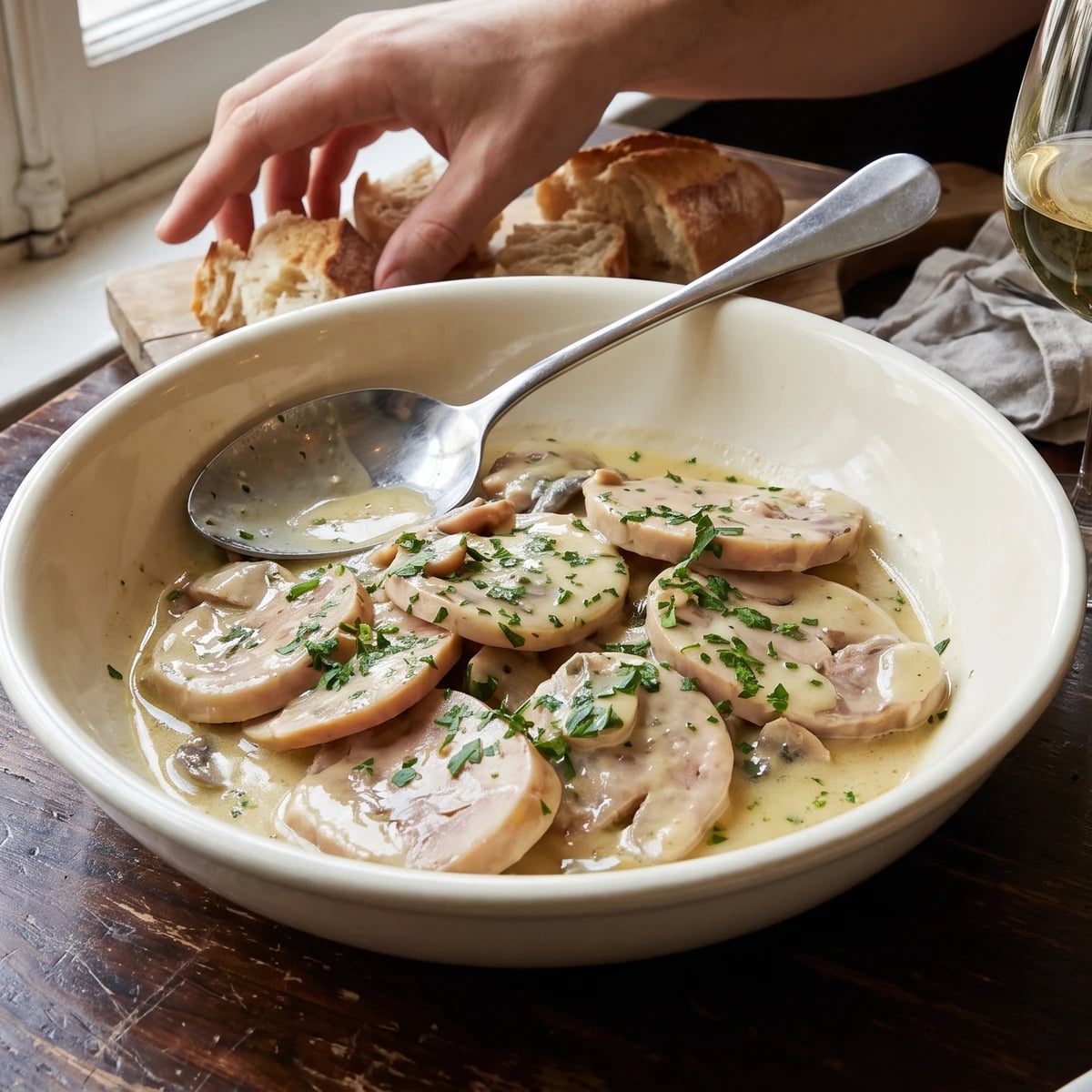
Tête de Veauà la Poulette
Created by Chef Juliette
Tête de Veau à la Poulette makes thrift magnificent: tender, pearly slices of calf’s head folded through Poulette Sauce (No. 101), glossy with butter, sharpened by lemon, and finished with parsley.
Tête de Veau à la Poulette, calf’s head with Poulette Sauce (No. 101), teaches the clean division of heat. The head needs a long, quiet poach until its collagen gives and the slices turn tender; the finished sauce needs the gentlest warming because a boil will drive out its gloss. Know that before you touch the pan, and the dish becomes calm work rather than an ordeal.
The book assumed a whole head already cleaned by the butcher, a blanc every cook knew by reflex, Poulette Sauce (No. 101) waiting from the saucier, and stock never off the fire behind him. Your home equivalent is a cleaned, boned head rolled and tied to fit one stockpot, plus a four-serving batch of the referenced sauce prepared from its own entry while the meat cooks. I have changed the shape and quantity because a loose head and a brigade yield are needless at home; I have not changed the blanc, the bias cut, the sequence, or the buttered finish. The brigade’s holding and service choreography are scaffolding. Those four things are the dish.
At the table, the pale, yielding slices sit under an ivory sauce scented with mushroom and sharpened by lemon, with parsley scattered at the last second. One cook, one stove, one evening. The final toss decides everything: keep it below a simmer, move the slices gently, and serve as soon as the sauce clings.
Ingredients
butcher-prepared calf’s head
Quantity
1 (3½ to 4 lb / 1.6 to 1.8 kg)
fully cleaned, boned, rolled, and tied
cold water
Quantity
About 6 quarts (5.7 liters / 5.7 kg), divided, plus more as needed to cover
plain flour
Quantity
⅓ cup (80 ml / 40 g)
| Ingredient | Quantity |
|---|---|
| butcher-prepared calf’s headfully cleaned, boned, rolled, and tied | 1 (3½ to 4 lb / 1.6 to 1.8 kg) |
| cold water | About 6 quarts (5.7 liters / 5.7 kg), divided, plus more as needed to cover |
| plain flour | ⅓ cup (80 ml / 40 g) |
Where cooking meets culture.
Culinary guides, cultural storytelling, and the editorial depth that makes cooking meaningful.
Discover Culinary Explorer