
Chef Juliette
John Dory (St. Pierre)
John Dory has the delicacy of sole and the firmness of turbot. A light flouring, a quick butter sauté, and nut-brown beurre noisette show exactly why looks never mattered.
A cooking platform built around craft, culture, and the stories behind what we eat.
Created by Chef Juliette
Based on No. 1210, Tête de Veau à l’Anglaise, from Le Guide Culinaire (1907) by Auguste Escoffier
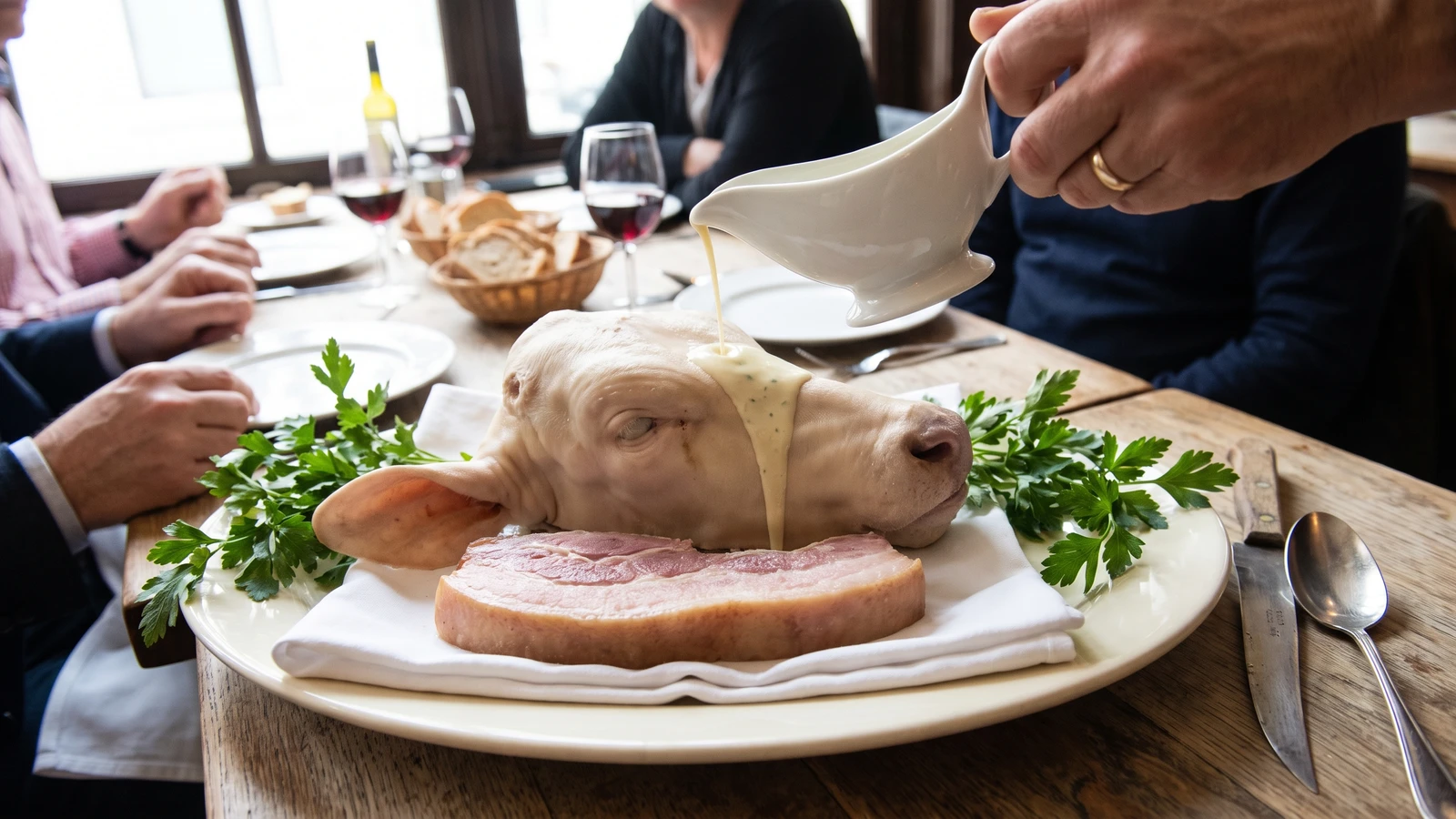
A pale, tender half calf’s head, poached bone-in through a lemon flour blanc, then brought to lunch with boiled bacon, vivid green parsley, and a generous sauceboat at its side.
Tête de Veau à l’Anglaise (calf’s head in the English manner) teaches control at the gentlest end of the stove. The head cooks in a blanc, water whisked with flour and lemon, which protects its pale colour while slow heat softens the skin and cheek. The one true thing to know before touching the pan is this: the blanc must tremble, never boil. A rolling pot contracts the skin before the collagen beneath it has become tender.
The book’s entry assumed a stockpot made for both halves of a calf’s head and a saucier standing ready with the sauceboat. It called for neither a stock never off the fire nor a salamander, so we add neither for grandeur. For one cook, one stove, one evening, one butcher-prepared unboned half fits a deep home stockpot and feeds four generously. The second half and the extra hands were brigade scaffolding and can go; the blanc, the bone-in cooking, the boiled bacon, the green parsley, and the separate sauceboat are the dish and must stay.
This is plain luncheon food in the finest sense: pale, yielding meat, salty bacon, fresh parsley, and butter-rich sauce. Keep the head completely submerged beneath its parchment cover and hold the cooking liquor at the barest tremble. That is the step that decides everything.
Tête de Veau à l’Anglaise belongs to the Parisian classical repertoire, where à l’anglaise marked an English-style service of plainly boiled meat, bacon, and parsley sauce. The name records a crossing of table customs rather than a French regional claim: professional kitchens took the English fondness for boiled meats and classified it beside their own preparations. Here à l’anglaise does not mean the breadcrumb coating the same phrase signals elsewhere in the canon; the unboned halves, blanc, boiled bacon, and sauceboat define this particular dish.
Quantity
1 (about 6 to 7 lb / 2.7 to 3.2 kg)
fully dehaired, with the eye and brain removed
Quantity
6 qt (5.7 L / 5.7 kg), plus more as needed
for soaking, the blanc, and topping up
Quantity
¾ cup (180 ml / 90 g)
Quantity
¼ cup (60 ml / 72 g)
Quantity
2 (about 8 oz / 225 g)
thickly sliced
Quantity
1 (about 8 oz / 225 g)
quartered
Quantity
2 (about 8 oz / 225 g total)
halved and squeezed, shells reserved
Quantity
1
4 parsley stems, 2 thyme sprigs, and 1 bay leaf
Quantity
1 lb (450 g)
Quantity
2 qt (1.9 L / 1.9 kg)
Quantity
1½ cups (360 ml / about 360 g) Parsley Sauce (No. 119a)
prepared according to its own entry
Quantity
1 small bunch (about 1 oz / 30 g)
the brightest sprays selected
| Ingredient | Quantity |
|---|---|
| butcher-prepared half calf’s head, unbonedfully dehaired, with the eye and brain removed | 1 (about 6 to 7 lb / 2.7 to 3.2 kg) |
| cold waterfor soaking, the blanc, and topping up | 6 qt (5.7 L / 5.7 kg), plus more as needed |
| all-purpose flour | ¾ cup (180 ml / 90 g) |
| fine sea salt | ¼ cup (60 ml / 72 g) |
| medium carrotsthickly sliced | 2 (about 8 oz / 225 g) |
| large yellow onionquartered | 1 (about 8 oz / 225 g) |
| lemonshalved and squeezed, shells reserved | 2 (about 8 oz / 225 g total) |
| bouquet garni4 parsley stems, 2 thyme sprigs, and 1 bay leaf | 1 |
| unsmoked slab bacon | 1 lb (450 g) |
| cold water for boiling the bacon | 2 qt (1.9 L / 1.9 kg) |
| Parsley Sauceprepared according to its own entry | 1½ cups (360 ml / about 360 g) Parsley Sauce (No. 119a) |
| flat-leaf parsleythe brightest sprays selected | 1 small bunch (about 1 oz / 30 g) |
Ask the butcher to split the calf’s head lengthwise but leave the bones in place, exactly as this variation requires. At home, rinse the half carefully under cold running water, paying attention to the cut surface and cavities, then soak it in a nonreactive basin of very cold water for 30 minutes, changing the water once. Keep the basin cold throughout. Drain and inspect the cut bones for loose fragments before cooking.
In a 16-quart heavy stockpot, whisk the flour with about 2 cups of the cold water until perfectly smooth. Whisk in the remaining water, salt, carrots, onion, lemon juice and squeezed shells, and bouquet garni. Bring the blanc slowly to a bare simmer, whisking across the pot floor until the flour is fully dispersed. If you see lumps, strain the blanc before the head goes in. Ça se rattrape, and straining now is easier than fishing flour from around a calf’s ear later. Wrap the head loosely in food-safe cheesecloth to make a lifting sling, then lower it carefully into the blanc. The liquid should cover it by about 1 inch. Set a parchment cartouche directly on the liquid and keep the pot partially covered.
Hold the blanc between 185 and 195°F (85 and 90°C), where an occasional bubble rises but the surface never rolls. Skim away grey scum as it gathers during the first 30 minutes, taking care not to remove the flour suspension itself. Cook for 2½ to 3 hours, turning the wrapped head once, until a skewer passes through the thick cheek without resistance and the skin feels tender rather than rubbery. Watch the level and add a little hot water if the head begins to emerge. If the pot reaches a hard boil, lift it off the heat and add a cup of cold water before returning it to the lowest burner. The skin may tighten slightly, but the dish is not lost. Ça se rattrape. If flour catches on the bottom, do not scrape it up; transfer the head and unburnt liquid to a clean pot and continue at gentler heat.
During the final 75 minutes, put the slab bacon in a separate saucepan and cover it with the measured cold water. Bring it slowly to a bare simmer and cook for 60 to 75 minutes, until a skewer enters easily but the piece still holds its shape. Taste the water after 10 minutes; if it is fiercely salty, drain the bacon, cover it with fresh hot water, and continue. This removes excess cure without taking away the bacon’s proper savour.
Scald a clean, unscented white cotton napkin with boiling water, wring it dry, fold it thickly, and lay it on a warmed oval platter. Refresh the parsley sprays in ice water for 10 minutes, then dry them thoroughly so they remain very green. Warm the finished Parsley Sauce (No. 119a) gently according to its own entry and pour it into a heated sauceboat. Do not let the sauce boil while it waits. If butter begins to bead around its edge, take it off the heat and whisk in a spoonful of cold water until it comes together again.
Lift the calf’s head by its cheesecloth sling and let it drain over the pot for 5 minutes. Remove the cloth carefully and set the half on the napkin, outer side uppermost, keeping its shape intact. Drain the bacon and place it beside the head as one generous piece. Arrange the very green parsley sprays around both, with no further decoration. Carry the platter and sauceboat to the table together. Carve the tender cheek, skin, and any tongue portion supplied into thick servings, remembering that the bones remain because this is à l’anglaise. Spoon the sauce generously over each portion and serve slices of boiled bacon alongside. Cooking well is not cooking fancy. À table!
1 serving (about 450g)
Culinary guides, cultural storytelling, and the editorial depth that makes cooking meaningful.
Discover Culinary ExplorerChef Juliette
John Dory has the delicacy of sole and the firmness of turbot. A light flouring, a quick butter sauté, and nut-brown beurre noisette show exactly why looks never mattered.

Chef Juliette
Fresh haddock proves its delicacy in the meunière pan: a fine flour crust, moist pearly flakes, and beurre noisette sharpened with lemon and parsley, ready from one skillet in half an hour.

Chef Juliette
Éperlans à l’Anglaise turns small fish into a lesson in disciplined coating: boned smelts under a close, crisp crumb, pan-fried in clarified butter and finished with bright, half-melted maître d’hôtel butter.

Chef Juliette
Tiny smelts, shallot, mushrooms, white wine, gratin sauce, and fine bread raspings meet a fierce oven, where the fish must turn tender in the same breath the buttered crust bronzes.