Culinary Explorer

A cooking platform built around craft, culture, and the stories behind what we eat.
Discover Culinary Explorer
Selle de Veau à la Tosca

Selle de Veau à la Tosca

Created by Chef Juliette

Based on No. 1189, Selle de Veau à la Tosca, from Le Guide Culinaire (1907) by Auguste Escoffier

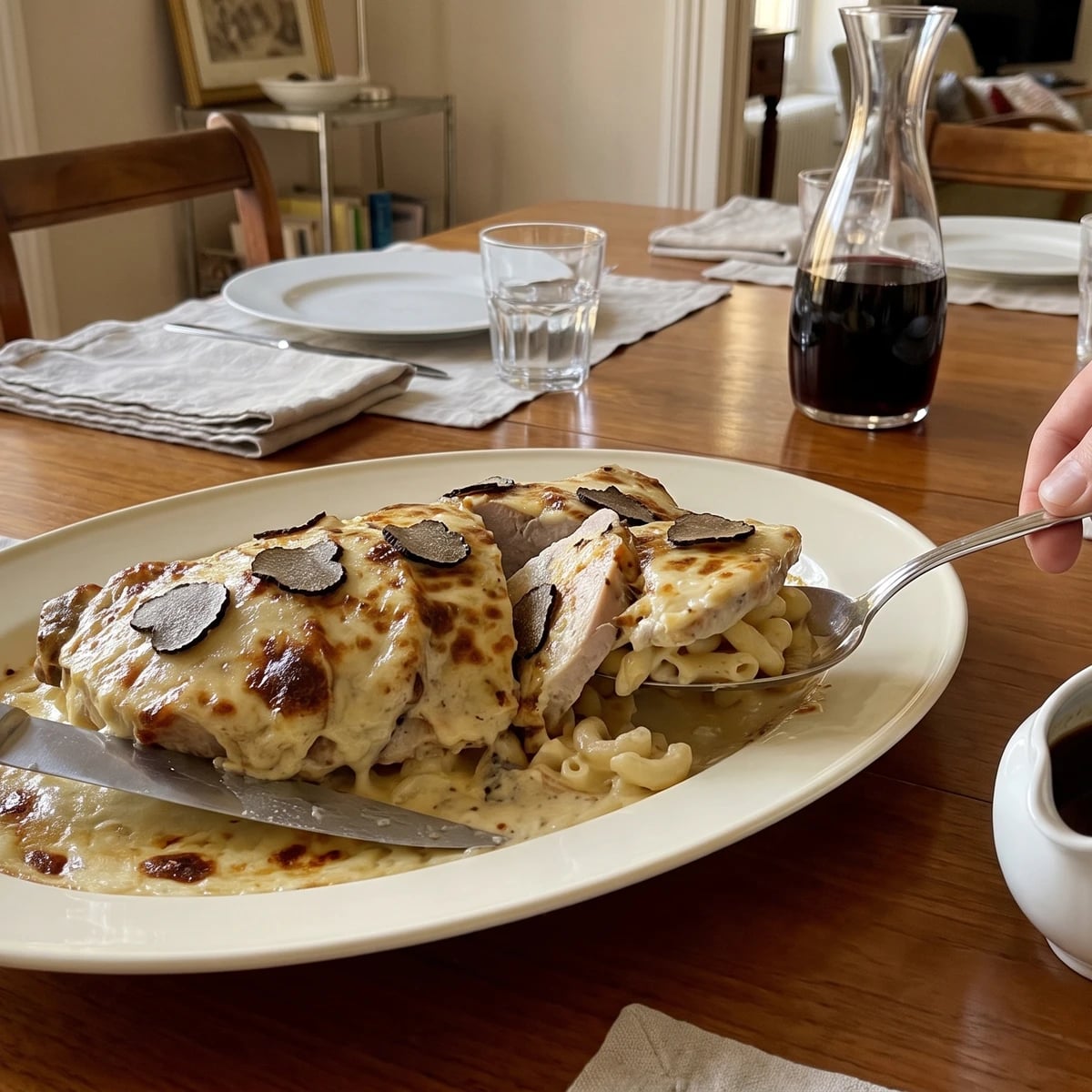
Selle de Veau à la Tosca turns reconstruction into supper: tender veal collops lifted on truffled macaroni, veiled with Mornay, glazed gold, and served with clear, concentrated braising liquor.

Main Dishes
French
Dinner Party
Special Occasion
45 min
Active Time
2 hr 30 min cook3 hr 15 min total
Yield4 servings

Selle de Veau à la Tosca (braised veal saddle with creamed macaroni, truffle, and Mornay) teaches construction. The macaroni is not a side dish tucked under the meat. It is the foundation that raises the collops proudly beside the chine, and it must be creamy enough to bind yet dry enough to carry their weight.

The classical formula assumed a full brigade saddle, a saucier on staff, stock never off the fire, several hands for carving and reconstruction, and a salamander waiting to glaze the sauce. At home, a butcher-prepared saddle for four, one saucepan of Mornay, an ovenproof serving platter, and a fiercely heated broiler do the same work. The brigade transfer with an enormous slice can go because we assemble on the platter that reaches the table. The braise, the careful removal and slant-cutting of the fillets, the truffled macaroni, the raised reconstruction, and the quick glaze must stay. Those steps are the dish.

Keep your attention on the macaroni. If it puddles, the collops slide and the architecture collapses; if it is tight, the filling eats like paste. Bring it to the point where a spoonful holds a soft mound, then reconstruct without hesitation. One cook, one stove, one evening.

Selle de Veau à la Tosca belongs to the Parisian grand-kitchen repertoire, not to Tuscany: à la Tosca names a French composition of macaroni, truffle, Mornay, and ceremonially reconstructed veal. The dish carried the familiar braised saddle from the carving board to the formal bourgeois table, using pasta as a structural garnish rather than a separate course. Its raised fillets were practical theater, displaying the cook's command of butchery, sauce, and service in a single joint.

The technique, the tradition, and the story behind every dish.

Discover Culinary Explorer

Ingredients

Selle de Veau à la Metternich

Quantity

1 home-scaled Selle de Veau à la Metternich (No. 1183), using a small bone-in veal saddle about 4 lb (1.8 kg)

Stop after braising, removing the fillets, and cutting them into regular collops.

reserved braising liquor

Quantity

2 cups (480 ml / about 480 g) from Selle de Veau à la Metternich (No. 1183)

degreased and strained

dried straight macaroni or bucatini

Quantity

1 cup (240 ml / 115 g)

heavy cream

Quantity

1/2 cup (120 ml / 120 g)

divided

unsalted butter for the macaroni

Quantity

1 tablespoon (15 ml / 14 g)

black truffle

Quantity

1 small truffle (about 1 oz / 28 g)

two-thirds cut into fine julienne and one-third thinly sliced

unsalted butter for the roux

Quantity

3 tablespoons (45 ml / 42 g)

plain flour

Quantity

3 tablespoons (45 ml / 24 g)

whole milk

Quantity

2 cups (480 ml / 490 g)

warmed and divided

Gruyère

Quantity

3/4 cup (180 ml / 75 g)

finely grated

Parmesan

Quantity

1/4 cup (60 ml / 22 g)

finely grated

cold unsalted butter for finishing

Quantity

1 tablespoon (15 ml / 14 g)

fine salt

Quantity

as needed

ground white pepper

Quantity

as needed

freshly grated nutmeg

Quantity

as needed

Equipment Needed

  • Heavy covered braiser sized for the veal saddle
  • Large ovenproof oval serving platter
  • Medium heavy-bottomed saucepan
  • Balloon whisk and fine-mesh sieve
  • Thin sharp slicing knife
  • Two broad metal spatulas

Instructions

  1. 1

    Prepare the saddle

    Follow Selle de Veau à la Metternich (No. 1183) to braise the home-scaled saddle. Carry that preparation only through marking the meat, carefully lifting the two fillets from beside the chine, and cutting them on a slight slant into even collops. Keep each row in its original order, cover the warm saddle loosely, and reserve its braising liquor. Do not add the Metternich paprika Béchamel, truffle arrangement, or pilaff, because the Tosca preparation takes over at this point.

    Ask the butcher for a compact, symmetrical bone-in saddle section and explain that the two loins must remain intact for removal after braising. A ragged or deeply scored loin cannot be reconstructed neatly.
  2. 2

    Cream the macaroni

    Boil the macaroni in generously salted water until it is supple but still about two minutes short of tender. Drain thoroughly, cut it into short lengths of about 1 inch (2.5 cm), and return it to the saucepan with the butter and 6 tablespoons (90 ml / 90 g) of the cream. Hold it over gentle heat, stirring, until the pasta finishes cooking and the cream clings rather than pools. Fold in the truffle julienne and season with salt and white pepper. A spoonful should hold a soft mound. If it spreads, simmer it another minute; if it turns stiff, fold in the reserved cream one spoonful at a time. This consistency is what carries the collops.

  3. 3

    Build the Mornay

    Melt the roux butter in a saucepan, stir in the flour, and cook for two minutes without allowing it to color. Whisk in 1 3/4 cups (420 ml / about 430 g) of the warm milk gradually, first in small additions to keep the base smooth, then in a steady stream. Simmer gently for five minutes until the Béchamel coats the back of a spoon. Remove it from the heat and stir in the Gruyère, Parmesan, cold finishing butter, white pepper, and a restrained grating of nutmeg. The finished Mornay, a cheese-enriched Béchamel, should fall from the spoon in a broad ribbon. If it lumps, whisk it off the heat and pass it through a fine sieve. If the cheese turns oily, the pan was too hot; whisk in a spoonful of the reserved warm milk until it comes together. Ça se rattrape.

  4. 4

    Raise the collops

    Set the warm saddle on a large ovenproof oval serving platter. Almost completely fill the two cavities beside the chine with the truffled macaroni, building each side into an even, gently raised platform. Reconstruct the fillets by replacing the collops in their original order, overlapping them slightly so the two rows look continuous and stand proud of the chine. If the collops slide, lift them off and return the macaroni to gentle heat for another minute; loose filling cannot support the meat.

  5. 5

    Mask with Mornay

    Heat the broiler fully and set a rack about 6 inches (15 cm) below it. Masquer, meaning coat completely, each reconstructed row with enough warm Mornay to cover the collops without burying their shape. Tuck one thin truffle slice between neighboring collops, then coat the exposed surface of the joint with the remaining sauce, leaving the dark truffle seams visible. Wipe the platter rim clean before it goes beneath the heat.

  6. 6

    Glaze it quickly

    Set the platter beneath the broiler for two to four minutes, rotating once if the heat is uneven, until the Mornay swells slightly and takes patches of deep butter gold. The broiler is the honest home equivalent of the salamander, and speed matters because the veal is already cooked. Do not step away. If one patch colors too quickly, shield it with a small piece of foil while the rest catches up. Rest the glazed saddle for five minutes; if checked, the center of the meat should register at least 145°F (63°C) after resting.

  7. 7

    Finish the liquor

    While the saddle glazes, bring the reserved braising liquor from Selle de Veau à la Metternich (No. 1183) to a lively simmer in a wide saucepan. Skim away every trace of surface fat and reduce it to about 1 cup (240 ml / about 240 g), or until concentrated yet still readily pourable, then pass it through a fine sieve into a warm sauceboat. If it becomes salty before it gains body, stop reducing and loosen it with a spoonful of water. The liquor belongs beside the Tosca, never poured over the Mornay in advance.

  8. 8

    Carve and serve

    Bring the whole glazed saddle to the table. Carve down through each raised row so every serving receives veal collops, truffled macaroni, and its coat of Mornay, then pass the clear braising liquor separately. The ivory sauce, black seams of truffle, and lifted fillets are the presentation; no stray herbs or decorative vegetables are needed. À table!

Chef Tips

  • The butcher matters more than luxury veal here. Ask for an evenly cut saddle section with the chine and both loins intact, scaled for four. Explain that the braised fillets will be removed, sliced, and rebuilt, so careless scoring before you receive it creates trouble no sauce can hide.
  • Fresh black truffle is splendid when the season gives it honestly. At other times, use a whole preserved black truffle with a firm texture, drained and dried before cutting. Truffle oil cannot supply the slices or the quiet earthy bite this construction requires.
  • The macaroni is ready when it holds a mound without looking dry. That narrow point is the dish's true test: a wet filling collapses, while an over-reduced one turns heavy beneath the delicate veal.
  • Use real Gruyère, Parmesan, butter, cream, and whole milk. Mornay depends on the emulsion of dairy fat, starch, and cheese; substitutes tend to split beneath the broiler and bring none of the proper flavor.
  • Pour a full-bodied dry white Burgundy or another restrained Chardonnay with enough acidity for the Mornay. A heavily tannic red fights the cream and makes the truffle disappear.

Advance Preparation

  • The saddle may be braised a day ahead in its liquor. Cool it intact, chill it covered, then lift off the solidified fat and rewarm the saddle gently in a little strained liquor before removing and slicing the fillets.
  • The Mornay can be made up to four hours ahead. Press buttered parchment directly against its surface, chill it, and reheat over very gentle heat with a spoonful of milk, whisking until smooth.
  • The truffled macaroni can be prepared two hours ahead and held covered. Reheat it gently with a spoonful of cream and restore the soft, mound-holding consistency before filling the saddle.
  • Complete the reconstruction no more than thirty minutes before serving. Apply the Mornay and glaze at the last moment, because the pasta continues absorbing cream and the browned sauce loses its proud finish if it waits.

Frequently Asked Questions

Nutrition Information

1 serving (about 520g)

Calories
915 calories
Total Fat
52 g
Saturated Fat
28 g
Trans Fat
1 g
Unsaturated Fat
23 g
Cholesterol
320 mg
Sodium
1050 mg
Total Carbohydrates
35 g
Dietary Fiber
1 g
Sugars
8 g
Protein
76 g

Note: Chef personas and recipes are created with AI assistance. Cook with care: follow safe food-handling practices, check doneness with a thermometer when needed, and adapt for allergies and your kitchen.

Where cooking meets culture.

Culinary guides, cultural storytelling, and the editorial depth that makes cooking meaningful.

Discover Culinary Explorer

More from Relevés and Entrées - VEAL

Browse the full collection