
Chef Juliette
John Dory (St. Pierre)
John Dory has the delicacy of sole and the firmness of turbot. A light flouring, a quick butter sauté, and nut-brown beurre noisette show exactly why looks never mattered.
A cooking platform built around craft, culture, and the stories behind what we eat.
Created by Chef Juliette
Based on No. 1183, Selle de Veau à la Metternich, from Le Guide Culinaire (1907) by Auguste Escoffier
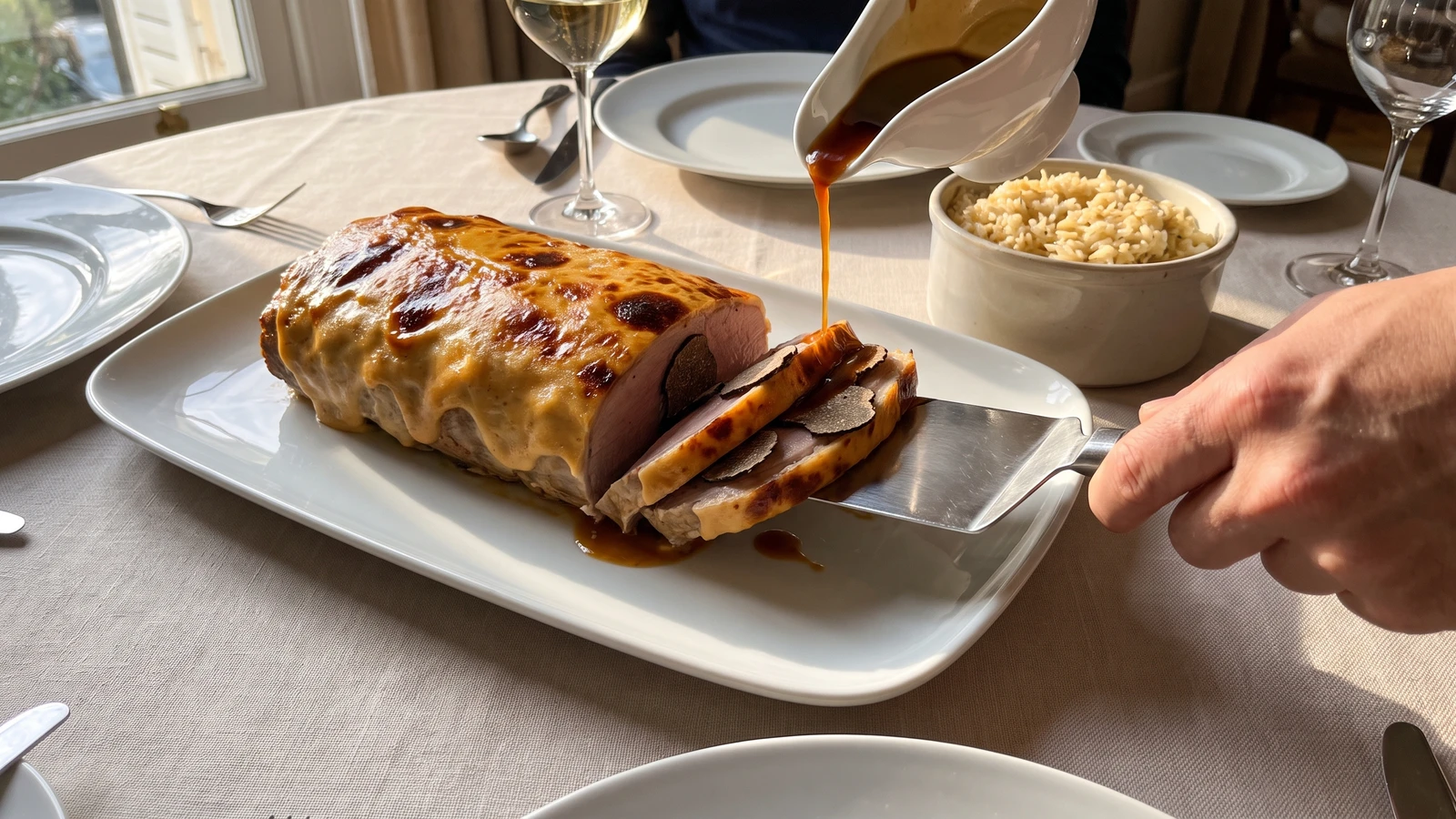
A veal saddle braised until tender, its fillets cut into collops and rebuilt with paprika Béchamel and truffle, then flashed beneath fierce heat until the ivory sauce glazes.
Selle de Veau à la Metternich (braised veal saddle rebuilt with paprika Béchamel and truffle) teaches reconstruction. The carving is not service after the cooking. It is the cooking. Your one true thing before touching the pan is that every collop must return to the precise place it occupied on the bone, so the finished saddle appears whole beneath its burnished glaze.
The original assumed brigade portions, a saucier on staff, a stock never off the fire, and a salamander fierce enough to color the sauce in moments. At home, that becomes a four-person center-cut saddle, dependable unsalted veal stock, one saucepan of paprika Béchamel (a roux-thickened milk sauce), and a fully heated broiler. I assemble it directly on a broiler-safe serving platter, removing the original second transfer because that was service scaffolding and risks undoing the reconstruction. One cook, one stove, one evening.
What stays is the dish itself: the careful braise, the fillets lifted whole and cut into slanting collops, Béchamel and two truffle slices tucked between every piece, and the quick final glaze. When it lands at the table, the saddle should look untouched, its paprika sauce glossy and lightly bronzed, with the dark reduced braising liquor and pilaff rice waiting separately. Keep the collops in exact order when you cut them. That is the step that decides everything.
Selle de Veau à la Metternich belongs to the ceremonial Parisian grand-kitchen table rather than the cooking of any single French province. Its title invokes the Austrian statesman Metternich, while paprika supplies a Central European accent and black truffle places the composition firmly within French formal service. It is often mistaken for veal with a flavored white sauce, but its identity lies in the carving, reconstruction, and rapid glaze, with reduced braising liquor and pilaff rice served apart.
Quantity
1, about 4½ lb (2 kg)
Quantity
2 tablespoons (30 ml / 28 g)
Quantity
1 tablespoon (15 ml / 18 g), plus more as needed
divided
Quantity
1 teaspoon (5 ml / 2 g)
divided
Quantity
1 medium, about 1 cup (240 ml / 150 g)
roughly chopped
Quantity
1 large, about ¾ cup (180 ml / 90 g)
roughly chopped
Quantity
1 large stalk, about ½ cup (120 ml / 60 g)
roughly chopped
Quantity
1
Quantity
5 cups (1.2 L / 1.2 kg)
divided
Quantity
4 tablespoons (60 ml / 57 g)
Quantity
½ cup (120 ml / 60 g)
Quantity
2½ cups (600 ml / 620 g)
warmed
Quantity
2 teaspoons (10 ml / 5 g)
Quantity
1 small (25 g)
fresh or preserved and drained, sliced paper-thin
Quantity
1½ tablespoons (22 ml / 21 g)
Quantity
1 small, about ½ cup (120 ml / 75 g)
finely minced
Quantity
1 cup (240 ml / 190 g)
Quantity
1
| Ingredient | Quantity |
|---|---|
| center-cut, bone-in veal saddle with both loins attached to the chine | 1, about 4½ lb (2 kg) |
| unsalted butter for browning | 2 tablespoons (30 ml / 28 g) |
| fine sea saltdivided | 1 tablespoon (15 ml / 18 g), plus more as needed |
| finely ground white pepperdivided | 1 teaspoon (5 ml / 2 g) |
| yellow onion for the braiseroughly chopped | 1 medium, about 1 cup (240 ml / 150 g) |
| carrotroughly chopped | 1 large, about ¾ cup (180 ml / 90 g) |
| celeryroughly chopped | 1 large stalk, about ½ cup (120 ml / 60 g) |
| bouquet garni of parsley stems, thyme, and bay | 1 |
| light unsalted veal stockdivided | 5 cups (1.2 L / 1.2 kg) |
| unsalted butter for the Béchamel | 4 tablespoons (60 ml / 57 g) |
| all-purpose flour | ½ cup (120 ml / 60 g) |
| whole milkwarmed | 2½ cups (600 ml / 620 g) |
| sweet paprika | 2 teaspoons (10 ml / 5 g) |
| whole black trufflefresh or preserved and drained, sliced paper-thin | 1 small (25 g) |
| unsalted butter for the pilaff and timbale bowl | 1½ tablespoons (22 ml / 21 g) |
| yellow onion for the pilafffinely minced | 1 small, about ½ cup (120 ml / 75 g) |
| long-grain white rice | 1 cup (240 ml / 190 g) |
| bay leaf | 1 |
Heat the oven to 325°F (165°C). Pat the saddle completely dry and tie it at 1½-inch (4 cm) intervals if the butcher has not already done so. Season it with 2 teaspoons of the salt and ¾ teaspoon of the white pepper. Melt the browning butter in a large oval braising pan over medium-high heat; when the foam subsides, brown the saddle deeply on every accessible surface, turning it only when the meat releases cleanly, 12 to 15 minutes in all. Pale veal gives the braising liquor very little character, so let it take a proper Maillard bronze without burning the butter.
Lift the browned saddle onto a tray and lower the heat to medium. Add the roughly chopped onion, carrot, and celery, then cook them in the same butter for 8 to 10 minutes, stirring until their edges color. Pour in a splash from the measured stock and scrape every patch of fond from the pan floor. Return the saddle bone-side down, add the bouquet garni, and pour 3¼ cups (780 ml / 780 g) of the stock around it. The liquid should rise roughly one-third of the way up the meat. Bring it only to a tremble, cover tightly, and place it in the oven.
Braise for 1 hour 15 minutes to 1 hour 45 minutes, basting once or twice, until an instant-read thermometer inserted into the thickest loin without touching bone registers 132 to 135°F (56 to 57°C). Time is only a guide because saddles vary enormously. Pull it at the thermometer reading, even if the clock argues; the carving and fierce glaze will finish the meat. If you braise it to serving temperature now, the collops will be dry by the time they reach the table.
While the saddle braises, melt the Béchamel butter over medium-low heat. Add the flour and stir for 2 minutes without allowing the roux to color. Stir in the paprika for no more than 10 seconds, then whisk in the warm milk gradually, making each addition smooth before adding the next. Simmer gently for 8 to 10 minutes, stirring into the corners, until the Béchamel holds a heavy ribbon and coats a spoon without running off. Season with ½ teaspoon salt and the remaining ¼ teaspoon white pepper. If it lumps, pass it through a fine sieve. If it grows too thick, whisk in a spoonful of milk. If the bottom catches, pour the clean sauce into another pan without scraping the scorched layer. Cover its surface directly with buttered parchment and keep it warm.
Begin the pilaff about 30 minutes before the saddle is expected to finish. Melt 1 tablespoon (15 ml / 14 g) of its butter in a small heavy saucepan, add the finely minced onion, and soften it without color for 4 minutes. Add the rice and stir until every grain is glossy and its edges look translucent, the classical nacrer, or pearling, that helps the grains remain distinct. Add the remaining 1¾ cups (420 ml / 420 g) stock, the bay leaf, and ½ teaspoon salt. Bring to a boil, cover tightly, and cook over the lowest heat for 16 to 18 minutes. Rest off the heat for 10 minutes. If the rice is still firm and dry, sprinkle in 2 tablespoons (30 ml / 30 g) stock or water, cover, and leave it over low heat for another 5 minutes.
Lift the saddle directly onto the broiler-safe serving platter and cover it loosely while it rests. Strain the braising liquor into a wide saucepan without pressing the vegetables, discard the bouquet garni and vegetables, then remove every visible trace of fat with a spoon or fat separator. Boil the cleared liquor until it reduces to about 1¼ cups (300 ml / 300 g), turns glossy, and tastes distinctly of veal, 12 to 20 minutes. If the salt becomes forceful before the liquor has reduced enough, stop. Ça se rattrape: loosen it with a little unsalted stock or water and serve a slightly larger quantity rather than concentrating it further.
Remove the twine. With the point of a small sharp knife, draw a line ½ inch (1.25 cm) inside the extreme edge along both sides and ends of the saddle, then draw another line down either side of the chine. Follow the bones closely and lift each long fillet away in one piece. Cut the fillets on a slight slant into regular collops about ½ inch (1.25 cm) thick. Lay them down in their original order and orientation as you work. Do not gather them into a pile. Their sequence is the map for rebuilding the saddle.
Rewarm the Béchamel gently if necessary. Spread about 3 tablespoons (45 ml / 47 g) in each of the two cavities left by the fillets. Return the collops to their respective sides in their original order, setting them close enough to make each loin appear whole. Between every pair of collops, spoon ½ tablespoon (7.5 ml / about 8 g) Béchamel and tuck in two paper-thin truffle slices, exactly as the composition requires. If a collop splits, place the pieces back together in sequence and bind the seam with Béchamel. Once coated, nobody at the table will know. Press the reconstructed loins gently into shape.
Heat the broiler fully and set a rack 4 to 6 inches (10 to 15 cm) below it. The remaining Béchamel must be thick enough to cling in a generous coat. Cover the entire upper surface of the reconstructed saddle, including the collops and exposed edges, then broil for 2 to 4 minutes, watching without interruption, until the sauce is glossy, lightly blistered, and spotted with deep gold. If the coating slides into the platter, pull it out at once, scrape the pooled sauce into a pan, simmer it until it holds a heavy ribbon, and recoat. Check that the center of the meat reaches 145°F (63°C), then rest it for 3 minutes. If it is short of that temperature, finish it in a 300°F (150°C) oven in 5-minute intervals, shielding the glaze loosely with foil.
Butter a warm 3-cup (720 ml) bowl with the remaining ½ tablespoon (7.5 ml / 7 g) butter. Discard the bay leaf, fluff the pilaff with a fork, and pack it lightly into the bowl; invert it onto a separate warm serving dish. Pour the reduced braising liquor into a warmed sauceboat. Bring the glazed saddle to the table on its platter and lift the collops with a broad serving slice, offering the liquor and pilaff separately as the original service requires. À table!
1 serving (about 650g)
Culinary guides, cultural storytelling, and the editorial depth that makes cooking meaningful.
Discover Culinary ExplorerChef Juliette
John Dory has the delicacy of sole and the firmness of turbot. A light flouring, a quick butter sauté, and nut-brown beurre noisette show exactly why looks never mattered.

Chef Juliette
Fresh haddock proves its delicacy in the meunière pan: a fine flour crust, moist pearly flakes, and beurre noisette sharpened with lemon and parsley, ready from one skillet in half an hour.

Chef Juliette
Éperlans à l’Anglaise turns small fish into a lesson in disciplined coating: boned smelts under a close, crisp crumb, pan-fried in clarified butter and finished with bright, half-melted maître d’hôtel butter.

Chef Juliette
Tiny smelts, shallot, mushrooms, white wine, gratin sauce, and fine bread raspings meet a fierce oven, where the fish must turn tender in the same breath the buttered crust bronzes.