
Chef Juliette
John Dory (St. Pierre)
John Dory has the delicacy of sole and the firmness of turbot. A light flouring, a quick butter sauté, and nut-brown beurre noisette show exactly why looks never mattered.
A cooking platform built around craft, culture, and the stories behind what we eat.
Created by Chef Juliette
Based on No. 1176, Émincé de Bœuf en Miroton, from Le Guide Culinaire (1907) by Auguste Escoffier
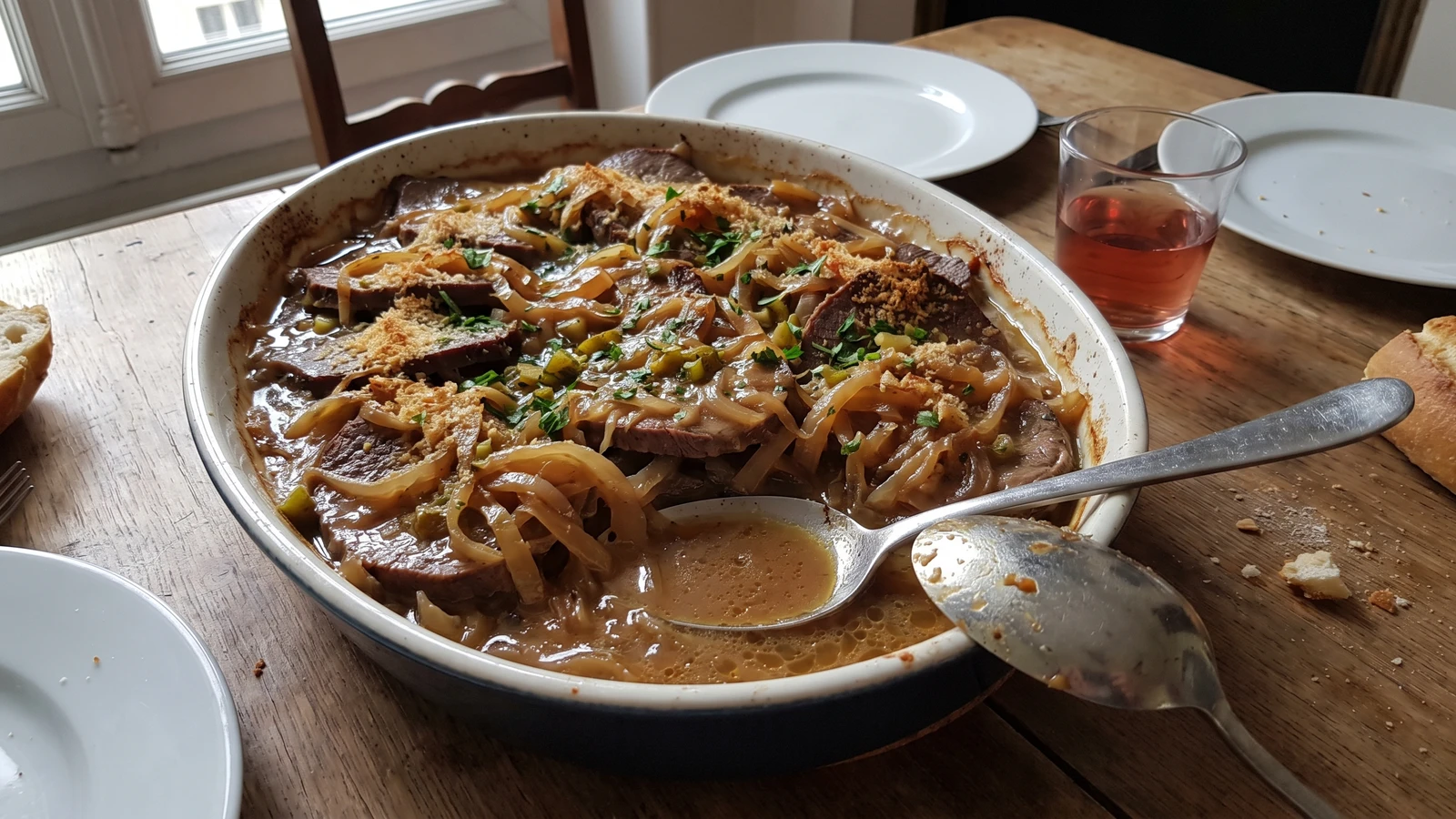
Émincé de Bœuf en Miroton turns yesterday’s pot-au-feu beef into tonight’s supper: tender slices under gilded onions, sharpened with vinegar and cornichons, then finished with a crisp breadcrumb gratin.
Émincé de Bœuf en Miroton (thin-sliced beef with gilded onions) teaches réchauffage, the careful reheating of cooked meat. The one true thing to know before touching the pan is that this is not a beef stew. The onions may boil before the meat arrives, but once the beef enters, the sauce must barely move. Warm it patiently and the slices remain tender; boil them and they tighten.
The source offers two paths for the onion sauce. Its flourless path spends reduced wine and half-glaze, the work of a saucier and a stockpot never off the fire. That is brigade scaffolding, so it can go. For a home stove, use the source’s own flour-thickened path with good prepared beef consommé, then replace a salamander’s fierce top heat with an ordinary broiler. The book’s one-pound quantity already feeds four comfortably, so it stays: one cook, one stove, one evening.
What must stay is the dish itself: onions evenly gilded in real butter, vinegar added at the last moment, minced cornichons, fine bread raspings, and long, quiet warming. Watch the heat when the beef enters. That moment decides the miroton.
Émincé de Bœuf en Miroton belongs to Parisian cuisine bourgeoise, where the bouilli from a pot-au-feu returned to the family table beneath onions instead of being treated as scraps. The vinegar is not a flourish; its sharpness wakes meat that has already surrendered much of its savor to the broth. Household versions vary between a simply sauced dish and this gratinéed form with cornichons and bread raspings, but both are deliberate second service, not beef stew.
Quantity
1 lb (454 g)
thoroughly chilled
Quantity
2 (about 2 1/2 cups / 600 ml / 350 g)
sliced somewhat finely
Quantity
2 tablespoons (30 ml / 28 g)
Quantity
1/2 tablespoon (7.5 ml / 4 g)
Quantity
1/2 cup (120 ml / 120 g)
Quantity
1 1/4 cups (300 ml / 300 g)
preferably low-sodium
Quantity
1/8 teaspoon (0.6 ml / 0.3 g)
Quantity
1/2 teaspoon (2.5 ml / 2.5 g)
Quantity
1/4 cup (60 ml / 45 g)
minced
Quantity
1/4 cup (60 ml / 20 g), for Gratins (No. 268)
Quantity
1 tablespoon (15 ml / 4 g)
finely chopped
| Ingredient | Quantity |
|---|---|
| leftover boiled beef from pot-au-feuthoroughly chilled | 1 lb (454 g) |
| medium yellow onionssliced somewhat finely | 2 (about 2 1/2 cups / 600 ml / 350 g) |
| unsalted butter | 2 tablespoons (30 ml / 28 g) |
| all-purpose flour | 1/2 tablespoon (7.5 ml / 4 g) |
| dry white wine | 1/2 cup (120 ml / 120 g) |
| prepared beef consommépreferably low-sodium | 1 1/4 cups (300 ml / 300 g) |
| freshly ground black pepper | 1/8 teaspoon (0.6 ml / 0.3 g) |
| wine vinegar | 1/2 teaspoon (2.5 ml / 2.5 g) |
| cornichonsminced | 1/4 cup (60 ml / 45 g) |
| fine dry breadcrumbs | 1/4 cup (60 ml / 20 g), for Gratins (No. 268) |
| flat-leaf parsleyfinely chopped | 1 tablespoon (15 ml / 4 g) |
Cut the chilled boiled beef across the grain into slices about 1/4 inch (6 mm) thick. These are somewhat thicker than the very thin slices used for freshly cooked roast beef, because boiled beef must endure a longer warming in the sauce. Keep the slices broad and intact, then prepare the onions, cornichons, and parsley before the pan goes on the heat.
Melt the butter in a wide heavy pan over medium-low heat. Add the onions and toss them often for 20 to 25 minutes, until soft, evenly golden, and glossy from edge to edge. Gild means giving them that golden sheen through heat, not scorching them brown in patches. If the pan floor darkens while the onions remain pale, lower the heat and loosen the browned film with a spoonful of the measured consommé; keep cooking until the liquid evaporates and the color evens out.
Sprinkle the flour evenly over the gilded onions and stir for one minute, just long enough to cook away its raw taste without coloring it. Pour in the white wine a little at a time, stirring against the pan floor, then add the consommé and pepper. Bring the sauce to one full boil before lowering it to a gentle simmer for 7 to 8 minutes. It should lightly coat the onions while remaining fluid enough to surround the beef. If the flour gathers into small lumps, take the pan off the heat and whisk the liquid between the onions until smooth. Ça se rattrape.
Lay the beef slices in the onion sauce, overlapping them loosely so sauce can pass between each one. Turn them once, cover the pan, and lower the heat until the surface barely trembles. Warm for 35 to 45 minutes; if the boiled beef is firm, give it up to an hour as the source allows. Never let it boil. If bubbling begins and the meat tightens, remove the pan from the heat at once, let the sauce become still, then cover and return it to the lowest setting for another 15 minutes without stirring. Connective cuts from pot-au-feu will often relax again under gentler heat.
One minute before the beef leaves the stove, stir the wine vinegar into the onions and sauce. Add the minced cornichons, reserving a spoonful for the surface. Arrange the beef in a shallow broiler-safe gratin dish, cover it completely with the onions and sauce, and scatter over the reserved cornichons followed by an even, light coat of breadcrumbs.
Finish with Gratins (No. 268), using a fully preheated broiler as the home equivalent of rapid top heat. Set the dish about 6 inches (15 cm) below the element for 2 to 4 minutes, just until the raspings gild and the sauce bubbles at the rim. Watch without wandering, because breadcrumbs travel from gold to burnt quickly. Sprinkle lightly with parsley, rest for 2 minutes, and serve from the dish. À table!
1 serving (about 275g)
Culinary guides, cultural storytelling, and the editorial depth that makes cooking meaningful.
Discover Culinary ExplorerChef Juliette
John Dory has the delicacy of sole and the firmness of turbot. A light flouring, a quick butter sauté, and nut-brown beurre noisette show exactly why looks never mattered.

Chef Juliette
Fresh haddock proves its delicacy in the meunière pan: a fine flour crust, moist pearly flakes, and beurre noisette sharpened with lemon and parsley, ready from one skillet in half an hour.

Chef Juliette
Éperlans à l’Anglaise turns small fish into a lesson in disciplined coating: boned smelts under a close, crisp crumb, pan-fried in clarified butter and finished with bright, half-melted maître d’hôtel butter.

Chef Juliette
Tiny smelts, shallot, mushrooms, white wine, gratin sauce, and fine bread raspings meet a fierce oven, where the fish must turn tender in the same breath the buttered crust bronzes.