
Chef Juliette
Châteaubriand, Fillet Steak, Tournedos
One tenderloin heart, three classical portions: roast Châteaubriand for carving, bifteck de filet for one, tournedos two to a plate, all with braised endives and a red-wine pan jus.
A cooking platform built around craft, culture, and the stories behind what we eat.

Created by Chef Juliette
Based on No. 1115, Tournedos Montgomery, from Le Guide Culinaire (1907) by Auguste Escoffier
Tournedos Montgomery sets butter-seared beef over a molded spinach pancake, then crowns it with reduced Soubise and truffle. The lesson is simple and unforgiving: a properly hot pan gives the fillet its bronze.
Tournedos Montgomery (butter-seared beef fillets on molded spinach pancakes) teaches the discipline of heat. The one true thing to know before touching the pan is this: the skillet must be properly hot before the beef arrives. In a hot pan, butter carries the tournedos to a deep Maillard bronze while the center stays tender; in a cool one, the fillets give up their juice and go gray.
The brigade entry assumed a saucier on staff to hand over Soubise already made, a garnish cook to send up molded Crêpes aux Épinards (No. 2138), and a kitchen where stock never left the fire. At home, prepare those finished components ahead, use four small tartlet molds or the wells of a standard muffin tin for the pancakes, and reduce the Soubise in one small saucepan. The grooved pipe becomes a ½-inch open-star tip. A salamander was not part of this finish and adds nothing. What changed is scale and coordination, not composition: four steaks, four pancakes, four rosettes, one cook, one stove, one evening.
The molded pancake, reduced Soubise, grooved rosette, and fine truffle slice are the dish; they stay. Brigade holding pans and last-second handoffs are scaffolding, so they go. Have everything warm before you sear, then trust the heat and leave the tournedos alone long enough to color. That first contact with the pan decides the plate.
Tournedos Montgomery belongs to the Parisian grand-kitchen repertoire of named tournedos, where a surname identified a precise garnish as reliably as a sauce name. Montgomery is not a regional beef preparation and carries no separate Montgomery sauce: its identity is the composition of butter-fried fillet, molded spinach pancake, reduced Soubise, and truffle. From hotel dining rooms it passed naturally into bourgeois home cookery, since the garnishes could be prepared ahead and the final service required only a swift turn in the pan.
Quantity
4 steaks, 5 oz (140 g) each and about 1½ inches (4 cm) thick
Quantity
4 Crêpes aux Épinards (No. 2138), each about 3¼ inches (8 cm) wide
Quantity
1 cup (240 ml / 245 g), for reducing to ½ cup (120 ml / 125 g)
Quantity
5 tablespoons (75 ml / 71 g), clarified to yield about 4 tablespoons (60 ml / 55 g)
clarified
Quantity
1 teaspoon (5 ml / 6 g)
Quantity
½ teaspoon (2.5 ml / 1 g)
Quantity
1 small truffle (about 0.4 oz / 12 g)
cut into 4 fine slices
Quantity
up to 2 tablespoons (30 ml / 30 g)
only if needed to loosen the Soubise
| Ingredient | Quantity |
|---|---|
| center-cut beef tenderloin steaks (tournedos) | 4 steaks, 5 oz (140 g) each and about 1½ inches (4 cm) thick |
| finished spinach pancakes | 4 Crêpes aux Épinards (No. 2138), each about 3¼ inches (8 cm) wide |
| prepared Soubise | 1 cup (240 ml / 245 g), for reducing to ½ cup (120 ml / 125 g) |
| unsalted butterclarified | 5 tablespoons (75 ml / 71 g), clarified to yield about 4 tablespoons (60 ml / 55 g) |
| fine sea salt | 1 teaspoon (5 ml / 6 g) |
| freshly ground black pepper | ½ teaspoon (2.5 ml / 1 g) |
| fresh or whole preserved black trufflecut into 4 fine slices | 1 small truffle (about 0.4 oz / 12 g) |
| hot water (optional)only if needed to loosen the Soubise | up to 2 tablespoons (30 ml / 30 g) |
Take the tournedos from the cold 25 minutes before cooking. Tie each once around its middle if needed to keep an even cylinder, then pat every surface thoroughly dry. Melt the butter gently, skim away the foam, and pour the clear butterfat from the milky sediment; you need about 4 tablespoons (60 ml / 55 g) of clarified butter. Heat the oven to 225°F (110°C), set the four finished Crêpes aux Épinards (No. 2138) on a covered tray, and warm them for 8 to 10 minutes without letting their edges dry. Keep them covered in the turned-off oven with four dinner plates.
Put the prepared Soubise in a small heavy saucepan and bring it to the gentlest simmer. Stir steadily, scraping the corners, until it has reduced from 1 cup (240 ml / 245 g) to about ½ cup (120 ml / 125 g) and a lifted spoon leaves ridges that hold for several seconds. This piping consistency is essential: loose Soubise slides from the steak instead of forming a rosette. If it tightens into a paste, ça se rattrape: whisk in hot water 1 teaspoon at a time until it is smooth and firm enough to hold the grooved shape. Cover and hold it off the heat.
Season the tournedos on every side with the salt and pepper just before cooking. Heat a dry 12-inch (30 cm) heavy skillet over medium-high heat for 3 minutes, then add 3 tablespoons (45 ml / 41 g) of the clarified butter. When the butter moves quickly across the pan and gleams, add the steaks with space between them. They must hiss immediately. If they don't, lift them out at once, heat the skillet another minute, pat the undersides dry, and try again. Ça se rattrape. Cook without shifting them for 2½ to 3 minutes, until the first face is deeply bronzed, then turn, add the remaining clarified butter, and baste while the second side cooks for 2 to 3 minutes. Briefly color the edges with tongs. For medium-rare, remove the steaks at 122 to 125°F (50 to 52°C); they will rise as they rest.
Rest the tournedos on a small rack for 5 minutes so their undersides stay dry. Rewarm the Soubise over low heat, stirring until supple, then transfer it to a piping bag fitted with a ½-inch (1.25 cm) open-star tip. Test one small rosette on a plate. If it slumps, return the Soubise to the saucepan and reduce it for another 30 to 60 seconds; if the ridges split, loosen it with a few drops of hot water.
Center one warm spinach pancake on each heated plate and set a rested tournedos squarely on top. Pipe a compact, generous rosette of reduced Soubise onto each steak, keeping enough height for the grooves to show. Lay one fine slice of truffle in the center of every rosette. Serve at once, while the beef remains tender and the Soubise holds its ivory gloss. À table!
1 serving (about 170g)
Culinary guides, cultural storytelling, and the editorial depth that makes cooking meaningful.
Discover Culinary ExplorerChef Juliette
One tenderloin heart, three classical portions: roast Châteaubriand for carving, bifteck de filet for one, tournedos two to a plate, all with braised endives and a red-wine pan jus.

Chef Juliette
Tournedos Algérienne teaches timing: crisp sweet-potato croquettes and tender oil-stewed tomatoes must be ready before lean fillet meets clarified butter, sears fast, and goes straight to the table.
Chef Juliette
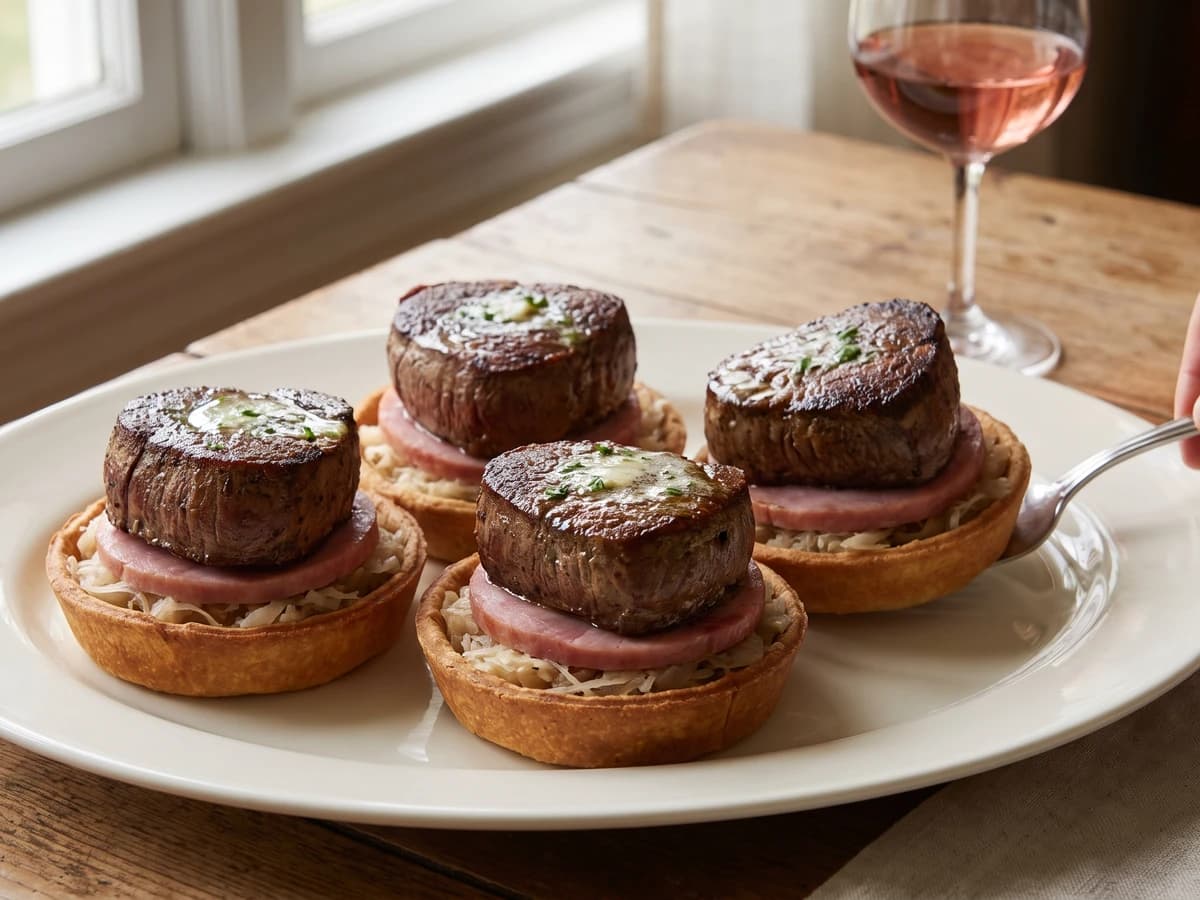
Tournedos crowned over crisp tartlets of wine-braised choucroute and lean ham: a hot, quick grill for the fillet, a dry, buttery foundation below, and Alsace carried through the whole plate.

Chef Juliette
Tender tournedos meet a Provençal ring of golden aubergine and sautéed tomato, each steak crowned with fried onion. The lesson is timing: prepare the garnish, then give lean fillet one hot, quick pan.