Culinary Explorer

A cooking platform built around craft, culture, and the stories behind what we eat.
Discover Culinary Explorer
Tournedos Mirabeau

Tournedos Mirabeau

Created by Chef Juliette

Based on No. 1111, Tournedos Mirabeau, from Le Guide Culinaire (1907) by Auguste Escoffier

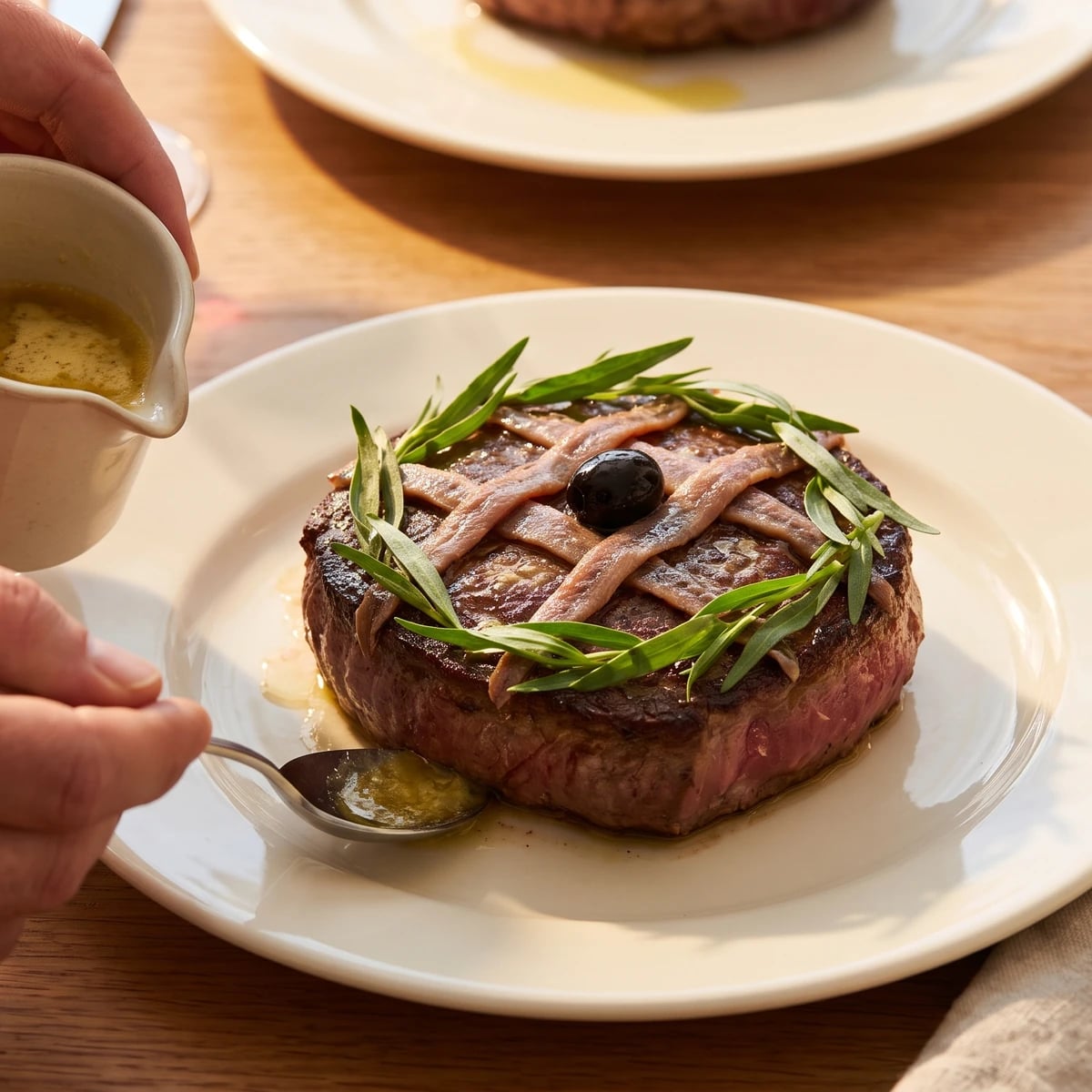
Hot-grilled beef tenderloin, dressed with an exact anchovy lattice, a green tarragon crown, and one olive, with half-melted anchovy butter served apart. The pan must be fierce and the cooking brief.

Main Dishes
French
Dinner Party
Special Occasion
Date Night
30 min
Active Time
20 min cook50 min total
Yield4 servings

Tournedos Mirabeau (grilled beef tenderloin with anchovy, tarragon, and olive) teaches the discipline of finishing before cooking. Tenderloin has little fat and almost no forgiveness, so the anchovy lattice, tarragon crown, olive, and butter must be ready before the beef touches heat. Grill fiercely and cook briefly. That is the one true thing.

The original recipe assumed a grillardin at full heat, another hand preparing thirty-two anchovy strips and the tarragon, and anchovy butter waiting for service. There is no need here for a saucier on staff, a stock never off the fire, or a salamander. One cast-iron grill pan replaces the commercial grill, and the brigade portion becomes four tournedos for one cook, one stove, one evening. The separate hands were scaffolding, so they go; the fierce grill, eight-strip lattice, tarragon crown, central olive, and ⅔ ounce of anchovy butter per steak are the dish, so they stay.

This is not a sauce-built tournedos, and inventing a fond or reduction would bury its sharp, clean composition. Its richness comes from real anchovy butter, served half-melted and apart. Before you touch the pan, finish every garnish and heat the iron until it can bronze the lean beef immediately; that preparation is what saves the tournedos from drying while you fuss with its crown.

Tournedos Mirabeau belongs to the Parisian grand-kitchen repertoire, where a named garnish could identify a preparation as clearly as its title: anchovy laid in a lattice, tarragon around the edge, and an olive at the center. The title follows the Parisian habit of naming dishes for public figures, and culinary histories commonly connect it to Honoré-Gabriel Riqueti, comte de Mirabeau, though the plate preserves the name more securely than the dedication. Despite its anchovy and olive, this is not a Provençal regional steak; it is a Parisian classical composition carried into the home by its short method and unmistakable finish.

The technique, the tradition, and the story behind every dish.

Discover Culinary Explorer

Ingredients

center-cut beef tenderloin steaks

Quantity

4 steaks, each about 1½ inches (4 cm) thick and 6 ounces (170 g), 24 ounces (680 g) total

fine sea salt

Quantity

¾ teaspoon (3.75 ml / 4.5 g)

freshly ground black pepper

Quantity

½ teaspoon (2.5 ml / 1 g)

clarified butter

Quantity

1 tablespoon (15 ml / 14 g)

oil-packed anchovy fillets

Quantity

16 fillets (about 1¾ ounces / 50 g)

drained and split lengthwise into 32 fine strips

fresh tarragon leaves

Quantity

1 loosely packed cup (240 ml / 20 g), finished according to Blanchings (No. 273)

cooled and thoroughly dried

large black olives

Quantity

4 olives (about 1½ ounces / 40 g)

pitted

anchovy butter

Quantity

about 5 tablespoons (75 ml / 76 g)

made from 3½ tablespoons (52 ml / 50 g) softened unsalted butter and 8 drained anchovy fillets (about 1 ounce / 26 g)

Equipment Needed

  • 30 cm cast-iron grill pan or heavy skillet
  • Instant-read thermometer
  • Small mortar and pestle or sturdy fork
  • Fine-mesh sieve
  • Small saucepan and warmed sauceboat
  • Kitchen twine and tongs

Instructions

  1. 1

    Make anchovy butter

    Pound the 8 anchovy fillets to a perfectly smooth paste with a mortar and pestle or the back of a sturdy fork. Work in the softened unsalted butter a little at a time until no streaks remain, then press the mixture through a fine sieve if you feel any fibers or bones. You should have about 5 tablespoons (75 ml / 76 g), exactly ⅔ ounce (19 g) for each tournedos. Keep it soft but not melted.

    The butter must taste distinctly of anchovy because it is served apart, not spread thinly through a sauce. Unsalted butter gives you control; the fish supplies all the salt it needs.
  2. 2

    Ready the garnish

    Take the tarragon leaves already finished under Blanchings (No. 273) and dry them carefully so they will sit neatly on the meat. Split the 16 garnish anchovies lengthwise to make 32 fine strips, eight for each tournedos, and blot away excess oil. Set out the four olives as well. This mise en place must be complete before the beef cooks because tenderloin will not wait while you search for an olive.

  3. 3

    Heat the grill pan

    Tie each tournedos around its middle with kitchen twine so it keeps a compact, even shape. Heat a cast-iron grill pan or heavy skillet over high heat for 8 to 10 minutes, until fiercely hot. Pat the beef completely dry, season it evenly with the measured salt and pepper, and brush both faces lightly with clarified butter. Clarified butter is still real butter, but without milk solids to scorch before the thick steaks are cooked.

  4. 4

    Grill the tournedos

    Lay the tournedos in the hot pan with space between them and leave them untouched for about 3 minutes, until the first face is deeply bronzed. Turn once and cook the second face for 2 to 3 minutes, then briefly color the edges with tongs. Begin checking early and pull the steaks at 125°F (52°C) for medium-rare; they should finish near 130°F (54°C) as they rest. If the pan loses heat and the beef begins turning gray, lift the steaks onto a rack, heat the empty pan hard again, then return them for 20 seconds per face before they reach their target temperature. Ça se rattrape. Once tenderloin is overcooked, however, no sauce can put its moisture back.

    Do not crowd the pan or keep turning the steaks. Fierce heat, dry beef, one clean turn. The cooking is brief because tenderloin is lean, and that brevity is the dish's discipline.
  5. 5

    Rest and dress

    Rest the tournedos uncovered for 4 to 5 minutes, then remove the twine. Lay eight fine anchovy strips over each steak, four in one direction and four crossing them to form the prescribed lattice. Arrange the tarragon leaves around the edge as a green crown and set one large pitted olive at the center. Keep the arrangement generous and legible; these are the Mirabeau garnish, not decoration added at whim.

  6. 6

    Half-melt the butter

    While the steaks rest, warm the anchovy butter in a small saucepan over the lowest heat, stirring until roughly half is liquid and the rest remains soft and creamy. It should look streaked, golden, and spoonable rather than like clear oil. If it melts completely, take it off the heat and whisk the saucepan over a bowl of cold water until the butter clouds and begins to thicken again. Ça se rattrape.

  7. 7

    Serve at once

    Set each dressed tournedos on a warm plate and pour the half-melted anchovy butter into a small warmed sauceboat, keeping it apart exactly as the dish requires. Allow each diner about 1¼ tablespoons (19 ml / 19 g). Do not pour it over the lattice before serving; the cook presents the garnish intact, and the diner adds the butter. À table!

Chef Tips

  • Ask for center-cut tenderloin steaks of equal thickness. Their weight matters less than their uniform shape because four uneven tournedos become four different degrees of doneness in the same pan.
  • Oil-packed anchovies are the honest home equivalent for fillets once kept ready in the cold larder. Choose plump fillets, drain them well, and blot rather than rinse; the anchovy must still announce itself against the beef.
  • The source is exact about the garnish: eight fine strips on every tournedos, crossed as a lattice, tarragon at the edge, one olive in the middle. Parsley, capers, garlic, and pan sauce belong elsewhere.
  • Serve pommes château, small potatoes browned in butter, or plain green beans alongside, but keep them off the tournedos so the Mirabeau arrangement remains clear.
  • Pour a fresh, medium-bodied red such as Chinon or a restrained Bordeaux. A heavily oaked, aggressively tannic bottle quarrels with the anchovy; this dish wants structure without shouting.

Advance Preparation

  • The anchovy butter can be made up to 3 days ahead, covered, and refrigerated. Let it soften before gently half-melting it for service.
  • The anchovy strips and tarragon finished under Blanchings (No. 273) can be prepared up to 4 hours ahead. Keep them covered separately in the refrigerator, then dry them again before dressing the beef.
  • Tie the tournedos earlier in the day and refrigerate them uncovered on a rack. Bring them out 20 to 30 minutes before cooking, but season only when the pan is hot.
  • The finished dish cannot be held or reheated without sacrificing the tenderloin. Prepare every component ahead, then grill and serve at the last moment.

Frequently Asked Questions

Nutrition Information

1 serving (about 175g)

Calories
520 calories
Total Fat
38 g
Saturated Fat
17 g
Trans Fat
1 g
Unsaturated Fat
20 g
Cholesterol
155 mg
Sodium
1310 mg
Total Carbohydrates
3 g
Dietary Fiber
1 g
Sugars
0 g
Protein
42 g

Note: Chef personas and recipes are created with AI assistance. Cook with care: follow safe food-handling practices, check doneness with a thermometer when needed, and adapt for allergies and your kitchen.

Where cooking meets culture.

Culinary guides, cultural storytelling, and the editorial depth that makes cooking meaningful.

Discover Culinary Explorer

More from Relevés and Entrées - Tournedos

Browse the full collection