
Chef Juliette
John Dory (St. Pierre)
John Dory has the delicacy of sole and the firmness of turbot. A light flouring, a quick butter sauté, and nut-brown beurre noisette show exactly why looks never mattered.
A cooking platform built around craft, culture, and the stories behind what we eat.
Created by Chef Juliette
Based on No. 1102, Tournedos Lucullus, from Le Guide Culinaire (1907) by Auguste Escoffier
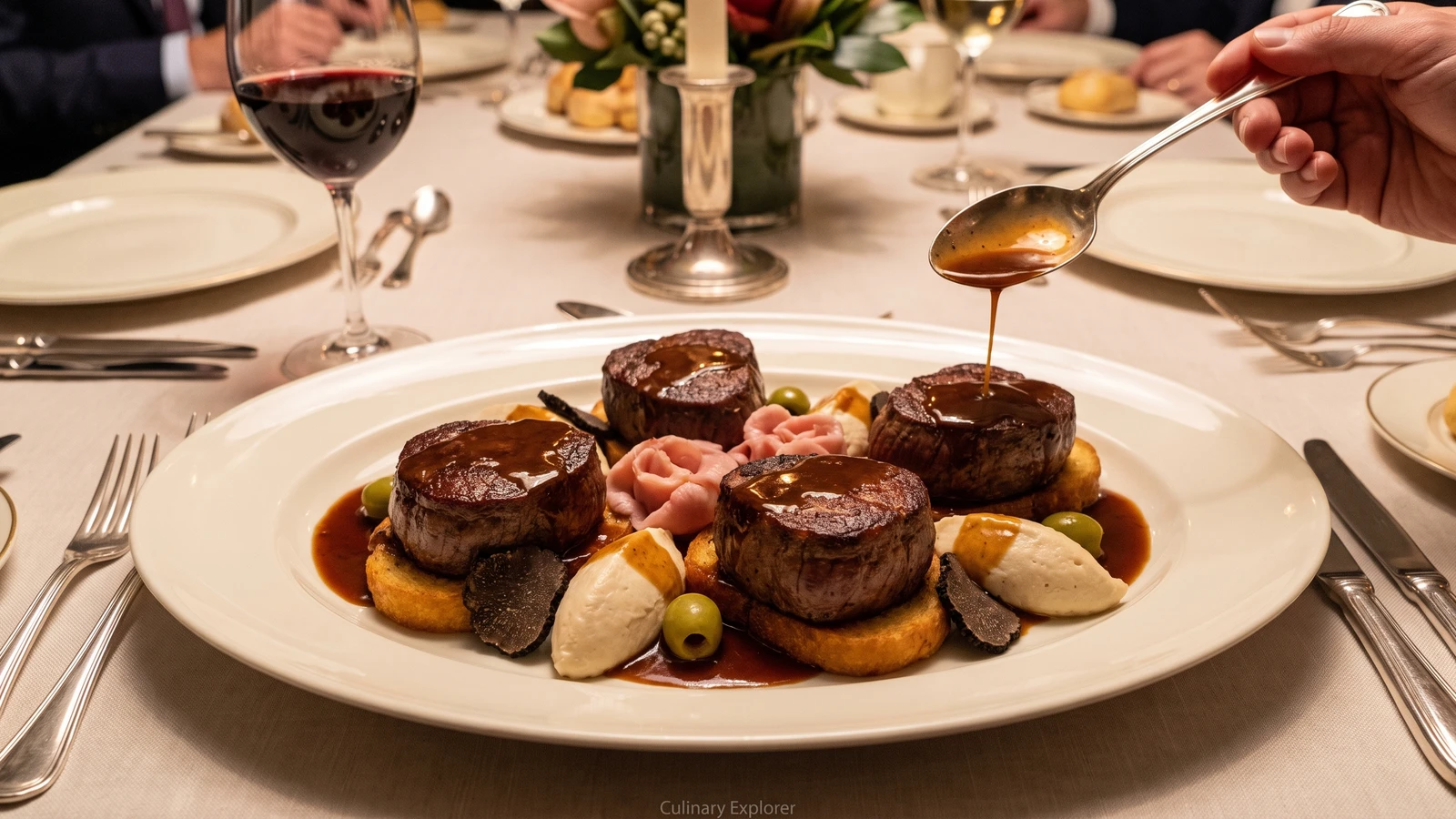
The luxury is timing, not fuss: hot seared beef on crisp butter-fried croûtons with delicate chicken quenelles, cocks’ combs, olives, truffles, and glossy demi-glace, all assembled at once.
Tournedos Lucullus (seared beef medallions with a truffled classical garnish) teaches one severe, useful lesson: luxury is timing. The sauce and garnish must be ready before the beef touches the pan, because tournedos wait badly and demi-glace waits beautifully. Get that order right and the many parts arrive as one generous dish, not a procession of lukewarm accomplishments.
The original formula assumed a saucier guarding demi-glace, a stockpot never off the fire, a commis shaping quenelles, and a larder where cocks’ combs arrived ready. It does not call on a salamander, so your broiler stays off. At home, a finished veal demi-glace (half-glaze) replaces the day-long stockpot, a food processor replaces the mortar and tamis for quenelles de volaille (oval chicken forcemeat dumplings), and prepared cocks’ combs replace the in-house cleaning station. Those are brigade scaffolds. The clarified-butter sear, croûtons, composed poultry garnish, olives, truffle, and truffle-scented demi-glace are the dish, so every one remains. One cook, one stove, one evening.
Done properly, the beef wears a dark bronze crust, the fried bread drinks just enough sauce, and the pale quenelles and cocks’ combs sit among black truffle and green olives under a mahogany gloss. Have the sauce and garnish warm, the croûtons fried, and the platter heated before you season the beef. That order decides the dish.
Tournedos Lucullus belongs to the grand Parisian table, where the name Lucullus became a culinary signal for lavish composed garnishes, especially truffle, rather than a claim to any French region. This version follows that logic exactly: beef raised on fried crusts, surrounded by chicken quenelles, cocks’ combs, truffles, and olives, then bound into one dish by demi-glace scented with truffle essence. It is not tournedos Rossini under another name; foie gras is absent here, while the poultry garnish and cocks’ combs give Lucullus its own identity.
Quantity
4 (1½ lb / 680 g total)
cut about 1½ inches / 4 cm thick, tied and patted dry
Quantity
½ cup (120 ml / 110 g)
divided
Quantity
4 (4 oz / 115 g total)
cut about 3 inches / 8 cm wide
Quantity
8 oz / 225 g
cubed and thoroughly chilled
Quantity
1 (1 oz / 30 g)
Quantity
½ cup (120 ml / 120 g)
divided
Quantity
2½ teaspoons (12.5 ml / 15 g)
divided
Quantity
¼ teaspoon (1.25 ml / 0.5 g)
Quantity
1 teaspoon (5 ml / 2 g)
Quantity
6 cups (1.4 L / 1.4 kg)
for poaching
Quantity
4, prepared through Blanchings (No. 273)
Quantity
½ cup (120 ml / 85 g), prepared through Blanchings (No. 273)
Quantity
1 oz / 28 g
thinly sliced
Quantity
2 tablespoons (30 ml / 30 g)
Quantity
1¼ cups (300 ml / 330 g)
homemade or prepared
| Ingredient | Quantity |
|---|---|
| center-cut beef tournedoscut about 1½ inches / 4 cm thick, tied and patted dry | 4 (1½ lb / 680 g total) |
| clarified butterdivided | ½ cup (120 ml / 110 g) |
| crustless pain de mie roundscut about 3 inches / 8 cm wide | 4 (4 oz / 115 g total) |
| boneless, skinless chicken breastcubed and thoroughly chilled | 8 oz / 225 g |
| large egg white | 1 (1 oz / 30 g) |
| cold heavy creamdivided | ½ cup (120 ml / 120 g) |
| fine sea saltdivided | 2½ teaspoons (12.5 ml / 15 g) |
| ground white pepper | ¼ teaspoon (1.25 ml / 0.5 g) |
| freshly ground black pepper | 1 teaspoon (5 ml / 2 g) |
| waterfor poaching | 6 cups (1.4 L / 1.4 kg) |
| fully cooked cocks’ combs | 4, prepared through Blanchings (No. 273) |
| pitted green olives | ½ cup (120 ml / 85 g), prepared through Blanchings (No. 273) |
| fresh or whole preserved black trufflethinly sliced | 1 oz / 28 g |
| truffle essence, truffle juice, or reserved truffle packing liquid | 2 tablespoons (30 ml / 30 g) |
| finished unsalted veal demi-glace (half-glaze)homemade or prepared | 1¼ cups (300 ml / 330 g) |
Remove the tournedos from the cold thirty minutes before cooking, but leave them unseasoned. Heat the oven to 200°F / 95°C and place the serving platter inside to warm. Set out the prepared cocks’ combs, olives, truffle, demi-glace, and bread rounds. Everything must be ready before the beef meets the pan: the sauce and garnish can wait gently, but tournedos cannot.
Put the chilled chicken, ¾ teaspoon of the salt, and the white pepper in a chilled food processor. Pulse until the meat becomes smooth and tacky, then incorporate the egg white. With the machine running in short bursts, add all but 1 tablespoon of the cold cream in a thin stream. Stop as soon as the forcemeat is smooth, glossy, and firm enough to hold on a spoon. If it turns loose or grainy because it became warm, stop processing and chill it for ten minutes, then pulse in the reserved cold cream. Ça se rattrape.
Bring the water to 180°F to 185°F / 82°C to 85°C in a broad saucepan. It should barely tremble, never boil. Using two damp dessert spoons, shape the chicken forcemeat into 8 small quenelles de volaille, oval chicken dumplings, and lower them into the water. Poach gently for 7 to 9 minutes, turning once, until firm yet springy and 165°F / 74°C at the center. Lift them out with a slotted spoon, drain well, and cover loosely.
Heat ¼ cup of the clarified butter in the heavy skillet over medium-high heat. Add the bread rounds and fry until deep butter-gold and crisp on both sides, about 2 minutes per side. These croûtons, the fried bread crusts, are part of the dish rather than decoration: they catch the beef juices and demi-glace. Drain them on a rack and hold them in the low oven.
Bring the demi-glace and truffle essence to a bare simmer in a wide saucepan. Reduce for 3 to 5 minutes, until the sauce nappes, coating the back of a spoon in a glossy layer. Add the cocks’ combs and olives already prepared through Blanchings (No. 273), followed by the quenelles and sliced truffle. Warm everything over the lowest heat without boiling. If the sauce becomes too tight, loosen it with a tablespoon of water; if it remains thin, lift out the garnish and reduce the sauce alone before returning it.
Season the tournedos with the remaining salt and the black pepper. Heat 3 tablespoons of clarified butter in the clean skillet over high heat until it shimmers. Add the beef without crowding and sear, undisturbed, for 2½ to 3 minutes per side, then brown the edges for about 30 seconds. For medium-rare, remove the tournedos at about 125°F / 52°C and rest them for 3 minutes. If the butter blackens and smells bitter, lift out the beef, wipe the pan, and continue with the reserved clean butter. The crust can still be saved.
Arrange the four hot croûtons in a loose crown on the warmed platter and set one tournedos on each. Remove the strings. Surround the beef with two quenelles, one cocks’ comb, three olives, and truffle slices per serving. Spoon the truffled demi-glace over the tournedos and garniture, coating the whole with a thin gleaming layer and letting the remainder pool generously around the crown. Carry it straight to the table. À table!
1 serving (about 390g)
Culinary guides, cultural storytelling, and the editorial depth that makes cooking meaningful.
Discover Culinary ExplorerChef Juliette
John Dory has the delicacy of sole and the firmness of turbot. A light flouring, a quick butter sauté, and nut-brown beurre noisette show exactly why looks never mattered.

Chef Juliette
Fresh haddock proves its delicacy in the meunière pan: a fine flour crust, moist pearly flakes, and beurre noisette sharpened with lemon and parsley, ready from one skillet in half an hour.

Chef Juliette
Éperlans à l’Anglaise turns small fish into a lesson in disciplined coating: boned smelts under a close, crisp crumb, pan-fried in clarified butter and finished with bright, half-melted maître d’hôtel butter.

Chef Juliette
Tiny smelts, shallot, mushrooms, white wine, gratin sauce, and fine bread raspings meet a fierce oven, where the fish must turn tender in the same breath the buttered crust bronzes.