
Chef Juliette
John Dory (St. Pierre)
John Dory has the delicacy of sole and the firmness of turbot. A light flouring, a quick butter sauté, and nut-brown beurre noisette show exactly why looks never mattered.
A cooking platform built around craft, culture, and the stories behind what we eat.
Created by Chef Juliette
Based on No. 1074, Filet de Bœuf Talleyrand, from Le Guide Culinaire (1907) by Auguste Escoffier
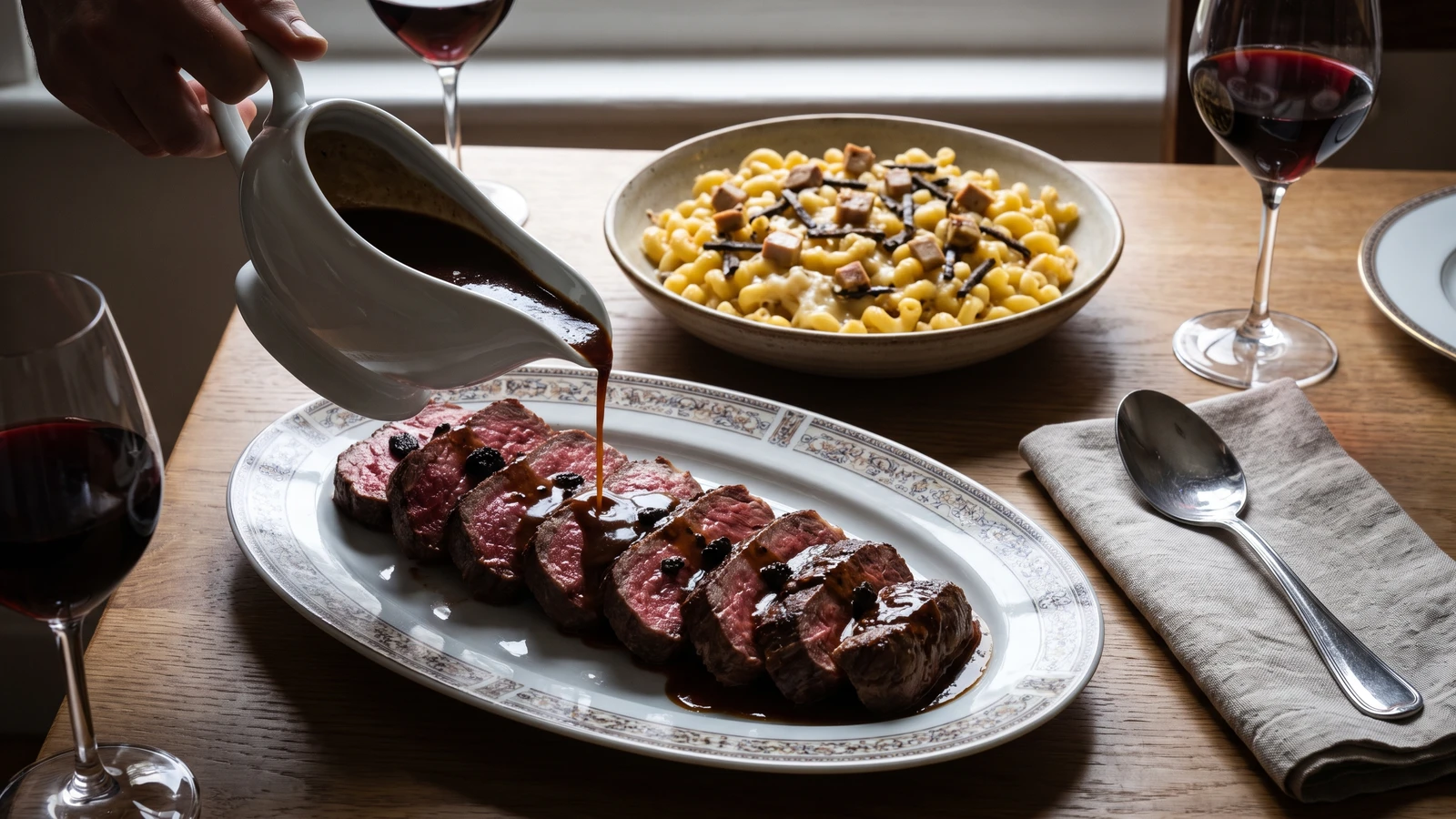
A truffle-studded filet braised gently in Madeira, glazed until it gleams, and served with Gruyère-bound macaroni enriched by foie gras and truffle, with Périgueux sauce passed separately as the canon intends.
Filet de Bœuf Talleyrand (Talleyrand beef tenderloin) teaches that luxury needs structure. The filet stays rosy beneath its Madeira glaze, the Périgueux sauce keeps its own deep truffle voice, and the macaroni arrives separately, bound with Gruyère, Parmesan, butter, truffle, and foie gras. The macaroni is no afterthought. It is half the composition.
The source assumed a saucier on staff, a dark stock never off the fire, a salamander for glazing, and a filet large enough for a dining room. At home, rich unsalted stock strengthened with a little gelatin supplies the proper body, the broiler supplies the fierce top heat, a narrow paring knife replaces the larding needle, and one center-cut roast feeds four. This version keeps the three-hour Madeira marinade, bacon wrapping, covered braise, exact macaroni proportions, and Périgueux sauce passed apart. Vast quantities and extra hands were scaffolding; these techniques are the dish. One cook, one stove, one evening.
The step that decides everything is temperature. Pull the filet from the braise while its center is still below the finished temperature, then let the glaze and broiler carry it to a warm rose. If you wait for it to finish inside the casserole, it will be overdone before it reaches the platter. Trust the thermometer, not the clock.
Filet de Bœuf Talleyrand belongs to the grand Parisian table, where dishes named for statesmen favored composed service: a roast on its platter, a garnish in its own dish, and sauce passed from a saucière. Its name evokes Talleyrand-Périgord and his celebrated diplomatic table, while the Périgueux sauce points south-west to Périgord through black truffle rather than turning the beef into a regional braise. The macaroni is not an Italian flourish added at whim; in the French classical canon, richly bound macaroni was a formal garnish, and here its foie gras and truffle make it equal to the filet.
Quantity
1 roast, about 1¾ lb (800 g)
silverskin removed and shaped to an even 3 in (7.5 cm) thickness
Quantity
¼ cup (60 ml / 30 g)
cut into 1 in by ¼ in (2.5 cm by 6 mm) batons, pointed at one end
Quantity
1 cup (240 ml / 240 g)
Quantity
¼ cup (60 ml / 60 g) Cooked Marinade for Venison (No. 168)
completely cold
Quantity
8 slices, about 8 oz (225 g)
Quantity
1 tablespoon (15 ml / 14 g)
softened
Quantity
2 teaspoons (10 ml / 12 g)
divided
Quantity
1 teaspoon (5 ml / 2 g)
divided
Quantity
2½ cups (600 ml / 600 g)
Quantity
1 teaspoon (5 ml / 3 g)
Quantity
½ cup (120 ml / 120 g)
Quantity
2 tablespoons (30 ml / 15 g)
cut into a fine julienne
Quantity
2 tablespoons (30 ml / 28 g)
diced
Quantity
2 cups (480 ml / 225 g)
Quantity
¼ cup (60 ml / 22 g)
finely grated
Quantity
¼ cup (60 ml / 21 g)
finely grated
Quantity
1½ tablespoons (22 ml / 21 g)
Quantity
⅓ cup (80 ml / 43 g)
cut into a fine julienne
Quantity
¼ cup (60 ml / 43 g)
cut into large dice
Quantity
2 tablespoons (30 ml / 36 g)
| Ingredient | Quantity |
|---|---|
| center-cut beef tenderloin roastsilverskin removed and shaped to an even 3 in (7.5 cm) thickness | 1 roast, about 1¾ lb (800 g) |
| fresh black truffle for studdingcut into 1 in by ¼ in (2.5 cm by 6 mm) batons, pointed at one end | ¼ cup (60 ml / 30 g) |
| dry Madeira for marinating | 1 cup (240 ml / 240 g) |
| Cooked Marinade for Venisoncompletely cold | ¼ cup (60 ml / 60 g) Cooked Marinade for Venison (No. 168) |
| thin unsmoked streaky bacon | 8 slices, about 8 oz (225 g) |
| unsalted butter for glazingsoftened | 1 tablespoon (15 ml / 14 g) |
| fine sea saltdivided | 2 teaspoons (10 ml / 12 g) |
| freshly ground black pepperdivided | 1 teaspoon (5 ml / 2 g) |
| rich unsalted veal or beef stock | 2½ cups (600 ml / 600 g) |
| unflavored powdered gelatin | 1 teaspoon (5 ml / 3 g) |
| dry Madeira for the Périgueux sauce | ½ cup (120 ml / 120 g) |
| fresh black truffle for the Périgueux saucecut into a fine julienne | 2 tablespoons (30 ml / 15 g) |
| cold unsalted butter for the Périgueux saucediced | 2 tablespoons (30 ml / 28 g) |
| dry long macaroni, ziti lunghi, or bucatini | 2 cups (480 ml / 225 g) |
| Gruyèrefinely grated | ¼ cup (60 ml / 22 g) |
| Parmesanfinely grated | ¼ cup (60 ml / 21 g) |
| unsalted butter for the macaroni | 1½ tablespoons (22 ml / 21 g) |
| fresh black truffle for the macaronicut into a fine julienne | ⅓ cup (80 ml / 43 g) |
| cooked foie gras terrinecut into large dice | ¼ cup (60 ml / 43 g) |
| fine sea salt for the macaroni water | 2 tablespoons (30 ml / 36 g) |
Dry the filet and set it lengthwise on the board. With the tip of a narrow paring knife, make small angled incisions over every side, spacing them about 1 in (2.5 cm) apart. Push a pointed truffle baton firmly into each incision until it sits flush with the surface; narrow cuts hold the truffle inside, while wide cuts let it escape during carving. Season with 1½ teaspoons of the salt and ¾ teaspoon of the pepper.
Place the studded filet in a snug nonreactive dish or heavy food-safe bag. Add the 1 cup of Madeira and the completely cold Cooked Marinade for Venison (No. 168), turning the meat until every surface is wet. Refrigerate for exactly 3 hours, turning once halfway through. The Cooked Marinade for Venison (No. 168) remains a finished preparation from its own entry; it is measured here, not rebuilt. Lift out the filet, reserve every drop of marinade, and pat the meat thoroughly dry.
During the final 45 minutes of marinating, spoon 2 tablespoons (30 ml) of the cold stock into a small bowl and sprinkle over the gelatin. Leave it for 5 minutes. Boil the remaining stock in a wide saucepan until reduced to 1 cup (240 ml), then add the ½ cup of Madeira and the bloomed gelatin. Simmer until about ¾ cup (180 ml) remains and the liquid lightly coats the back of a spoon. Hold it over the gentlest heat. This concentrated stock is the honest home foundation for the Périgueux sauce; the brigade quantity has gone, but the reduction has not.
Heat the oven to 375°F (190°C) with a rack in the center. Lay the bacon slices in an overlapping sheet, place the dried filet across them, and wrap the meat completely. Tie it with butcher's twine at four even intervals. Pour the reserved marinade into a snug heavy casserole and boil it briskly for 2 minutes, then settle in the wrapped filet and cover. Do not sear the beef first. In this preparation the bacon protects the filet, and the final glaze supplies its color.
Transfer the covered casserole to the oven. Braiser, to cook covered with a shallow measure of liquid, must remain gentle for tenderloin. Turn the filet once after 12 minutes, then begin checking its center at 20 minutes. Remove it when the thermometer reads 117 to 118°F (47 to 48°C), usually after 25 to 35 minutes. Transfer it to a rack, cut away the twine, peel off the bacon, and let the filet rest loosely covered while you reduce the glaze.
Time the macaroni so it finishes as the filet leaves the oven. Bring a large pot of water to a boil, add the 2 tablespoons of salt, and poach the macaroni until tender but still holding its shape. Reserve 1 cup (240 ml) of cooking water, drain, and cut the long tubes into 1½ in (4 cm) lengths. Return them to the warm pot with the 1½ tablespoons of butter, Gruyère, and Parmesan. Toss over low heat until the cheeses bind the macaroni in a glossy coating, then remove the pot from the heat and fold in the truffle julienne and large foie gras dice. If the cheese tightens into strings or releases oil, stop the heat and beat in hot pasta water one spoonful at a time. Ça se rattrape.
Strain the braising liquid into a wide pan, skim away the bacon fat, and boil until it becomes syrupy and measures about ⅓ cup (80 ml). Remove it from the heat and whisk in the softened tablespoon of butter. Glacer means coating the meat repeatedly until its surface shines: brush the filet all over, set it on a metal tray about 6 in (15 cm) below the broiler, and broil for 45 to 60 seconds. Rotate, brush again, and repeat until the surface is deep bronze and glossy. Watch without leaving the stove. If the glaze darkens before it shines, lower the tray and loosen the glaze with a spoonful of unsalted stock. Remove the filet when its center reaches 124 to 126°F (51 to 52°C), then rest it for 8 minutes.
Bring the reduced sauce base back to a bare simmer and add the fine julienne of truffle, using matchstick cuts rather than chopped truffle as the source directs. Simmer for 1 minute, then remove the pan from the heat and whisk in the cold butter one piece at a time. Taste before adding the remaining salt and pepper. The finished Périgueux sauce should nap the spoon and fall in a smooth, glossy ribbon. If the butter separates, whisk a teaspoon of cold stock in a clean warm pan, then add the broken sauce gradually until it comes together again.
Transfer the macaroni to a warmed serving dish and pour the Périgueux sauce into a warmed saucière. Carve the rested filet crosswise into four thick portions, revealing the truffle studs, and arrange them on a long warm platter with their Madeira glaze. Send the macaroni and sauce separately, exactly as the composition requires, so each guest takes the three elements together without losing their distinct textures. À table!
1 serving (about 420g)
Culinary guides, cultural storytelling, and the editorial depth that makes cooking meaningful.
Discover Culinary ExplorerChef Juliette
John Dory has the delicacy of sole and the firmness of turbot. A light flouring, a quick butter sauté, and nut-brown beurre noisette show exactly why looks never mattered.

Chef Juliette
Fresh haddock proves its delicacy in the meunière pan: a fine flour crust, moist pearly flakes, and beurre noisette sharpened with lemon and parsley, ready from one skillet in half an hour.

Chef Juliette
Éperlans à l’Anglaise turns small fish into a lesson in disciplined coating: boned smelts under a close, crisp crumb, pan-fried in clarified butter and finished with bright, half-melted maître d’hôtel butter.

Chef Juliette
Tiny smelts, shallot, mushrooms, white wine, gratin sauce, and fine bread raspings meet a fierce oven, where the fish must turn tender in the same breath the buttered crust bronzes.