Culinary Explorer

A cooking platform built around craft, culture, and the stories behind what we eat.
Discover Culinary Explorer
Filet de Bœuf Saint-Florentin

Filet de Bœuf Saint-Florentin

Created by Chef Juliette

Based on No. 1072, Filet de Bœuf Saint-Florentin, from Le Guide Culinaire (1907) by Auguste Escoffier

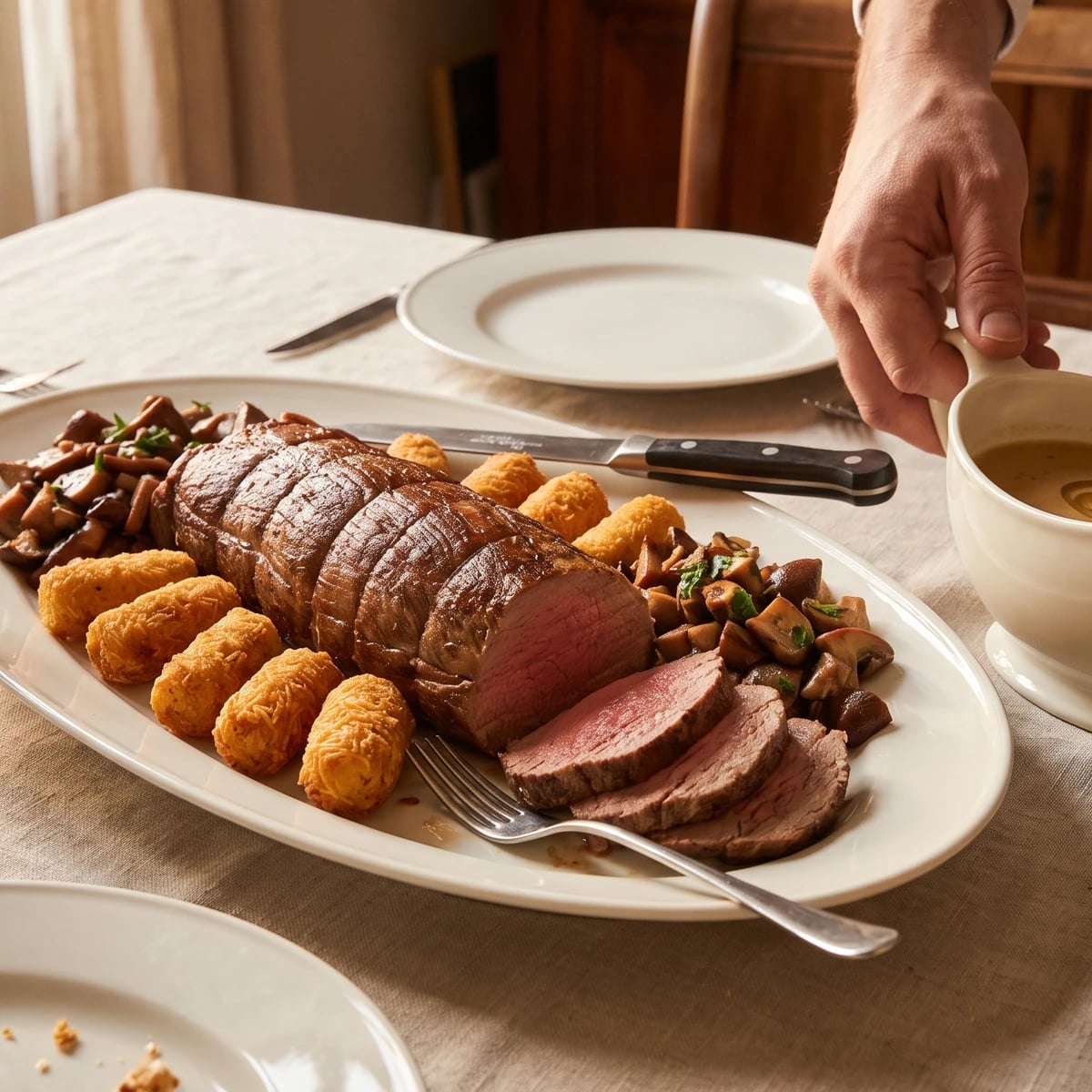
Filet de Bœuf Saint-Florentin gathers a rosy roast fillet, bronze vermicelli-crusted croquettes rich with tongue, and glossy cèpes around a light white-wine Bordelaise, proof that composed service is timing, not theatre.

Main Dishes
French
Dinner Party
Special Occasion
1 hr 15 min
Active Time
1 hr 30 min cook2 hr 45 min total
Yield4 servings

Filet de Bœuf Saint-Florentin (roasted fillet of beef with cèpes and tongue croquettes) teaches orchestration. The fillet itself asks only for sound browning and a thermometer; the true work is bringing a light sauce, crisp lozenge-shaped croquettes, glossy mushrooms, and properly rested beef to the same platter at their best.

The original assumes a saucier on staff, a stock never off the fire, a larding needle, and separate hands watching the fryer and sauté pan. At home, a reduced gelatin-rich stock stands in for the stockpot, a thin metal skewer carries chilled fatback through the fillet, and a deep pot with a thermometer replaces the dedicated fryer. The salamander has no work here: the vermicelli crust must be fried, not browned from above. One cook, one stove, one evening.

Those extra brigade hands were scaffolding, and careful staging replaces them. What remains is the dish: lard and roast the fillet, enrich the dry potato paste generously with tongue, coat the croquettes à l’anglaise with vermicelli, cook the cèpes at the last minute, and keep the white-wine Bordelaise light and separate. Have the sauce base strained, croquettes coated and cold, and cèpes cut before the beef meets heat. That mise en place is the one step that decides the service.

Filet de Bœuf Saint-Florentin belongs to the formal Parisian table of grande cuisine, where a title often identified a fixed garnish rather than the birthplace of a dish. The composition carried banquet service into the bourgeois dining room: Bordeaux speaks through cèpes à la Bordelaise and a Bordelaise sauce unusually made with white wine, while tongue-rich potato croquettes supply the Saint-Florentin identity. The name is not evidence of a Burgundian household roast from Saint-Florentin in the Yonne; it is the canon's shorthand for this exact arrangement.

The technique, the tradition, and the story behind every dish.

Discover Culinary Explorer

Ingredients

center-cut beef tenderloin roast

Quantity

1 roast (2 lb / 900 g)

trimmed to an even cylinder

ready-to-eat dry-cured unsmoked pork fatback

Quantity

⅓ cup (80 ml / 60 g)

cut into long narrow batons and chilled until firm

fine sea salt

Quantity

2 teaspoons (10 ml / 12 g)

for the beef

freshly ground black pepper

Quantity

1 teaspoon (5 ml / 2 g)

for the beef

high-heat neutral oil

Quantity

1 tablespoon (15 ml / 14 g)

unsalted butter

Quantity

1 tablespoon (15 ml / 14 g)

for roasting

shallots

Quantity

3 medium, about ¾ cup (180 ml / 120 g)

finely sliced for the sauce

dry white Bordeaux

Quantity

1½ cups (360 ml / 360 g)

unsalted gelatin-rich veal or beef stock

Quantity

2½ cups (600 ml / 600 g)

unflavored powdered gelatin (optional)

Quantity

1 teaspoon (5 ml / 3 g)

thyme

Quantity

2 sprigs

bay leaf

Quantity

1

black peppercorns

Quantity

1 teaspoon (5 ml / 3 g)

lightly crushed

beef bone marrow

Quantity

½ cup (120 ml / 75 g)

chilled and diced

cold unsalted butter

Quantity

3 tablespoons (45 ml / 43 g)

cubed for the sauce

fine sea salt

Quantity

Up to ½ teaspoon (2.5 ml / 3 g)

for the sauce

fresh lemon juice

Quantity

1 teaspoon (5 ml / 5 g)

for the sauce

baking potatoes

Quantity

4 medium (1½ lb / 700 g)

peeled and cut into equal chunks

unsalted butter

Quantity

3 tablespoons (45 ml / 43 g)

for the croquettes

large egg yolks

Quantity

3

cooked peeled beef tongue

Quantity

1¼ cups (300 ml / 200 g)

very finely chopped

fine sea salt

Quantity

1 teaspoon (5 ml / 6 g)

for the croquettes

freshly ground black pepper

Quantity

½ teaspoon (2.5 ml / 1 g)

for the croquettes

freshly grated nutmeg

Quantity

⅛ teaspoon (0.6 ml / 0.25 g)

all-purpose flour

Quantity

1 cup (240 ml / 125 g)

Anglaise

Quantity

1 cup (240 ml / 240 g) Anglaise (No. 174)

prepared as its own finished component

very fine wheat vermicelli

Quantity

2 cups (480 ml / 150 g)

crushed into 2 to 3 mm lengths

neutral frying oil

Quantity

6 cups (1.5 L / 1.4 kg)

fresh cèpes, also called porcini mushrooms

Quantity

6 loosely packed cups (1.4 L / 450 g)

cleaned and thickly sliced

olive oil

Quantity

3 tablespoons (45 ml / 41 g)

unsalted butter

Quantity

2 tablespoons (30 ml / 28 g)

for the cèpes

shallot

Quantity

1 medium, about ¼ cup (60 ml / 40 g)

finely chopped for the cèpes

garlic

Quantity

2 cloves (about 10 g)

finely chopped

flat-leaf parsley

Quantity

½ cup loosely packed (120 ml / 25 g)

finely chopped

fresh lemon juice

Quantity

2 teaspoons (10 ml / 10 g)

for the cèpes

fine sea salt

Quantity

½ teaspoon (2.5 ml / 3 g)

for the cèpes

freshly ground black pepper

Quantity

¼ teaspoon (1.25 ml / 0.5 g)

for the cèpes

Equipment Needed

  • 12-inch (30 cm) ovenproof skillet
  • 2-quart (2 L) saucepan and fine-mesh strainer
  • Wide sauté pan
  • Deep 5-quart (5 L) heavy pot
  • Deep-frying thermometer
  • Instant-read meat thermometer
  • Potato ricer
  • Thin metal skewer and kitchen twine
  • Wire rack set over a tray
  • Long warmed serving platter and sauceboat

Instructions

  1. 1

    Build the sauce base

    Combine the three sliced shallots, white Bordeaux, thyme, bay leaf, and peppercorns in a small saucepan. Boil steadily until only about ⅓ cup (80 ml) remains and the wine smells rounded rather than raw. If using the optional gelatin, bloom it for five minutes in 2 tablespoons of the measured cold stock. Add all the stock and gelatin, then simmer until reduced to about 1½ cups (360 ml). The sauce should have flavor and light body, not the weight of gravy. Strain it and set it aside without adding the butter, marrow, lemon, or final salt.

    Taste as the stock reduces. If salt begins to dominate, stop reducing and strengthen the sauce later with the roasting fond rather than forcing it farther.
  2. 2

    Make the potato paste

    Steam the potato chunks over gently boiling water until a knife passes through without resistance, about 18 to 22 minutes. Drain them, return them to the dry hot pan, and stir over low heat for two minutes to drive away surface moisture. Pass them through a ricer while hot, then beat in the croquette butter. Let the paste cool for five minutes before mixing in the yolks, tongue, salt, pepper, and nutmeg. It must be firm enough to hold a sharp ridge. If it slumps, spread it thinly on a tray and chill it; adding loose flour inside would make the croquettes heavy.

  3. 3

    Shape the lozenges

    Divide the potato mixture into 12 equal portions. With lightly floured hands, form each into a plump lozenge about 3 inches (7.5 cm) long and ¾ inch (2 cm) thick, pinching four clean points without making the centers thin. Set them on a flour-dusted tray and chill for 30 minutes. Cold paste holds its shape when coated and reaches the frying oil without sagging.

  4. 4

    Coat à l’anglaise

    Paner à l’anglaise means building a sealed flour, egg, and dry outer coat. Roll each chilled lozenge lightly in flour, shaking away the excess, then coat it thoroughly in the Anglaise (No. 174). Press it into the crushed fine vermicelli instead of breadcrumbs, as Saint-Florentin requires. Inspect the points and seams carefully, patching any bare place with another dab of Anglaise (No. 174) and vermicelli. Chill the coated croquettes for at least 20 minutes.

    Use fine wheat vermicelli, not rice noodles. Its short, slender pieces form the crisp, close armor that keeps the tongue-rich potato paste inside.
  5. 5

    Lard and tie

    Heat the oven to 450°F (230°C). Place the beef flat on the board with your supporting hand kept behind the tool. Working from both cut ends, use a thin metal skewer to open six narrow channels parallel to the grain; the channels need not meet. Push the firm fatback batons into them, trim the ends flush, and tie the fillet at 1½-inch (4 cm) intervals. A larding needle once did this in one motion. The chilled fat and skewer give a home cook the same interior seasoning without specialized equipment. Season the outside with the measured salt and pepper.

  6. 6

    Roast by temperature

    Heat the neutral oil in a large ovenproof skillet until shimmering. Brown the fillet on every side, including both ends, for 6 to 8 minutes in total. Add the roasting butter for the final minute and baste the beef as it foams. Transfer the skillet to the oven and roast until the center reaches 125°F (52°C) for medium-rare, usually 15 to 22 minutes. It will rise to about 131 to 135°F (55 to 57°C) while resting. For a final temperature of 145°F (63°C), remove it at 138 to 140°F (59 to 60°C). Rest loosely covered for 18 to 20 minutes. If the center remains below your chosen temperature after resting, return it to a 350°F (180°C) oven in four-minute intervals. A thermometer settles the matter before guessing can spoil it.

  7. 7

    Claim the roasting fond

    Move the beef to a warm board. Pour the strained sauce base into the hot roasting skillet and scrape up every bronze trace of fond with a wooden spoon. Simmer for two minutes, then strain the sauce back into its saucepan and hold it at the barest tremble. This concentrated fond is the home equivalent of the meat glaze a stockpot kitchen could reach for without thinking. Lower the oven to 250°F (120°C) and place the long serving platter inside to warm.

  8. 8

    Fry the croquettes

    Heat the frying oil in a deep heavy pot to 355°F (180°C). Fry the croquettes in two batches, giving them room, until the vermicelli crust is deep gold and firm, about three minutes per batch. Drain them on a wire rack and hold them in the low oven for no more than ten minutes. If the first croquette cracks, lift it out, clear any loose filling, and let the oil return fully to temperature. Patch any weak seam on the remaining croquettes with Anglaise (No. 174) and vermicelli before continuing.

  9. 9

    Cook cèpes Bordelaise

    Heat the olive oil in the widest sauté pan over high heat. Add the cèpes in a single layer, working in two batches if necessary, and leave them undisturbed until their undersides bronze. Turn and cook until tender at the center, then return all the mushrooms to the pan. Pour off excess oil, add the cèpes butter and chopped shallot, and toss for two minutes. Add the garlic for 30 seconds, then the parsley, lemon juice, salt, and pepper. If the mushrooms release a pool of liquid, keep the heat high until it evaporates before adding the butter. The cèpes will recover their gloss and browned edges.

  10. 10

    Finish the sauce

    Poach the diced marrow in barely simmering salted water until just firm, about one minute, then drain it carefully. Bring the sauce to a bare simmer and check its consistency: it should nappe, coating the back of a spoon with a light film while still pouring freely. Remove it from the heat and whisk in the cold butter a few cubes at a time to make the final emulsion. Add the lemon juice, fold in the marrow, and correct the salt. Do not boil it again. If the butter separates, take the pan off the heat and whisk in a tablespoon of cold water from the center outward. Ça se rattrape.

  11. 11

    Arrange Saint-Florentin

    Remove the strings from the rested fillet and set it lengthwise on the warmed long platter. Carve two or three slices from one end to show the rosy center while leaving the rest whole. Place a generous heap of cèpes à la Bordelaise at each end and arrange six croquettes along each side. Pour the light white-wine Bordelaise into a warmed sauceboat and send it separately, never over the croquettes, whose crust you worked to preserve. À table!

Chef Tips

  • Ask the butcher for the even center section of the tenderloin, not a tapered whole fillet. Ask at the same counter for ready-to-eat dry-cured unsmoked fatback, cooked peeled beef tongue, and marrow bones split lengthwise. This is a shopping conversation, not difficult butchery.
  • Fresh cèpes are seasonal. Outside their season, good frozen whole cèpes cooked directly from frozen are the classical pantry's honest answer. Dried cèpes are splendid for flavoring sauce, but they cannot make the fleshy browned heaps this garnish requires.
  • A proper light stock should set softly when chilled. If yours remains watery, the optional gelatin restores the body that a stock never off the fire supplied, without turning the Bordelaise thick or floury.
  • Crush wheat vermicelli into short, even pieces inside a folded towel with a rolling pin. Powder gives a pasty coat and long strands fall away; the croquettes need tiny distinct needles that lock together in the oil.
  • Pour a red Bordeaux with the beef, preferably one with freshness and firm structure rather than sheer weight. The white Bordeaux belongs in the sauce, where its acidity keeps marrow, butter, tongue, and fillet in balance.
  • Refrigerate leftover beef, sauce, and croquettes separately within two hours. Reheat the sauce gently without boiling, warm the beef covered in a low oven, and re-crisp croquettes at 400°F (200°C); they keep safely for up to three days, though the cèpes are best the night they are cooked.

Advance Preparation

  • Reduce and strain the sauce base up to 48 hours ahead. Chill it promptly, then add the roasting fond, marrow, lemon, and cold butter only at service.
  • Shape and coat the croquettes up to 24 hours ahead. Refrigerate them in one layer, uncovered until the coating feels dry, then cover loosely. Fry directly from the cold.
  • Lard and tie the fillet up to 8 hours ahead. Keep it covered in the refrigerator, then take it out about 45 minutes before roasting so the surface loses its chill.
  • Clean and slice the cèpes earlier in the day, but do not cook them ahead. Frying the croquettes and sautéing the cèpes at the last minute are the dish, not brigade scaffolding that can be discarded.

Frequently Asked Questions

Nutrition Information

1 serving (about 725g)

Calories
1700 calories
Total Fat
120 g
Saturated Fat
41 g
Trans Fat
2 g
Unsaturated Fat
77 g
Cholesterol
500 mg
Sodium
2750 mg
Total Carbohydrates
74 g
Dietary Fiber
8 g
Sugars
7 g
Protein
81 g

Note: Chef personas and recipes are created with AI assistance. Cook with care: follow safe food-handling practices, check doneness with a thermometer when needed, and adapt for allergies and your kitchen.

Where cooking meets culture.

Culinary guides, cultural storytelling, and the editorial depth that makes cooking meaningful.

Discover Culinary Explorer

More from Relevés and Entrées - BEEF

Browse the full collection