
Chef Juliette
Fillet of Beef (Relevé)
A whole rosy fillet, larded with cool fatback and poêlé beneath butter, then carved thick under glossy jus. The lesson is exact but simple: deep colour outside, red tenderness within.
A cooking platform built around craft, culture, and the stories behind what we eat.
Created by Chef Juliette
Based on No. 1064, Filet de Bœuf Orientale, from Le Guide Culinaire (1907) by Auguste Escoffier
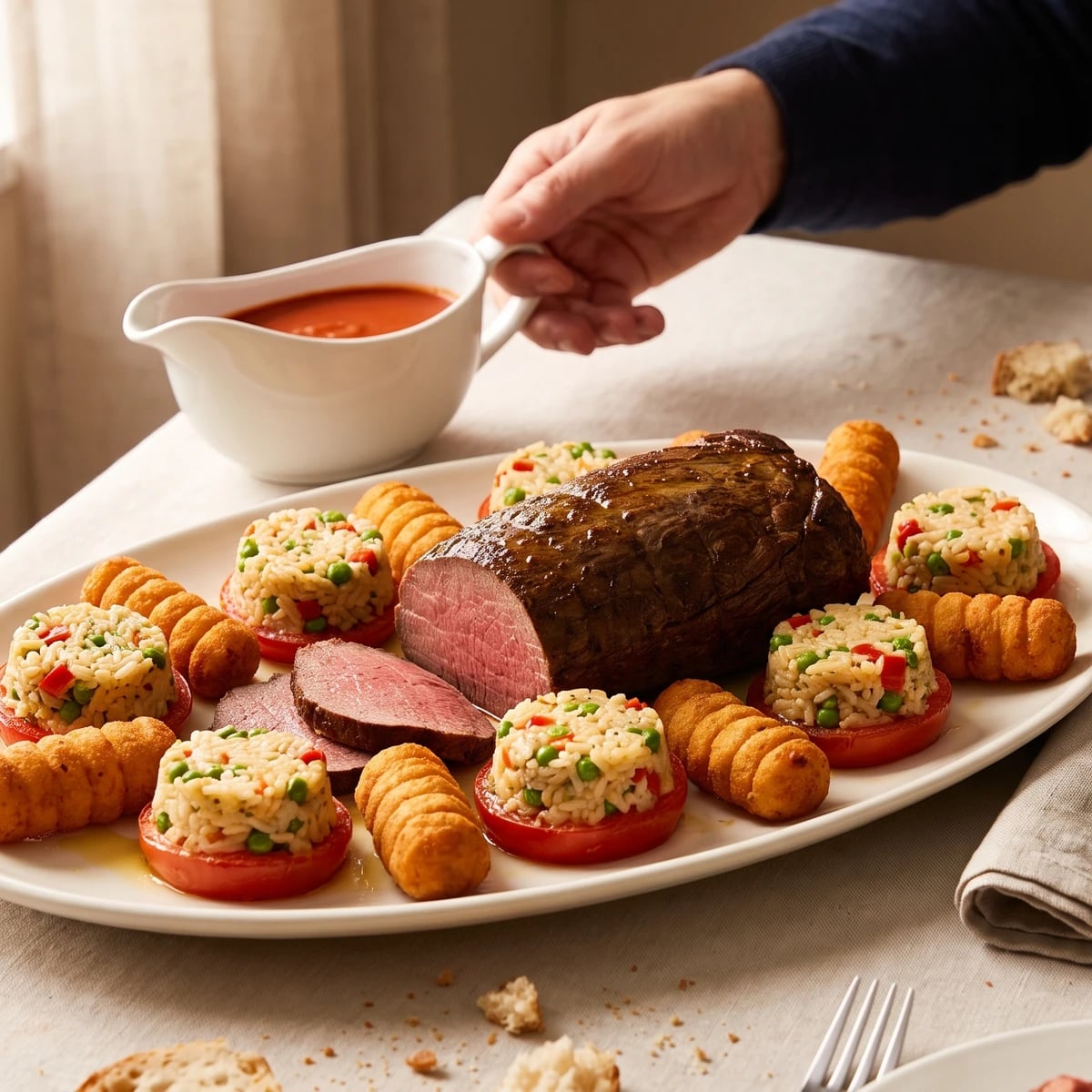
Plain-roasted fillet wears its own bronze crust, ringed with buttered tomatoes crowned by Riz à la Grecque timbales and crisp sweet-potato croquettes, while a peppery tomato sauce waits in the saucière.
Filet de Bœuf Orientale (plain-roasted beef fillet with composed garnishes) teaches the discipline of service: the meat must keep its crust, the rice must hold its little mould, the croquettes must arrive crisp, and the sauce must be passed hot, all at the same moment. The one true thing to know before touching a pan is that the fillet stays plain. No larding needle, no bacon veil. Dry meat, a hard initial sear, and a measured roast give you the bronze outside the dish requires.
The brigade entry assumed a saucier on staff, a stock never off the fire, rows of dariole-moulds, and another pair of hands watching the frying fat. A salamander might wait over the range, but this dish never needs it. At home, a reduced tomato sauce in one saucepan, one small buttered ramekin reused eight times, and a thermometer beside the roast do the same honest work. The prepared Riz à la Grecque (No. 2253) remains a finished component, just as the source intends; here the garnish is scaled to eight small timbales and eight croquettes for four diners.
Keeping a separate saucier and a bank of moulds is brigade scaffolding, and it can go. The alternating ring of rice on buttered tomato and sweet-potato croquette, the unlarded crust, and the last-minute frying are the dish itself, and they must stay. Dry the fillet thoroughly before it meets the pan. Guard that crust, and the rest is choreography for one cook, one stove, one evening.
Filet de Bœuf Orientale belongs to the Parisian grand-kitchen register, where a garnish name told the brigade how a plainly roasted joint was to be dressed and which sauce traveled beside it. Orientale here is a classical menu label, not a claim to one eastern region: Riz à la Grecque, sweet potatoes, tomatoes, and piquant sauce make the prescribed identity. The composition passed from formal dining service to the bourgeois dinner table because its spectacle comes from orderly garnishes and timing, not from equipment a home cook cannot own.
Quantity
1 roast (2 lb / 900 g)
trimmed of silver skin and tied at 1½-inch (4 cm) intervals
Quantity
2½ teaspoons (12.5 ml / 15 g)
divided
Quantity
1½ teaspoons (7.5 ml / 3 g)
divided
Quantity
1 tablespoon (15 ml / 14 g)
Quantity
2 tablespoons (30 ml / 28 g)
Quantity
4 medium (about 1¼ lb / 570 g)
halved crosswise
Quantity
3 tablespoons (45 ml / 43 g)
Quantity
1½ lb (680 g)
Quantity
2 tablespoons (30 ml / 28 g)
Quantity
1
Quantity
½ cup (120 ml / 60 g)
Quantity
2
beaten
Quantity
1½ cups (360 ml / 150 g)
Quantity
4 cups (960 ml / 880 g)
Quantity
1 can, 28 oz (794 g), about 3 cups (720 ml)
crushed by hand
Quantity
1 (about 4 oz / 115 g)
finely chopped
Quantity
1 clove
crushed
Quantity
1 tablespoon (15 ml / 16 g)
Quantity
1
Quantity
¼ teaspoon (1.25 ml / 0.5 g)
Quantity
3 tablespoons (45 ml / 43 g)
divided
| Ingredient | Quantity |
|---|---|
| center-cut beef tenderloin roasttrimmed of silver skin and tied at 1½-inch (4 cm) intervals | 1 roast (2 lb / 900 g) |
| fine sea saltdivided | 2½ teaspoons (12.5 ml / 15 g) |
| freshly ground black pepperdivided | 1½ teaspoons (7.5 ml / 3 g) |
| neutral high-heat oil | 1 tablespoon (15 ml / 14 g) |
| unsalted butter for the beef | 2 tablespoons (30 ml / 28 g) |
| prepared rice garnishkept warm | 2 cups (480 ml / 400 g) Riz à la Grecque (No. 2253) |
| ripe but firm tomatoeshalved crosswise | 4 medium (about 1¼ lb / 570 g) |
| unsalted butter for the dariole-mould and tomatoes | 3 tablespoons (45 ml / 43 g) |
| orange-fleshed sweet potatoes | 1½ lb (680 g) |
| unsalted butter for the croquettes | 2 tablespoons (30 ml / 28 g) |
| large egg yolk | 1 |
| all-purpose flour | ½ cup (120 ml / 60 g) |
| large eggsbeaten | 2 |
| fine dry breadcrumbs | 1½ cups (360 ml / 150 g) |
| neutral frying oil | 4 cups (960 ml / 880 g) |
| whole peeled tomatoescrushed by hand | 1 can, 28 oz (794 g), about 3 cups (720 ml) |
| small yellow onionfinely chopped | 1 (about 4 oz / 115 g) |
| garliccrushed | 1 clove |
| tomato paste | 1 tablespoon (15 ml / 16 g) |
| bay leaf | 1 |
| cayenne pepper | ¼ teaspoon (1.25 ml / 0.5 g) |
| cold unsalted butter for the tomato saucedivided | 3 tablespoons (45 ml / 43 g) |
Heat the oven to 425°F (220°C). Prick the sweet potatoes and bake them directly on a tray until completely tender and beginning to collapse, 40 to 50 minutes. Baking rather than boiling keeps the flesh dry enough to hold a cork shape later. Leave the oven on for the beef.
While the sweet potatoes bake, melt 1 tablespoon of the sauce butter in a saucepan over medium-low heat. Add the onion and cook for 6 to 8 minutes until tender but not browned. Stir in the garlic and tomato paste for 1 minute, then add the canned tomatoes, bay leaf, cayenne, ¼ teaspoon of the salt, and ¼ teaspoon of the black pepper. Simmer uncovered for 25 to 30 minutes, stirring often, until concentrated but still pourable. Remove the bay leaf, blend the sauce smooth, and press it through a fine sieve if the seeds remain coarse. Hold it off the heat; the remaining cold butter goes in only at service.
Split the sweet potatoes while they are hot, scoop out the flesh, and pass it through a ricer or mash it until perfectly smooth. Stir in the croquette butter, ½ teaspoon of the salt, and ¼ teaspoon of the black pepper. Let the purée cool for 5 minutes, then beat in the egg yolk. Spread it in a shallow layer and chill for 20 minutes. If the cold mixture still slumps instead of holding a mound, ça se rattrape: work in 1 tablespoon of the measured flour and chill it for another 10 minutes. Add no more unless truly necessary, because flour dulls the sweet potato.
Divide the cold sweet-potato mixture into 8 equal portions. With lightly floured hands, roll each into a compact cork about 2 inches (5 cm) long and 1 inch (2.5 cm) thick. Set the flour, beaten eggs, and breadcrumbs in three shallow dishes. Coat each croquette first in flour, then egg, then breadcrumbs, pressing gently so no cracks remain. Chill them until the moment of frying. This is not decoration: the close coating is what keeps the purée inside the croquette instead of in the frying oil.
Pat the fillet thoroughly dry, then season it all over with 1½ teaspoons of the salt and ¾ teaspoon of the black pepper. Heat the high-heat oil in a large ovenproof skillet until it shimmers. Sear the beef on every side, including both ends, for 6 to 8 minutes total, leaving each face against the pan until a deep bronze crust forms. Add the beef butter only after the crust has developed, then baste for 1 minute. Transfer the skillet to the oven and roast until the centre reaches 122 to 125°F (50 to 52°C) for medium-rare, about 18 to 25 minutes. Rest the fillet uncovered or very loosely tented for 15 to 20 minutes. If the crust is dark before the centre is ready, lower the oven to 375°F (190°C) and finish gently. Do not wrap it tightly, or that hard-won crust softens.
While the beef rests, warm the prepared Riz à la Grecque (No. 2253) gently in a covered saucepan. Melt 2 tablespoons of the tomato butter in a wide skillet. Season the tomato halves with the remaining ¼ teaspoon salt and ¼ teaspoon black pepper, then cook them cut-side down for 1 to 2 minutes. Turn and spoon the butter over them for another minute; they should be glossy and warmed through, not collapsed. Arrange them cut-side up around a warmed long platter. Brush a ¼-cup (60 ml) dariole-mould or straight-sided ramekin with the remaining tablespoon of butter, pack it firmly with rice, and invert it onto a tomato half. Re-butter lightly and repeat for all 8 halves. If a timbale sticks, set a warm cloth against the mould for a few seconds and loosen only the rim with a thin knife.
Pour the frying oil into a heavy saucepan, filling it no more than halfway, and heat it to 350°F (175°C). Fry the croquettes in two batches until evenly deep gold and crisp, 2 to 3 minutes, keeping the oil between 340 and 350°F (170 and 175°C). Drain them on a rack. If one cracks, lift it out at once. Ça se rattrape: bring the oil fully back to temperature, patch the remaining croquettes with flour, egg, and crumbs, then fry again. Cool oil and a broken coating cause bursting; hotter oil is not the answer.
Reheat the tomato sauce to a lively simmer and stir in any juices released by the resting beef. If it is thin, reduce it until it lightly coats a spoon; if it is too tight, loosen it with a spoonful of water. Take it off the heat and whisk in the remaining 2 tablespoons of cold sauce butter, one piece at a time, until glossy. If the butter separates, don't pour it out. Ça se rattrape: whisk in 1 teaspoon of cold water until the sauce comes together. Set the whole fillet lengthwise on the warm platter and alternate the 8 rice-crowned tomato halves with the 8 sweet-potato croquettes around it. Pour the highly seasoned tomato sauce into a warmed saucière and pass it separately. À table!
1 serving (about 800g)
Culinary guides, cultural storytelling, and the editorial depth that makes cooking meaningful.
Discover Culinary Explorer
Chef Juliette
A whole rosy fillet, larded with cool fatback and poêlé beneath butter, then carved thick under glossy jus. The lesson is exact but simple: deep colour outside, red tenderness within.

Chef Juliette
A larded fillet glazed at the last moment, surrounded by rice-filled peppers, crisp aubergine cases, tomato concassée, and chipolatas: a grand garniture brought within reach of one attentive home cook.

Chef Juliette
One burnished fillet, six vegetables, and a clear gravy passed beside it: Bouquetière teaches the classical art of cooking each garnish correctly, then arranging colour with generosity rather than fuss.

Chef Juliette
Beef fillet hollowed and rebuilt around foie gras, cream, and truffle, then poêled until the center is just set and the roast gleams under Périgueux sauce and four garnished tartlets.