
Chef Juliette
John Dory (St. Pierre)
John Dory has the delicacy of sole and the firmness of turbot. A light flouring, a quick butter sauté, and nut-brown beurre noisette show exactly why looks never mattered.
A cooking platform built around craft, culture, and the stories behind what we eat.
Created by Chef Juliette
Based on No. 2253, Riz à la Grecque, from Le Guide Culinaire (1907) by Auguste Escoffier
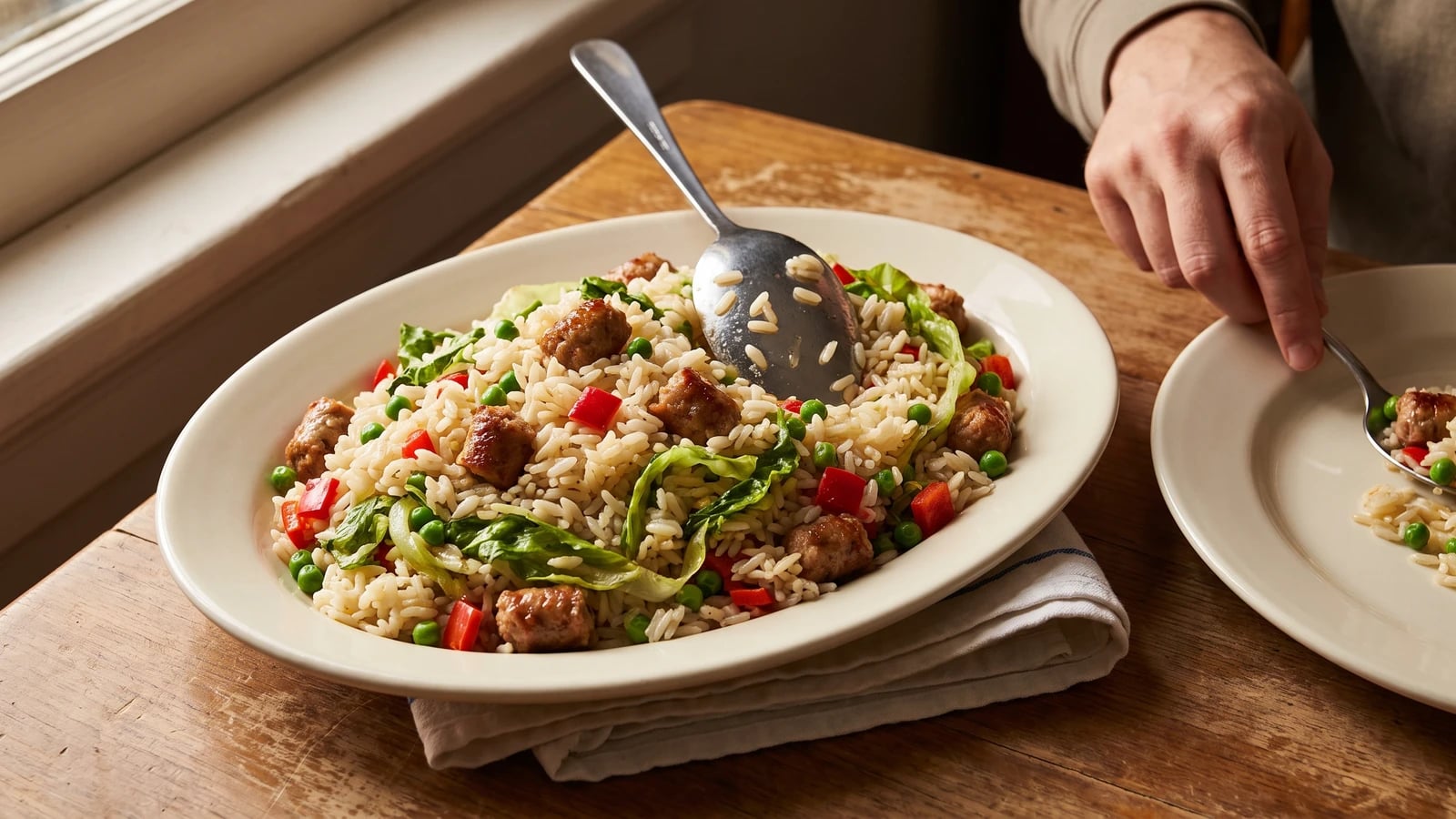
Riz à la Grecque turns disciplined pilaff into supper with pork sausage, ciseled lettuce, green peas, and red capsicum, all folded in for the final seven minutes.
Riz à la Grecque (French pilaff rice with sausage, lettuce, peas, and red capsicum) teaches the discipline of finishing late. The rice must be cooked and separate before the garnish arrives, then peas, ciseled lettuce, pork, and red capsicum get only seven or eight minutes together. That short final marriage keeps each ingredient itself instead of turning the pan into a soft, muddled rice.
The original kitchen assumed Pilaff rice already hot, peas cooked à la Française in their own pan, a stockpot never off the fire, and several hands weighing garnish by the pound. At home, a lidded saucepan makes the Pilaff, one deep skillet handles both garnishes, and frozen peas plus jarred roasted red capsicum stand honestly for vegetables kept ready in the brigade pantry. This formula makes about two pounds of finished rice, enough for four, while preserving the source proportions. One cook, one stove, one evening.
The separate holding pans were brigade scaffolding, so they go. The final seven-minute fold is the dish, so it stays. Keep the heat low and fold with a broad spoon; if the rice tightens, a spoonful of hot stock brings it back. Ça se rattrape.
Riz à la Grecque belongs to the codified Parisian classical repertory, where names such as à la grecque often identified a fixed garnish rather than a household dish from the country named. Pilaff reached French kitchens through the eastern Mediterranean, then the grand kitchens paired its separate grains with carefully prepared garnishes at the moment of service. Here sausage meat, lettuce, peas à la Française, and red capsicum define the French formula; the name is not a general description of Greek rice.
Quantity
2 cups (475 ml / 370 g)
Quantity
3 cups (720 ml / 720 g)
heated
Quantity
5 tablespoons (75 ml / 70 g)
divided
Quantity
½ onion (about ¼ cup / 60 ml / 45 g)
finely chopped
Quantity
1
Quantity
1¼ teaspoons (6 ml / 7 g)
divided
Quantity
1 cup plus 3 tablespoons (285 ml / 180 g)
Quantity
4 (about 60 g)
trimmed
Quantity
2 leaves (about 20 g)
Quantity
¼ cup (60 ml / 60 g)
Quantity
½ teaspoon (2.5 ml / 2 g)
Quantity
1 onion (about 1 cup / 240 ml / 140 g)
chopped
Quantity
½ cup (120 ml / 115 g)
casing removed
Quantity
1 head (about 115 g)
ciseled
Quantity
½ cup (120 ml / 85 g)
drained and cut into small dice
| Ingredient | Quantity |
|---|---|
| long-grain white rice | 2 cups (475 ml / 370 g) |
| unsalted chicken stockheated | 3 cups (720 ml / 720 g) |
| unsalted butterdivided | 5 tablespoons (75 ml / 70 g) |
| small yellow onion for the Pilafffinely chopped | ½ onion (about ¼ cup / 60 ml / 45 g) |
| bay leaf | 1 |
| fine saltdivided | 1¼ teaspoons (6 ml / 7 g) |
| frozen green peas | 1 cup plus 3 tablespoons (285 ml / 180 g) |
| small spring onionstrimmed | 4 (about 60 g) |
| inner butter-lettuce leaves | 2 leaves (about 20 g) |
| water | ¼ cup (60 ml / 60 g) |
| granulated sugar | ½ teaspoon (2.5 ml / 2 g) |
| medium yellow onion for the garnishchopped | 1 onion (about 1 cup / 240 ml / 140 g) |
| plain fatty pork sausage meatcasing removed | ½ cup (120 ml / 115 g) |
| small butter lettuceciseled | 1 head (about 115 g) |
| jarred roasted red capsicum or pimientodrained and cut into small dice | ½ cup (120 ml / 85 g) |
Keep the stock hot over low heat. Cisel the small lettuce, meaning cut it crosswise into narrow, even ribbons, much as a chaff cutter works through a bundle. Dry those ribbons well because wet lettuce floods the skillet. Leave the two inner leaves for the peas whole, chop the medium onion, trim the spring onions, and drain and dice the roasted red capsicum.
Melt 2 tablespoons of the butter in a heavy lidded saucepan over medium-low heat. Add the finely chopped half-onion and cook without browning for 3 minutes. Add the rice and nacrer it, coating and heating the grains in butter until they glisten and begin to look pearly at the edges. Pour in the hot stock, add the bay leaf and ½ teaspoon of the salt, and bring the liquid to a full simmer. Stir once, cover tightly, lower the heat as far as it will go, and cook for 18 minutes. Remove the pan from the heat and leave it covered for 10 minutes, then discard the bay leaf and loosen the grains with a fork. If the rice is still firm and the pan is dry, sprinkle in 2 tablespoons of hot stock, cover, and return it to the lowest heat for 5 minutes; if it is wet, leave it uncovered over low heat for 2 minutes. You want about 2 pounds of separate, tender Pilaff rice.
While the rice cooks, make the peas à la Française. Put the frozen peas, spring onions, two whole lettuce leaves, 1 tablespoon of butter, the water, sugar, and ¼ teaspoon of salt in a deep skillet. Cover and hold at a gentle simmer for 6 to 8 minutes, shaking the pan once or twice, until the peas are tender and bright and the liquid has become a light buttery glaze. Lift out the lettuce leaves and spring onions. If liquid remains when the peas are tender, uncover and toss over medium heat until it clings; if the butter separates into an oily film, add a teaspoon of cold water and toss again.
Transfer the peas to a bowl and wipe the skillet. Melt the remaining 2 tablespoons of butter over medium heat, then add the chopped medium onion, the sausage meat pinched into hazelnut-sized portions, and the ciseled lettuce together, exactly as the source directs. Season with another ¼ teaspoon of salt and cook for 8 to 10 minutes, turning the sausage gently rather than crushing it, until the onion is tender, the lettuce has collapsed, and the sausage is cooked through with no pink at its centre. If the lettuce leaves a watery puddle, raise the heat briefly and let that moisture cook away before adding the rice.
Seven or eight minutes before serving, lower the heat and fold the hot Pilaff rice into the sausage, onion, and lettuce. Add the peas à la Française and diced red capsicum, turning everything with a broad spoon so the grains stay whole. Cover loosely and warm for 7 to 8 minutes, folding once halfway through. This timing is the dish: longer cooking dulls the peas and dissolves the lettuce into the rice. If the mixture tightens, sprinkle in up to 2 tablespoons of hot stock; if it seems damp, remove the lid for the final 2 minutes. Ça se rattrape.
Taste and use the remaining salt only if the stock and sausage allow it. Loosen the rice once more with a fork, then spoon it generously into a warmed shallow serving dish. Its green peas, red capsicum, soft lettuce, and small sausage morsels are the finish, so scatter nothing else over the top. Serve at once. À table!
1 serving (about 420g)
Culinary guides, cultural storytelling, and the editorial depth that makes cooking meaningful.
Discover Culinary ExplorerChef Juliette
John Dory has the delicacy of sole and the firmness of turbot. A light flouring, a quick butter sauté, and nut-brown beurre noisette show exactly why looks never mattered.

Chef Juliette
Fresh haddock proves its delicacy in the meunière pan: a fine flour crust, moist pearly flakes, and beurre noisette sharpened with lemon and parsley, ready from one skillet in half an hour.

Chef Juliette
Éperlans à l’Anglaise turns small fish into a lesson in disciplined coating: boned smelts under a close, crisp crumb, pan-fried in clarified butter and finished with bright, half-melted maître d’hôtel butter.

Chef Juliette
Tiny smelts, shallot, mushrooms, white wine, gratin sauce, and fine bread raspings meet a fierce oven, where the fish must turn tender in the same breath the buttered crust bronzes.