
Chef Juliette
John Dory (St. Pierre)
John Dory has the delicacy of sole and the firmness of turbot. A light flouring, a quick butter sauté, and nut-brown beurre noisette show exactly why looks never mattered.
A cooking platform built around craft, culture, and the stories behind what we eat.
Created by Chef Juliette
Based on No. 1061, Filet de Bœuf Moderne, from Le Guide Culinaire (1907) by Auguste Escoffier
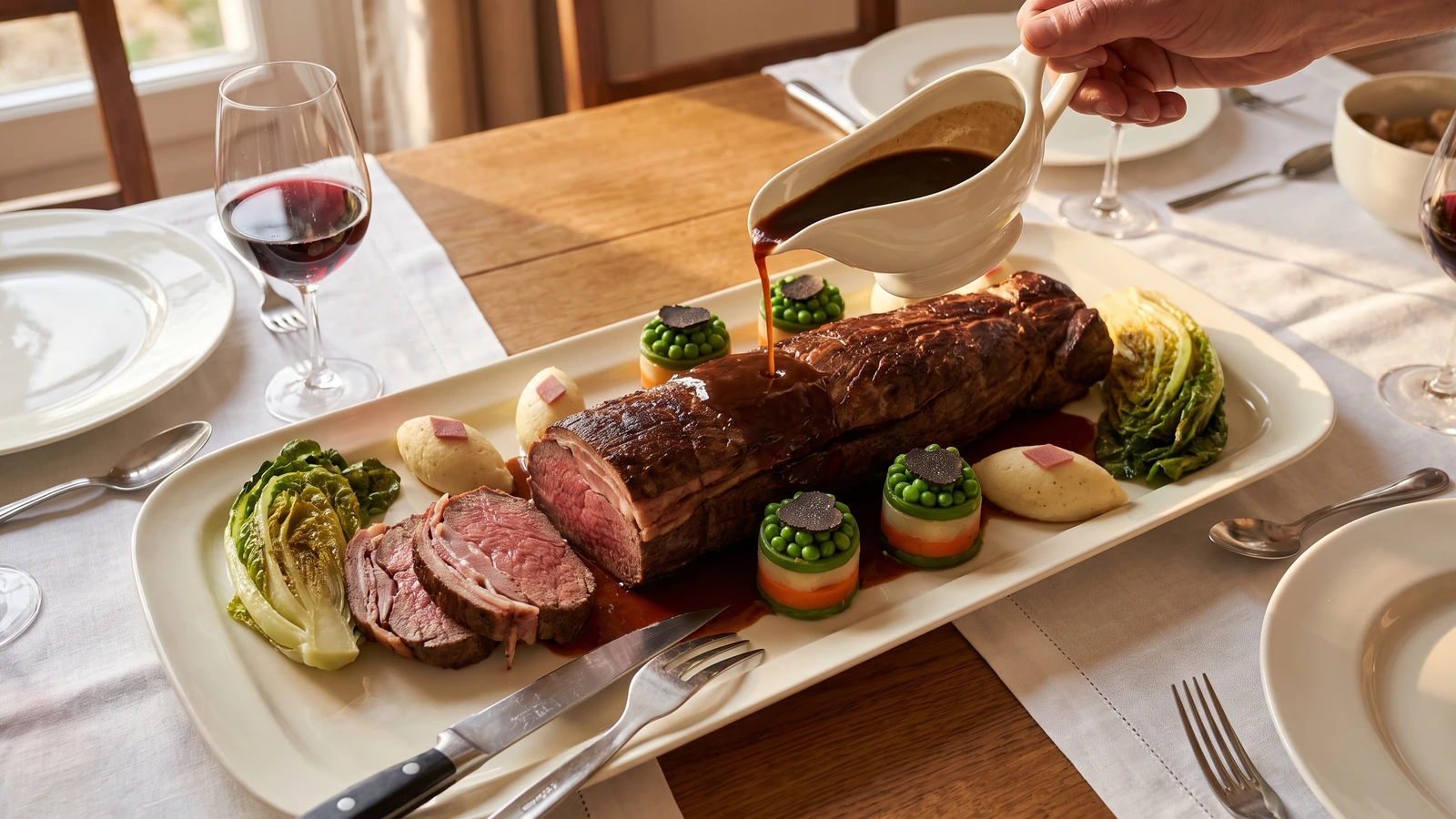
Poëled beef fillet with alternating threads of bacon and tongue, vegetable-mosaic chartreuses, tender lettuce, and quenelles: a generous showpiece whose real lesson is calm sequencing at the home stove.
Filet de Bœuf Moderne (modern-style beef fillet) teaches orchestration. The one true thing to know before you touch a pan is this: the fillet must not wait for its garnishes. Build the chartreuses, lettuce, quenelles, and sauce path first, then let the beef's resting time become your service window.
The original entry assumed a saucier on staff, stock never off the fire, a larding needle, rows of hexagonal molds, and a salamander ready to glaze a brigade-sized fillet. Here, one 1¾-pound center-cut fillet feeds four; a narrow knife and skewer replace the larding needle, four small ramekins replace the molds, and the home broiler supplies the final gloss. Poëlings (No. 250), the book's butter-roasting preparation, remains separate exactly as the canon keeps it. One cook finishes its liquor while the meat rests. The book's ten-minute bain-marie also assumes warm molds waiting at service; cold home-assembled chartreuses need 12 to 15 minutes and a thermometer so their chicken mousseline cooks safely.
The exact vegetable geometry is brigade scaffolding and may be simplified. The alternating bacon and tongue, butter poëling, cabbage-filled chartreuses, braised half-lettuces, tongue-marked quenelles, and lightly bound liquor are the dish, and they stay. Complete every garnish mise en place before the fillet enters the oven. That sequencing is the step that matters most. One cook, one stove, one evening.
Filet de Bœuf Moderne belongs to the formal Parisian grand-kitchen table, where a whole fillet was presented at the center of an architectural garnish rather than sliced out of sight. Moderne is a named composition, not permission for free invention: vegetable-lined chartreuses, braised half-lettuces, tongue-decorated quenelles, and light poëling liquor define it. The chartreuse here is a molded vegetable mosaic, not the Alpine liqueur, and its passage to a household celebration requires smaller molds and tighter sequencing, not the removal of its garnishes.
Quantity
1¾ pounds (800 g)
trimmed and tied lengthwise
Quantity
1 ounce (30 g)
cut into 4 long, slender batons
Quantity
2 ounces (55 g)
half cut into 4 long batons and half into 4 thin diamonds
Quantity
2 teaspoons (10 ml / 12 g), plus more for the vegetable water
divided
Quantity
½ teaspoon (2.5 ml / 1 g)
Quantity
1 home-scale preparation (No. 250), scaled for the beef fillet and sufficient to yield about 1½ cups (360 ml / 360 g) poëling liquor
Quantity
8 ounces (225 g)
cubed and thoroughly chilled
Quantity
1
Quantity
½ cup (120 ml / 120 g)
Quantity
6 tablespoons (90 ml / 85 g)
divided
Quantity
4 thin slices, about ¾ ounce (20 g)
patted dry
Quantity
⅔ cup (100 g)
cut into batons about ⅛ inch thick
Quantity
⅔ cup (100 g)
cut into batons about ⅛ inch thick
Quantity
⅔ cup (80 g)
trimmed and cut to the height of the ramekins
Quantity
½ cup (70 g)
fresh or frozen
Quantity
5 packed cups (450 g)
finely shredded
Quantity
1 cup (240 ml / 240 g)
divided
Quantity
2 small heads
halved lengthwise through the root
Quantity
2 teaspoons (10 ml / 6 g)
Quantity
1 tablespoon (15 ml / 15 g)
| Ingredient | Quantity |
|---|---|
| center-cut beef fillettrimmed and tied lengthwise | 1¾ pounds (800 g) |
| chilled unsmoked back baconcut into 4 long, slender batons | 1 ounce (30 g) |
| cooked salted beef tonguehalf cut into 4 long batons and half into 4 thin diamonds | 2 ounces (55 g) |
| fine sea saltdivided | 2 teaspoons (10 ml / 12 g), plus more for the vegetable water |
| finely ground white pepper | ½ teaspoon (2.5 ml / 1 g) |
| Poëlings | 1 home-scale preparation (No. 250), scaled for the beef fillet and sufficient to yield about 1½ cups (360 ml / 360 g) poëling liquor |
| boneless, skinless chicken breastcubed and thoroughly chilled | 8 ounces (225 g) |
| large egg white | 1 |
| cold heavy cream | ½ cup (120 ml / 120 g) |
| unsalted butterdivided | 6 tablespoons (90 ml / 85 g) |
| preserved or fresh black trufflepatted dry | 4 thin slices, about ¾ ounce (20 g) |
| carrotcut into batons about ⅛ inch thick | ⅔ cup (100 g) |
| turnipcut into batons about ⅛ inch thick | ⅔ cup (100 g) |
| slender green beanstrimmed and cut to the height of the ramekins | ⅔ cup (80 g) |
| small peasfresh or frozen | ½ cup (70 g) |
| Savoy cabbagefinely shredded | 5 packed cups (450 g) |
| unsalted beef or veal stockdivided | 1 cup (240 ml / 240 g) |
| Little Gem or compact romaine lettucehalved lengthwise through the root | 2 small heads |
| arrowroot | 2 teaspoons (10 ml / 6 g) |
| cold water | 1 tablespoon (15 ml / 15 g) |
Chill the food-processor bowl and blade for 15 minutes. Pulse the cold chicken with ½ teaspoon of the salt and a pinch of white pepper until it becomes smooth and tacky. Add the egg white and pulse just until absorbed. Hold back 2 tablespoons of the cream, then add the remainder in a thin stream while pulsing, stopping as soon as the mousseline is glossy and cohesive. Poach a teaspoon in barely trembling water, taste, and correct the seasoning. Reserve four rounded tablespoons for the quenelles and keep everything cold. If the mixture turns loose or greasy, stop processing. Ça se rattrape: set the bowl over ice for 10 minutes, then pulse briefly while adding the reserved cream a spoonful at a time.
Blanch the shredded cabbage in salted boiling water for 2 minutes, drain it, cool it enough to handle, and squeeze it firmly in a clean towel. Melt 2 tablespoons of butter in a wide pan, add the cabbage and ½ cup of the stock, season lightly, cover, and braise gently for 15 minutes. Uncover and cook until no free moisture remains, then press the cabbage beneath a small plate while it cools. In a second pan, melt 1½ tablespoons of butter, lay in the lettuce halves cut-side down, add the remaining stock, season, cover, and braise gently for 8 to 10 minutes, until tender but still intact. Hold them in their liquor. Wet cabbage makes the chartreuses slump; if it still glistens with liquid, return it to the pan uncovered and dry it patiently.
Bring one saucepan of well-salted water to a boil and cook each vegetable according to its nature. Simmer the carrot and turnip batons separately until just tender, blanch the green beans until vivid and flexible, then cook the peas only until sweet and tender. Cool each promptly in cold water, drain thoroughly, and spread them on towels to dry. Toss the vegetables with 1 tablespoon of melted butter. They must bend enough to line a mold without becoming soft; if a baton breaks under its own weight, keep it for the center and use a firmer piece on the wall.
Brush four 3-ounce ramekins generously with the remaining 1½ tablespoons of butter and chill them for 5 minutes. Lay one truffle slice across most of each base. Stand alternating carrot, turnip, and green-bean batons against the walls, pressing peas into the small gaps to make a coloured mosaic. Spread a thin veil of cold mousseline over the vegetables, using the back of a teaspoon and taking care not to disturb the pattern. Pack the centers firmly with the dry braised cabbage, leaving a narrow rim, then seal with another thin layer of mousseline. Cover and refrigerate. If the pattern slides, the vegetables or mold are too warm; chill both for 5 minutes, pat the vegetables dry, and reset them.
Simmer the bacon batons in water for 2 minutes, then drain, dry, and chill them until firm. From one end of the fillet, push a narrow paring knife lengthwise through the meat to form eight evenly spaced channels around the center. Widen each gently with a straight metal skewer, then thread in the four bacon and four tongue batons, alternating them around the fillet. If a baton buckles, chill it again rather than forcing it. Tie the roast at 1½-inch intervals so it keeps an even cylinder, then season it with the remaining salt and white pepper.
Heat the oven to 325°F (165°C). Cook the larded fillet according to Poëlings (No. 250), scaled to this piece and using a heavy covered casserole only just large enough to hold it. Follow the referenced covered butter cooking and final uncovered colouring, adding no liquid while the meat itself cooks. Begin checking the center after 22 minutes; a fillet of this size generally needs 28 to 35 minutes. Remove it at 122°F to 125°F (50°C to 52°C) for a medium-rare finish, transfer it to a rack, and tent it loosely for 15 to 20 minutes. If the vegetables beneath begin to darken before the beef is ready, lower the oven to 300°F (150°C) and move the casserole higher, but do not pour in stock. Moistening now changes poëling into a braise.
As soon as the beef comes out, raise the oven to 375°F (190°C). Set the ramekins in a small roasting pan and pour boiling water halfway up their sides to make a bain-marie, a hot-water bath that keeps the mousseline gentle. Cook for 12 to 15 minutes, until the filling is just firm and reaches 165°F (74°C). If it has not reached that temperature, give it another 2 minutes; colour is no guide because the mousseline remains pale. Lift the molds from the water, dry their bases, and hold them for unmolding.
Keep a saucepan of salted water at about 175°F (80°C), with only an occasional tremble at the surface. Shape the reserved mousseline into four round quenelles with damp spoons or lightly wet hands, press a tongue diamond onto each, and lower them into the water. Poach for 7 to 9 minutes, turning once, until firm and cooked through to 165°F (74°C). Lift them onto a buttered plate. If the water begins boiling, add a splash of cold water and lower the heat immediately; hard boiling toughens the outside before the center cooks. Warm the lettuce halves gently in their reserved braising liquor, then drain them well.
Complete the liquor stage of Poëlings (No. 250) while the beef rests. Keep its stock in contact with the butter and aromatic vegetables for the full prescribed 10 minutes before removing the fat, because that contact carries the meat's aroma into the liquor. Strain, degrease thoroughly, and return 1 to 1½ cups to a clean saucepan. Stir the arrowroot into the cold water, then whisk in only enough slurry to give the simmering liquor a light, pouring body. Cook for no more than 30 seconds. If it tightens beyond a thin coating, loosen it with a spoonful of stock; if it forms specks, strain it again. Brush the fillet twice with the liquor, then pass it under the broiler for 20 to 30 seconds, watching without blinking. The aim is a lacquered gloss, not further cooking.
Set the glazed fillet whole along the center of a warmed long platter. Run a thin knife around each chartreuse, invert two along either side of the meat, and lift the ramekins straight upward. If one clings, tap the base firmly and let gravity work; never dig through the vegetable pattern. Curve the braised half-lettuces around both ends of the fillet, then place the four tongue-decorated quenelles between the lettuce and chartreuses. Pour the remaining liquor into a warm sauceboat and send it separately. Carve the fillet at the table so every slice shows its alternating threads of bacon and tongue. À table!
1 serving (about 610g)
Culinary guides, cultural storytelling, and the editorial depth that makes cooking meaningful.
Discover Culinary ExplorerChef Juliette
John Dory has the delicacy of sole and the firmness of turbot. A light flouring, a quick butter sauté, and nut-brown beurre noisette show exactly why looks never mattered.

Chef Juliette
Fresh haddock proves its delicacy in the meunière pan: a fine flour crust, moist pearly flakes, and beurre noisette sharpened with lemon and parsley, ready from one skillet in half an hour.

Chef Juliette
Éperlans à l’Anglaise turns small fish into a lesson in disciplined coating: boned smelts under a close, crisp crumb, pan-fried in clarified butter and finished with bright, half-melted maître d’hôtel butter.

Chef Juliette
Tiny smelts, shallot, mushrooms, white wine, gratin sauce, and fine bread raspings meet a fierce oven, where the fish must turn tender in the same breath the buttered crust bronzes.