
Chef Juliette
John Dory (St. Pierre)
John Dory has the delicacy of sole and the firmness of turbot. A light flouring, a quick butter sauté, and nut-brown beurre noisette show exactly why looks never mattered.
A cooking platform built around craft, culture, and the stories behind what we eat.
Created by Chef Juliette
Based on No. 1060, Filet de Bœuf au Madère et aux Champignons, from Le Guide Culinaire (1907) by Auguste Escoffier
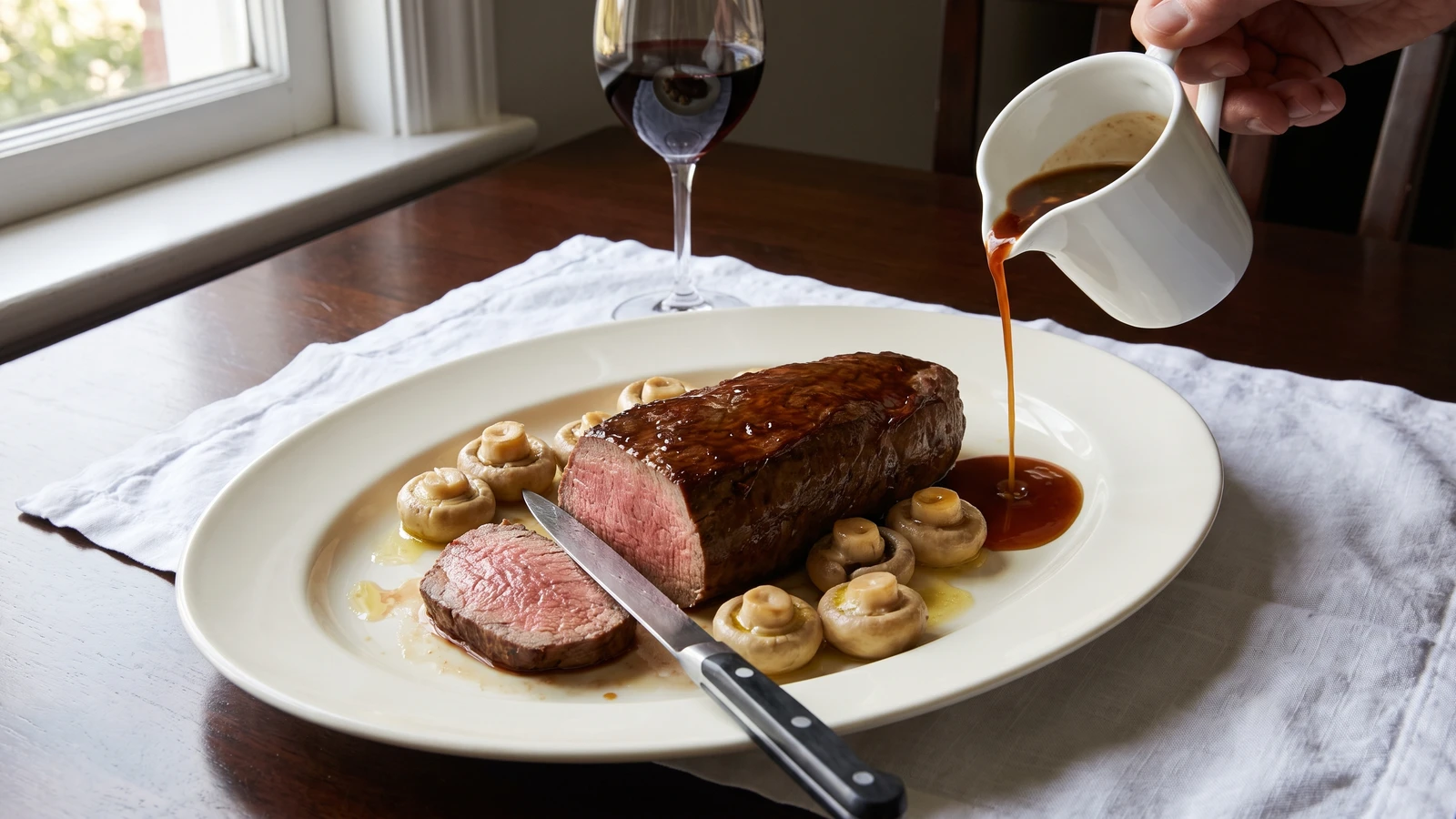
Filet de Bœuf au Madère et aux Champignons teaches the whole authority of fond: a butter-poêled fillet, neat mushrooms, and a glossy Madeira sauce that tastes of the pan, not decoration.
Filet de Bœuf au Madère et aux Champignons (butter-poêled beef fillet with Madeira and mushrooms) teaches one uncompromising thing: the fond is the sauce. Poêler means to roast gently in butter, with the meat protected for most of the cooking and colored at the end. If you dilute that liquor, scorch it, or skim its butter before the stock has captured the aromas, no amount of Madeira can put the character back. The glossy fillet, grooved mushroom caps, and mahogany sauce all begin in that pan.
The old formula assumed a larding needle, a saucier reducing prepared Madeira sauce beside a stockpot never off the fire, and a salamander ready to set the glaze. At home, a slim skewer and narrow knife draw chilled fatback through the beef, rich unsalted brown veal stock reduced with Madeira replaces the brigade sauce base, and two brushed coats of concentrated Poëlings (No. 250) liquor give the glaze without forcing the tender fillet back under fierce heat. The larding and carefully shaped mushrooms stay because they belong to the dish. A separate sauce station and overhead glazing are brigade scaffolding, so they go. One cook, one stove, one evening.
The step that decides everything is the degreasing. Let the stock spend its full ten minutes with the aromatic cooking butter as the poëling formula directs, then skim every visible bead before reduction. If the liquor still looks greasy, let it settle and skim again. Ça se rattrape. Madeira should deepen the fond, never cover it.
Filet de bœuf au Madère belongs to the classical Parisian dining-room repertoire, where a whole tender fillet arrived glazed, surrounded by precisely cut mushroom heads, with its sauce following separately in a sauceboat. Madère names the wine of the Portuguese island, not a French region; French sauce work took readily to its nutty, oxidized character because it stands firmly beside reduced brown stock. The old term poêlé can mislead a modern cook: here it means a butter-rich covered roast whose cooking liquor becomes part of the sauce, not a quick pan-fry.
Quantity
1 roast, 2 lb (907 g)
trimmed of silverskin
Quantity
2 oz (57 g)
cut into six batons about 1/4 inch by 1/4 inch by 3 inches (6 mm by 6 mm by 8 cm)
Quantity
2 teaspoons (10 ml / 12 g), divided
Quantity
1 teaspoon (5 ml / 2 g)
Quantity
1 home-scale quantity Poëlings (No. 250), scaled for one 2 lb (907 g) beef fillet
Quantity
16 caps, about 12 oz (340 g)
stems reserved for another dish
Quantity
2 tablespoons (30 ml / 28 g)
Quantity
1/2 cup (120 ml / 120 g)
Quantity
2 teaspoons (10 ml / 10 g)
Quantity
3/4 cup (180 ml / 185 g)
Quantity
2 cups (480 ml / 480 g)
gelatinous when cold
Quantity
2 teaspoons (10 ml / 6 g)
Quantity
1 cup (240 ml / 240 g) reserved from Poëlings (No. 250)
| Ingredient | Quantity |
|---|---|
| center-cut beef fillet roasttrimmed of silverskin | 1 roast, 2 lb (907 g) |
| chilled fatbackcut into six batons about 1/4 inch by 1/4 inch by 3 inches (6 mm by 6 mm by 8 cm) | 2 oz (57 g) |
| fine sea salt | 2 teaspoons (10 ml / 12 g), divided |
| freshly ground black pepper | 1 teaspoon (5 ml / 2 g) |
| Poëlings preparation | 1 home-scale quantity Poëlings (No. 250), scaled for one 2 lb (907 g) beef fillet |
| firm white mushroom capsstems reserved for another dish | 16 caps, about 12 oz (340 g) |
| unsalted butter | 2 tablespoons (30 ml / 28 g) |
| water | 1/2 cup (120 ml / 120 g) |
| fresh lemon juice | 2 teaspoons (10 ml / 10 g) |
| dry or medium-dry Madeira | 3/4 cup (180 ml / 185 g) |
| rich unsalted brown veal stockgelatinous when cold | 2 cups (480 ml / 480 g) |
| unflavored powdered gelatin (optional) | 2 teaspoons (10 ml / 6 g) |
| strained poëling liquor | 1 cup (240 ml / 240 g) reserved from Poëlings (No. 250) |
Chill the fatback batons until quite firm, about 15 minutes. Dry the beef, then use a smooth metal skewer to open six evenly spaced channels lengthwise through the roast, always working on the board and away from your hand. Follow each channel carefully with the tip of a narrow knife, then push a fatback baton through and trim it flush. If a baton softens or tears, don't widen the hole. Rechill it and feed shorter pieces from opposite ends. Season the beef with 1 1/2 teaspoons (7.5 ml / 9 g) salt and all the pepper, then tie it at 1-inch (2.5 cm) intervals into an even cylinder.
Heat the oven to 350°F (175°C). Carry out Poëlings (No. 250) exactly as its own formula directs, using a heavy covered vessel that holds this fillet snugly. Its butter-rich aromatic bed, frequent basting, and final uncovered coloring remain intact; most critically, add no liquid while the beef itself cooks. Begin checking the center after 20 minutes. Uncover near 125°F (52°C), then baste and color until the center reaches 137 to 140°F (58 to 60°C). A larger brigade fillet had time to bronze before its center was done; this smaller one may not. If the meat reaches temperature while still rather pale, stop cooking. The final glaze supplies the color without drying the beef.
While the fillet cooks, pour the Madeira into a small heavy saucier and boil steadily until reduced to 1/4 cup (60 ml / about 62 g). The harsh alcoholic smell should give way to a rounded, nutty aroma. If using ordinary stock, bloom the gelatin in 2 tablespoons (30 ml / 30 g) of the measured cold stock for five minutes. Add it with the remaining stock, then simmer until the sauce base measures about 3/4 cup (180 ml / 180 g). Do not salt it yet. Reduction multiplies salt as efficiently as flavor.
Trim each mushroom stem flush with its cap. With a small paring knife, turn the caps into neat rounded shapes, then cut shallow curved grooves from crown to rim. They needn't resemble military buttons, but they should be even enough to make a proper ring around the beef. Put them in a small sauté pan with the butter, water, lemon juice, and remaining 1/2 teaspoon (2.5 ml / 3 g) salt. Cover and simmer gently for 5 to 7 minutes, until tender. Uncover and roll them through the pan until the water has nearly disappeared and the butter leaves them pale and glossy. Hold them warm.
Transfer the cooked fillet to a rack and cover it loosely while it rests for 15 minutes. Finish the cooking liquor from Poëlings (No. 250) as that formula directs, allowing its stock the full ten-minute contact with the aromatic butter before straining. Measure 1 cup (240 ml / 240 g), let it settle briefly, and skim off every visible trace of fat. Return it to a clean pan and reduce it to 1/2 cup (120 ml / 120 g). If the liquor looks emulsified and greasy, take it off the heat for two minutes, then skim again with a shallow spoon or touch the surface lightly with the corner of a paper towel. Ça se rattrape.
Add the reduced, completely degreased poëling liquor to the Madeira and stock base. Simmer for 2 to 4 minutes, until the sauce nappes, or coats, the back of a spoon in a glossy film and yields about 1 cup (240 ml / 240 g). Strain it and taste only now for salt. If it runs thin, reduce it a little longer. If it tightens too far, loosen it a tablespoon at a time with unsalted stock. If grease reappears, let the sauce settle off the heat and skim once more. Do not mount it with extra butter; this particular finish should carry the aroma of the poëling without carrying its grease.
Warm an oval serving platter and a sauceboat. Set the whole fillet on the platter, brush it with a thin coat of the hot Madeira sauce, wait 30 seconds, then brush on a second coat so the surface gleams. Arrange the turned and grooved mushroom caps in a close ring around the beef. Pour the remaining sauce into the sauceboat and send it separately, exactly as the dish intends. Carve the fillet crosswise at the table and spoon sauce over each slice. Cooking well is not cooking fancy. À table!
1 serving (about 340g)
Culinary guides, cultural storytelling, and the editorial depth that makes cooking meaningful.
Discover Culinary ExplorerChef Juliette
John Dory has the delicacy of sole and the firmness of turbot. A light flouring, a quick butter sauté, and nut-brown beurre noisette show exactly why looks never mattered.

Chef Juliette
Fresh haddock proves its delicacy in the meunière pan: a fine flour crust, moist pearly flakes, and beurre noisette sharpened with lemon and parsley, ready from one skillet in half an hour.

Chef Juliette
Éperlans à l’Anglaise turns small fish into a lesson in disciplined coating: boned smelts under a close, crisp crumb, pan-fried in clarified butter and finished with bright, half-melted maître d’hôtel butter.

Chef Juliette
Tiny smelts, shallot, mushrooms, white wine, gratin sauce, and fine bread raspings meet a fierce oven, where the fish must turn tender in the same breath the buttered crust bronzes.