
Chef Juliette
Fillet of Beef (Relevé)
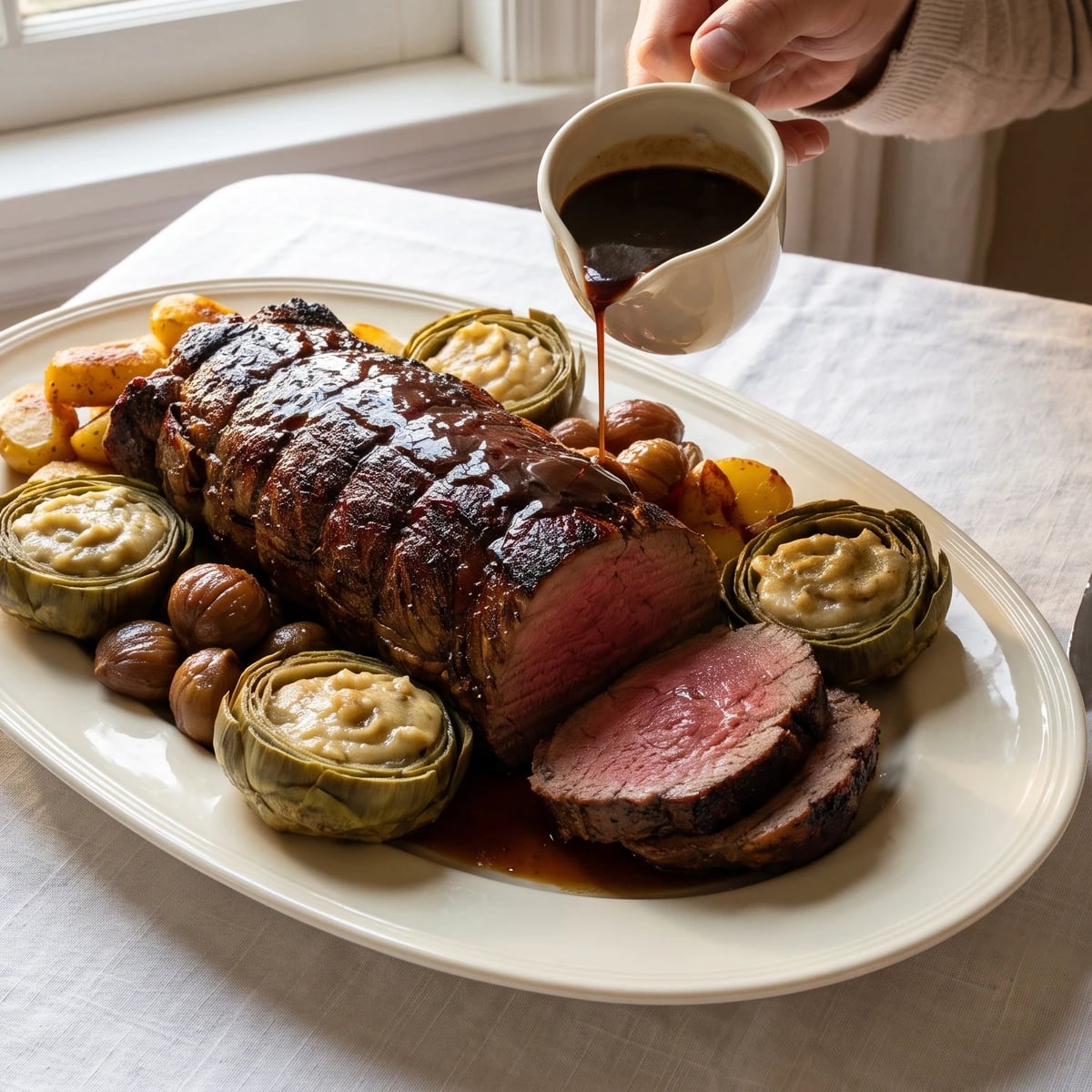
A whole rosy fillet, larded with cool fatback and poêlé beneath butter, then carved thick under glossy jus. The lesson is exact but simple: deep colour outside, red tenderness within.
A cooking platform built around craft, culture, and the stories behind what we eat.
Created by Chef Juliette
Based on No. 1047, Filet de Bœuf Châtelaine, from Le Guide Culinaire (1907) by Auguste Escoffier
A whole beef fillet poêled in butter, ringed with Soubise-filled artichokes, chestnuts, and bronzed potatoes, then glazed and served with Madeira sauce built from its own aromatic roasting liquor.
Filet de Bœuf Châtelaine (beef fillet with the Châtelaine garnish) teaches coordination. Poëling, roasting almost entirely in butter, gives the fillet its tenderness and aromatic liquor, but the triumph is timing: the meat rests while the chestnuts, filled artichokes, potatoes, and Madeira sauce each reach the table at their best. Nothing here is especially difficult. Everything must arrive together.
The original assumed a larding needle, a saucier on staff, brown veal stock never off the fire, a salamander for glazing, and several hands tending separate garnishes. At home, a slim skewer guides chilled fatback through the fillet, a snug covered roasting pan performs the poëling, good gelatin-rich stock makes the sauce, and the oven broiler sets the final glaze. The brigade-sized platter becomes one center-cut fillet and four generous arrangements of garnish. Separate holding pans were scaffolding and can go. The larding, butter poëling, thick Soubise, three-part garnish, and sauce served separately are the dish, so they stay. One cook, one stove, one evening.
Keep the poëling dry while the beef cooks. Stock added too early turns a butter roast into a braise and takes away the character you came for. If the vegetables beneath threaten to scorch, move the meat to a clean tray for its final coloring rather than reaching for water. That single decision protects both the fillet and the sauce.
Filet de Bœuf Châtelaine belongs to the codified grand-kitchen table of Paris, where a garnish name signaled a complete composition and allowed meat, sauce, and vegetables to arrive in concert. Châtelaine is not a regional claim: here the name means artichoke bottoms filled with Soubise, peeled chestnuts, butter-browned potatoes, and Madeira sauce arranged around a poêled fillet. The composition passed naturally to the bourgeois dinner table because its separate garnishes could be prepared in order and assembled around one generous roast.
Quantity
1 home-scaled preparation Poëlings (No. 250), yielding about 1½ cups (360 ml / 360 g) poëling liquor
Quantity
2 lb 4 oz (1.02 kg)
trimmed of silverskin
Quantity
1½ oz (45 g)
cut into 8 narrow batons and thoroughly chilled
Quantity
7 tablespoons (105 ml / 99 g)
divided
Quantity
2 medium, about 3 cups (720 ml / 420 g)
thinly sliced
Quantity
1½ tablespoons (22 ml / 20 g)
Quantity
⅓ cup (80 ml / 82 g)
Quantity
⅓ cup (80 ml / 80 g)
Quantity
4 medium, about 1½ cups (360 ml / 240 g)
drained and patted dry
Quantity
1½ cups (360 ml / 250 g)
Quantity
1¼ lb (570 g)
peeled and cut or turned into ¾-inch (2 cm) pieces
Quantity
2 cups (480 ml / 480 g)
Quantity
¾ cup (180 ml / 180 g)
Quantity
3 teaspoons (15 ml / 18 g)
divided
Quantity
1 teaspoon (5 ml / 2 g)
| Ingredient | Quantity |
|---|---|
| Poëlings | 1 home-scaled preparation Poëlings (No. 250), yielding about 1½ cups (360 ml / 360 g) poëling liquor |
| center-cut beef tenderloin roasttrimmed of silverskin | 2 lb 4 oz (1.02 kg) |
| cured pork fatbackcut into 8 narrow batons and thoroughly chilled | 1½ oz (45 g) |
| unsalted butterdivided | 7 tablespoons (105 ml / 99 g) |
| yellow onionsthinly sliced | 2 medium, about 3 cups (720 ml / 420 g) |
| short-grain white rice | 1½ tablespoons (22 ml / 20 g) |
| whole milk | ⅓ cup (80 ml / 82 g) |
| heavy cream | ⅓ cup (80 ml / 80 g) |
| unseasoned artichoke bottomsdrained and patted dry | 4 medium, about 1½ cups (360 ml / 240 g) |
| cooked peeled chestnuts | 1½ cups (360 ml / 250 g) |
| small waxy potatoespeeled and cut or turned into ¾-inch (2 cm) pieces | 1¼ lb (570 g) |
| gelatin-rich brown veal stock | 2 cups (480 ml / 480 g) |
| medium-dry Madeira | ¾ cup (180 ml / 180 g) |
| fine saltdivided | 3 teaspoons (15 ml / 18 g) |
| freshly ground black pepper | 1 teaspoon (5 ml / 2 g) |
Let the trimmed beef stand outside the cold for 30 minutes. Push a slim metal skewer lengthwise through the fillet to make eight evenly spaced channels, then guide one chilled fatback baton through each. A traditional larding needle makes this quicker, but the skewer does the same honest work. If the fat softens or refuses to pass, stop and chill it again; forcing warm fat only tears the meat. Tie the fillet at 1½-inch (4 cm) intervals so it keeps an even cylinder, then season it with 2 teaspoons (12 ml / 12 g) salt and the pepper.
Melt 2 tablespoons (30 ml / 28 g) butter in a covered saucepan over low heat. Add the onions and ¼ teaspoon (1.25 ml / 1.5 g) salt, cover, and cook for 15 minutes until collapsed and translucent without browning. Stir in the rice and milk, cover again, and cook at the gentlest simmer for about 20 minutes, until the rice crushes completely between two fingers. Purée until smooth, then work in enough cream to make a thick Soubise that holds a soft mound. If it becomes loose, simmer it uncovered for a few minutes; if it catches, transfer the unburned portion to a clean pan without scraping the bottom and loosen it with cream. Ça se rattrape. Cover and keep warm.
Bring the brown veal stock to a steady simmer in a wide saucepan and reduce it from 2 cups (480 ml / 480 g) to about 1 cup (240 ml / 240 g). Add the Madeira and continue reducing until you have roughly 1 cup (240 ml / 240 g) of glossy, concentrated sauce base. It should taste rounded rather than sharply alcoholic. Hold it over the lowest heat and do not season yet, because the poëling liquor will bring its own concentration.
Heat the oven to 325°F (165°C). Prepare the snug covered roasting vessel and cook the larded fillet according to Poëlings (No. 250), scaling the preparation to this single roast and reserving every drop of its liquor. Baste with the butter from the poëling every 10 minutes, but add no stock or water while the beef cooks. When the center reaches 115 to 118°F (46 to 48°C), uncover it and color it under the broiler, the home equivalent of the salamander, until burnished and 125°F (52°C) for a final rosy temperature near 131°F (55°C). For a fully cooked target of 145°F (63°C), remove it at 140°F (60°C). If the vegetables beneath begin blackening, transfer the beef to a clean rimmed tray for this final coloring and return its drippings to the roasting vessel.
Transfer the beef to a warm plate and rest it loosely covered for 15 to 20 minutes. Finish the Poëlings (No. 250) preparation in its roasting vessel, keeping the cooking butter in contact with the aromatic vegetables for the prescribed extraction before straining the liquor and removing its grease. Do not skim the butter prematurely, because it has carried the flavor of both meat and vegetables. If any vegetables scorched, leave the blackened layer undisturbed and strain only the clean liquid above it.
Bring 1 cup (240 ml / 240 g) of the strained Poëlings (No. 250) liquor to a bare simmer. Add the chestnuts and cook gently for 8 to 10 minutes, turning the pan rather than stirring, until they are hot and glazed but still whole. Lift them out and reserve their cooking liquor. Meanwhile, warm the artichoke bottoms in 1 tablespoon (15 ml / 14 g) butter with 2 tablespoons (30 ml / 30 g) water, covered, for about 5 minutes. Drain them, set each hollow side up, and fill generously with hot Soubise.
Melt 3 tablespoons (45 ml / 42 g) butter in a broad skillet over medium-low heat. Add the potatoes and ½ teaspoon (2.5 ml / 3 g) salt, cover, and cook for 10 to 12 minutes, shaking the pan regularly so they cook evenly. Uncover and continue for another 8 to 10 minutes until tender inside and lightly bronzed all around. This last-minute butter cooking is part of the Châtelaine garnish, not brigade scaffolding. If the butter darkens before the potatoes are tender, lift the pan from the heat, add a small piece of fresh butter, and continue more gently.
Combine all the reserved, degreased poëling liquor, including the chestnut cooking liquor, and boil it down to ½ cup (120 ml / 120 g). Stir this reduced liquor into the Madeira base and simmer until the sauce reaches nappé, coating the back of a spoon in a thin, glossy layer. Taste before adding the remaining salt. Off the heat, whisk in 1 tablespoon (15 ml / 14 g) cold butter. If the sauce looks greasy, skim it before adding that butter; if the finished emulsion separates, whisk in a teaspoon of cold stock away from the heat. Ça se rattrape. If it tightens too far, loosen it with stock one spoonful at a time.
Warm a long serving platter and a sauceboat. Remove the strings from the fillet, brush it lightly with 2 tablespoons (30 ml / 30 g) of Madeira sauce, and pass it beneath the broiler for 30 to 60 seconds, just long enough to set a gleaming glaze without cooking the center further. Place the whole fillet on the platter. Arrange the Soubise-filled artichoke bottoms around it, tuck the chestnuts between them, and add four small heaps of butter-browned potatoes. Send the remaining Madeira sauce separately in the warm sauceboat. À table!
1 serving (about 650g)
Culinary guides, cultural storytelling, and the editorial depth that makes cooking meaningful.
Discover Culinary Explorer
Chef Juliette
A whole rosy fillet, larded with cool fatback and poêlé beneath butter, then carved thick under glossy jus. The lesson is exact but simple: deep colour outside, red tenderness within.

Chef Juliette
A larded fillet glazed at the last moment, surrounded by rice-filled peppers, crisp aubergine cases, tomato concassée, and chipolatas: a grand garniture brought within reach of one attentive home cook.

Chef Juliette
One burnished fillet, six vegetables, and a clear gravy passed beside it: Bouquetière teaches the classical art of cooking each garnish correctly, then arranging colour with generosity rather than fuss.

Chef Juliette
Beef fillet hollowed and rebuilt around foie gras, cream, and truffle, then poêled until the center is just set and the roast gleams under Périgueux sauce and four garnished tartlets.