
Chef Juliette
John Dory (St. Pierre)
John Dory has the delicacy of sole and the firmness of turbot. A light flouring, a quick butter sauté, and nut-brown beurre noisette show exactly why looks never mattered.
A cooking platform built around craft, culture, and the stories behind what we eat.
Created by Chef Juliette
Based on No. 1041, Fish Cakes, from Le Guide Culinaire (1907) by Auguste Escoffier
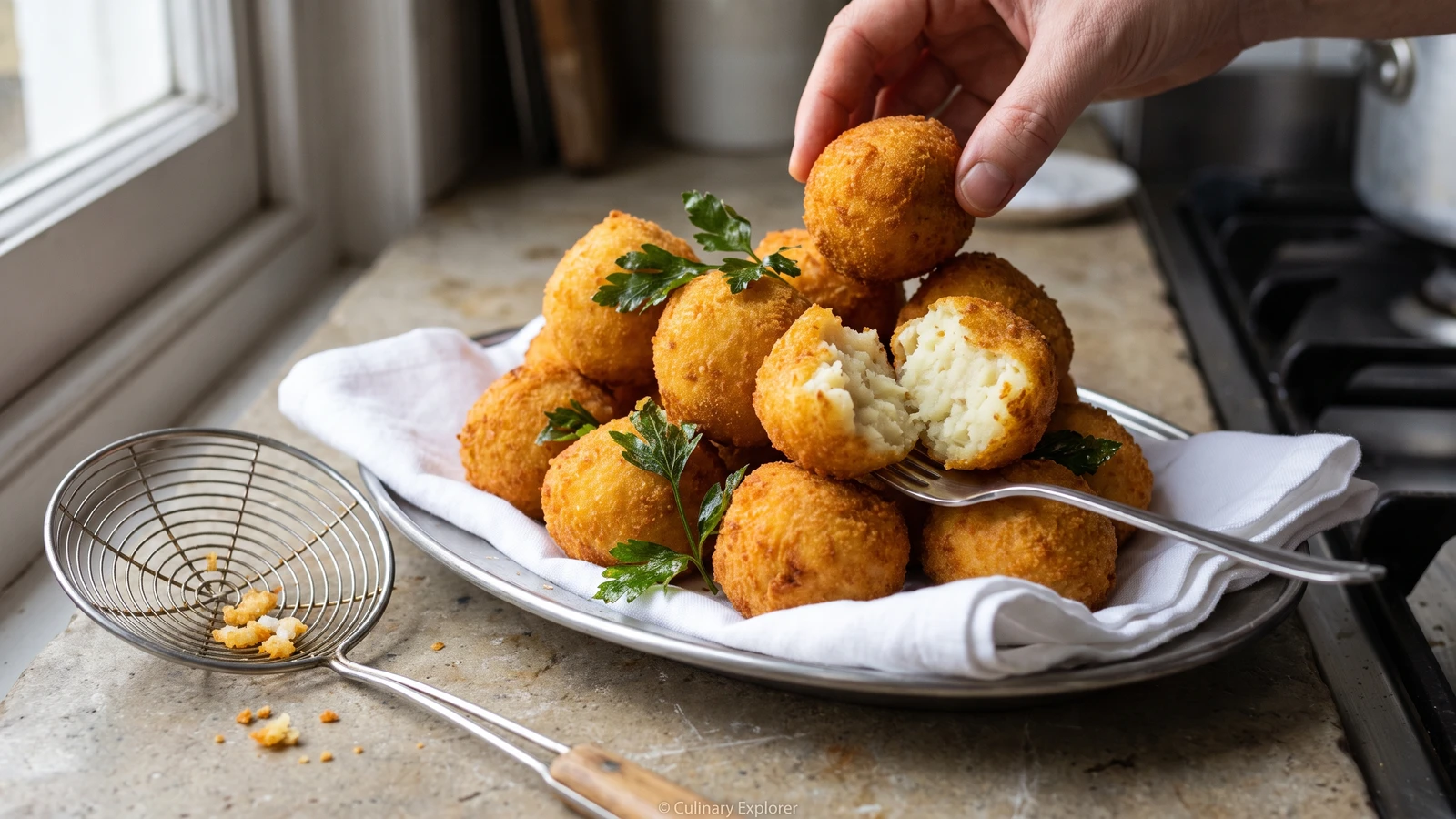
Salt cod, floury potato, and reduced Béchamel become croquettes beneath a complete panure à l’anglaise, fried in very hot fat so the crust sets at once and the center stays tender.
Croquettes de morue (salt cod fish cakes) teach one true thing: the coating must set before the filling can escape. The panure à l’anglaise (English-style breading) isn't decoration. It is the wall around a tender paste of salt cod, floury potato, egg, and reduced Béchamel, and very hot fat seals that wall the instant each cake enters the pan.
The original kitchen assumed a broad mortar for pounding, a saucier keeping reduced Béchamel ready, and a fryer held hot through service. Your honest equivalents are a potato ricer and sturdy spoon, a small pan reducing just enough Béchamel, and a thermometer clipped to a heavy saucepan. The book's proportion already lands neatly at a four-person table, so I have kept its exact pound of cod, half-pound of potato, two eggs, two spoonfuls of sauce, and two-ounce portions. The brigade scaffolding can go. The smooth paste, complete Anglaise, and very hot fat are the dish.
Dry the fish and potato thoroughly, because trapped water loosens the paste and drags down the frying temperature. Then watch the thermometer and let the fat recover between batches. That is the step that decides whether the croquettes seal into crisp bronze rounds or open in the pan.
Croquettes de morue occupy an unusual place in the French classical canon, since the repertory itself records fish cakes as especially appreciated in England and America. French kitchens gave that thrifty use of boiled fish the discipline of panure à l’anglaise, while favoring salt cod because its firm, seasoned flakes bind more reliably than delicate fresh fish. The dish belongs less to one French region than to the cosmopolitan classical table, where an Anglo-American favorite was translated into croquette form.
Quantity
About 3⅓ cups (800 ml / 454 g)
thoroughly drained, flaked, and cleared of skin and bones
Quantity
2 medium, about 10½ ounces (300 g) raw, to yield 1⅓ cups (320 ml / 227 g) freshly cooked potato
peeled and cut into even pieces
Quantity
¼ cup (60 ml / 60 g), reduced to 2 tablespoons (30 ml / 30 g)
Quantity
2
Quantity
Up to ¼ teaspoon (1.25 ml / 1.5 g)
Quantity
½ teaspoon (2.5 ml / 1 g)
Quantity
½ cup (120 ml / 60 g)
for the board and shaping
Quantity
1 batch Anglaise (for Egg-and-bread-crumbing) (No. 174), sufficient to coat 14 cakes
Quantity
4 cups (960 ml / 880 g)
for deep-frying
Quantity
1 loosely packed cup (240 ml / 15 g)
washed and completely dried
| Ingredient | Quantity |
|---|---|
| cooked salt codthoroughly drained, flaked, and cleared of skin and bones | About 3⅓ cups (800 ml / 454 g) |
| floury potatoespeeled and cut into even pieces | 2 medium, about 10½ ounces (300 g) raw, to yield 1⅓ cups (320 ml / 227 g) freshly cooked potato |
| plain Béchamel sauce made with butter and whole milk | ¼ cup (60 ml / 60 g), reduced to 2 tablespoons (30 ml / 30 g) |
| large eggs | 2 |
| fine salt (optional) | Up to ¼ teaspoon (1.25 ml / 1.5 g) |
| freshly ground black pepper | ½ teaspoon (2.5 ml / 1 g) |
| all-purpose flourfor the board and shaping | ½ cup (120 ml / 60 g) |
| prepared coating | 1 batch Anglaise (for Egg-and-bread-crumbing) (No. 174), sufficient to coat 14 cakes |
| refined peanut or sunflower oilfor deep-frying | 4 cups (960 ml / 880 g) |
| flat-leaf parsley sprigswashed and completely dried | 1 loosely packed cup (240 ml / 15 g) |
Cover the potatoes with cold water, bring them to a gentle boil, and cook until a knife passes through without resistance, about 12 to 15 minutes. Drain them thoroughly, return them to the dry hot pan, and shake over low heat for 1 minute until their surface looks floury. Weigh out 8 ounces (227 g), then pass it through a ricer while hot. If the potato still looks wet or glossy, keep it over low heat for another minute. Ça se rattrape now; once the eggs enter, that excess water is much harder to correct.
Put the Béchamel in the smallest saucepan you own and simmer it gently, stirring constantly, until ¼ cup has reduced to 2 tablespoons and falls heavily from the spoon. Scrape it into a shallow dish and let it cool until merely warm. The reduction matters: ordinary pouring Béchamel carries too much water and makes a paste that slumps.
Spread the cod on a clean towel and press firmly to remove any remaining moisture, then check it again for skin and bones. Put it in a sturdy bowl with the hot riced potato and pound with a wooden spoon or firm potato masher until the flakes have broken down and the mixture looks even. Beat in the reduced Béchamel, then the eggs one at a time, working vigorously until the paste is smooth and cohesive. Add the pepper, fry a teaspoonful of paste in a small pan, and taste before adding any salt. If the paste feels too soft to hold a ball, set the bowl over ice and beat until cold and firm, about 10 minutes. Don't bury the problem with breadcrumbs; they change the cake.
Dust the board lightly with flour. Divide the paste into fourteen portions of about 2 ounces (57 g) each, roll them into balls with floured hands, and flatten them into thick quoits, round cakes about 2½ inches (6 cm) wide and ¾ inch (2 cm) thick. Keep the edges smooth and compact. If a rim cracks, pinch it closed now, since every crack becomes an invitation for the filling to escape.
Coat every cake completely with the Anglaise (for Egg-and-bread-crumbing) (No. 174), following that preparation as written. Set the coated croquettes on a tray without stacking them and inspect the sides as carefully as the faces. If you find a bald patch, cover it before frying. Ça se rattrape on the tray; in the fat, an uncovered patch becomes a leak.
Pour the oil into a heavy 3-quart saucepan, leaving at least 3 inches (7.5 cm) of clear space above it. Clip on a thermometer and heat the oil to 365°F (185°C). This is the home equivalent of the service fryer, and the thermometer removes the guesswork. Set a wire rack over a tray beside the stove so the fried crust stays crisp rather than sweating against paper.
Lower three or four croquettes into the fat with a spider and fry until deep golden brown, turning once if needed, about 3 to 4 minutes. The center should reach 160°F (71°C). Keep the fat between 350°F and 365°F (175°C and 185°C), letting it recover fully before the next batch. If a cake opens, lift it out at once and allow the oil to return to temperature; inspect the remaining croquettes and close any weak patches with more Anglaise before continuing. Drain each batch on the rack and season very lightly only if the fried tasting sample showed the cod needed it.
When the croquettes are finished, make certain the parsley is completely dry. Lower a few sprigs at a time into the hot fat with the spider, step back from the pan, and fry for about 10 seconds until dark green and crisp. Drain well. Arrange the croquettes on a folded napkin or absorbent paper on a warm platter, place the fried parsley all around, and serve immediately. À table!
1 serving (about 240g)
Culinary guides, cultural storytelling, and the editorial depth that makes cooking meaningful.
Discover Culinary ExplorerChef Juliette
John Dory has the delicacy of sole and the firmness of turbot. A light flouring, a quick butter sauté, and nut-brown beurre noisette show exactly why looks never mattered.

Chef Juliette
Fresh haddock proves its delicacy in the meunière pan: a fine flour crust, moist pearly flakes, and beurre noisette sharpened with lemon and parsley, ready from one skillet in half an hour.

Chef Juliette
Éperlans à l’Anglaise turns small fish into a lesson in disciplined coating: boned smelts under a close, crisp crumb, pan-fried in clarified butter and finished with bright, half-melted maître d’hôtel butter.

Chef Juliette
Tiny smelts, shallot, mushrooms, white wine, gratin sauce, and fine bread raspings meet a fierce oven, where the fish must turn tender in the same breath the buttered crust bronzes.