
Chef Juliette
John Dory (St. Pierre)
John Dory has the delicacy of sole and the firmness of turbot. A light flouring, a quick butter sauté, and nut-brown beurre noisette show exactly why looks never mattered.
A cooking platform built around craft, culture, and the stories behind what we eat.
Created by Chef Juliette
Based on No. 1035c, Rouget au Fenouil, from Le Guide Culinaire (1907) by Auguste Escoffier
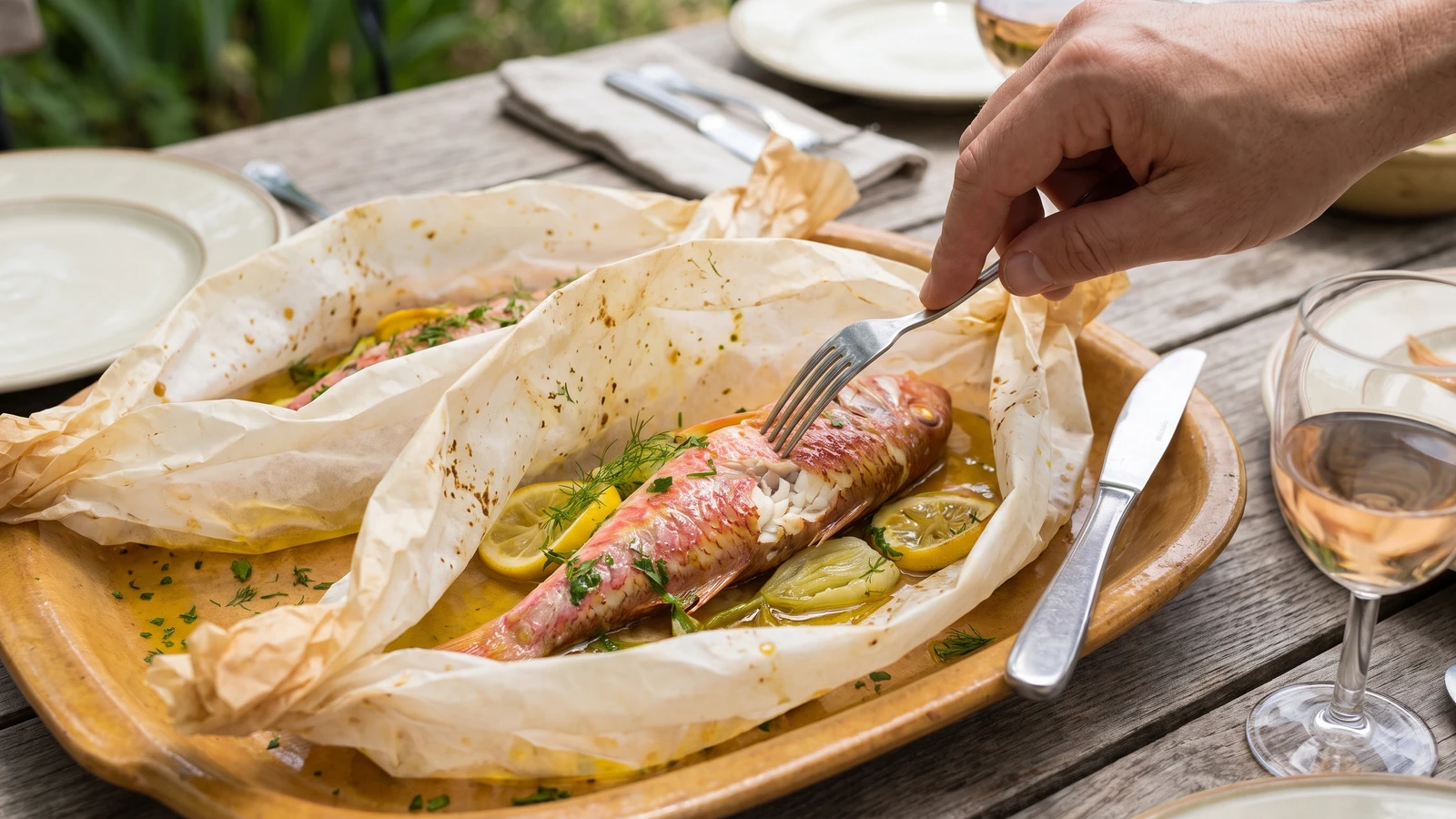
Rouget au fenouil turns a paper parcel into an aromatic cooking vessel: red mullet, fennel, lemon, parsley, and pork fat grilled gently until the skin gleams and the flesh releases from the bone.
Rouget au fenouil (red mullet with fennel) teaches the discipline of cuisson en papillote, cooking in a sealed paper parcel. The wrapping is not packaging. It is the cooking vessel, holding the fennel against the fish while lemon, parsley, and pork fat collect beneath it in glossy, fragrant juices. Know one thing before touching the grill: seal the parcel tightly, then cook it gently.
The original assumed strong oiled paper, a double fish grill, and brigade quantities of prepared marinade. It needed no saucier, stockpot, or salamander, but its paper could face a professional fire without complaint. At home, heavy parchment preserves the enclosed cooking, while an outer sheet of foil protects that parchment from flame. Four small fish replace a service quantity, and only a measured portion of the finished Cooked Marinade for Venison (No. 168) is needed. The five-quart batch is brigade scaffolding. The cisel cuts, chopped fennel, raw pork fat, close wrapping, and gentle grill are the dish itself, so they stay.
The finished rouget should emerge coral-red and glistening, with tender flesh that lifts cleanly from the backbone and fennel-scented juices gathered in the paper. Guard the seam above all. If a parcel tears, spoon back the escaped juices and wrap it again. Ça se rattrape.
Rouget au fenouil belongs to Mediterranean Provence, where red mullet and fennel meet naturally in the coastal larder. As the preparation traveled from open grilling into the classical kitchen, oiled paper protected the delicate fish and held its aromatics close, while roughly chopped raw pork fat supplied a steady internal basting. The pork may surprise a modern cook, but here it serves technique rather than geography; olive oil, lemon, fennel, and Mediterranean rouget still define the dish.
Quantity
4 fish, about 8 to 10 oz (225 to 280 g) each
cleaned, scaled, ciseled, and accompanied by the retained marinade
Quantity
½ cup (120 ml / 20 g)
finely chopped
Quantity
¼ cup (60 ml / 55 g)
roughly chopped into small dice
Quantity
¼ cup (60 ml / 15 g)
roughly chopped
Quantity
2 tablespoons (30 ml / 27 g)
for oiling the parchment
| Ingredient | Quantity |
|---|---|
| whole red mullet prepared to the marinating stage of Grilled Red Mullet (No. 1035a)cleaned, scaled, ciseled, and accompanied by the retained marinade | 4 fish, about 8 to 10 oz (225 to 280 g) each |
| Cooked Marinade for Venison (No. 168)fully cooled | ¼ cup (60 ml / 60 g) |
| fresh fennel fronds and tender stemsfinely chopped | ½ cup (120 ml / 20 g) |
| unsmoked raw pork back fatroughly chopped into small dice | ¼ cup (60 ml / 55 g) |
| flat-leaf parsleyroughly chopped | ¼ cup (60 ml / 15 g) |
| olive oilfor oiling the parchment | 2 tablespoons (30 ml / 27 g) |
Set the red mullet prepared to the marinating stage of Grilled Red Mullet (No. 1035a) in a shallow nonreactive dish, keeping all the marinade and aromatics from that preparation. Add the fully cooled Cooked Marinade for Venison (No. 168) and the chopped fennel. Turn the fish carefully until the cisel cuts, the shallow scoring already made along both sides, carry the marinade. Cover and refrigerate for 1 hour, turning twice so the fennel perfumes both sides evenly.
Prepare a grill with two heat zones and settle it near 375 to 400°F (190 to 205°C). Clean the grate and keep the cooler side clear. For a stovetop equivalent, heat a broad cast-iron grill pan over medium-low heat and have a close-fitting lid or an inverted roasting pan ready to cover it. The original double fish grill was useful brigade equipment, but it is not the dish; steady, enclosed heat is the honest home equivalent.
About 20 minutes before serving, lift the dish from the refrigerator and fold the chopped raw pork fat and parsley through the marinade. Tuck a few pieces of fat into the cisel cuts and the belly of each fish, leaving the remainder among the fennel. Keep every drop of marinade. The fat must be chopped small enough to soften and baste the rouget during its brief cooking.
Cut four sheets of heavy parchment large enough to enclose the fish generously, then brush their inner surfaces with olive oil. Place one fish in the centre of each sheet, divide the fennel, pork fat, parsley, and retained marinade among them, and fold the parchment into tight packets with the seams uppermost. Wrap each packet loosely in foil as a protective outer jacket, keeping the parchment against the food. If the paper tears or the marinade escapes, stop and rewrap the fish with the juices spooned back inside. Ça se rattrape.
Lay the parcels on the cooler side of the grill, close the lid, and cook for 7 to 8 minutes. Turn each parcel with two broad spatulas, keeping it level, then cook for another 7 to 8 minutes. On a covered grill pan, use the same timing over medium-low heat. The rouget is ready when the thickest flesh reaches 145°F (63°C), looks opaque beside the backbone, and releases when nudged with a knife. If the outer wrapping darkens too quickly, move it farther from the heat rather than opening the parcel; the trapped juices are doing the cooking.
Rest the parcels for 2 minutes. Remove the protective foil in the kitchen, leaving each parchment packet closed, then arrange them on a warmed platter exactly as the source directs. Let each diner open a parcel and spoon the fennel-scented juices over the flesh. Warn the table that the fish are whole, set down a bowl for the bones, and serve at once. À table!
1 serving (about 155g)
Culinary guides, cultural storytelling, and the editorial depth that makes cooking meaningful.
Discover Culinary ExplorerChef Juliette
John Dory has the delicacy of sole and the firmness of turbot. A light flouring, a quick butter sauté, and nut-brown beurre noisette show exactly why looks never mattered.

Chef Juliette
Fresh haddock proves its delicacy in the meunière pan: a fine flour crust, moist pearly flakes, and beurre noisette sharpened with lemon and parsley, ready from one skillet in half an hour.

Chef Juliette
Éperlans à l’Anglaise turns small fish into a lesson in disciplined coating: boned smelts under a close, crisp crumb, pan-fried in clarified butter and finished with bright, half-melted maître d’hôtel butter.

Chef Juliette
Tiny smelts, shallot, mushrooms, white wine, gratin sauce, and fine bread raspings meet a fierce oven, where the fish must turn tender in the same breath the buttered crust bronzes.