
Chef Juliette
John Dory (St. Pierre)
John Dory has the delicacy of sole and the firmness of turbot. A light flouring, a quick butter sauté, and nut-brown beurre noisette show exactly why looks never mattered.
A cooking platform built around craft, culture, and the stories behind what we eat.
Created by Chef Juliette
Based on No. 1035b, Rouget à la Bordelaise, from Le Guide Culinaire (1907) by Auguste Escoffier
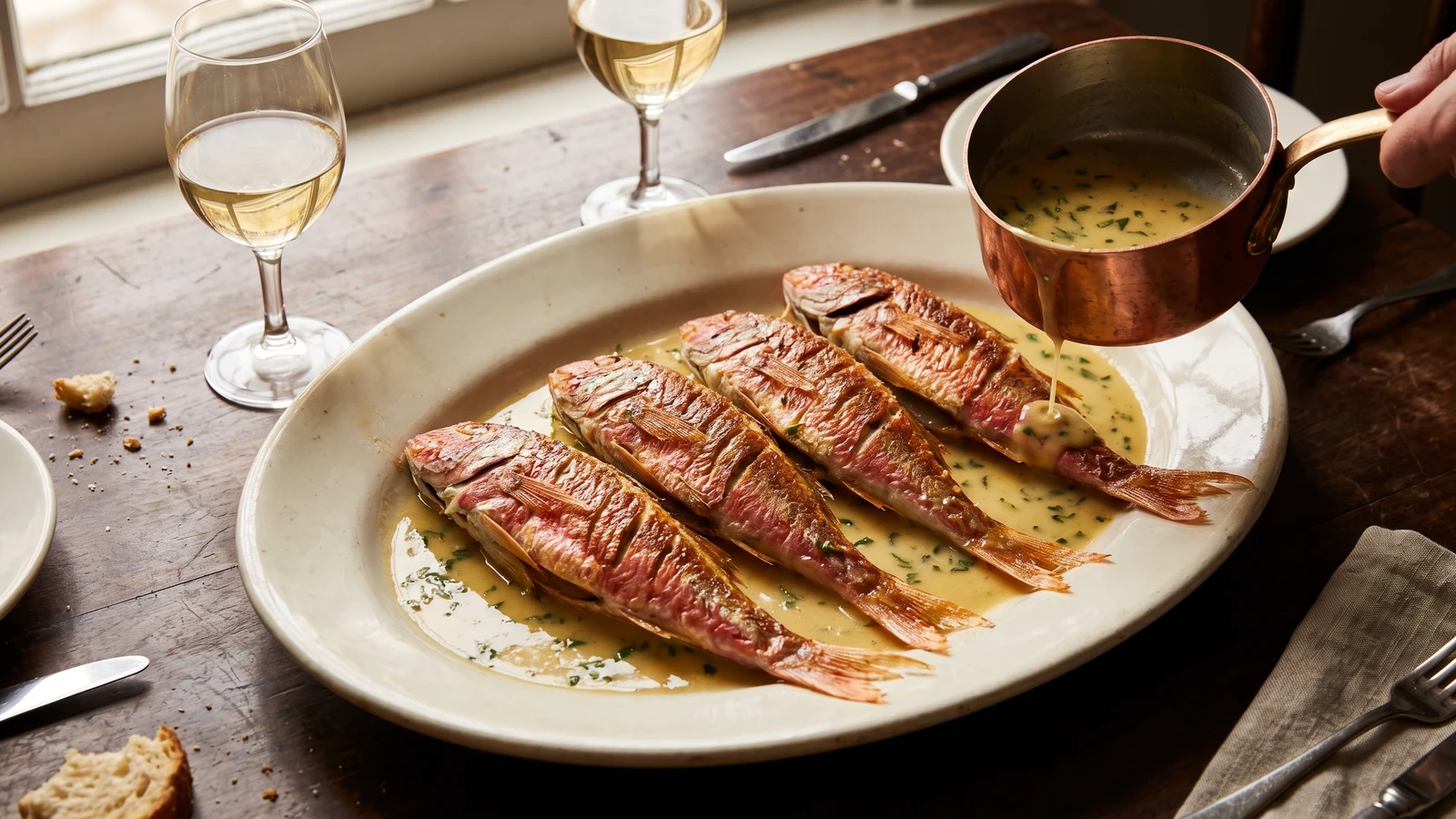
Rouget à la Bordelaise teaches the old balance: fierce heat for the fish, gentleness for the sauce, with bronzed red mullet laid over buttery, tarragon-flecked Bonnefoy.
Rouget à la Bordelaise (red mullet with white Bordeaux sauce) teaches two heats at once: strong, direct heat for the fish and the gentlest warmth for its butter-bound sauce. The one true thing is timing. Have the sauce ready before the rouget meets the grill, because this delicate fish will not wait while you organize the stove.
The old entry assumed a saucier, velouté, the pale stock-bound sauce, drawn from stock never off the fire, and a salamander waiting above the pass. At home, the finished Bonnefoy Sauce, or White Bordelaise Sauce (No. 67) reaches the stove as its own prepared component, exactly as the book's cross-reference intends, while an ordinary broiler supplies the salamander's hard upper heat. The source permits a grill or a sauté; broiling follows its first direction and lets four portions finish together. Separate stations and long service holding are brigade scaffolding, so they go. The finished sauce, decisive heat, and last-minute service are the dish, so they stay. One cook, one stove, one evening.
Your work is simple but exact: warm the sauce without boiling it, cook the fish quickly, and turn it only once. Dry the rouget until the skin feels almost tacky before it meets the heat. That is the step that matters most, because wet skin cannot bronze, and no quantity of fine sauce can return its crispness.
Rouget à la Bordelaise belongs to Bordeaux's classical table, where white Bordeaux could build a sauce for richly flavored red mullet from the Atlantic markets. Bonnefoy is the white Bordelaise, which corrects a common misconception: bordelaise does not always mean a dark red-wine sauce enriched with marrow. The dish traveled through the grand repertoire by cross-reference, with the fish grilled or sautéed to order while the saucier supplied the finished sauce.
Quantity
4 fish, about 10 ounces (280 g) each
scaled, gutted, and fins trimmed
Quantity
1 cup (240 ml / about 240 g) Bonnefoy Sauce, or White Bordelaise Sauce (No. 67)
fully prepared
Quantity
1 tablespoon (15 ml / 14 g)
melted
Quantity
1½ teaspoons (7.5 ml / 9 g)
Quantity
½ teaspoon (2.5 ml / 1 g)
Quantity
1 tablespoon (15 ml / 15 g)
for rescuing the sauce only
| Ingredient | Quantity |
|---|---|
| whole red mulletscaled, gutted, and fins trimmed | 4 fish, about 10 ounces (280 g) each |
| Bonnefoy Sauce, or White Bordelaise Saucefully prepared | 1 cup (240 ml / about 240 g) Bonnefoy Sauce, or White Bordelaise Sauce (No. 67) |
| unsalted buttermelted | 1 tablespoon (15 ml / 14 g) |
| fine sea salt | 1½ teaspoons (7.5 ml / 9 g) |
| freshly ground black pepper | ½ teaspoon (2.5 ml / 1 g) |
| cold water (optional)for rescuing the sauce only | 1 tablespoon (15 ml / 15 g) |
Set the fully prepared Bonnefoy Sauce, or White Bordelaise Sauce (No. 67) in a small heavy saucepan over the lowest heat, or in a heatproof bowl over barely warm water. Whisk slowly until it is fluid and glossy, then remove it from the heat and cover. Never let this butter-bound sauce boil. If an oily rim appears, take it off the heat and whisk in 1 teaspoon of the cold water. If it still refuses, put another teaspoon of cold water in a clean bowl and whisk the broken sauce into it by spoonfuls. Ça se rattrape.
Set an oven rack 4 to 5 inches (10 to 13 cm) below the broiler and heat the broiler on high for 10 minutes. Line a heavy rimmed sheet pan with foil and brush it lightly with half the melted butter. This hard upper heat performs the work of a salamander without asking your kitchen to become a brigade.
Pat the fish thoroughly dry inside and out, paying close attention around the fins and belly opening. Season the cavities and skins with the salt and pepper, then brush the exposed skin with the remaining butter. Do this just before cooking. Salt draws moisture, and wet skin turns leathery before it ever bronzes.
Arrange the rouget on the prepared pan with at least 1 inch (2.5 cm) between them. Broil for 4 to 5 minutes, until the upper skin is coral-red, bronzed at the high points, and beginning to blister. If the butter darkens before the skin colours, lower the pan one rack position. If the fish remains pale after 4 minutes, move it slightly closer for the final minute rather than cooking it longer at weak heat.
Slide a wide fish spatula beneath each rouget from head toward tail and turn it carefully. If the skin resists, wait 20 seconds and try again; pulling harder only tears it. Broil the second side for 3 to 4 minutes. The fish is ready when the flesh beside the backbone has turned opaque, separates in moist flakes, and reaches 145°F (63°C) at the thickest part. Look for bronze, not black.
Warm four plates with hot water and dry them well. Pool about 3 tablespoons of the Bonnefoy Sauce, or White Bordelaise Sauce (No. 67) on each plate, lay one rouget over it, and spoon the remaining sauce alongside without covering the bronzed upper skin. Serve immediately. Rouget waits for nobody. À table!
1 serving (about 185g)
Culinary guides, cultural storytelling, and the editorial depth that makes cooking meaningful.
Discover Culinary ExplorerChef Juliette
John Dory has the delicacy of sole and the firmness of turbot. A light flouring, a quick butter sauté, and nut-brown beurre noisette show exactly why looks never mattered.

Chef Juliette
Fresh haddock proves its delicacy in the meunière pan: a fine flour crust, moist pearly flakes, and beurre noisette sharpened with lemon and parsley, ready from one skillet in half an hour.

Chef Juliette
Éperlans à l’Anglaise turns small fish into a lesson in disciplined coating: boned smelts under a close, crisp crumb, pan-fried in clarified butter and finished with bright, half-melted maître d’hôtel butter.

Chef Juliette
Tiny smelts, shallot, mushrooms, white wine, gratin sauce, and fine bread raspings meet a fierce oven, where the fish must turn tender in the same breath the buttered crust bronzes.