Culinary Explorer

A cooking platform built around craft, culture, and the stories behind what we eat.
Discover Culinary Explorer
Merlan en Lorgnette au Gratin

Merlan en Lorgnette au Gratin

Created by Chef Juliette

Based on No. 1020, Merlan en Lorgnette au Gratin, from Le Guide Culinaire (1907) by Auguste Escoffier

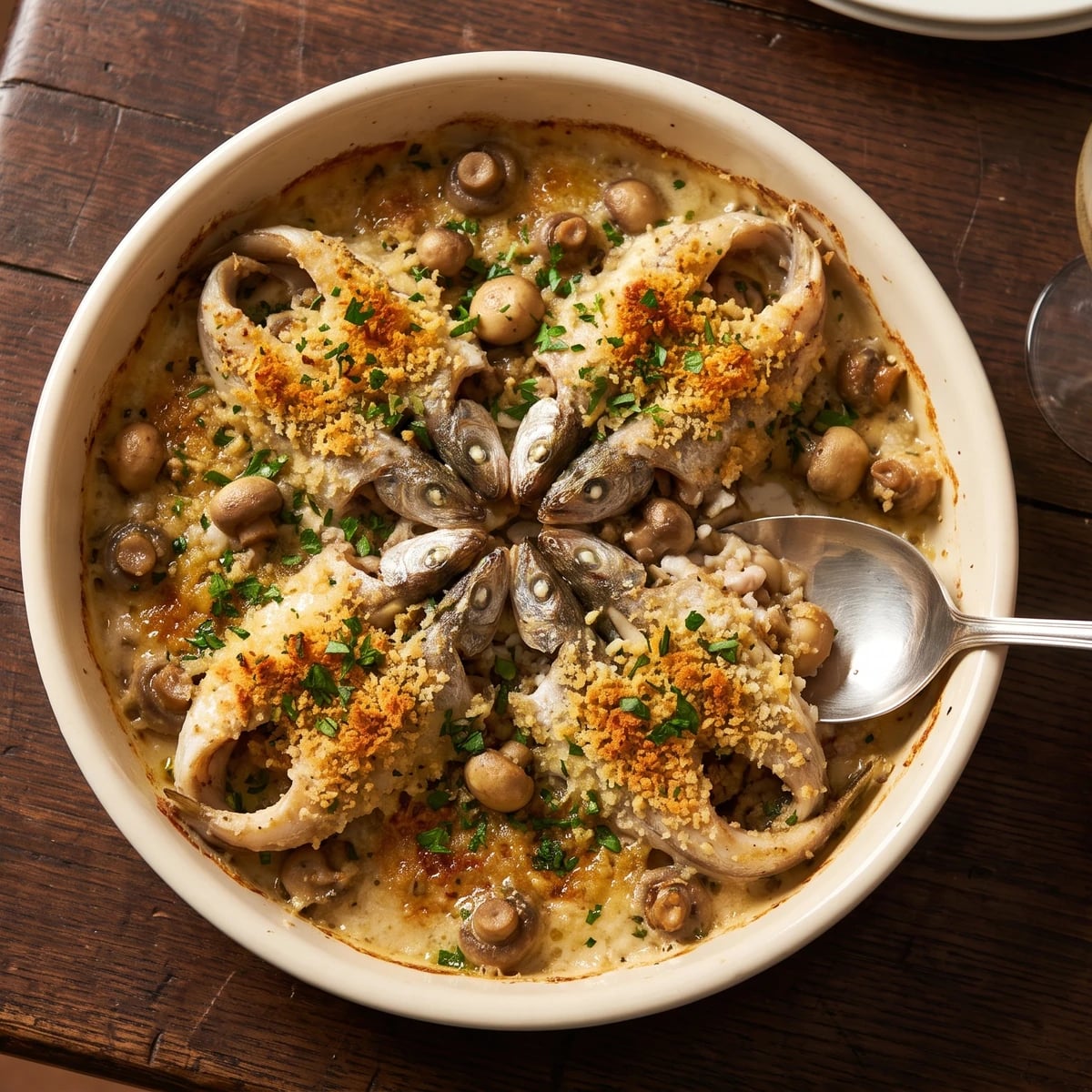
Whiting fillets rolled into lorgnette scrolls around their own heads, filled with fines-herbes forcemeat and baked under mushroom-rich gratin sauce, white wine, crumbs, and butter until the rim bubbles bronze.

Main Dishes
French
Dinner Party
Special Occasion
55 min
Active Time
18 min cook1 hr 15 min total
Yield4 servings

Merlan en Lorgnette au Gratin (whiting coiled like a pair of spectacles and baked beneath a gratin) teaches that presentation begins at the knife, not on the serving plate. The one true thing to know is this: each pair of fillets must remain joined to its head while the backbone comes away. Lose that hinge and the fish will still taste good, but the lorgnette has lost its grammar.

The original assumed a poissonnier at the fish bench, chilled forcemeat waiting in the garde-manger, a saucier holding Gratin Sauce from Gratins (No. 268) over a stock never off the fire, and a salamander ready to finish the operation drawn from Filets de Merlan au Gratin (No. 1018). Your honest equivalents are a fishmonger who scales and guts without filleting, a flexible knife, the prepared referenced components, a fiercely heated home oven, and a brief touch of the broiler only if the crumbs need it. Separate stations and the salamander are brigade scaffolding. The attached heads, fines-herbes forcemeat, inward curls, mushrooms, white wine, built sauce, buttered crumbs, and single decisive bake are the dish and must stay. One cook, one stove, one evening.

The finished gratin is splendidly direct: four whiting heads meet at the center while their filled fillets curl outward beneath a bronzed crust, with mushrooms settled into a glossy sauce and lemon sharpening the final spoonful. Before you touch the baking dish, give your full attention to the tail-to-head boning cut. Everything afterward depends on that small attachment at the collar.

Merlan en lorgnette au gratin belongs to the Parisian grand-kitchen repertoire, where modest Channel and Atlantic whiting was turned into a formal whole-fish presentation through exact knife work. Lorgnette means a small pair of spectacles: the two filled fillet scrolls form the lenses while the retained head preserves the fish's identity, and several fish are arranged with their heads meeting at the center. The preparation passed comfortably into bourgeois dining rooms because its drama comes from skill and arrangement, not an expensive species.

The technique, the tradition, and the story behind every dish.

Discover Culinary Explorer

Ingredients

whole whiting

Quantity

4 fish, 9 to 11 ounces (255 to 310 g) each

scaled and gutted with heads and tails intact and gills removed

fish forcemeat aux fines herbes

Quantity

1 cup (240 ml / 225 g)

thoroughly chilled

Gratin Sauce prepared through Gratins

Quantity

1½ cups (360 ml / 360 g) Gratin Sauce prepared through Gratins (No. 268)

warm and fluid

referenced gratin finishing procedure

Quantity

1 home-scale finishing procedure from Filets de Merlan au Gratin (No. 1018)

unsalted butter

Quantity

4 tablespoons (60 ml / 56 g)

divided

shallots

Quantity

¼ cup (60 ml / 45 g)

finely chopped

raw button mushrooms

Quantity

1½ cups (360 ml / 120 g)

thinly sliced

small cooked button mushrooms

Quantity

16 mushrooms, about 1 cup (240 ml / 150 g)

drained and patted dry

dry white wine

Quantity

½ cup (120 ml / 120 g)

divided

fine fresh bread raspings

Quantity

½ cup (120 ml / 50 g)

flat-leaf parsley

Quantity

2 tablespoons (30 ml / 8 g)

finely chopped

fresh lemon juice

Quantity

1 tablespoon (15 ml / 15 g)

fine sea salt

Quantity

1 teaspoon (5 ml / 6 g)

ground white pepper

Quantity

¼ teaspoon (1.25 ml / 0.5 g)

Equipment Needed

  • 12-inch (30 cm) round shallow gratin dish
  • Flexible filleting knife
  • Kitchen shears
  • Fish-bone tweezers
  • Wooden picks
  • Instant-read thermometer

Instructions

  1. 1

    Ready the fierce oven

    Heat the oven to 475°F (245°C) with a rack in the upper third. Soften 1 tablespoon (15 ml / 14 g) of the butter and use it generously on a round 12-inch (30 cm) gratin dish. Have the chilled forcemeat beside you and the Gratin Sauce from Gratins (No. 268) warm enough to flow from a spoon, never boiling. Reserve 2 tablespoons (30 ml / 30 g) of the white wine for the possible rescue during baking.

  2. 2

    Remove each backbone

    Pat the whiting dry inside and out. Lay one fish on its side and slip a flexible knife between the flesh and bones at the tail. Raise the first fillet from tail to head, following the frame closely, but stop at the collar so the fillet remains joined beside the head. Turn the fish and repeat on the second side. Snip the backbone immediately behind the head, then lift away the spine, ribs, and tail assembly together. Pull any remaining pin bones with tweezers and repeat with the other fish. Season the flesh lightly with the salt and white pepper.

    The attachment at the collar is the hinge that makes the lorgnette. If a fillet comes free, don't discard it. Ça se rattrape: place it against its original head and secure the underside with a wooden pick, which you will remove before serving.
  3. 3

    Form the lorgnettes

    Spread the fish forcemeat aux fines herbes over the flesh side of every fillet in a thin, even layer, about 2 tablespoons (30 ml / 28 g) per fillet. Leave a narrow margin so the filling does not squeeze out. Starting at each narrow tail end, roll the fillet inward toward its attached head, trapping the tail end inside the scroll. The paired scrolls should sit like two lenses behind the head. Secure them through the underside with wooden picks only if they refuse to hold. Keep the fish cold while you shape the remainder.

  4. 4

    Build the round dish

    Scatter the chopped shallots across the buttered dish and spread ⅓ cup (80 ml / 80 g) of the Gratin Sauce from Gratins (No. 268) over the bottom. Arrange the fish side by side around the dish, all four heads pointing toward the center and the paired scrolls radiating outward. Tuck the sliced raw mushrooms between the fish, then place two small cooked mushrooms on every fillet scroll. Pour all but the reserved white wine around the fish. Spoon over the remaining sauce, covering the scrolls while leaving the heads recognizable. Finish with the fine bread raspings and the remaining 3 tablespoons (45 ml / 42 g) butter, melted and drizzled evenly.

  5. 5

    Bake all at once

    Bake using the simultaneous finishing principle of Filets de Merlan au Gratin (No. 1018): the fierce heat must cook the fish and forcemeat, reduce the wine-enriched sauce, and bronze the buttered crumbs at the same time. Begin checking at 12 minutes. The sauce should bubble thickly at the rim, the scrolls should feel just firm, and the center of the forcemeat should reach 145°F (63°C), usually within 15 to 18 minutes. If the surface browns before the center is ready, shield the dark patches loosely with foil. If the sauce tightens and looks dry first, spoon the reserved wine around the rim and lower the dish one rack. Ça se rattrape.

  6. 6

    Finish with brightness

    Let the gratin settle for 2 minutes, then remove every wooden pick. Sprinkle the chopped parsley over the browned surface and dot the lemon juice across the sauce, keeping its brightness at the finish rather than baking it away. Carry the round dish directly to the table so the lorgnette arrangement remains intact. Serve one whole whiting presentation to each guest, with plenty of mushrooms and sauce. À table!

Chef Tips

  • Ask for small whole whiting that will fit together in one round dish. Tell the fishmonger to scale, gut, and remove the gills, but not to cut off the heads or fillet the fish. Ordinary loose fillets can make a pleasant gratin, but they cannot make a lorgnette.
  • Have the fish forcemeat aux fines herbes thoroughly cold and the Gratin Sauce from Gratins (No. 268) already prepared. The sauce is the built foundation, not a coat of plain cream, and the forcemeat must be firm enough to stay inside the curls.
  • Small cooked button mushrooms from a good jar are an honest answer here. Drain and dry them well so they do not water the sauce. The separate raw slices still supply the fresh mushroom flavor called for by Filets de Merlan au Gratin (No. 1018).
  • Use fine fresh bread raspings rather than coarse crumbs. They absorb the melted butter evenly and bronze before the delicate fish overcooks. We don't apologize for butter, especially when it is doing such useful work.
  • Pour a dry, mineral white with the gratin. Muscadet Sèvre et Maine is particularly good with whiting, mushrooms, and lemon, while a restrained Chablis suits a richer Gratin Sauce.

Advance Preparation

  • Prepare the fish forcemeat aux fines herbes and the Gratin Sauce from Gratins (No. 268) up to 1 day ahead and keep both covered in the refrigerator. Warm only the sauce until fluid before assembly; keep the forcemeat cold.
  • The whiting can be boned and shaped up to 3 hours ahead. Arrange the lorgnettes on a parchment-lined tray, cover without crushing the scrolls, and refrigerate.
  • Slice the raw mushrooms, drain the cooked mushrooms, chop the shallots and parsley, and make the bread raspings earlier on the day of serving. Keep each component separate.
  • Do not add the wine and sauce more than 20 minutes before baking. A long wait in liquid softens the delicate whiting and dulls the precise lorgnette shape.

Frequently Asked Questions

Nutrition Information

1 serving (about 320g)

Calories
485 calories
Total Fat
29 g
Saturated Fat
17 g
Trans Fat
1 g
Unsaturated Fat
11 g
Cholesterol
180 mg
Sodium
1300 mg
Total Carbohydrates
20 g
Dietary Fiber
2 g
Sugars
6 g
Protein
36 g

Note: Chef personas and recipes are created with AI assistance. Cook with care: follow safe food-handling practices, check doneness with a thermometer when needed, and adapt for allergies and your kitchen.

Where cooking meets culture.

Culinary guides, cultural storytelling, and the editorial depth that makes cooking meaningful.

Discover Culinary Explorer

More from Fish - Cod (Cabillaud)

Browse the full collection