
Chef Juliette
John Dory (St. Pierre)
John Dory has the delicacy of sole and the firmness of turbot. A light flouring, a quick butter sauté, and nut-brown beurre noisette show exactly why looks never mattered.
A cooking platform built around craft, culture, and the stories behind what we eat.
Created by Chef Juliette
Based on No. 1017, Mousselines de Merlan, from Le Guide Culinaire (1907) by Auguste Escoffier
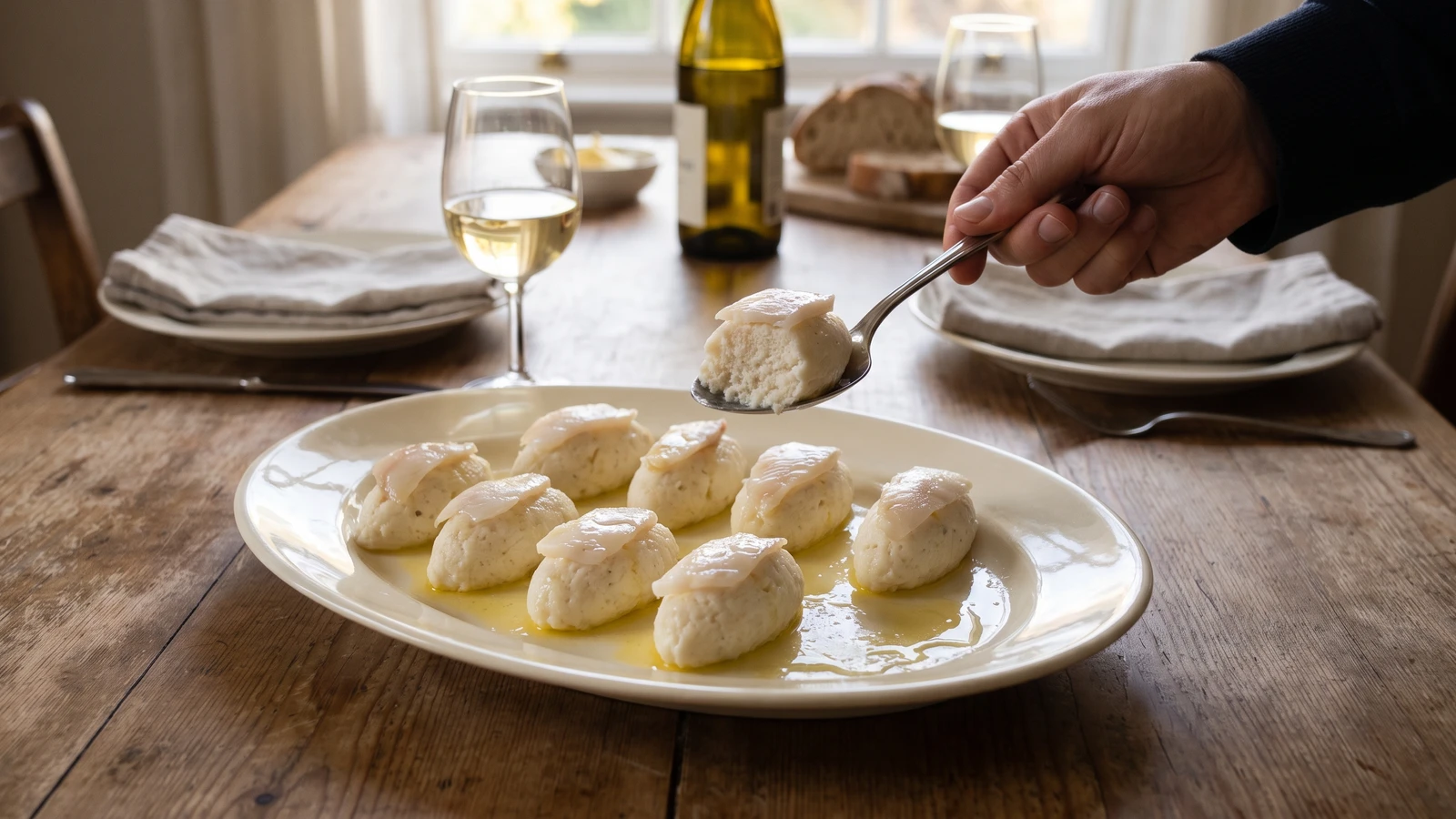
Mousselines de Merlan turn modest whiting into eight ivory spoon quenelles, delicate yet properly set. Keep the forcemeat cold enough to accept its cream, poach at a tremble, and the whole canon makes sense.
Mousselines de Merlan (whiting mousselines) teach the cold emulsion beneath the finest forcemeats in the canon. The one true thing is simple: the whiting paste must stay cold enough to drink its cream without breaking. Lose the cold and the mousselines turn grainy or slack; keep it, and they poach into ivory quenelles so light they yield to the side of a fork.
The source sends the cook to Fine Chicken Forcemeat or “Mousseline” (No. 195), replacing the chicken with fish exactly as that formula permits, then borrows the spoon-moulding and poaching of Mousseline de Saumon (No. 797). Its brigade expected a mortar, a tamis (fine sieve), deep ice, and enough hands to pound while another cook minded the poaching pan. The dressed Tosca service also assumed a saucier, a stock never off the fire, and a salamander ready to glaze. Here a food processor, two nested bowls, a wide sauté pan, one small saucepan, and a home broiler are their honest equivalents. This version makes a half batch, eight generous mousselines for four, while keeping the reference ratio intact. The pounding and brigade quantity are scaffolding; the tamis, the ice, and the gentle poach are the dish.
Before you shape even one, poach a teaspoonful as a test. It tells you whether the emulsion is cold and firm enough, and it gives you the chance to rescue it before dinner depends on your nerve. One cook, one stove, one evening. Keep that bowl on ice.
Mousselines de Merlan belong to the Parisian classical table, where plentiful Channel and Atlantic whiting was transformed by pounding, sieving, and cream into a forcemeat finer than the fish's humble reputation suggested. A mousseline in this register is not a moulded fish mousse, but a large spoon-shaped quenelle named for the lightness of its forcemeat; the method traveled from grand kitchens into bourgeois dining rooms because the mousselines could be poached ahead and sauced at service. The whiting version accepts the same treatments as salmon mousselines and, by the canon's own logic, many garnishes used for sole.
Quantity
½ batch Fine Chicken Forcemeat or “Mousseline” (No. 195), about 2 cups (475 ml / 500 g)
prepared with one 8-ounce (227 g) skinless whiting fillet in place of chicken, as permitted by the formula
Quantity
1 preparation Mousseline de Saumon (No. 797)
Quantity
1 optional preparation Mousseline de Saumon à la Tosca (No. 799)
Quantity
1 small fillet (2 ounces / 57 g)
cut on the bias into 8 very thin raw slices
Quantity
2 tablespoons (30 ml / 28 g)
softened and divided
Quantity
10 cups (2.4 litres / 2.4 kg)
divided between the poaching pan and spoon bowl
Quantity
1 teaspoon (5 ml / 6 g)
Quantity
4 cups (950 ml / 600 g)
| Ingredient | Quantity |
|---|---|
| Fine Chicken Forcemeat or “Mousseline”prepared with one 8-ounce (227 g) skinless whiting fillet in place of chicken, as permitted by the formula | ½ batch Fine Chicken Forcemeat or “Mousseline” (No. 195), about 2 cups (475 ml / 500 g) |
| salmon mousseline shaping and poaching preparation | 1 preparation Mousseline de Saumon (No. 797) |
| Tosca serving preparation (optional) | 1 optional preparation Mousseline de Saumon à la Tosca (No. 799) |
| skinless whiting filletcut on the bias into 8 very thin raw slices | 1 small fillet (2 ounces / 57 g) |
| unsalted buttersoftened and divided | 2 tablespoons (30 ml / 28 g) |
| cold waterdivided between the poaching pan and spoon bowl | 10 cups (2.4 litres / 2.4 kg) |
| fine sea salt | 1 teaspoon (5 ml / 6 g) |
| ice | 4 cups (950 ml / 600 g) |
Chill the food processor cup and blade, tamis, receiving bowl, and two tablespoons for 20 minutes. Nest the receiving bowl over the ice, keeping the ice below the rim so no meltwater can enter the forcemeat. Put 1 cup (240 ml / 240 g) of the cold water in a small bowl for dipping the spoons, then use about 1 teaspoon of the butter to coat a tray. Cold equipment buys you working time; warm metal takes it away.
Prepare the half batch of Fine Chicken Forcemeat or “Mousseline” (No. 195) according to its own linked method, making the permitted substitution of whiting for chicken and leaving every ratio intact. Return the processor cup to the ice between short pulses, pass the paste through the chilled tamis, and keep the receiving bowl nested over ice while the forcemeat takes its cream. It should remain below 45°F (7°C), satin-smooth, and cohesive. If it becomes slick or grainy, stop. Ça se rattrape: chill it for 10 minutes, pulse one quarter of the mixture until tacky again, then add the remainder back a spoonful at a time, returning the cup to the ice whenever it warms.
Pour the remaining 9 cups (2.1 litres / 2.1 kg) water into the sauté pan, add the salt, and heat it to 175 to 180°F (80 to 82°C). The surface should barely quiver. Poach a teaspoonful of forcemeat for 2 to 3 minutes, until opaque and set through, then taste it. It should hold cleanly while yielding under the spoon. If it spreads or feathers into the water, return the bowl to the ice for 15 minutes and test again; if it looks broken as well as loose, use the cold re-emulsifying rescue in the preceding step. Never stiffen it with breadcrumbs or flour. They would save the shape by losing the mousseline.
Following Mousseline de Saumon (No. 797), divide the cold forcemeat visually into 8 equal portions, about ¼ cup (60 ml / 60 g) each. Dip two ordinary tablespoons into the cold water, take a generously heaped spoonful with one, and pass it between the bowls of the spoons until it forms a smooth oval with three clean sides. Set it on the buttered tray and repeat. Lay one thin raw slice of whiting along the top of each mousseline, pressing only enough to make it adhere. Keep the tray cold while the poaching water returns to temperature.
Slide the mousselines carefully into the water, leaving space around each, and cover the surface with a round of buttered parchment. Hold the water between 175 and 180°F (80 and 82°C) for 12 to 15 minutes, until the mousselines feel lightly springy, the top slices are opaque, and the centres reach 145°F (63°C). A boil seizes the fish proteins and pushes cream from the emulsion. If bubbles gather in earnest, pull the pan from the heat and add a little cold water around the edge, never directly over the mousselines. If one cracks, leave it undisturbed until set; the texture inside can still be perfectly tender.
Lift the mousselines with a slotted spoon and let them drain for 30 seconds on a clean towel. Melt the remaining butter and brush it lightly over the surfaces, then arrange two per warmed plate. For the source's full garnished service, apply Mousseline de Saumon à la Tosca (No. 799) to the drained whiting mousselines, keeping its sauce and garnish whole rather than rebuilding them here. For plain service, send them out immediately with the sauce or seasonal vegetable purée chosen for the menu. À table!
1 serving (about 145g)
Culinary guides, cultural storytelling, and the editorial depth that makes cooking meaningful.
Discover Culinary ExplorerChef Juliette
John Dory has the delicacy of sole and the firmness of turbot. A light flouring, a quick butter sauté, and nut-brown beurre noisette show exactly why looks never mattered.

Chef Juliette
Fresh haddock proves its delicacy in the meunière pan: a fine flour crust, moist pearly flakes, and beurre noisette sharpened with lemon and parsley, ready from one skillet in half an hour.

Chef Juliette
Éperlans à l’Anglaise turns small fish into a lesson in disciplined coating: boned smelts under a close, crisp crumb, pan-fried in clarified butter and finished with bright, half-melted maître d’hôtel butter.

Chef Juliette
Tiny smelts, shallot, mushrooms, white wine, gratin sauce, and fine bread raspings meet a fierce oven, where the fish must turn tender in the same breath the buttered crust bronzes.