
Chef Juliette
John Dory (St. Pierre)
John Dory has the delicacy of sole and the firmness of turbot. A light flouring, a quick butter sauté, and nut-brown beurre noisette show exactly why looks never mattered.
A cooking platform built around craft, culture, and the stories behind what we eat.
Created by Chef Juliette
Based on No. 799, Mousseline de Saumon à la Tosca, from Le Guide Culinaire (1907) by Auguste Escoffier
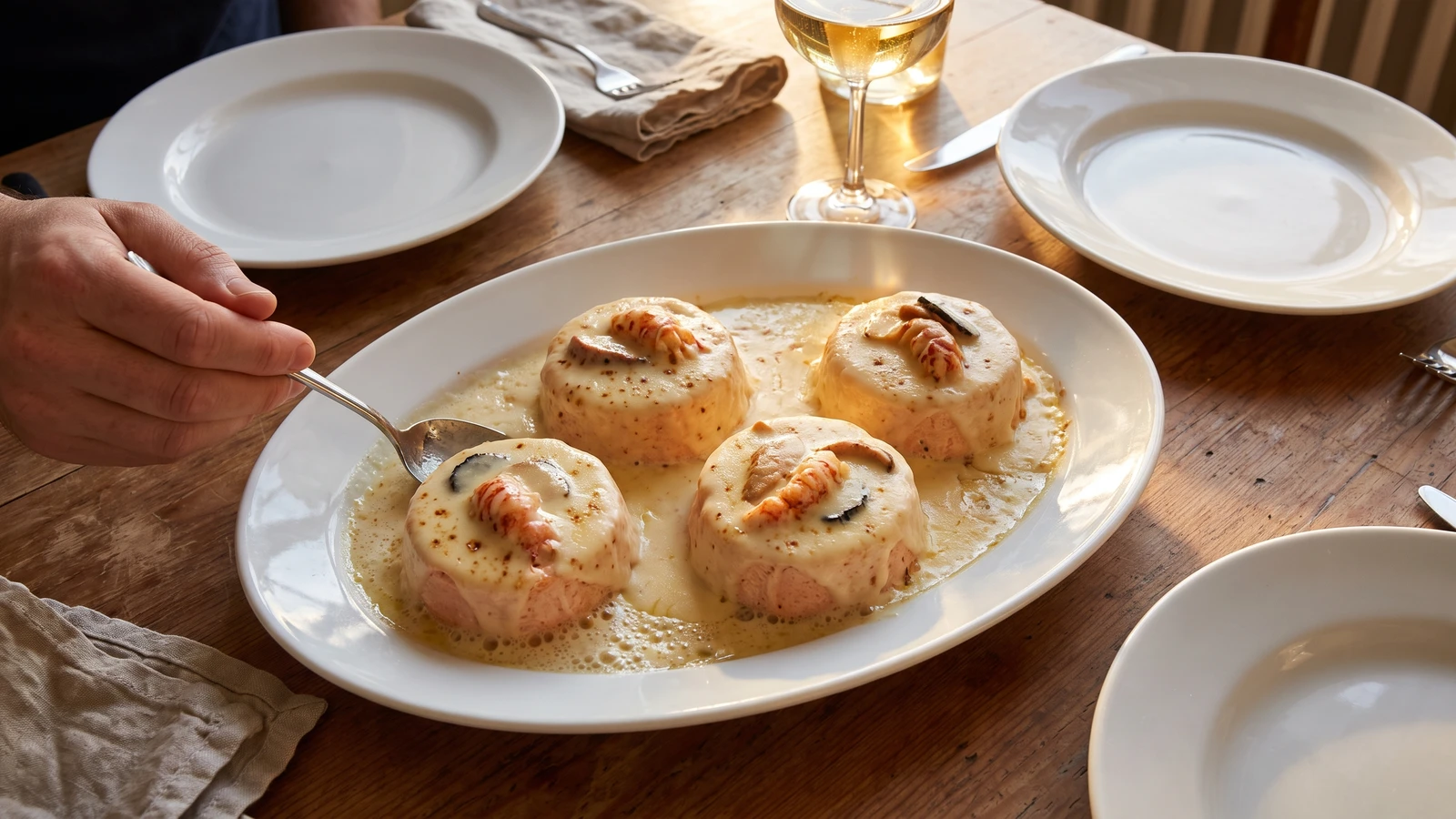
A silken salmon mousseline lifted with crayfish cream, poached gently, dressed with milt, crayfish tails and truffle, then glazed beneath a light glossy crayfish-butter Mornay.
Mousseline de Saumon à la Tosca (moulded salmon mousse with crayfish, milt, truffle, and glazed Mornay) teaches the cold emulsion. The one true thing is simple: cold is structure. If the salmon, cream, and bowl stay cold while the forcemeat comes together, the Mousselines poach into something fine and silken; let them warm and the mixture turns grainy before it ever reaches the water.
The original entry assumed a saucier on staff, a stockpot never off the fire, crayfish cream-cullis and Mornay waiting in separate pans, individual metal moulds, and a salamander ready for the final glaze. At home, the crayfish shells make one concentrated butter, a food processor and fine sieve replace the pounding bench, four ramekins replace brigade moulds, and a fierce broiler replaces the salamander. The holding pans were scaffolding and can go. The cold forcemeat, the exact proportion of one and one-half ounces of crayfish cream-cullis to one pound of salmon forcemeat, the gentle poach, the Tosca garnish, and the quick glaze are the dish, so they stay. One cook, one stove, one evening.
The finished Mousselines should be pale coral and softly resilient beneath an ivory sauce, with crayfish sweetness, the delicate richness of milt, and black truffle appearing in measured flashes. Before touching a pan, clear space in the refrigerator and chill the processor bowl, blade, salmon, cream, and egg white. That preparation decides the dish.
À la Tosca belongs to the codified grand-kitchen repertory of Paris, where operatic names identified elaborate garnitures rather than regional origins; the title does not make this a Tuscan preparation. The composition turns individual Mousselines into a formal seafood course through crayfish, black truffle, Mornay, and la laitance, the soft roe of a male fish, which French cooks valued for its delicate richness. Moulded forcemeats moved readily from brigade service to private dining tables because they portion neatly and wait just long enough for their final sauce and glaze.
Quantity
20 small crayfish (about 25 oz / 700 g)
tails removed; reserve 16 tails for garnish, 4 tails for the cream-cullis, and all shells and bodies
Quantity
8 tablespoons (120 ml / 113 g)
Quantity
¼ cup (60 ml / 60 g)
Quantity
1¾ cups (420 ml / 280 g)
kept very cold, pin bones removed and cut into 1-inch pieces
Quantity
1 large (2 tablespoons / 30 ml / 30 g)
Quantity
½ cup plus 4 teaspoons (140 ml / 140 g)
Quantity
¾ teaspoon (3.75 ml / 4 g)
Quantity
⅛ teaspoon (0.6 ml / 0.3 g)
Quantity
1 large (2 tablespoons / 30 ml / 30 g)
Quantity
1 teaspoon (5 ml / 5 g)
Quantity
2 tablespoons (30 ml / 28 g)
Quantity
3 tablespoons (45 ml / 24 g)
Quantity
1 cup (240 ml / 245 g)
warmed
Quantity
½ cup (120 ml / 120 g)
reserve 1 tablespoon for adjusting the sauce
Quantity
⅓ cup (80 ml / 35 g)
finely grated
Quantity
2 tablespoons (30 ml / 10 g)
finely grated
Quantity
¼ teaspoon (1.25 ml / 1.5 g), plus more as needed
Quantity
1⁄16 teaspoon (0.3 ml / 0.1 g)
Quantity
1 pinch
Quantity
4 thin slices (about 3 oz / 80 g)
Quantity
1 tablespoon (15 ml / 14 g)
Quantity
1 small truffle (about ¾ oz / 20 g)
drained and cut into 8 thin slices
| Ingredient | Quantity |
|---|---|
| whole cooked unseasoned crayfishtails removed; reserve 16 tails for garnish, 4 tails for the cream-cullis, and all shells and bodies | 20 small crayfish (about 25 oz / 700 g) |
| unsalted butter for crayfish butter | 8 tablespoons (120 ml / 113 g) |
| heavy cream for crayfish cream-cullis | ¼ cup (60 ml / 60 g) |
| skinless, boneless salmonkept very cold, pin bones removed and cut into 1-inch pieces | 1¾ cups (420 ml / 280 g) |
| cold egg white | 1 large (2 tablespoons / 30 ml / 30 g) |
| cold heavy cream for salmon forcemeat | ½ cup plus 4 teaspoons (140 ml / 140 g) |
| fine sea salt for salmon forcemeat | ¾ teaspoon (3.75 ml / 4 g) |
| finely ground white pepper for salmon forcemeat | ⅛ teaspoon (0.6 ml / 0.3 g) |
| additional cold egg white for rescuing the forcemeat (optional) | 1 large (2 tablespoons / 30 ml / 30 g) |
| softened unsalted butter for the moulds | 1 teaspoon (5 ml / 5 g) |
| unsalted butter for light Mornay | 2 tablespoons (30 ml / 28 g) |
| all-purpose flour | 3 tablespoons (45 ml / 24 g) |
| whole milkwarmed | 1 cup (240 ml / 245 g) |
| heavy cream for light Mornayreserve 1 tablespoon for adjusting the sauce | ½ cup (120 ml / 120 g) |
| Gruyèrefinely grated | ⅓ cup (80 ml / 35 g) |
| Parmesanfinely grated | 2 tablespoons (30 ml / 10 g) |
| fine sea salt for Mornay and milt | ¼ teaspoon (1.25 ml / 1.5 g), plus more as needed |
| finely ground white pepper for Mornay | 1⁄16 teaspoon (0.3 ml / 0.1 g) |
| freshly grated nutmeg | 1 pinch |
| fresh salmon or cod milt | 4 thin slices (about 3 oz / 80 g) |
| unsalted butter for lightly browning the milt | 1 tablespoon (15 ml / 14 g) |
| preserved whole black truffledrained and cut into 8 thin slices | 1 small truffle (about ¾ oz / 20 g) |
If the crayfish are frozen, thaw them completely in the refrigerator and pat them dry. Twist away all 20 tails and peel them carefully. Choose the 16 finest tails for the garnish and split each lengthwise into two clean halves, giving you eight halves for every Mousseline. Cover and refrigerate them. Roughly chop the remaining 4 tails for the cream-cullis, then crack the reserved shells and bodies with the back of a heavy knife.
Put the cracked crayfish shells and bodies in a small heavy saucepan with the 8 tablespoons of butter. Cook over gentle heat for 10 to 12 minutes, pressing and turning the shells until the butter becomes deeply coral and smells distinctly of crayfish without browning. Strain it through a fine sieve, pressing firmly, and discard the shells. For the crayfish cream-cullis, combine the 4 chopped tails, ¼ cup cream, and 1 tablespoon (15 ml / 14 g) of the crayfish butter in a small pan. Simmer gently for 3 minutes, blend until smooth, pass through the fine sieve, and reduce until exactly 3 tablespoons (45 ml / 42.5 g) remain. If it reduces below that weight, restore it with cold cream a few drops at a time. Chill the cream-cullis completely.
Chill the food-processor bowl and blade for 15 minutes. Process the cold salmon with the measured salt and white pepper in short pulses until finely cut, then add the egg white and pulse just until absorbed. With the machine running briefly, pour in the 140 ml cold cream in a thin stream. Stop as soon as the mixture becomes smooth and glossy; it must remain below 10°C / 50°F. If it loses its gloss or beads liquid, stop immediately and set the bowl over ice for 10 minutes. Pulse again once cold. If it remains split, process the additional cold egg white in a clean chilled bowl, then feed in the broken mixture one spoonful at a time. Ça se rattrape. Press the forcemeat through a fine sieve, weigh out 1 pound (454 g), and fold in the cold 3 tablespoons (45 ml / 42.5 g) crayfish cream-cullis until the colour is even.
Heat the oven to 300°F / 150°C and butter four ⅔-cup (150 ml) ramekins or oval moulds. Divide the forcemeat evenly among them, about 4⅓ ounces (124 g) per mould, smooth the tops, and tap each mould once against a folded towel to release large air pockets. Set them in a roasting pan and add hot water at about 175°F / 80°C to come halfway up their sides. Cover the pan loosely with foil and poach for 18 to 22 minutes, until the centres reach 155°F / 68°C and spring back gently under a fingertip. If the water begins bubbling hard, remove the pan from the oven and replace a cupful with cool water before continuing; boiling toughens the edges while the centre is still setting.
Melt the 2 tablespoons butter in a saucepan, stir in the flour, and cook gently for 2 minutes without colouring. Whisk in the warm milk a little at a time, then add all but 1 tablespoon of the cream. Simmer gently for 5 to 6 minutes, whisking, until the sauce is nappant, thick enough to coat the back of a spoon while remaining light enough to flow. Remove it from the heat and stir in the Gruyère, Parmesan, salt, white pepper, and nutmeg. Whisk in 2 tablespoons (30 ml / 28 g) crayfish butter last. If the sauce looks oily, take it fully off the heat and whisk in the reserved cold cream; once smooth, keep it warm over barely hot water.
Pat the milt slices dry and season them lightly. Melt the tablespoon of butter in a small skillet and let it colour only to pale hazelnut. Add the milt and cook for 60 to 90 seconds per side, until lightly bronzed, opaque throughout, and at least 145°F / 63°C at the thickest point. Lift the slices onto a warm plate. Off the heat, turn the crayfish tail halves through a teaspoon of the remaining crayfish butter for 20 seconds, just long enough to gloss and warm them without making them tough.
Let the poached Mousselines rest in their moulds for 3 minutes, then run a thin knife around each edge and invert them onto a plain ovenproof oval platter. Arrange them in a circle, exactly as the source directs. Set one slice of browned milt on each Mousseline, arrange eight crayfish tail halves over and around it, and place one thin truffle slice at each end.
Heat the broiler fully. Spoon the hot light Mornay over the Mousselines and their garnishes in an even coat, enough to cloak them without flooding the platter. Set the dish 2 to 3 inches below the heat and glaze quickly for 30 to 90 seconds, watching without interruption, until the sauce takes a faint golden blush and tiny bubbles catch around the edges. The broiler is doing the salamander's work, so speed matters. Bring the platter straight to the table. À table!
1 serving (about 300g)
Culinary guides, cultural storytelling, and the editorial depth that makes cooking meaningful.
Discover Culinary ExplorerChef Juliette
John Dory has the delicacy of sole and the firmness of turbot. A light flouring, a quick butter sauté, and nut-brown beurre noisette show exactly why looks never mattered.

Chef Juliette
Fresh haddock proves its delicacy in the meunière pan: a fine flour crust, moist pearly flakes, and beurre noisette sharpened with lemon and parsley, ready from one skillet in half an hour.

Chef Juliette
Éperlans à l’Anglaise turns small fish into a lesson in disciplined coating: boned smelts under a close, crisp crumb, pan-fried in clarified butter and finished with bright, half-melted maître d’hôtel butter.

Chef Juliette
Tiny smelts, shallot, mushrooms, white wine, gratin sauce, and fine bread raspings meet a fierce oven, where the fish must turn tender in the same breath the buttered crust bronzes.