
Chef Juliette
John Dory (St. Pierre)
John Dory has the delicacy of sole and the firmness of turbot. A light flouring, a quick butter sauté, and nut-brown beurre noisette show exactly why looks never mattered.
A cooking platform built around craft, culture, and the stories behind what we eat.
Created by Chef Juliette
Based on No. 1016, Merlan à la Colbert, from Le Guide Culinaire (1907) by Auguste Escoffier
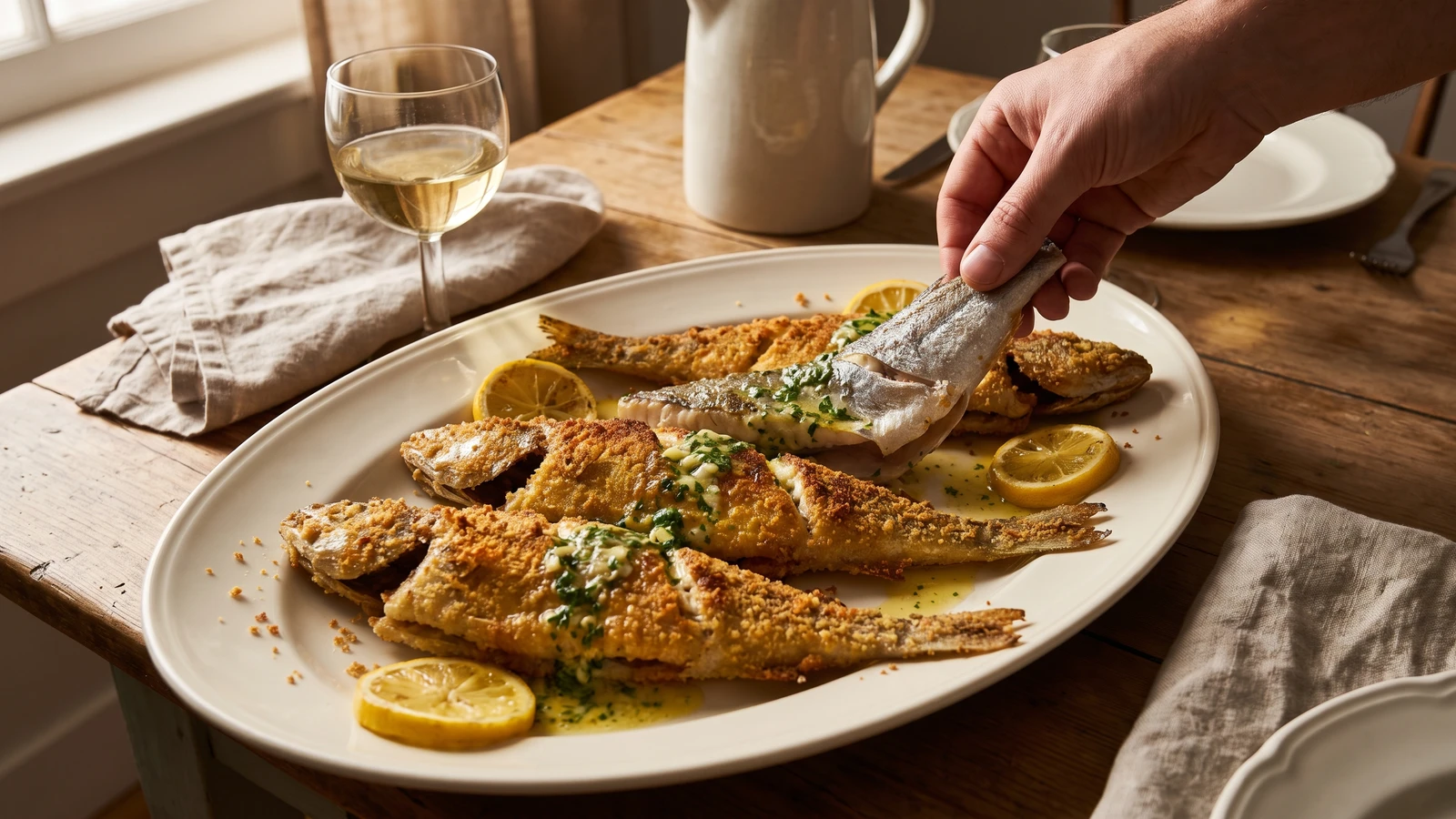
A modest whole whiting becomes a grand supper through exact technique: opened along the back, boned, coated à l'anglaise, fried crisp, and filled with parsley-lemon butter that melts into every flake.
Merlan à la Colbert (back-opened, boned whiting fried in a crumb coat and filled with maître d'hôtel parsley-lemon butter) teaches one clean principle: the crust must seize in hot fat before this delicate fish can surrender its juices. That is what pané à l'anglaise, coated in egg and crumbs, is doing. It is armor, not decoration.
The original entry assumed a fish cook who could open and bone a tray of whitings, an Anglaise (for Egg-and-bread-crumbing) (No. 174) always waiting, and a deep-fat range large enough to send them out together. A saucier, a stock never off the fire, and a salamander were brigade fixtures, but none is needed here. Your honest equivalents are a fishmonger willing to do the dorsal boning, a wide heavy pot, a thermometer, and a low oven that holds each fish while the others fry. The standing breading station and brigade quantity are scaffolding and can go; the dorsal opening, the milk and flour before Anglaise, the very hot fat, and the maître d'hôtel butter are the dish and must stay. One cook, one stove, one evening.
The reward is a whole fish under a deep golden crust, its back opened to receive cold green-flecked butter that immediately slips between the hot flakes. Serve it without delay. Before you touch the pot, remember the step that decides everything: the oil must return to 180°C before each fish goes in.
Merlan à la Colbert belongs to Parisian classical service rather than to a single coastal province: inexpensive whiting from the Channel ports was given formal presence by opening it along the back, removing the skeleton, and frying it in a protective crumb coat. In the classical vocabulary, à la Colbert came to mean precisely this preparation finished with maître d'hôtel butter, so the grand name identifies a method more reliably than it proves an origin story. The dish passed readily onto bourgeois tables because its luxury lies in careful knife work and frying, not costly fish.
Quantity
4 whole fish, 9 to 11 oz (250 to 300 g) each
scaled, gutted through the gills, and opened and boned down the back with heads, tails, and belly skin intact
Quantity
1¼ teaspoons (6 ml / 7.5 g)
divided
Quantity
½ teaspoon (2.5 ml / 1 g)
divided
Quantity
1 cup (240 ml / 245 g)
Quantity
1 cup (240 ml / 125 g)
Quantity
1 home-scale batch Anglaise (for Egg-and-bread-crumbing) (No. 174), enough for 4 fish
prepared and ready to use
Quantity
3 qt (2.8 L / 2.6 kg), or enough for a 1½-inch (4 cm) depth
Quantity
½ cup (120 ml / 113 g)
softened
Quantity
3 tablespoons (45 ml / 12 g)
finely chopped
Quantity
1 tablespoon (15 ml / 15 g)
Quantity
1 large lemon, about 5 oz (140 g)
grooved lengthwise and thinly sliced
| Ingredient | Quantity |
|---|---|
| whole European whitingscaled, gutted through the gills, and opened and boned down the back with heads, tails, and belly skin intact | 4 whole fish, 9 to 11 oz (250 to 300 g) each |
| fine sea saltdivided | 1¼ teaspoons (6 ml / 7.5 g) |
| freshly ground white pepperdivided | ½ teaspoon (2.5 ml / 1 g) |
| whole milk | 1 cup (240 ml / 245 g) |
| plain flour | 1 cup (240 ml / 125 g) |
| Anglaise (for Egg-and-bread-crumbing)prepared and ready to use | 1 home-scale batch Anglaise (for Egg-and-bread-crumbing) (No. 174), enough for 4 fish |
| neutral frying oil | 3 qt (2.8 L / 2.6 kg), or enough for a 1½-inch (4 cm) depth |
| unsalted buttersoftened | ½ cup (120 ml / 113 g) |
| flat-leaf parsleyfinely chopped | 3 tablespoons (45 ml / 12 g) |
| fresh lemon juice | 1 tablespoon (15 ml / 15 g) |
| large lemongrooved lengthwise and thinly sliced | 1 large lemon, about 5 oz (140 g) |
Work the softened butter to pommade, a soft, spreadable texture. Beat in the parsley, lemon juice, ¼ teaspoon of the salt, and ⅛ teaspoon of the white pepper, adding the juice gradually so the butter accepts it. If liquid beads on the surface, the butter is too cold; set the bowl over barely warm water for five seconds, remove it, and beat again without letting the butter melt. Ça se rattrape. Divide the maître d'hôtel butter into four equal portions and keep it cool but pliable.
If the fishmonger has prepared the whiting, feel carefully along each cavity and remove any remaining bones with tweezers. To do the work yourself, lay each fish belly-down and cut through the dorsal skin along both sides of the backbone, working from just behind the head toward the tail. Follow the ribs without piercing the belly skin, snip the backbone behind the head and near the tail, then lift out the backbone and rib cage. The intact belly is the hinge that keeps the fish whole. Open the back gently, pull any pin bones, and pat every surface thoroughly dry. Season inside and out with the remaining salt and white pepper.
Set the milk, flour, and prepared Anglaise (for Egg-and-bread-crumbing) (No. 174) in that order. Dip one whiting in the milk and let the excess drain, roll it thoroughly in flour, and shake away every loose patch. Apply the prepared Anglaise evenly over the fish, pressing its coating into the curves around the dorsal opening. Repeat with the remaining whiting, then rest them on a rack in the cold for 10 minutes. The rest lets the coat grip. If a bare patch appears, touch it with a little more prepared Anglaise and press the coating back into place before the fish reaches the oil.
Heat the oven to 200°F (95°C) and set a wire rack over a sheet pan inside. Pour the oil into a wide, deep pot, keeping the pot no more than half full, and heat it to 355°F (180°C). Lower one whiting away from you and fry for 5 to 6 minutes, turning once if it floats unevenly, until the coat is deep golden and the thickest flesh is opaque and reaches 145°F (63°C). Drain it on the warm rack and let the oil return fully to 355°F (180°C) before adding the next fish. If the temperature falls below 340°F (170°C) and the crust looks pale or greasy, lift the fish out, restore the heat, and return it for 45 to 60 seconds. Ça se rattrape. Never crowd the pot.
Transfer the fried whiting to a warmed long platter with their dorsal openings facing upward. Tuck one portion of maître d'hôtel butter into each opening while the fish is still fiercely hot; the butter should soften at once, slip between the flakes, and pool in a green-flecked ribbon without drowning the crust. Border the platter with the grooved lemon slices. Do not cover the fish and do not make it wait. À table!
1 serving (about 255g)
Culinary guides, cultural storytelling, and the editorial depth that makes cooking meaningful.
Discover Culinary ExplorerChef Juliette
John Dory has the delicacy of sole and the firmness of turbot. A light flouring, a quick butter sauté, and nut-brown beurre noisette show exactly why looks never mattered.

Chef Juliette
Fresh haddock proves its delicacy in the meunière pan: a fine flour crust, moist pearly flakes, and beurre noisette sharpened with lemon and parsley, ready from one skillet in half an hour.

Chef Juliette
Éperlans à l’Anglaise turns small fish into a lesson in disciplined coating: boned smelts under a close, crisp crumb, pan-fried in clarified butter and finished with bright, half-melted maître d’hôtel butter.

Chef Juliette
Tiny smelts, shallot, mushrooms, white wine, gratin sauce, and fine bread raspings meet a fierce oven, where the fish must turn tender in the same breath the buttered crust bronzes.