
Chef Juliette
John Dory (St. Pierre)
John Dory has the delicacy of sole and the firmness of turbot. A light flouring, a quick butter sauté, and nut-brown beurre noisette show exactly why looks never mattered.
A cooking platform built around craft, culture, and the stories behind what we eat.
Created by Chef Juliette
Based on No. 1014, Merlan à l’Anglaise, from Le Guide Culinaire (1907) by Auguste Escoffier
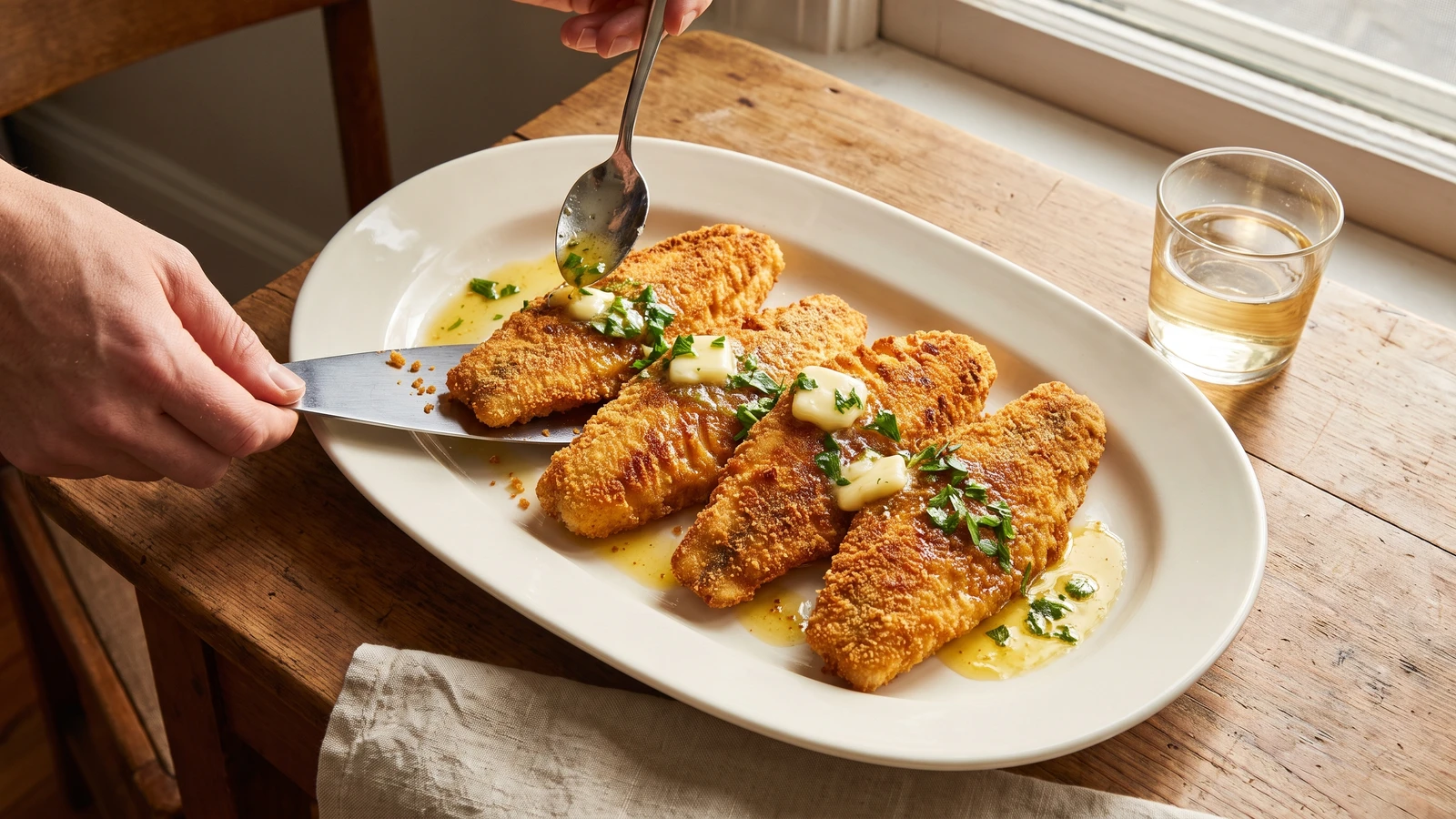
Whiting opened flat, spine drawn, sealed beneath a fine à l’anglaise crust, and cooked fast in clarified butter, with melting parsley and lemon beurre maître d’hôtel spooned generously over the top.
Merlan à l’Anglaise (whiting in a fine egg-and-breadcrumb coat) teaches one severe little truth: the clarified butter must be properly hot before the fish enters. The coat then sets at once, stays crisp, and protects flesh so delicate it can pass from pearly to dry while you are still arranging the platter.
The grand kitchen had a fish cook to draw the spines, trays of very fine crumbs, prepared egg coating, and clarified butter already hot. It did not call on a saucier, the perpetual stockpot, or a salamander, so neither will we. At home, let the fishmonger handle the fiddliest cut, then use a wide skillet and a warm platter. Four small whiting replace the brigade quantity, but the spine drawn cleanly, the à l’anglaise coat, the clarified butter, and the half-melted beurre maître d’hôtel (parsley-lemon butter) all stay. Those are the dish. The rest is scaffolding.
Heat the clarified butter until a test crumb answers with an immediate, lively sizzle. That instant setting of the crust is the step that matters most. One cook, one stove, one evening, and fish brought to the table while the butter still gleams.
Merlan à l’Anglaise belongs to the Parisian classical fish repertoire, built around the small whiting carried inland from Channel and Atlantic ports. In French usage, à l’anglaise names a method rather than a claim of English origin: flour, seasoned egg preparation, and fine crumbs form a coat that sets the instant it meets hot fat. Opening the fish down the back and drawing its spine made a modest catch elegant, and the method passed easily from grand kitchens to bourgeois tables because its real luxuries were speed, discipline, and good butter.
Quantity
4 fish, 7 to 9 ounces (200 to 250 g) each
scaled, gutted, heads removed, opened down the back, and spine completely removed
Quantity
¾ cup (180 ml / 90 g)
Quantity
½ cup (120 ml / 115 g) Anglaise (for Egg-and-bread-crumbing) (No. 174)
Quantity
2 cups (480 ml / 120 g)
Quantity
1 cup (240 ml / 215 g)
Quantity
8 tablespoons (120 ml / 113 g)
softened
Quantity
3 tablespoons (45 ml / 12 g)
very finely chopped
Quantity
1 tablespoon (15 ml / 15 g)
Quantity
1¼ teaspoons (6 ml / 7.5 g)
divided
Quantity
½ teaspoon (2.5 ml / 1 g)
divided
| Ingredient | Quantity |
|---|---|
| small whole whitingscaled, gutted, heads removed, opened down the back, and spine completely removed | 4 fish, 7 to 9 ounces (200 to 250 g) each |
| all-purpose flour | ¾ cup (180 ml / 90 g) |
| Anglaise (for Egg-and-bread-crumbing) | ½ cup (120 ml / 115 g) Anglaise (for Egg-and-bread-crumbing) (No. 174) |
| very fresh fine white breadcrumbs | 2 cups (480 ml / 120 g) |
| clarified butter | 1 cup (240 ml / 215 g) |
| unsalted buttersoftened | 8 tablespoons (120 ml / 113 g) |
| flat-leaf parsleyvery finely chopped | 3 tablespoons (45 ml / 12 g) |
| fresh lemon juice | 1 tablespoon (15 ml / 15 g) |
| fine sea saltdivided | 1¼ teaspoons (6 ml / 7.5 g) |
| ground white pepperdivided | ½ teaspoon (2.5 ml / 1 g) |
Beat the softened butter with the parsley, lemon juice, ¼ teaspoon of the salt, and a pinch of the white pepper. Work only until evenly mixed. Shape it into a short roll, wrap, and chill for 15 minutes so it becomes firm enough to cut. This beurre maître d’hôtel must taste of butter first, with parsley and lemon sharpening the finish rather than taking it over.
Ask the fishmonger to open each whiting down the back, loosen and completely remove the spine, and leave the two fillets joined along the belly so the fish opens flat. Check carefully for stray bones, then blot every surface dry. Season the inside of each fish with the remaining salt and white pepper. Wet fish loosens its coating and cools the butter, so take the drying seriously.
Arrange the flour, the Anglaise (for Egg-and-bread-crumbing) (No. 174), and the fine breadcrumbs in three wide shallow dishes. Dust each whiting lightly with flour, shaking away every loose patch. Coat it thoroughly with the Anglaise, let the excess drain, then lay it in the crumbs and press gently so every surface wears a fine, even coat. Set the coated fish on a rack for 5 minutes while the butter heats. Thick clumps become greasy; fine adhesion is what gives the crust its strength.
Set a platter in a 200°F (95°C) oven. Pour enough clarified butter into a wide heavy skillet to form a generous film and heat it over medium-high heat to about 350°F (175°C). Drop in a pinch of breadcrumbs: they must bubble immediately and rise, taking colour gradually rather than burning. Whole butter cannot do this cleanly because its milk solids scorch before the fish is cooked. Clarified butter is the foundation here.
Lower two whiting into the butter, outer skin side down, without crowding the pan. Cook for 2 to 3 minutes, until the underside is evenly butter-gold, then turn with two broad spatulas and cook for another 1½ to 2 minutes. The flesh should be opaque at its thickest point and reach 145°F (63°C) if checked. Transfer the fish to the warm platter and repeat, skimming out loose crumbs and adding clarified butter as needed. If the coating begins drinking fat without colouring, lift the fish carefully to the rack and bring the butter back to a lively sizzle before returning it. Ça se rattrape.
Cut the chilled beurre maître d’hôtel into pieces. Warm three quarters of it in a small pan over the lowest heat until golden liquid pools around pieces that remain soft but visible, then remove the pan and swirl in the reserved cold pieces. If it liquefies completely, don't pour it out. Ça se rattrape: take it off the heat and beat in the cold reserved butter until the finish becomes creamy and half-melted again. Spoon it generously over the whiting, letting the parsley-speckled butter collect around the crisp edges, and serve immediately. À table!
1 serving (about 230g)
Culinary guides, cultural storytelling, and the editorial depth that makes cooking meaningful.
Discover Culinary ExplorerChef Juliette
John Dory has the delicacy of sole and the firmness of turbot. A light flouring, a quick butter sauté, and nut-brown beurre noisette show exactly why looks never mattered.

Chef Juliette
Fresh haddock proves its delicacy in the meunière pan: a fine flour crust, moist pearly flakes, and beurre noisette sharpened with lemon and parsley, ready from one skillet in half an hour.

Chef Juliette
Éperlans à l’Anglaise turns small fish into a lesson in disciplined coating: boned smelts under a close, crisp crumb, pan-fried in clarified butter and finished with bright, half-melted maître d’hôtel butter.

Chef Juliette
Tiny smelts, shallot, mushrooms, white wine, gratin sauce, and fine bread raspings meet a fierce oven, where the fish must turn tender in the same breath the buttered crust bronzes.