
Chef Juliette
John Dory (St. Pierre)
John Dory has the delicacy of sole and the firmness of turbot. A light flouring, a quick butter sauté, and nut-brown beurre noisette show exactly why looks never mattered.
A cooking platform built around craft, culture, and the stories behind what we eat.
Created by Chef Juliette
Based on No. 1011, Filets de Maquereau aux Fines Herbes, from Le Guide Culinaire (1907) by Auguste Escoffier
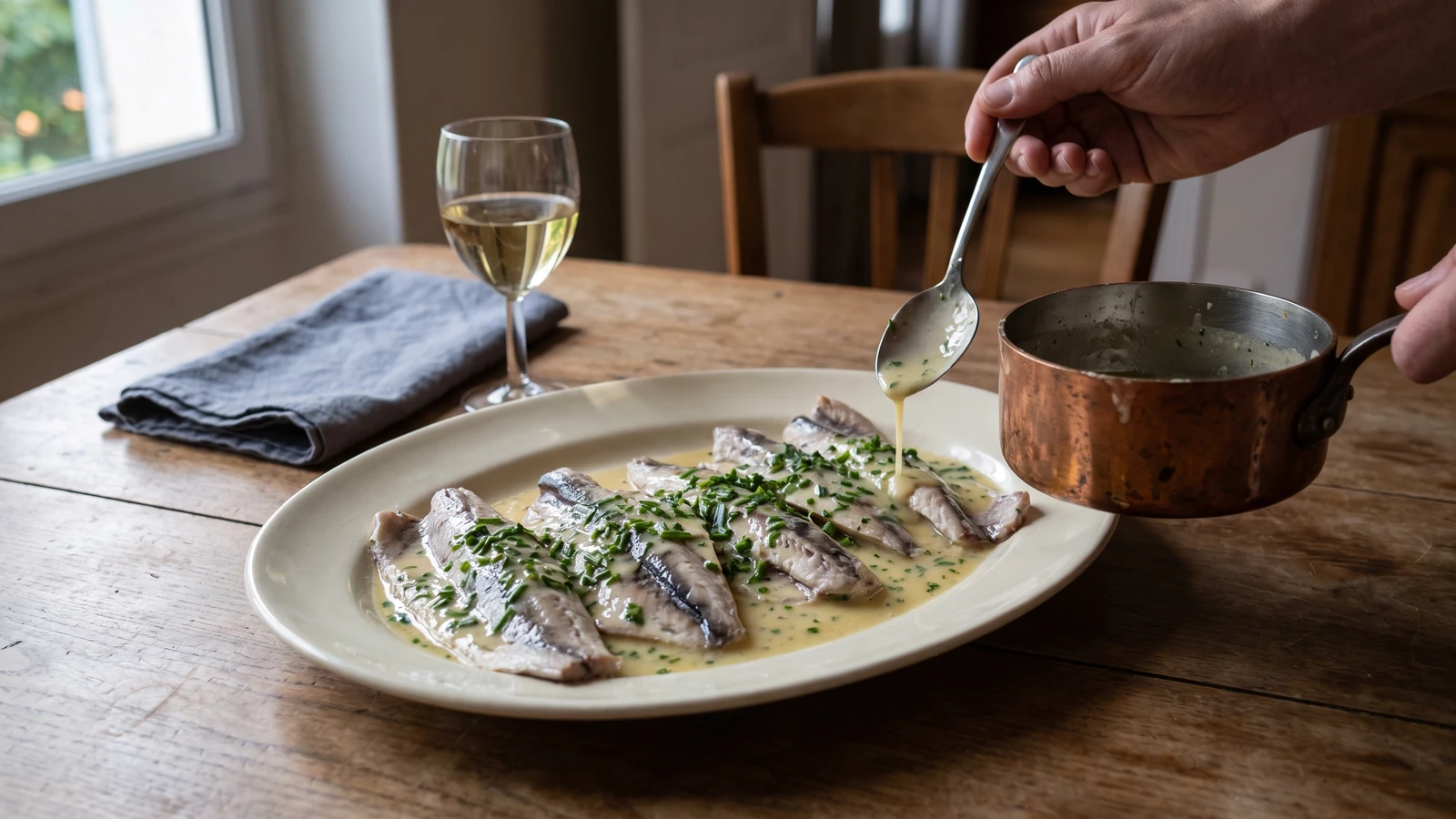
Silvery mackerel fillets poached under a close cover, skinned warm, and laid beneath glossy Herb Sauce (No. 83), deepened with white wine, mushroom liquor, and the fish's own reduced juices.
Filets de Maquereau aux Fines Herbes (mackerel fillets with fine-herb sauce) teaches the discipline of the covered poach. Mackerel stays succulent when the liquid barely trembles and the cover never wanders; let it boil uncovered and its generous flesh turns coarse before the sauce can save it.
The grand kitchen expected a fish station to raise neat fillets and a saucier to have Herb Sauce (No. 83) waiting beside strained mushroom liquor. For four servings, buy eight pin-boned fillets, keep the finished sauce whole, trade linen straining for a fine-mesh sieve, and use buttered parchment beneath a tight lid. The separate sauce station and procession of service pans were brigade scaffolding. The equal measures of wine and mushroom liquor, the covered poach, warm skinning, and reduction are the dish itself, so those stay. One cook, one stove, one evening.
Done properly, the fillets remain pearly and moist beneath an ivory sauce flecked green with fines herbes, while the reduced cooking liquor gives the richness enough maritime backbone to suit oily fish. Keep the fillets covered from the moment the liquid warms until they leave it; that quiet, protected poach is the step that decides the dish.
Filets de Maquereau aux Fines Herbes belongs to the codified Parisian grand-kitchen repertoire, where abundant coastal mackerel received the same precise filleting and sauce work as more costly fish. Mushroom liquor was not meant to make the dish taste of mushrooms; within the Parisian sauce system it quietly deepened the white-wine cooking liquor, while parsley, chervil, tarragon, and chives supplied the fines herbes. The preparation passed naturally to bourgeois home tables because its distinction lies in reduction and timing, not an expensive catch.
Quantity
8 (about 1¾ lb / 800 g total)
pin bones removed
Quantity
1 tablespoon (15 ml / 14 g)
softened
Quantity
⅔ cup (160 ml / 160 g)
Quantity
⅔ cup (160 ml / 160 g)
Quantity
¾ teaspoon (3.75 ml / 4 g)
Quantity
1 cup (240 ml / 245 g) Herb Sauce (No. 83)
| Ingredient | Quantity |
|---|---|
| small skin-on mackerel filletspin bones removed | 8 (about 1¾ lb / 800 g total) |
| unsalted buttersoftened | 1 tablespoon (15 ml / 14 g) |
| dry white wine | ⅔ cup (160 ml / 160 g) |
| strained mushroom cooking liquor | ⅔ cup (160 ml / 160 g) |
| fine sea salt | ¾ teaspoon (3.75 ml / 4 g) |
| Herb Sauce | 1 cup (240 ml / 245 g) Herb Sauce (No. 83) |
Heat the oven to 325°F (165°C). Run a fingertip down each fillet and pull any remaining pin bones with clean tweezers, then blot the fish dry and season the flesh evenly with the salt. Use half the softened butter to coat a 13 by 9 inch (33 by 23 cm) shallow baking dish, and butter one side of a sheet of parchment with the remainder.
Arrange the fillets in one snug layer, skin side up. Warm the white wine and mushroom cooking liquor together until the edges just begin to tremble, then pour the equal measures around the fish; the liquid should rise roughly halfway up the fillets rather than drown them. Press the buttered side of the parchment directly over the fish and seal the dish tightly with its lid or foil. The parchment and close cover are the home equivalent of the classical covered poaching dish, and they keep the exposed flesh moist.
Slide the covered dish into the oven and poach for 8 to 12 minutes, depending on thickness. Check through a lifted corner only near the end: the liquid should quiver gently, the flesh should be opaque at its thickest point, and an instant-read thermometer should register 145°F (63°C). If the liquid has broken into a boil, pull the dish out immediately and lower the oven. Ça se rattrape: test the fish early and remove each fillet as soon as it flakes under light pressure, because continued boiling is what toughens it.
Lift the fillets carefully with a flexible fish spatula and reserve every drop of cooking liquor. While the fish is still warm, catch the skin at the tail end with a small knife and peel it gently toward the wider end, supporting the flesh with your free hand. If the skin tears, remove it in strips and stop digging as soon as clean flesh appears; the sauce will cover an untidy surface, while a gouged fillet cannot be put back together. Arrange the skinned fillets on a warmed long platter and cover them loosely.
Pass the reserved cooking liquor through a fine-mesh sieve into a wide saucepan. The original called for linen, but the sieve gives the home cook the clear liquor that matters without a second straining station. Boil it briskly for 7 to 10 minutes, until reduced to ⅓ cup (80 ml) and concentrated without tasting harsh. Measure it if your eye is uncertain. If it has gone syrupy, loosen it with a spoonful of water; do this now, before the finished sauce enters the pan.
Lower the heat completely and whisk the warm reduction into the Herb Sauce (No. 83), a spoonful at a time, until the sauce is glossy and coats the back of a spoon. Warm it gently, but never let it boil; hard heat can separate the sauce's butter finish. If an oily rim appears, take the pan off the heat and whisk in 1 tablespoon (15 ml) of cold water until it comes together again. Taste before adding any further salt, since both the sauce and the reduced fish liquor carry seasoning.
Spoon the sauce generously over the fillets, covering each one and letting a proper pool gather around them on the long platter, exactly as the source intends. Serve at once, while the mackerel is moist and the sauce still holds its gloss. Plain boiled potatoes are enough beside it; they understand what sauce is for. À table!
1 serving (about 245g)
Culinary guides, cultural storytelling, and the editorial depth that makes cooking meaningful.
Discover Culinary ExplorerChef Juliette
John Dory has the delicacy of sole and the firmness of turbot. A light flouring, a quick butter sauté, and nut-brown beurre noisette show exactly why looks never mattered.

Chef Juliette
Fresh haddock proves its delicacy in the meunière pan: a fine flour crust, moist pearly flakes, and beurre noisette sharpened with lemon and parsley, ready from one skillet in half an hour.

Chef Juliette
Éperlans à l’Anglaise turns small fish into a lesson in disciplined coating: boned smelts under a close, crisp crumb, pan-fried in clarified butter and finished with bright, half-melted maître d’hôtel butter.

Chef Juliette
Tiny smelts, shallot, mushrooms, white wine, gratin sauce, and fine bread raspings meet a fierce oven, where the fish must turn tender in the same breath the buttered crust bronzes.