
Chef Juliette
John Dory (St. Pierre)
John Dory has the delicacy of sole and the firmness of turbot. A light flouring, a quick butter sauté, and nut-brown beurre noisette show exactly why looks never mattered.
A cooking platform built around craft, culture, and the stories behind what we eat.
Created by Chef Juliette
Based on No. 1007, Mousse Chaude d’Éperlans à la Royale, from Le Guide Culinaire (1907) by Auguste Escoffier
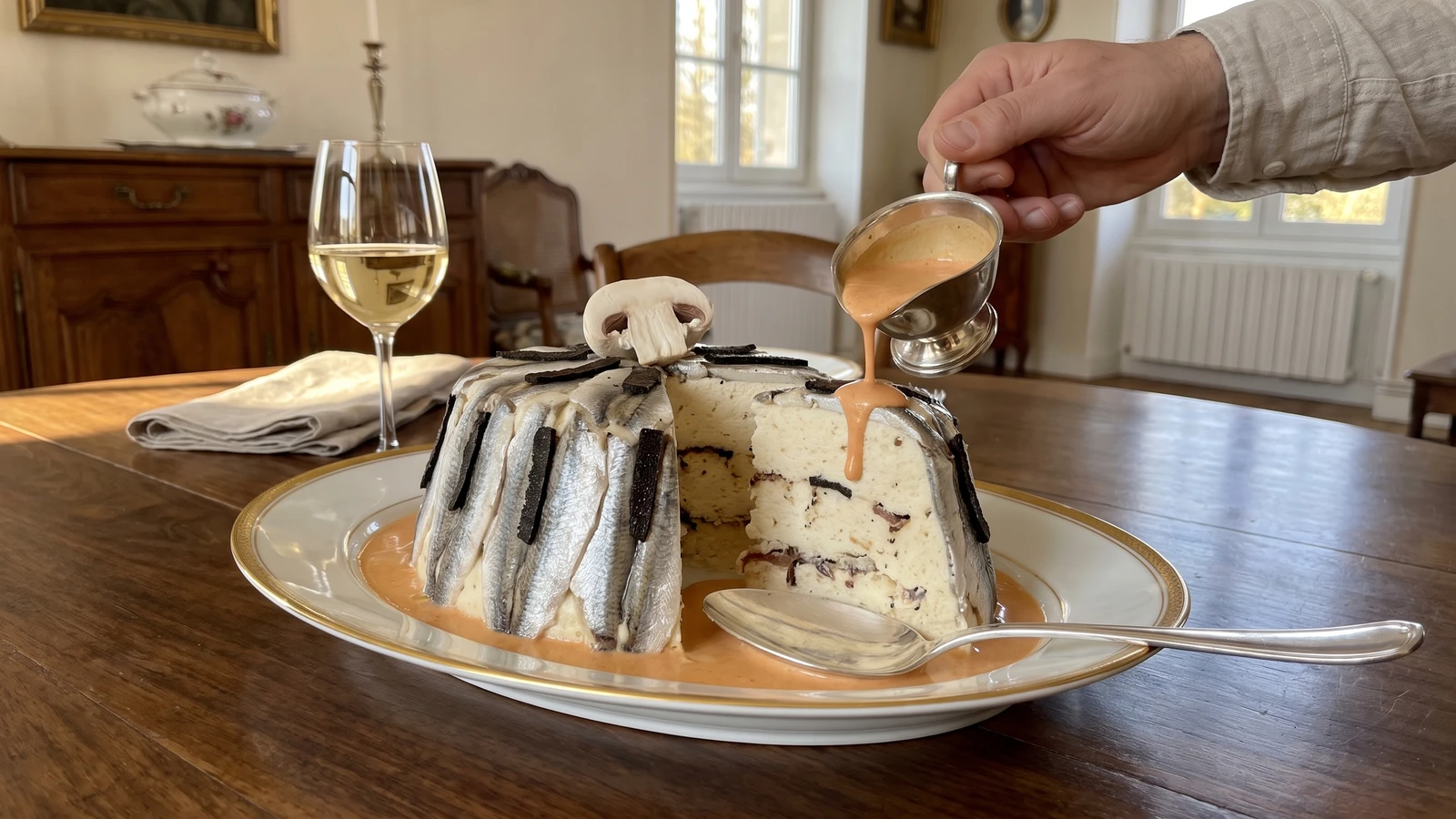
Silvery smelt and black truffle wrap a tender hot mousseline, gently poached in its mould and turned out beneath coral-ivory sauce, a grand dish made workable for one careful cook at home.
Mousse Chaude d’Éperlans à la Royale (hot moulded smelt mousse with truffle) teaches the discipline behind every fish mousseline, a cold fish-and-cream emulsion: the fish, bowl, blade, egg white, and cream must remain cold until the mould enters the oven. Get that one truth right and the mousse cuts tender and close, not rubbery, while silver skins and black truffle make their own pattern beneath glossy coral-ivory sauce.
The source formula assumed a brigade, one cook flattening and trimming every fillet, another making the forcemeat, and a saucier on staff holding Mousseline Sauce (No. 92), with a stockpot never off the fire and a salamander standing ready elsewhere on the service. This mousse needs neither stock nor salamander. At home, a chilled food processor replaces pounding and repeated sieving, a roasting tin becomes the bain-marie (water bath), and a one-quart charlotte mould produces four generous portions. These are scaffolding changes. The patterned lining, half-inch mousseline shell, layers of smelt, anchovy, and truffle, and the covered gentle poach are the dish. They stay.
Your only nervous moment is the emulsion. Add the cream gradually and stop if the mixture loses its chill or turns oily; chill it over ice, then continue with the remaining cream. Ça se rattrape. Before you touch a pan, clear refrigerator space and chill the processor bowl. The cold emulsion decides this dish.
Mousse Chaude d’Éperlans à la Royale belongs to Parisian grand-kitchen service, where modest smelt arriving through the capital’s fish markets was transformed by filleting, moulding, and a truffled lining into a formal shared dish. In classical kitchen vocabulary, a mousse fills one large mould for several diners, while mousselines are made as individual portions; à la Royale describes the rich truffle treatment rather than proving an origin at a royal table. The source also permits sole, salmon, or trout, but the cold forcemeat, patterned lining, and gentle poach remain the grammar of the preparation.
Quantity
1 lb 5 oz (600 g)
From about 20 to 24 medium smelts, pin bones removed and fish kept very cold
Quantity
2 tablespoons (30 ml / 28 g)
Very soft and divided
Quantity
2 small truffles (about 1½ oz / 40 g)
Drained if preserved, one cut into narrow strips and one thinly sliced
Quantity
1 egg white (2 tablespoons / 30 ml / 30 g)
Very cold
Quantity
Scant 1 cup (225 ml / 225 g)
Ice-cold
Quantity
¾ teaspoon (3.75 ml / 5 g)
Quantity
⅛ teaspoon (0.6 ml / 0.3 g)
Quantity
8 fillets (about 1 oz / 30 g)
Rinsed and patted dry
Quantity
1 mushroom (about 1 oz / 30 g)
Stem removed
Quantity
1½ cups (360 ml / 350 g) Mousseline Sauce (No. 92)
Just prepared and warm
Quantity
1½ tablespoons (22 ml / 21 g)
Softened
| Ingredient | Quantity |
|---|---|
| skin-on smelt filletsFrom about 20 to 24 medium smelts, pin bones removed and fish kept very cold | 1 lb 5 oz (600 g) |
| unsalted butterVery soft and divided | 2 tablespoons (30 ml / 28 g) |
| whole black trufflesDrained if preserved, one cut into narrow strips and one thinly sliced | 2 small truffles (about 1½ oz / 40 g) |
| large egg whiteVery cold | 1 egg white (2 tablespoons / 30 ml / 30 g) |
| heavy cream, at least 35% fatIce-cold | Scant 1 cup (225 ml / 225 g) |
| fine sea salt | ¾ teaspoon (3.75 ml / 5 g) |
| finely ground white pepper | ⅛ teaspoon (0.6 ml / 0.3 g) |
| salt-cured anchovy filletsRinsed and patted dry | 8 fillets (about 1 oz / 30 g) |
| large white button mushroomStem removed | 1 mushroom (about 1 oz / 30 g) |
| Mousseline Sauce (No. 92)Just prepared and warm | 1½ cups (360 ml / 350 g) Mousseline Sauce (No. 92) |
| prepared crayfish butterSoftened | 1½ tablespoons (22 ml / 21 g) |
Put the food-processor bowl and blade, a metal mixing bowl, and the cream in the cold for at least 15 minutes. Pat the smelt fillets dry and keep them over a bowl of ice. Weigh 8 oz (225 g) for the forcemeat, remove its skin, and cut it into 1-inch pieces. Reserve about 2½ oz (75 g) for the inner layers and the remaining 10½ oz (300 g) of the broadest, most even fillets for lining the mould.
Reserve 1 teaspoon of the butter for the mushroom. Butter the bottom and sides of a 1-quart mould. Cut a parchment circle for the bottom and a collar for the sides, press them into place, then butter their exposed surfaces. Lay the lining fillets between two sheets of parchment and flatten them very lightly with a rolling pin, just enough to break their fibres without crushing the flesh. Trim them to even widths and lengths, saving the trimmings for the inner layers. Cut the truffle strips about one-quarter as wide as the fillets.
Process the skinned smelt with the salt until it becomes smooth and tacky, about 30 seconds, then add the egg white and white pepper. Process briefly until absorbed. Add all but 1 tablespoon of the ice-cold cream in four additions, pulsing only until each disappears and scraping the bowl between additions. Poach a teaspoon of forcemeat in barely trembling water for 2 minutes; it should be tender, cohesive, and delicately seasoned. Pulse in the final tablespoon of cream. If the mixture becomes warm, shiny, or oily, stop immediately, spread it in the chilled metal bowl, and set the bowl over ice for 10 minutes before adding the remaining cream. Ça se rattrape. Do not add crumbs or flour, which would save the shape by sacrificing the dish.
Arrange smelt fillets across the bottom of the mould with their skin sides against the buttered paper, fitting a narrow truffle strip between each one. Line the sides in the same fashion, placing the fillets on a diagonal rather than upright and keeping every skin side against the mould. Patch any small gaps with trimming pieces. The pattern need not look perfect from inside; unmoulding reverses it, and the silver skin and black truffle will read clearly on the plate.
Spread mousseline forcemeat ½ inch (1.25 cm) thick over the lined bottom and sides, using a small wet spatula and taking care not to disturb the pattern. Cover the bottom with a close layer of truffle slices, then spread over a thin layer of forcemeat. Lay reserved smelt fillets and anchovy fillets alternately across it. Cover with more forcemeat, add another layer of truffle slices, and continue until the mould is filled to within ½ inch (1.25 cm) of the rim. Finish with an even layer of forcemeat. Tap the mould once against a folded towel to settle hidden air pockets, then cover it with buttered parchment and foil.
Heat the oven to 325°F (165°C). Set the covered mould in a deep roasting tin and pour hot water around it to come halfway up the sides. Poach for 45 to 50 minutes. The water should quiver but never boil; if bubbles gather around the mould, lower the oven and add a little cool water to the bath, because hard heat makes the mousseline grainy and forces out its moisture. Insert a thin knife into the centre at 45 minutes. The mousse is set when the blade comes out clean and hot, or the centre registers at least 145°F (63°C). If the blade carries raw paste, continue in 5-minute intervals.
While the mousse finishes, make the champignon cannelé (fluted mushroom). With a small sharp knife, cut eight shallow curved channels from the centre of the mushroom cap toward its rim. Put the cap in a small pan with the reserved teaspoon of butter, cover, and cook over low heat for 3 to 4 minutes, until tender but still pale. Keep it warm.
Warm the serving platter. Remove the mould from its bath, discard the covers, place the platter over it, and invert at once. Raise one edge of the mould about ⅛ inch (3 mm) with the tip of a palette knife and leave it for 2 minutes so the liquid collected inside can drain. Blot that liquid from the platter, lift off the mould, and peel away the paper. If white froth clings to the smelt fillets, remove it with a clean pastry brush dipped in warm water. Brush, never wipe, or the patterned fillets may tear.
Reserve 2 tablespoons of Mousseline Sauce (No. 92). Off the heat, fold the softened crayfish butter into the remaining warm sauce in small pieces until its colour is evenly coral-ivory. If butter sits in beads, set the bowl over barely warm water for 5 seconds and continue folding. If the sauce thins or looks greasy, move the bowl over cool water and fold in the reserved sauce one spoonful at a time. Ça se rattrape. Spoon enough sauce around the mousse to form a generous pool, set the fluted mushroom on top, and send the remainder in a warm sauceboat. Cut with a thin knife dipped in hot water between slices. À table!
1 serving (about 325g)
Culinary guides, cultural storytelling, and the editorial depth that makes cooking meaningful.
Discover Culinary ExplorerChef Juliette
John Dory has the delicacy of sole and the firmness of turbot. A light flouring, a quick butter sauté, and nut-brown beurre noisette show exactly why looks never mattered.

Chef Juliette
Fresh haddock proves its delicacy in the meunière pan: a fine flour crust, moist pearly flakes, and beurre noisette sharpened with lemon and parsley, ready from one skillet in half an hour.

Chef Juliette
Éperlans à l’Anglaise turns small fish into a lesson in disciplined coating: boned smelts under a close, crisp crumb, pan-fried in clarified butter and finished with bright, half-melted maître d’hôtel butter.

Chef Juliette
Tiny smelts, shallot, mushrooms, white wine, gratin sauce, and fine bread raspings meet a fierce oven, where the fish must turn tender in the same breath the buttered crust bronzes.