
Chef Juliette
John Dory (St. Pierre)
John Dory has the delicacy of sole and the firmness of turbot. A light flouring, a quick butter sauté, and nut-brown beurre noisette show exactly why looks never mattered.
A cooking platform built around craft, culture, and the stories behind what we eat.
Created by Chef Juliette
Based on No. 1006, Mousselines d’Éperlans, from Le Guide Culinaire (1907) by Auguste Escoffier
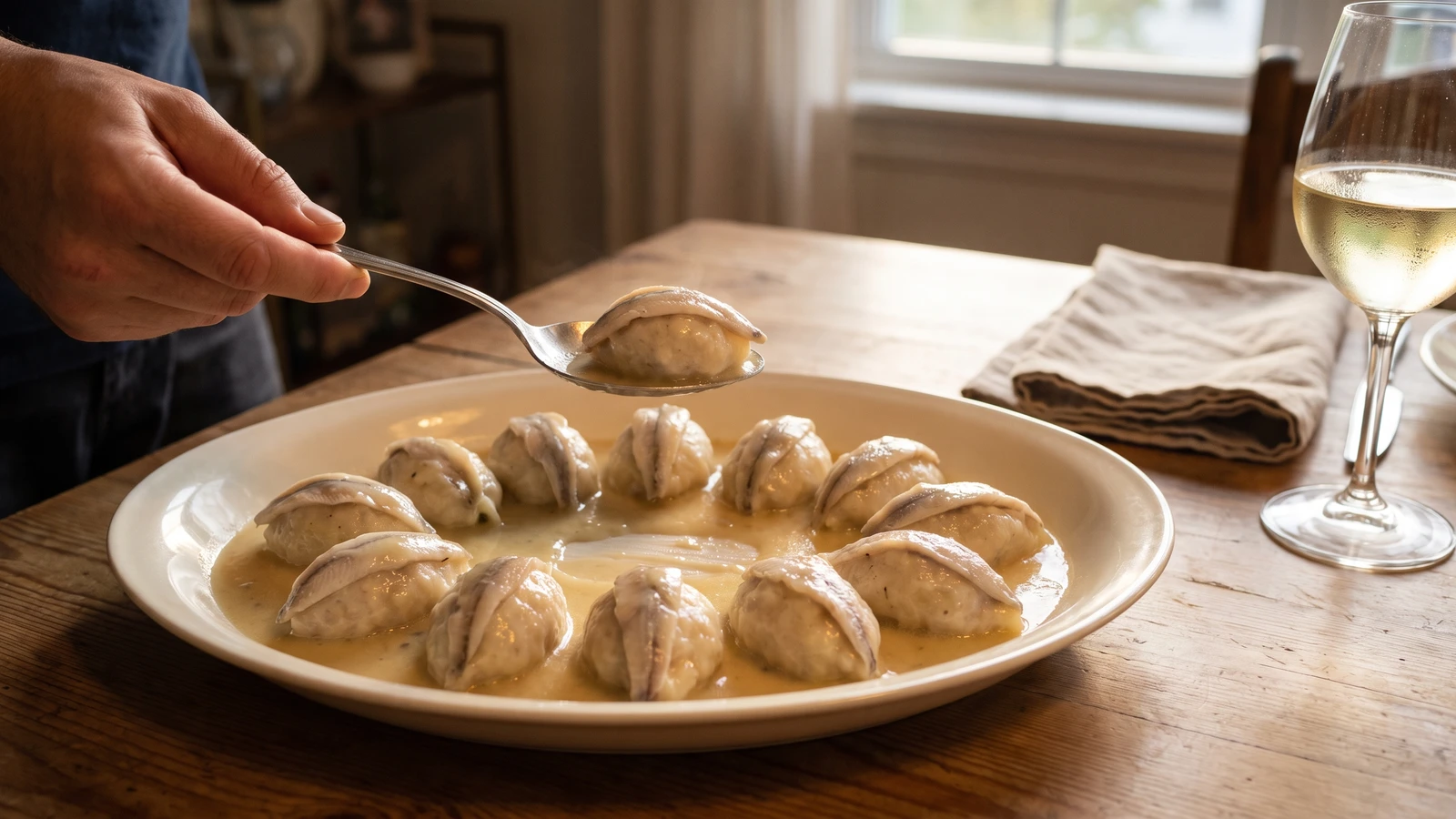
Mousselines d’Éperlans teach the discipline of a cold forcemeat: one-third assertive smelt, two-thirds mild white fish, enough cream for tenderness, and a quiet poach that keeps each quenelle feather-light.
Mousselines d’Éperlans (light smelt quenelles) teach restraint. Smelt must perfume the forcemeat, never command it, so the book insists on one part smelt to two parts sole or whiting. The milder fish softens that pungency and accepts more cream, giving the mousselines their mellow flavour and extraordinary lightness.
The brigade entry assumed a mortar, a tamis (fine sieve), a basin held on ice, a saucier with stock never off the fire, and spare hands to shape while the sauce waited. At home, a food processor replaces the mortar, a sturdy fine sieve replaces the tamis, and Velouté d’Éperlans (No. 680) is prepared first and rewarmed gently. There is nothing to brown, so the salamander stays out of it. Those are scaffolding changes. The fish ratio, the cold emulsion, the tablespoon moulding, the raw smelt slice, and the quiet poach are the dish and must stay. One cook, one stove, one evening.
Properly made, the mousselines swell into pearly ovals that yield under the spoon, with the clean flavour of smelt carried by cream rather than buried beneath it. Keep the forcemeat cold before and during the cream addition. That is the step that decides everything.
Mousselines d’Éperlans belong to the Parisian grand-kitchen repertoire, where smelt arriving from Channel and Atlantic estuaries was refined into spoon-moulded quenelles for formal fish service. The technique passed naturally to the bourgeois dinner table because the forcemeat could be prepared ahead, then shaped and poached shortly before the meal. Despite the dish’s name, smelt alone was never considered superior: the canon limits it to one-third because neutral white fish tempers its force and lets the mixture absorb enough cream to become light.
Quantity
1 home-scale application
canonical shaping, garnishing, and poaching method
Quantity
1 home-scale application
made with the fish, egg white, seasoning, and cream listed below
Quantity
¾ cup, loosely packed (100 g / 3½ oz)
skin and pin bones removed, thoroughly chilled
Quantity
1½ cups, loosely packed (200 g / 7 oz)
skin and pin bones removed, thoroughly chilled
Quantity
2 tablespoons plus 2 teaspoons (40 ml / 40 g), about 1⅓ large egg whites
Quantity
1 tablespoon (15 ml / 18 g)
Quantity
¼ teaspoon (1.25 ml / 0.6 g)
Quantity
1 small pinch
Quantity
1½ cups (375 ml / 370 g)
Quantity
2 fillets (about ¼ cup / 30 g)
reserved for the fine raw slices
Quantity
1 tablespoon (15 ml / 14 g)
softened, for the poaching pan and parchment
Quantity
1½ quarts (1.4 L / 1.4 kg)
for poaching
Quantity
2 tablespoons (30 ml / 30 g)
only for rescuing the velouté
Quantity
4 cups (950 ml / 900 g)
for the ice bath
| Ingredient | Quantity |
|---|---|
| Mousseline de Saumon (No. 797)canonical shaping, garnishing, and poaching method | 1 home-scale application |
| Fine Chicken Forcemeat or “Mousseline” (No. 195)made with the fish, egg white, seasoning, and cream listed below | 1 home-scale application |
| cleaned smelt filletsskin and pin bones removed, thoroughly chilled | ¾ cup, loosely packed (100 g / 3½ oz) |
| sole or whiting filletsskin and pin bones removed, thoroughly chilled | 1½ cups, loosely packed (200 g / 7 oz) |
| cold egg white | 2 tablespoons plus 2 teaspoons (40 ml / 40 g), about 1⅓ large egg whites |
| fine sea salt | 1 tablespoon (15 ml / 18 g) |
| ground white pepper | ¼ teaspoon (1.25 ml / 0.6 g) |
| freshly grated nutmeg | 1 small pinch |
| cold heavy cream, at least 35 percent fat | 1½ cups (375 ml / 370 g) |
| small smelt filletsreserved for the fine raw slices | 2 fillets (about ¼ cup / 30 g) |
| unsalted buttersoftened, for the poaching pan and parchment | 1 tablespoon (15 ml / 14 g) |
| waterfor poaching | 1½ quarts (1.4 L / 1.4 kg) |
| Velouté d’Éperlans (No. 680)freshly prepared | 2 cups (480 ml / 480 g) |
| cold heavy cream (optional)only for rescuing the velouté | 2 tablespoons (30 ml / 30 g) |
| ice cubesfor the ice bath | 4 cups (950 ml / 900 g) |
Put the processor bowl, blade, mixing bowl, sieve, fish, egg white, and cream in the cold for at least 20 minutes. Fill a larger bowl with the ice and nest the mixing bowl inside it. The food processor is the home equivalent of the mortar assumed by Fine Chicken Forcemeat or “Mousseline” (No. 195), but the tamis work still matters: the fine sieve removes fibres and any overlooked bones while giving the forcemeat its satin texture.
Cut the 100 g smelt and 200 g sole or whiting into small cubes, keeping the exact one-to-two ratio. Process them in short pulses with the salt, white pepper, and nutmeg until the fish forms a smooth, tacky paste. Add the egg white in three additions, pulsing only until each disappears. This applies Fine Chicken Forcemeat or “Mousseline” (No. 195) to fish exactly as its formula permits. Push the paste through the chilled fine sieve into the bowl over ice, scraping the underside clean. If the paste begins to feel warmer than the chilled bowl, stop and return everything to the cold for 10 minutes.
Work the 375 ml cream into the fish paste with a wooden spoon, adding it in six or seven small portions and incorporating each completely before the next. Keep the bowl buried in ice. The mild sole or whiting is what allows the full measure of cream to enter without smelt becoming harsh. The finished forcemeat should be glossy, soft, and able to hold a rounded spoon mark. Poach a teaspoonful in water held at 80 to 85°C (175 to 185°F); it should set tenderly without releasing fat or spreading. If it spreads, chill the bowl for 15 minutes and test again. If the mixture looks oily, set it deeper in the ice and fold slowly until smooth. Ça se rattrape. If it still refuses to bind, spoon it into four buttered ramekins and poach them in a bain-marie; the shape changes, but the light mousseline survives.
Butter a wide, shallow 30 cm pan and one side of a parchment round. Cut the two reserved smelt fillets across the grain into 12 very thin raw slices. Following Mousseline de Saumon (No. 797), dip two ordinary tablespoons in cold water, gather a generous spoonful of forcemeat with one, and pass it between the spoons until it forms a smooth oval. Arrange 12 mousselines in the pan without letting them touch, then lay one fine smelt slice neatly along the top of each. Do not fuss over absolute symmetry. A clean oval poaches evenly; geometry beyond that is kitchen theater.
Heat the poaching water to 80 to 85°C (175 to 185°F), then pour it carefully down the side of the pan until the mousselines are nearly covered. Lay the parchment buttered-side down over them. Hold the water at the faintest tremble for 10 to 12 minutes, never a boil, until the mousselines have swollen slightly, feel resilient at the centre, and reach 63°C (145°F) inside. If the water boils, pull the pan from the heat immediately and add a small splash of cold water at the edge. Ça se rattrape: a roughened mousseline still tastes splendid once cloaked with velouté. Lift them with a slotted spoon and drain briefly on a clean towel.
Warm the Velouté d’Éperlans (No. 680) gently in a small saucepan, whisking until it is smooth and glossy, but do not let it boil. If the liaison begins to grain at the edge, take it off the heat and whisk in the optional cold cream one teaspoon at a time. Pour the velouté into a warmed shallow serving dish and settle the mousselines into it, smelt slices facing upward. Bring the dish directly to the table, three mousselines to each person. À table!
1 serving (about 315g)
Culinary guides, cultural storytelling, and the editorial depth that makes cooking meaningful.
Discover Culinary ExplorerChef Juliette
John Dory has the delicacy of sole and the firmness of turbot. A light flouring, a quick butter sauté, and nut-brown beurre noisette show exactly why looks never mattered.

Chef Juliette
Fresh haddock proves its delicacy in the meunière pan: a fine flour crust, moist pearly flakes, and beurre noisette sharpened with lemon and parsley, ready from one skillet in half an hour.

Chef Juliette
Éperlans à l’Anglaise turns small fish into a lesson in disciplined coating: boned smelts under a close, crisp crumb, pan-fried in clarified butter and finished with bright, half-melted maître d’hôtel butter.

Chef Juliette
Tiny smelts, shallot, mushrooms, white wine, gratin sauce, and fine bread raspings meet a fierce oven, where the fish must turn tender in the same breath the buttered crust bronzes.