
Chef Jeong-sun
Agwi-jjim (Braised Monkfish with Bean Sprouts)
Firm monkfish buried under crisp soybean sprouts, minari, and a red gochugaru sauce thickened at the end; Masan's market dish asks for heat, timing, and a steady hand.
A cooking platform built around craft, culture, and the stories behind what we eat.

Created by
A market bowl of warm rice, seasoned raw beef, namul, pear, and raw yolk, mixed at once so the beef stays clean and cold while the rice carries everything.
Yukhoe-bibimbap lives or dies before the bowl is mixed. The beef must be cut clean, kept cold, and seasoned lightly enough that it still tastes like beef. The rice must be warm, not hot enough to cook the meat. If those two things are wrong, the rest is decoration.
This is not a bowl of tartare with rice hiding underneath. The identity is bibimbap: rice, vegetables, sauce, sesame, and the hand that mixes them together the moment the bowl lands. Hamyang market bowls are direct like that. A little raw beef on top makes the meal special, but the namul still have to be seasoned one by one, in their own bowls, or everything becomes one muddy taste.
My teacher made us cut yukhoe twice if the strips were uneven. I thought she was being severe. She was protecting the beef. Thick pieces chew heavily, ragged pieces weep, and both make the bowl dull. Keep the knife work exact, keep the seasoning restrained, and mix while the rice is still warm. 손맛 is real. I still measure it, so it can be handed on.
Bibimbap appears in late Joseon-era records under names such as goldongban, a mixed rice dish made from rice, vegetables, and seasonings already present on the Korean table. Raw-beef bibimbap became strongly associated with market restaurants in places such as Hamyang and Jinju, where good cattle, busy market days, and fast mixed-rice meals met in one bowl. It should be understood as a regional market specialty, not as a palace dish dressed up after the fact.
Quantity
450g
very fresh, trimmed of sinew
Quantity
1/2
peeled and julienned, soaked briefly in cold water
Quantity
2 tablespoons
Quantity
1 tablespoon
Quantity
1 teaspoon
Quantity
1 small clove
very finely grated
Quantity
1 teaspoon
crushed
Quantity
1/8 teaspoon
freshly ground
Quantity
4 cups cooked
warm
Quantity
200g
rinsed
Quantity
150g
trimmed and washed
Quantity
1 medium
julienned
Quantity
1 small
julienned
Quantity
120g
soaked and boiled if dried, cut into 2-inch lengths
Quantity
4
thinly sliced
Quantity
2 tablespoons, divided
Quantity
1 1/4 teaspoons, divided, plus more for blanching water
Quantity
2 teaspoons, divided
Quantity
2 teaspoons, divided
Quantity
4 teaspoons, divided, plus more for finishing
Quantity
2 teaspoons, divided
Quantity
4 tablespoons
Quantity
1 tablespoon
Quantity
1 tablespoon
Quantity
1 tablespoon
Quantity
4
very fresh, preferably pasteurized
Quantity
to finish
crushed
| Ingredient | Quantity |
|---|---|
| beef tenderloin or eye of roundvery fresh, trimmed of sinew | 450g |
| Korean pearpeeled and julienned, soaked briefly in cold water | 1/2 |
| soy sauce | 2 tablespoons |
| toasted sesame oil | 1 tablespoon |
| honey or sugar | 1 teaspoon |
| garlicvery finely grated | 1 small clove |
| toasted sesame seedscrushed | 1 teaspoon |
| black pepperfreshly ground | 1/8 teaspoon |
| short-grain white ricewarm | 4 cups cooked |
| soybean sproutsrinsed | 200g |
| spinachtrimmed and washed | 150g |
| carrotjulienned | 1 medium |
| zucchinijulienned | 1 small |
| gosari (bracken fern)soaked and boiled if dried, cut into 2-inch lengths | 120g |
| shiitake mushroomsthinly sliced | 4 |
| neutral oil | 2 tablespoons, divided |
| fine sea salt | 1 1/4 teaspoons, divided, plus more for blanching water |
| soup soy sauce (guk-ganjang) | 2 teaspoons, divided |
| minced garlic | 2 teaspoons, divided |
| toasted sesame oil | 4 teaspoons, divided, plus more for finishing |
| toasted sesame seeds | 2 teaspoons, divided |
| gochujang (Korean chili paste) | 4 tablespoons |
| rice vinegar | 1 tablespoon |
| maesil-cheong (green plum syrup) or honey | 1 tablespoon |
| water | 1 tablespoon |
| egg yolksvery fresh, preferably pasteurized | 4 |
| gim (roasted seaweed) (optional)crushed | to finish |
Put the trimmed beef on a tray, cover it, and freeze for 20 to 25 minutes until firm at the edges but not frozen solid. This is not for storage; it is for knife work. Cold beef cuts into clean matchsticks, and clean cuts keep the yukhoe glossy instead of wet. Use beef bought the same day from a butcher you trust, keep it refrigerated below 4 degrees C, and do not serve raw beef to pregnant people, young children, older adults, or anyone with a weakened immune system.
Stir together the gochujang, rice vinegar, maesil-cheong or honey, and water until smooth. This gives you about 6 tablespoons. Use 1 tablespoon per bowl at first, then add more at the table. Yukhoe-bibimbap should not be buried under chili paste; the sauce is there to bind the rice, not erase the beef.
Put the soybean sprouts in a pot with 1/2 cup water and 1/4 teaspoon salt. Cover, bring to a boil, and cook 7 minutes without lifting the lid. Drain, then season in its own bowl with 1/2 teaspoon minced garlic, 1 teaspoon toasted sesame oil, 1/4 teaspoon salt, and 1/2 teaspoon sesame seeds. Taste one sprout. It should be nutty, clean, and still crisp.
Bring a small pot of salted water to a boil. Blanch the spinach for 20 to 30 seconds, just until it collapses, then rinse cold and squeeze firmly. Season it alone with 1/2 teaspoon soup soy sauce, 1/2 teaspoon sesame oil, 1/4 teaspoon minced garlic, and 1/2 teaspoon sesame seeds. Spinach wants a light hand. If you season it like bracken, it disappears.
Heat 1 tablespoon neutral oil in a skillet over medium heat. Cook the carrot with 1/8 teaspoon salt for 1 to 2 minutes, until flexible but still bright. Move it to a bowl. In the same pan, cook the zucchini with 1/8 teaspoon salt for 1 to 2 minutes, just until softened. Keep them separate. Bibimbap is mixed at the end, not cooked as a crowd.
Add the remaining 1 tablespoon neutral oil to the skillet. Cook the gosari with 1 teaspoon soup soy sauce, 1/2 teaspoon minced garlic, and 1 teaspoon sesame oil for 3 to 4 minutes, until seasoned through and no longer watery. Move it out, then cook the shiitake with 1/4 teaspoon salt for 2 minutes until tender. Gosari needs deeper seasoning than the greens; that is why it gets soy sauce and time.
Slice the chilled beef against the grain into 1/8-inch slices, then cut into matchsticks about 1/8 inch wide. Toss gently with soy sauce, sesame oil, honey or sugar, grated garlic, crushed sesame seeds, and black pepper. Add half the julienned pear and toss once more. Season the beef no more than 10 minutes before serving, because salt pulls moisture from raw meat.
Divide the warm rice among 4 wide bowls, 1 cup per bowl. Arrange the soybean sprouts, spinach, carrot, zucchini, gosari, and shiitake in separate small mounds over the rice, then place the seasoned beef in the center. Add the remaining pear beside it. Spoon 1 tablespoon sauce near the side of each bowl, not over the beef.
Set one egg yolk on each mound of beef. Scatter a little crushed gim if using and add a few drops of sesame oil. Carry the bowls to the table at once and mix immediately, breaking the yolk through the rice, beef, namul, and sauce. The bowl should be eaten right away, while the rice is warm and the beef is still cool.
1 serving (about 570g)
Culinary guides, cultural storytelling, and the editorial depth that makes cooking meaningful.
Discover Culinary ExplorerChef Jeong-sun
Firm monkfish buried under crisp soybean sprouts, minari, and a red gochugaru sauce thickened at the end; Masan's market dish asks for heat, timing, and a steady hand.

Chef Jeong-sun
A quick Korean rice bowl built on contrast: warm rice, cold popping flying-fish roe, chopped vegetables, gim, sesame oil, and the crisp rice bottom a hot stone bowl gives you.
Chef Jeong-sun
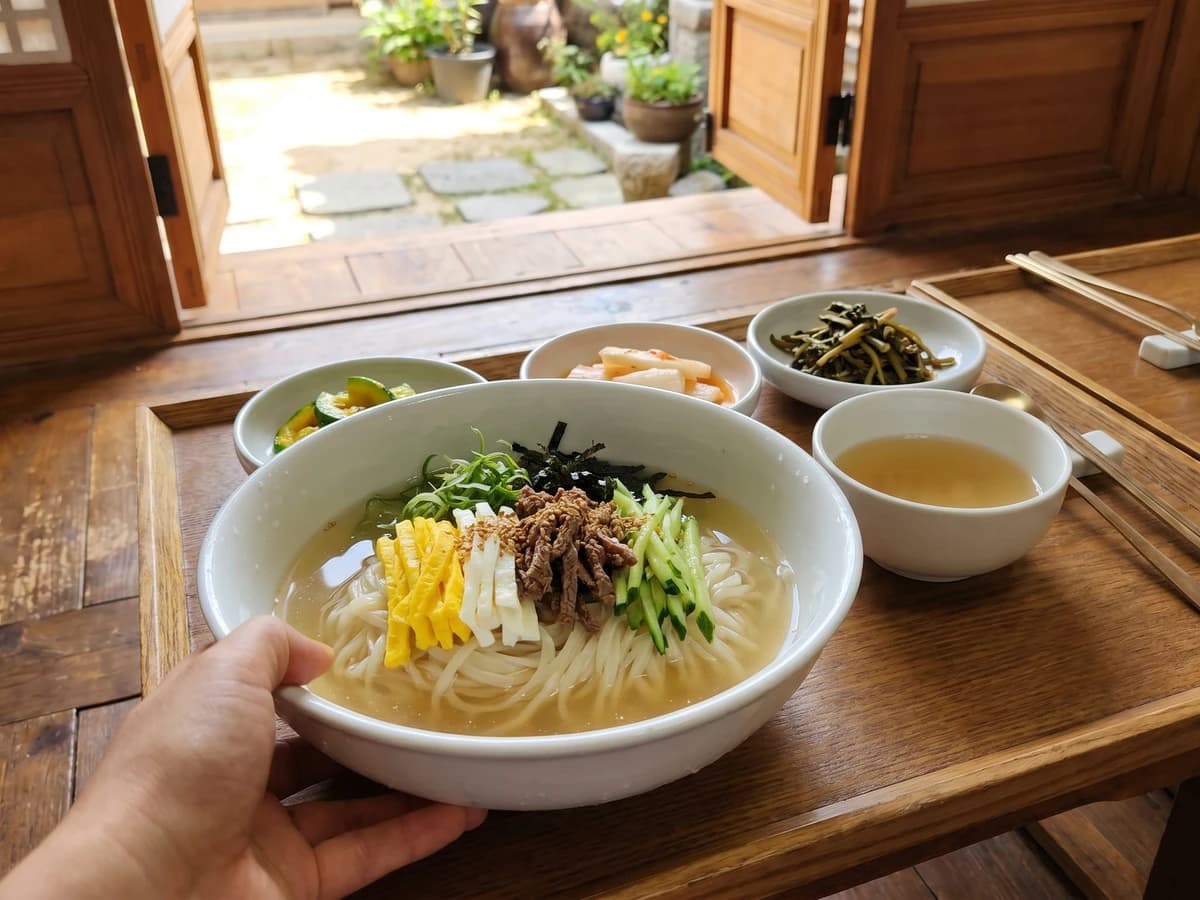
Andong's guest noodles, wheat and roasted soybean flour rolled thin, boiled and rinsed cold, then set in a clear chilled anchovy broth with careful strips of beef, egg, and cucumber.

Chef Jeong-sun
Andong's ritual-table rice served on an ordinary day: separate soy-sesame namul, warm rice, and clear radish soup, mixed without gochujang so every vegetable keeps its own voice.