
Chef Jeong-sun
Agwi-jjim (Braised Monkfish with Bean Sprouts)
Firm monkfish buried under crisp soybean sprouts, minari, and a red gochugaru sauce thickened at the end; Masan's market dish asks for heat, timing, and a steady hand.
A cooking platform built around craft, culture, and the stories behind what we eat.

Created by
A quick Korean rice bowl built on contrast: warm rice, cold popping flying-fish roe, chopped vegetables, gim, sesame oil, and the crisp rice bottom a hot stone bowl gives you.
Albap lives or dies by timing, not difficulty. The rice must be hot, the roe must stay cold until the last moment, and the vegetables must be cut small enough that one spoonful carries everything. If you throw it together carelessly, it becomes rice with decorations. If you measure and cut properly, it eats like a bright, quick meal that still belongs at a Korean table.
This is not old court food, and there is no shame in that. It belongs to the modern casual table: lunch counters, seafood restaurants, late dinners with friends, and homes where someone wants one bowl that feels generous without making five banchan. The flying-fish roe pops under the teeth, the gim brings sea and salt, the sesame oil rounds the bowl, and the hot dolsot gives a thin layer of nurungji (scorched rice) at the bottom.
My teacher Master Seong-nyeo would have made me cut the cucumber and danmuji again if one piece was twice the size of another. She was right. In a mixed rice bowl, knife work is seasoning. Keep each piece about 5 mm, season lightly, and let every ingredient taste like itself. 손맛 is real; I measure it anyway, because that is how the next cook gets the same good bowl.
Albap, literally "roe rice," is a modern Korean rice bowl rather than a documented royal or ritual dish. The flying-fish roe version became familiar through late twentieth-century casual restaurants, Japanese-style pubs, sushi suppliers, and seafood houses, then entered home kitchens because the ingredients are quick and the bowl feels complete. The dolsot version borrows from bibimbap's hot stone bowl tradition, using the vessel to crisp the rice while the roe and vegetables keep their sharp contrast.
Quantity
2 cups
hot
Quantity
80g
kept chilled
Quantity
1 tablespoon
Quantity
1 teaspoon
Quantity
1/4 teaspoon
Quantity
1/2 cup
seeded and diced 5 mm
Quantity
1/3 cup
diced 5 mm
Quantity
1/3 cup
diced 5 mm
Quantity
1/3 cup
squeezed lightly and chopped
Quantity
2 tablespoons
finely sliced
Quantity
2 sheets
crushed
Quantity
2 teaspoons, plus 1 teaspoon for the bowls
Quantity
1 teaspoon
Quantity
1 teaspoon
for the dolsot
Quantity
1 teaspoon
for adjusting at the table
| Ingredient | Quantity |
|---|---|
| freshly cooked short-grain white ricehot | 2 cups |
| flying-fish roe (nalchial)kept chilled | 80g |
| rice vinegar | 1 tablespoon |
| mirin or maesil cheong (green plum syrup) | 1 teaspoon |
| fine sea salt | 1/4 teaspoon |
| cucumberseeded and diced 5 mm | 1/2 cup |
| danmuji (yellow pickled radish)diced 5 mm | 1/3 cup |
| carrotdiced 5 mm | 1/3 cup |
| napa cabbage kimchisqueezed lightly and chopped | 1/3 cup |
| scallionsfinely sliced | 2 tablespoons |
| roasted gimcrushed | 2 sheets |
| toasted sesame oil | 2 teaspoons, plus 1 teaspoon for the bowls |
| toasted sesame seeds | 1 teaspoon |
| neutral oilfor the dolsot | 1 teaspoon |
| soy sauce (optional)for adjusting at the table | 1 teaspoon |
Keep the flying-fish roe cold while you work. Stir the rice vinegar, mirin, and salt in a small bowl until the salt dissolves, then fold this through the roe gently. This takes away the flat freezer taste and wakes up the roe without making it sweet. Put it back in the refrigerator until the rice is ready.
Dice the cucumber, danmuji, carrot, and kimchi into pieces about 5 mm across. This measure matters because albap is eaten by the spoon. Large pieces fall away from the rice, and tiny pieces disappear. Squeeze the kimchi lightly so it seasons the bowl without flooding it.
If using dolsot, brush the inside with 1 teaspoon neutral oil and 1 teaspoon sesame oil, then set it over low heat for 3 minutes. Add the hot rice and press it gently into an even layer. Let it sit over medium-low heat for 5 minutes, until the bottom begins to crackle and the edge smells nutty. Do not stir yet; the rice needs stillness to make nurungji.
Turn off the heat. Arrange the cucumber, danmuji, carrot, kimchi, scallions, and crushed gim over the rice in small piles so the colors stay clear before mixing. Spoon the chilled roe into the center last. The cold roe against the hot rice is the point, so do not cook it in the bowl.
Sprinkle with toasted sesame seeds and drizzle with 2 teaspoons sesame oil. Carry the bowl to the table and mix just before eating, scraping the crisp rice from the bottom as you go. Taste first, then add a few drops of soy sauce only if the bowl needs salt. The gim, kimchi, danmuji, and roe already bring plenty.
For a regular bowl, warm the rice well and mix it with 1 teaspoon sesame oil before adding the toppings. You will lose the crisp rice bottom, but the bowl is still honest if the rice is hot, the roe is cold, and the vegetables are cut properly. That is a safe corner to cut. The knife work is not.
1 serving (about 360g)
Culinary guides, cultural storytelling, and the editorial depth that makes cooking meaningful.
Discover Culinary ExplorerChef Jeong-sun
Firm monkfish buried under crisp soybean sprouts, minari, and a red gochugaru sauce thickened at the end; Masan's market dish asks for heat, timing, and a steady hand.
Chef Jeong-sun
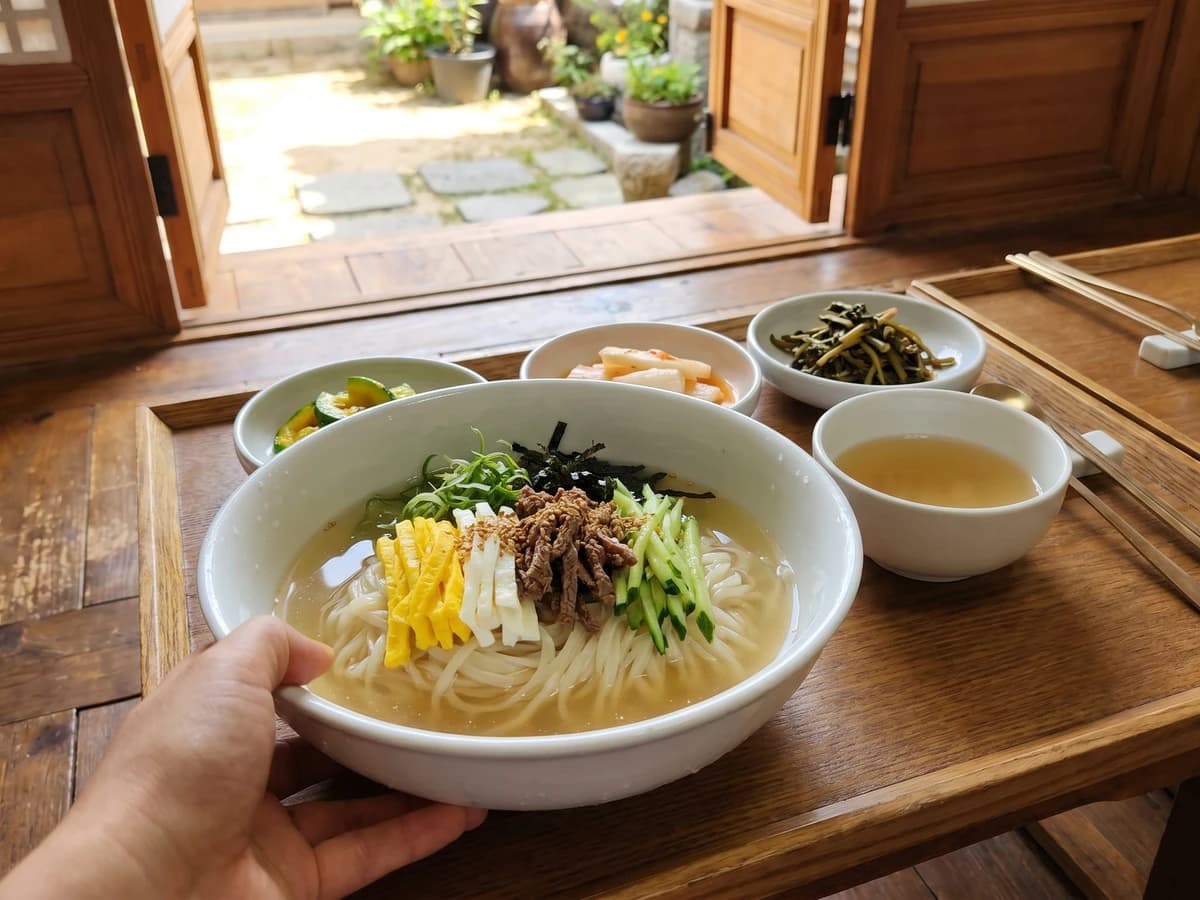
Andong's guest noodles, wheat and roasted soybean flour rolled thin, boiled and rinsed cold, then set in a clear chilled anchovy broth with careful strips of beef, egg, and cucumber.

Chef Jeong-sun
Andong's ritual-table rice served on an ordinary day: separate soy-sesame namul, warm rice, and clear radish soup, mixed without gochujang so every vegetable keeps its own voice.

Chef Jeong-sun
A generous Andong market braise of chicken, potatoes, chilies, and glass noodles in glossy soy sauce, cooked in the right order so the noodles soak up flavor without turning heavy.