
Chef Jeong-sun
Agwi-jjim (Braised Monkfish with Bean Sprouts)
Firm monkfish buried under crisp soybean sprouts, minari, and a red gochugaru sauce thickened at the end; Masan's market dish asks for heat, timing, and a steady hand.
A cooking platform built around craft, culture, and the stories behind what we eat.

Created by
Sticky rice folded with chestnuts, jujubes, black beans, and ginkgo, wrapped in lotus leaves and steamed until the leaf becomes both vessel and seasoning for a quiet summer table.
Lotus leaves tell you the season before the calendar does. In early summer they arrive at the market folded like green umbrellas, too large for an ordinary basket, and the aunties carry them home as if carrying plates. Yeonnip-bap belongs to that season and to the temple table: rice scented by its own wrapper, not by a loud sauce.
People think the leaf is decoration. It isn't. The leaf is the vessel, the lid, and the seasoning. If it cracks, the rice dries. If the rice is not soaked, the center stays hard. If the beans are raw, they stay stubborn after the rice is ready. So we soak, par-cook, wrap tightly, and steam once more. This is not hard, but it asks for order.
Notebook 42, from a summer lesson with Master Seong-nyeo, has one scolding in the margin: don't sweeten it into yakbap. She was right. Chestnut and jujube give enough sweetness; black beans give earth; the lotus leaf should still read clearly. 손맛 is real; I measure it anyway, so the next cook can find the same quiet bowl.
Yeonnip-bap is most closely tied to Korean Buddhist temple cooking, where lotus leaves from summer ponds are used as a wrapper for glutinous rice, beans, nuts, and jujubes. The lotus is a major Buddhist symbol, but the cooking use is practical as well: the leaf keeps sticky rice moist and perfumes it without meat broth, garlic, or heavy seasoning. Modern restaurant versions are common near temples and in lotus-growing areas such as Muan in Jeollanam-do, known for Hoesan White Lotus Pond.
Quantity
2 cups (400g)
rinsed and soaked 4 to 8 hours
Quantity
1/3 cup (65g)
soaked 8 to 12 hours
Quantity
4 large leaves, at least 16 inches wide
dried and soaked until pliable, or fresh and briefly blanched
Quantity
6
quartered
Quantity
6
pitted and thinly sliced
Quantity
2 tablespoons
Quantity
2 tablespoons
Quantity
1 teaspoon
divided
Quantity
1 teaspoon
Quantity
2 tablespoons
Quantity
1 tablespoon
Quantity
1 teaspoon
Quantity
1 teaspoon
Quantity
1 small
finely chopped
Quantity
1/4 teaspoon
| Ingredient | Quantity |
|---|---|
| chapssal (glutinous sweet rice)rinsed and soaked 4 to 8 hours | 2 cups (400g) |
| dried black soybeans (seoritae)soaked 8 to 12 hours | 1/3 cup (65g) |
| food-grade lotus leavesdried and soaked until pliable, or fresh and briefly blanched | 4 large leaves, at least 16 inches wide |
| peeled chestnutsquartered | 6 |
| dried jujubes (daechu)pitted and thinly sliced | 6 |
| peeled ginkgo nuts (optional) | 2 tablespoons |
| pine nuts (optional) | 2 tablespoons |
| fine sea saltdivided | 1 teaspoon |
| toasted sesame oil (optional) | 1 teaspoon |
| soy sauce, for optional yangnyeomjang seasoning sauce (optional) | 2 tablespoons |
| water, for optional sauce (optional) | 1 tablespoon |
| toasted sesame oil, for optional sauce (optional) | 1 teaspoon |
| toasted sesame seeds, for optional sauce (optional) | 1 teaspoon |
| scallion, for optional sauce (optional)finely chopped | 1 small |
| gochugaru (Korean chili flakes), for optional sauce (optional) | 1/4 teaspoon |
Rinse the chapssal in several changes of water until the water is only lightly cloudy, then soak it in plenty of cool water for 4 to 8 hours. Rinse the black soybeans and soak them separately for 8 to 12 hours. Sticky rice cooks from the outside in; soaking is what keeps the center from staying chalky after the leaf has done its work.
Drain the soaked beans and put them in a small pot with 2 cups water. Simmer 20 to 25 minutes, adding 1/4 teaspoon of the salt for the last 5 minutes, until the beans are tender at the edge but not splitting. Drain and save 1 1/3 cups of the bean cooking liquid for the rice, topping up with water if you are short. Raw beans will not politely finish cooking inside the packet, so give them this head start.
For dried lotus leaves, rinse off any dust, then soak them in a wide basin of warm water for about 30 minutes, turning once, until they bend without cracking. Cut away the hard center nub and any thick stem. For fresh leaves, rinse well, dip in boiling water for 20 seconds, then cool and pat dry. Use only food-grade leaves, never leaves from an ornamental pond.
Drain the soaked rice for 15 minutes. Put it in a rice cooker with the reserved bean liquid, the remaining 3/4 teaspoon salt, and 1 teaspoon sesame oil if using. Cook on the white rice or sweet rice setting. For a pot, bring it just to a simmer, stir once, cover tightly, cook over low heat for 12 minutes, then rest off the heat for 10 minutes. The rice should be glossy and firm, not wet, because it still has one more cooking inside the lotus leaf.
Turn the hot rice into a wide bowl. Fold in the cooked beans, chestnuts, jujubes, ginkgo nuts, and pine nuts with a rice paddle, lifting rather than mashing. Taste one grain. It should be gently salted, with the chestnut and jujube still clear. Two cups of rice wants 1 teaspoon salt total; more than that makes the leaf and nuts disappear.
Lay one lotus leaf flat with the veined side facing up. Put one quarter of the rice mixture in the center, about 1 heaping cup or 240g. Fold the bottom of the leaf over the rice, fold in the sides, then fold the top down to make a snug square packet. Set it seam-side down, tying with kitchen twine if the leaf wants to open. A tight packet keeps the rice moist and lets the leaf season it evenly.
Arrange the packets seam-side down in a steamer basket, leaving a little room between them. Steam over steadily boiling water for 35 to 40 minutes, checking the water level halfway so the pot does not run dry. Rest the packets 10 minutes before opening. That rest matters; the grains settle, the chestnuts finish softening, and the leaf scent becomes part of the rice instead of only sitting on the outside.
If you want the seasoning sauce, stir together the soy sauce, water, sesame oil, sesame seeds, scallion, and gochugaru. For a temple-style table, leave out the scallion and gochugaru. Serve each packet in its leaf and open it at the table. Spoon on only a little sauce, 1/2 teaspoon at a time, because yeonnip-bap should taste first of rice, chestnut, bean, and leaf.
1 serving (about 275g)
Culinary guides, cultural storytelling, and the editorial depth that makes cooking meaningful.
Discover Culinary ExplorerChef Jeong-sun
Firm monkfish buried under crisp soybean sprouts, minari, and a red gochugaru sauce thickened at the end; Masan's market dish asks for heat, timing, and a steady hand.

Chef Jeong-sun
A quick Korean rice bowl built on contrast: warm rice, cold popping flying-fish roe, chopped vegetables, gim, sesame oil, and the crisp rice bottom a hot stone bowl gives you.
Chef Jeong-sun
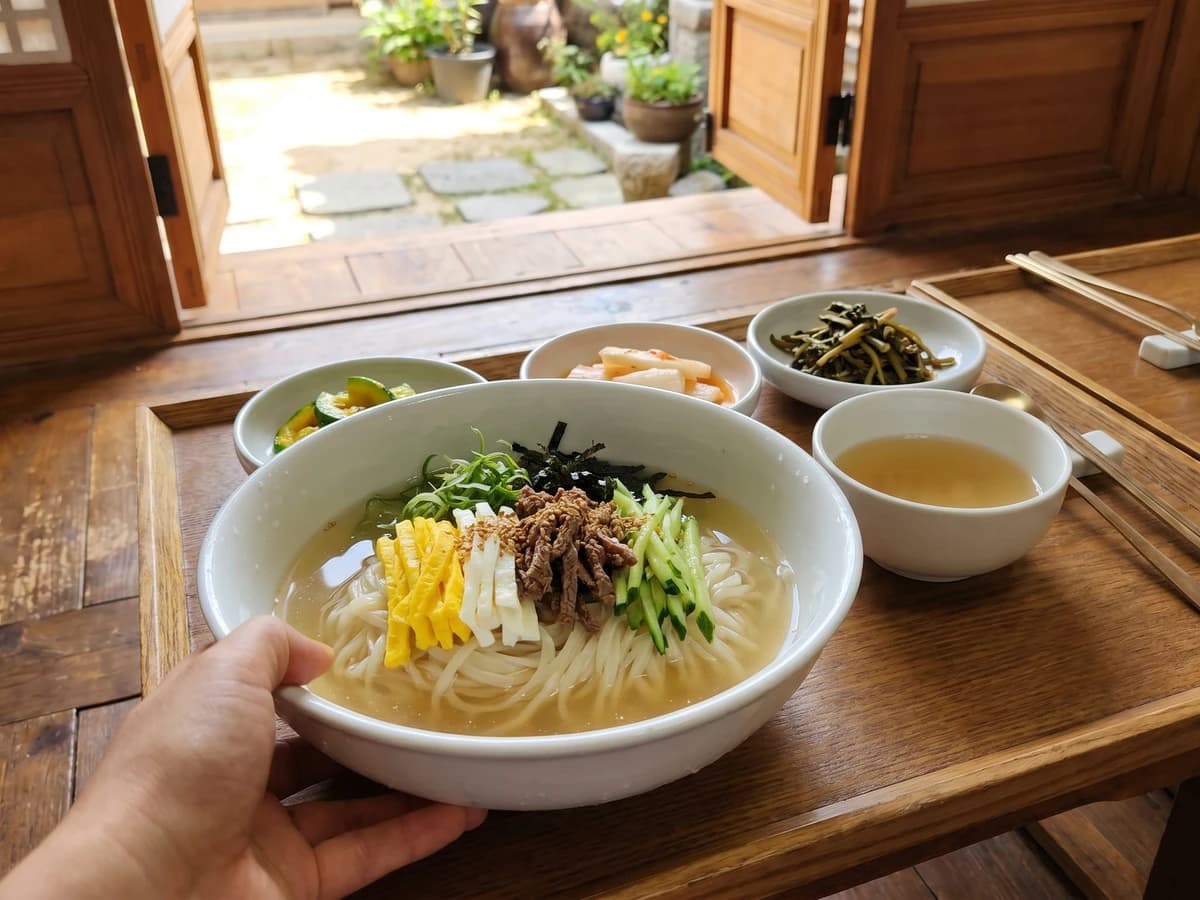
Andong's guest noodles, wheat and roasted soybean flour rolled thin, boiled and rinsed cold, then set in a clear chilled anchovy broth with careful strips of beef, egg, and cucumber.

Chef Jeong-sun
Andong's ritual-table rice served on an ordinary day: separate soy-sesame namul, warm rice, and clear radish soup, mixed without gochujang so every vegetable keeps its own voice.