
Chef Jeong-sun
Agwi-jjim (Braised Monkfish with Bean Sprouts)
Firm monkfish buried under crisp soybean sprouts, minari, and a red gochugaru sauce thickened at the end; Masan's market dish asks for heat, timing, and a steady hand.
A cooking platform built around craft, culture, and the stories behind what we eat.
Created by
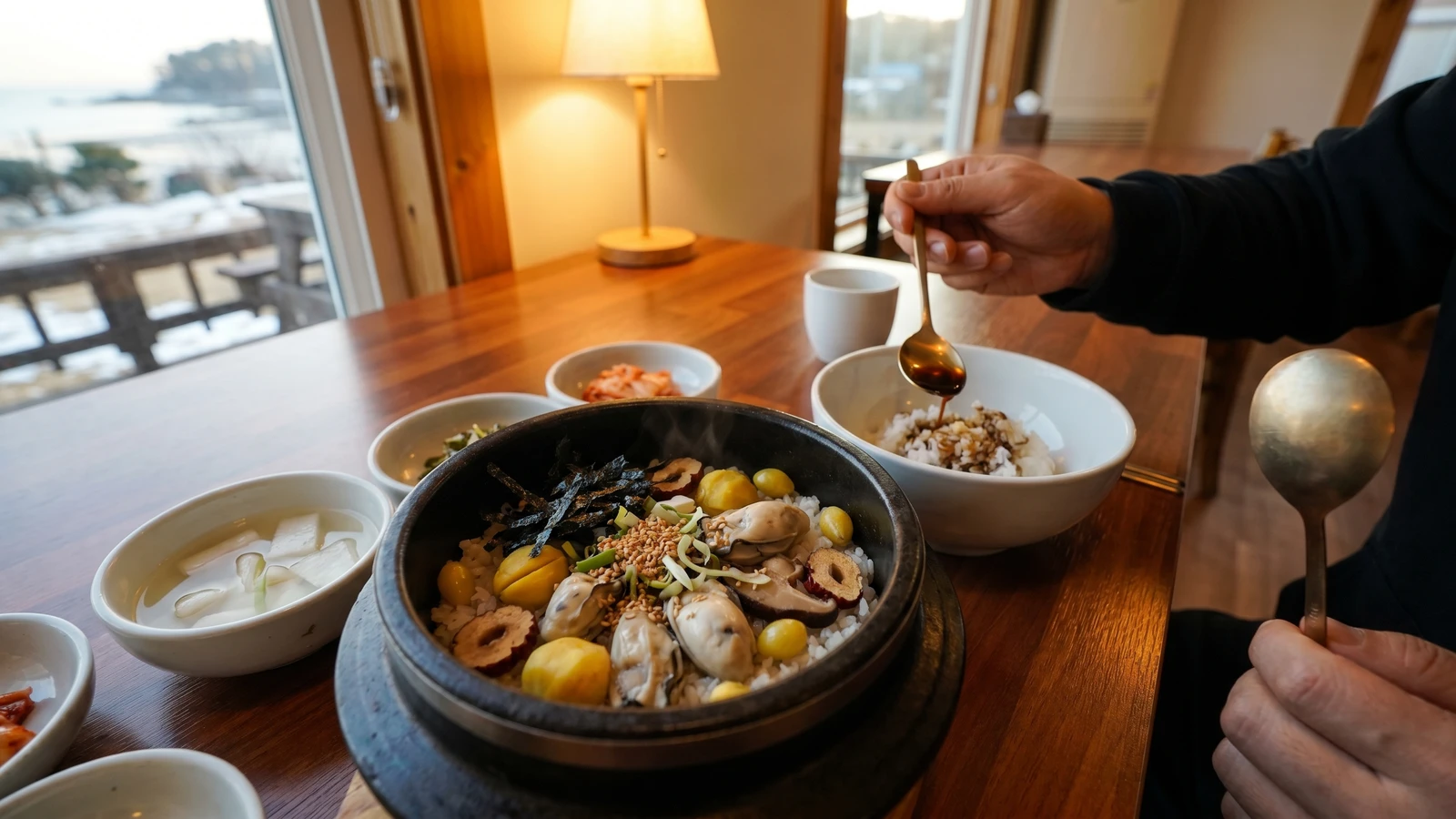
Winter oyster rice from the Chungcheong coast, cooked with chestnut, jujube, and shiitake, then finished with oysters at the last covered rest so they stay plump under a soy-perilla sauce.
Cook the month you're standing in. Yeongyang-gulbap belongs to cold weather, when the Chungcheong coast sends small, clean oysters to market and the chestnuts still taste of autumn storage. In Suwon, my mother didn't make this as often as plain rice, of course. This was the pot that made an ordinary table lean a little toward occasion.
Gulbap, rice cooked or served with oysters, is tied to Korea's coastal regions, and the Chungcheong version draws from the Yellow Sea tidal flats around places such as Seosan, Taean, and Boryeong, where winter oysters are prized. The word yeongyang means nourishment or nutrition, a plain name for rice enriched with chestnut, jujube, mushrooms, and sometimes ginkgo, not a borrowed court title. The late addition of oysters reflects practical coastal cooking: they give their liquor to the rice but stay tender when they are not boiled from the start.
Quantity
1 3/4 cups (350g)
Quantity
1/4 cup (50g)
Quantity
2 1/2 cups
for kelp water
Quantity
1 piece, about 4 inches square
Quantity
1/2 teaspoon
Quantity
250g
kept very cold
Quantity
1 teaspoon
for washing oysters
Quantity
2 cups
for washing oysters
Quantity
6
peeled and quartered
Quantity
4
pitted and thinly sliced
Quantity
4
stems removed and caps sliced
Quantity
10
Quantity
4 tablespoons
Quantity
2 tablespoons
Quantity
1 tablespoon
Quantity
2
finely chopped
Quantity
1 small clove
very finely minced
Quantity
1 tablespoon
lightly crushed
Quantity
1/2 teaspoon
Quantity
1 teaspoon maesil-cheong or 1/2 teaspoon sugar
Quantity
1 sheet
cut into thin strips
| Ingredient | Quantity |
|---|---|
| short-grain white rice | 1 3/4 cups (350g) |
| sweet rice (chapssal) | 1/4 cup (50g) |
| cold waterfor kelp water | 2 1/2 cups |
| dried kelp (dasima) | 1 piece, about 4 inches square |
| fine sea salt | 1/2 teaspoon |
| fresh shucked oysterskept very cold | 250g |
| coarse sea saltfor washing oysters | 1 teaspoon |
| cold waterfor washing oysters | 2 cups |
| fresh chestnutspeeled and quartered | 6 |
| dried jujubes (daechu)pitted and thinly sliced | 4 |
| fresh shiitake mushroomsstems removed and caps sliced | 4 |
| peeled ginkgo nuts (optional) | 10 |
| soy sauce | 4 tablespoons |
| water or reserved kelp water | 2 tablespoons |
| perilla oil (deulgireum) | 1 tablespoon |
| scallionsfinely chopped | 2 |
| garlicvery finely minced | 1 small clove |
| toasted sesame seedslightly crushed | 1 tablespoon |
| gochugaru (Korean chili flakes) (optional) | 1/2 teaspoon |
| maesil-cheong or sugar (optional) | 1 teaspoon maesil-cheong or 1/2 teaspoon sugar |
| roasted gim (optional)cut into thin strips | 1 sheet |
Rinse the short-grain rice and sweet rice together in several changes of cold water, rubbing the grains gently with your hand, until the water turns cloudy instead of milky. Soak 30 minutes, then drain in a sieve for 10 minutes. This is not fussing. Soaked rice cooks evenly before the oysters go in, and drained rice takes the measured water properly.
Put the dried kelp in 2 1/2 cups cold water while the rice soaks. After 20 to 30 minutes, lift the kelp out and measure 2 cups of the kelp water for cooking the rice. Cold-soaked kelp gives body without the slick bitterness that comes when kelp is boiled too long.
Dissolve 1 teaspoon coarse sea salt in 2 cups cold water. Add the oysters and swish them gently with your fingers, then lift them out into a sieve instead of pouring the gritty water over them. Pick out any shell bits. Keep the oysters cold until the moment they go into the pot. They should smell clean and briny, never sour.
Quarter the chestnuts, pit and slice the jujubes, slice the shiitake caps, and have the ginkgo nuts ready if using. Keep the pieces modest, about the size of a chestnut quarter or smaller, so every spoonful has rice first and treasure second. Yeongyang means nourishing, but it does not mean crowded.
Put the drained rice, 2 cups kelp water, and 1/2 teaspoon fine sea salt in a 3-quart heavy pot. Level the rice, then scatter the chestnuts, jujubes, shiitake, and ginkgo nuts over the top without stirring them down. Cover and cook over medium-high heat until the liquid is clearly boiling at the edges, about 6 to 7 minutes, then reduce the heat to low and cook 10 minutes.
Open the lid quickly and lay the drained oysters across the top of the rice in one layer. Close the lid at once and cook over low heat for 5 minutes. This is the step the dish lives or dies by. If oysters cook from the beginning, they tighten and give up everything. Added late, they season the rice and stay plump.
Turn off the heat and let the pot sit, covered, for 10 minutes. Do not peek. The rice finishes settling, the chestnuts soften through, and the oysters should turn opaque with lightly curled edges. If any oyster still looks translucent, cover again and put the pot over low heat for 2 more minutes.
While the rice rests, stir together the soy sauce, 2 tablespoons water or kelp water, perilla oil, scallions, garlic, crushed sesame seeds, gochugaru if using, and maesil-cheong or sugar if using. Taste it. It should be salty and nutty, but not sharp enough to cover the oyster. 손맛 is real. I still measure it, so it can be handed on.
Use a rice paddle to lift the rice from the bottom and turn it gently, keeping the oysters as whole as you can. Serve in warm bowls with the soy-perilla sauce on the side, adding about 1 teaspoon sauce per bowl at first. Scatter gim strips over the top if you like. The rice should taste of winter oyster, chestnut, and kelp, with the sauce tying it together rather than taking the bowl away.
1 serving (about 390g)
Culinary guides, cultural storytelling, and the editorial depth that makes cooking meaningful.
Discover Culinary ExplorerChef Jeong-sun
Firm monkfish buried under crisp soybean sprouts, minari, and a red gochugaru sauce thickened at the end; Masan's market dish asks for heat, timing, and a steady hand.

Chef Jeong-sun
A quick Korean rice bowl built on contrast: warm rice, cold popping flying-fish roe, chopped vegetables, gim, sesame oil, and the crisp rice bottom a hot stone bowl gives you.
Chef Jeong-sun
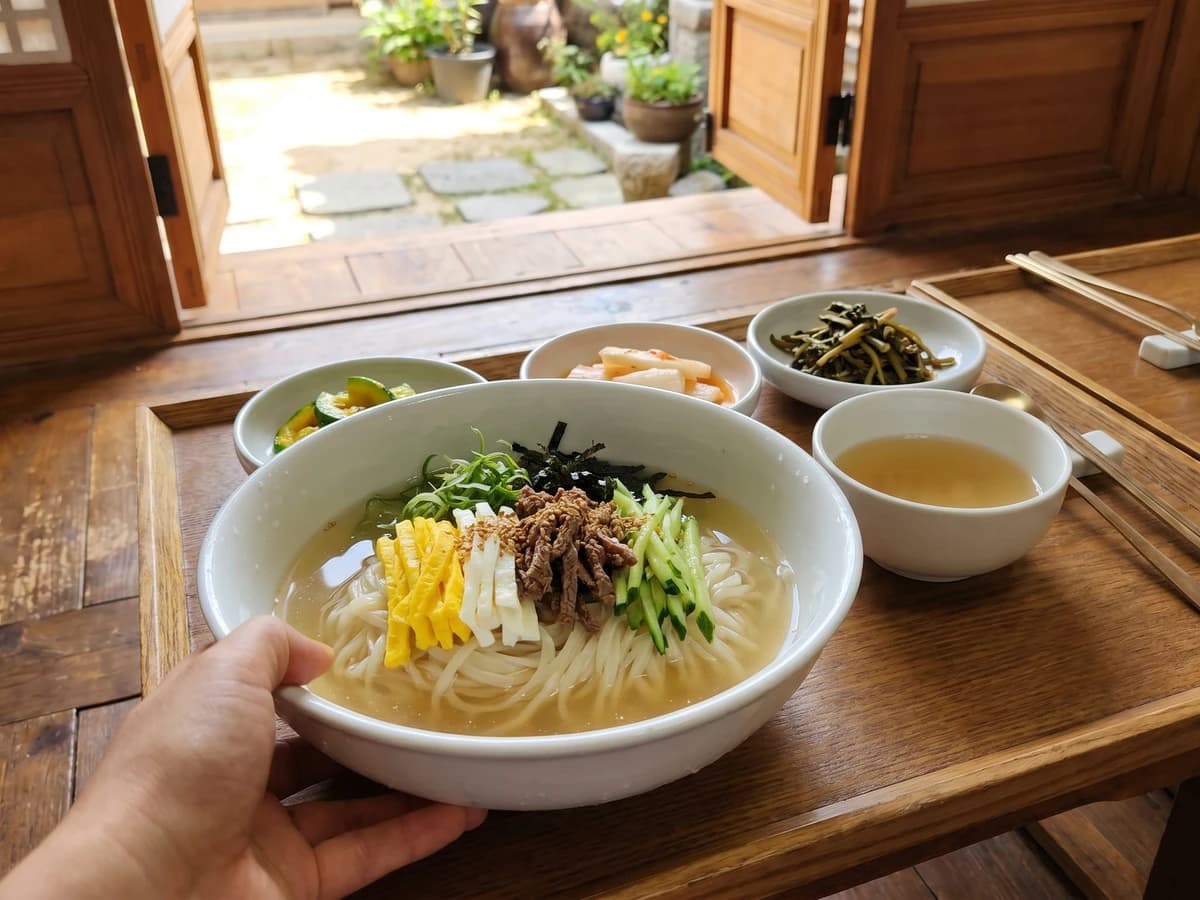
Andong's guest noodles, wheat and roasted soybean flour rolled thin, boiled and rinsed cold, then set in a clear chilled anchovy broth with careful strips of beef, egg, and cucumber.

Chef Jeong-sun
Andong's ritual-table rice served on an ordinary day: separate soy-sesame namul, warm rice, and clear radish soup, mixed without gochujang so every vegetable keeps its own voice.