Umukai Ika me Mei (Marquesan Earth-Oven Fish and Breadfruit)
Created by
In the Marquesas, the hot-stone umukai feeds the table with reef fish, mei, the breadfruit kin, banana leaf, coconut, and the patient heat of the old oven.
Main Dishes
Polynesian
Celebration
Special Occasion
Outdoor Dining
45 min
Active Time
2 hr 30 min cook•3 hr 15 min total
Yield6 servings
The canoe went farther east than most people can imagine, past Tahiti, past the Tuamotu, into the steep green valleys and hard blue water of the Marquesas. That is where this dish belongs. Marquesan hands set the fish and the mei, breadfruit, into the umukai, the hot-stone earth oven, and the table comes from the reef, the tree, the leaf, and the fire.
This is not my home dish from Oʻahu. I cook it open-handed, with respect, and for the deeper ceremony of the Marquesas I send you to the Marquesan elders and aunties who carry that knowledge from the inside. What I can do is help you approach it right: no rush the stones, no treat the breadfruit like a plain starch, no turn the oven into a cookout. The umu by any name is one oven, but each island has its own hand.
The cousins are all around it. In Hawaiʻi, the imu holds kālua and ʻulu. In Sāmoa and Tonga, the umu feeds the Sunday table. In the Cook Islands, the umukai carries meat, fish, taro, and coconut. Down in Aotearoa, the hāngī cooks in the ground. One ocean, one canoe, one root, and still the Marquesan plate is Marquesan.
Most of us don't have a stone pit ready in the yard, so I give you the outdoor way and the home-oven way. Eat what you have. If the fish is good, the leaf is clean, the coconut is rich, and the breadfruit cooks until it gives, the old shape still comes through.
The Marquesas were settled by Eastern Polynesian voyagers roughly in the first millennium CE, and breadfruit, mei, became one of the great foundation foods of those high islands, eaten fresh and also preserved in fermented forms when the crop was abundant. The earth oven belongs to the shared Polynesian cooking grammar: Hawaiian imu, Sāmoan and Tongan umu, Tahitian ahimaʻa, Cook Islands umukai, Māori hāngī, and Marquesan hot-stone ovens all speak the same old idea in different island hands. Fish and breadfruit together show the deep-food table before later mission and plantation foods, reef and canoe crop feeding the people from their own place.
The technique, the tradition, and the story behind every dish.
thawed if frozen, wiped clean, thick ribs softened or trimmed
coconut oil
Quantity
2 tablespoons
lime (optional)
Quantity
1
cut into wedges, for serving
Ingredient
Quantity
whole reef fish or firm white fishcleaned and scaled, or use 2 pounds thick fillets
1 (3 to 4 pounds)
breadfruit (mei or ʻulu)ripe but firm
2 medium
thick coconut creampreferably fresh-pressed
1 1/2 cups
lime juicefresh
2 tablespoons
sweet onionthinly sliced
1 small
green onionsthinly sliced
3
fresh gingergrated
1 tablespoon
coarse sea saltplus more to taste
2 teaspoons
freshly cracked black pepper
1/2 teaspoon
banana leaves or ti leavesthawed if frozen, wiped clean, thick ribs softened or trimmed
8 to 10
coconut oil
2 tablespoons
lime (optional)cut into wedges, for serving
1
Equipment Needed
•Outdoor earth oven setup with food-safe hot stones, banana leaves, and clean wet cloth, or a heavy 7-quart Dutch oven
•Instant-read thermometer for checking fish
•Kitchen twine or softened banana-leaf strips for tying bundles
Instructions
1
Heat the oven
For an outdoor umukai, burn hardwood until fist-size stones are fully hot and the fire has settled, about 1 1/2 to 2 hours. For a home kitchen, heat the oven to 375F and set a heavy roasting pan or Dutch oven ready. The stones, or the covered pan, should hold steady heat without scorching the leaf.
Use only dry, food-safe volcanic or oven stones if you know them. Wet river stones can crack hard in fire. If you don't know the stone, use the home oven.
2
Start the mei
Wash the breadfruit, cut out the stem plug, and score each one around the equator so the skin can open as it cooks. Rub with coconut oil and a pinch of salt, then wrap each breadfruit in banana leaf. Put the mei into the hot-stone oven first, or into the covered roasting pan, because it needs more time than the fish. Cook 60 to 75 minutes before adding the fish bundle.
The breadfruit is ready when a skewer slides through with no hard center. If it fights you, give it time. No blame the taro, no blame the mei. You rushed it.
3
Season the fish
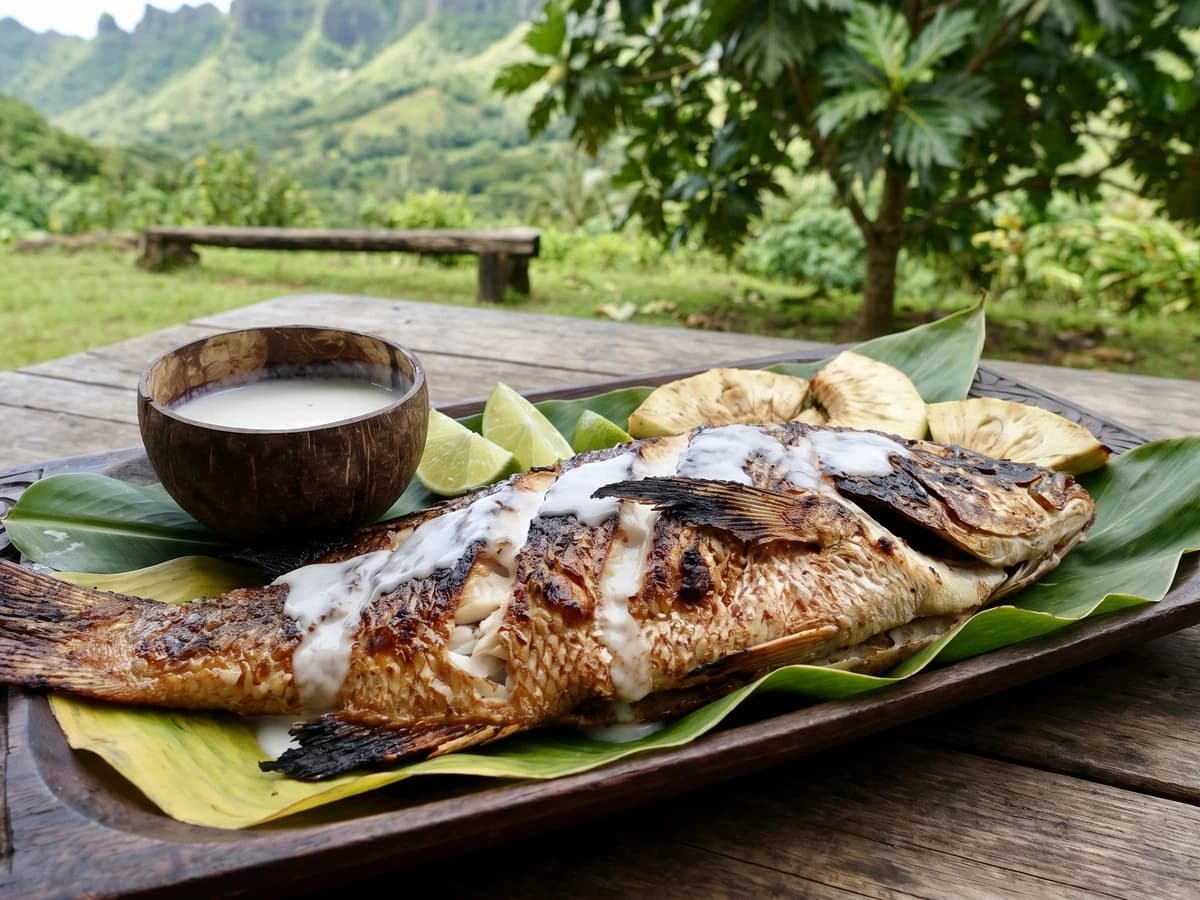
Pat the fish dry. Cut two or three shallow slashes into each side if using a whole fish, then season inside and out with salt, pepper, ginger, onion, and green onion. Stir the coconut cream with the lime juice and a small pinch of salt, then spoon some into the belly or over the fillets. Keep the rest for finishing at the table.
4
Wrap in leaf
Lay banana leaves in a wide cross, glossy side toward the fish. Set the fish in the center, spoon over a little more coconut cream, and fold the leaves tight so the juices stay inside. Wrap with another leaf if you see gaps. The leaf is not decoration. It is the vessel, the seasoning, and the wall that lets the fish steam gently.
5
Cook together
Nestle the fish bundle beside the partly cooked breadfruit. In an outdoor umukai, cover with more leaf, then clean wet cloth or burlap, then earth or a tight metal cover. In the oven, cover the roasting pan tightly. Cook 35 to 45 minutes for a whole fish, 18 to 25 minutes for thick fillets, until the flesh flakes clean and stays glossy, not dry.
Fish does not forgive the way pork does. Check once near the end, then close it back up if it needs more time. The center should be opaque and just firm.
6
Open and finish
Rest the bundles 10 minutes. Open the fish over its leaves so the coconut-rich juices stay with it, then spoon the reserved coconut cream lightly over the top. Split the breadfruit, pull away the core, and break the flesh into big warm pieces. Serve fish, mei, and lime wedges together, family-style, with the leaf underneath and enough on the mat for one more person.
Chef Tips
•Name the hand. This is Marquesan, from the far eastern islands, not a nameless plate. The cousins matter, but the dish still belongs to its own people.
•For fish, ask when it came out of the water. Fresh fish smells clean, like ocean and almost nothing else. If it smells tired, cook it harder in another dish and no shame.
•Breadfruit should feel heavy for its size and give just a little if ripe. Very green mei cooks firm and starchy. Softer ripe mei turns sweeter and more fragrant.
•Fresh coconut cream is best when you can press it from grated mature coconut. A good thick can is fine in a regular kitchen. Eat what you have.
•No yard, no stones, no problem. A covered Dutch oven with banana leaf will not become a Marquesan ceremony, but it will teach the same patience and give you good food.
Advance Preparation
•Clean the leaves and thaw frozen banana leaves the night before, then wipe them dry and keep them wrapped in the refrigerator.
•Mix the coconut cream, lime, ginger, and salt up to 4 hours ahead and keep it cold. Stir before using.
•Do not season the fish too early. Salt and wrap it within 30 minutes of cooking so the flesh stays firm and sweet.
Frequently Asked Questions
Nutrition Information
1 serving (about 500g)
Calories
695 calories
Total Fat
27 g
Saturated Fat
22 g
Trans Fat
0 g
Unsaturated Fat
5 g
Cholesterol
75 mg
Sodium
870 mg
Total Carbohydrates
85 g
Dietary Fiber
16 g
Sugars
34 g
Protein
35 g
Where cooking meets culture.
Culinary guides, cultural storytelling, and the editorial depth that makes cooking meaningful.