Culinary Explorer

A cooking platform built around craft, culture, and the stories behind what we eat.
Discover Culinary Explorer
Ahimaʻa Puaʻa (Tahitian Earth-Oven Pork)

Ahimaʻa Puaʻa (Tahitian Earth-Oven Pork)

Created by

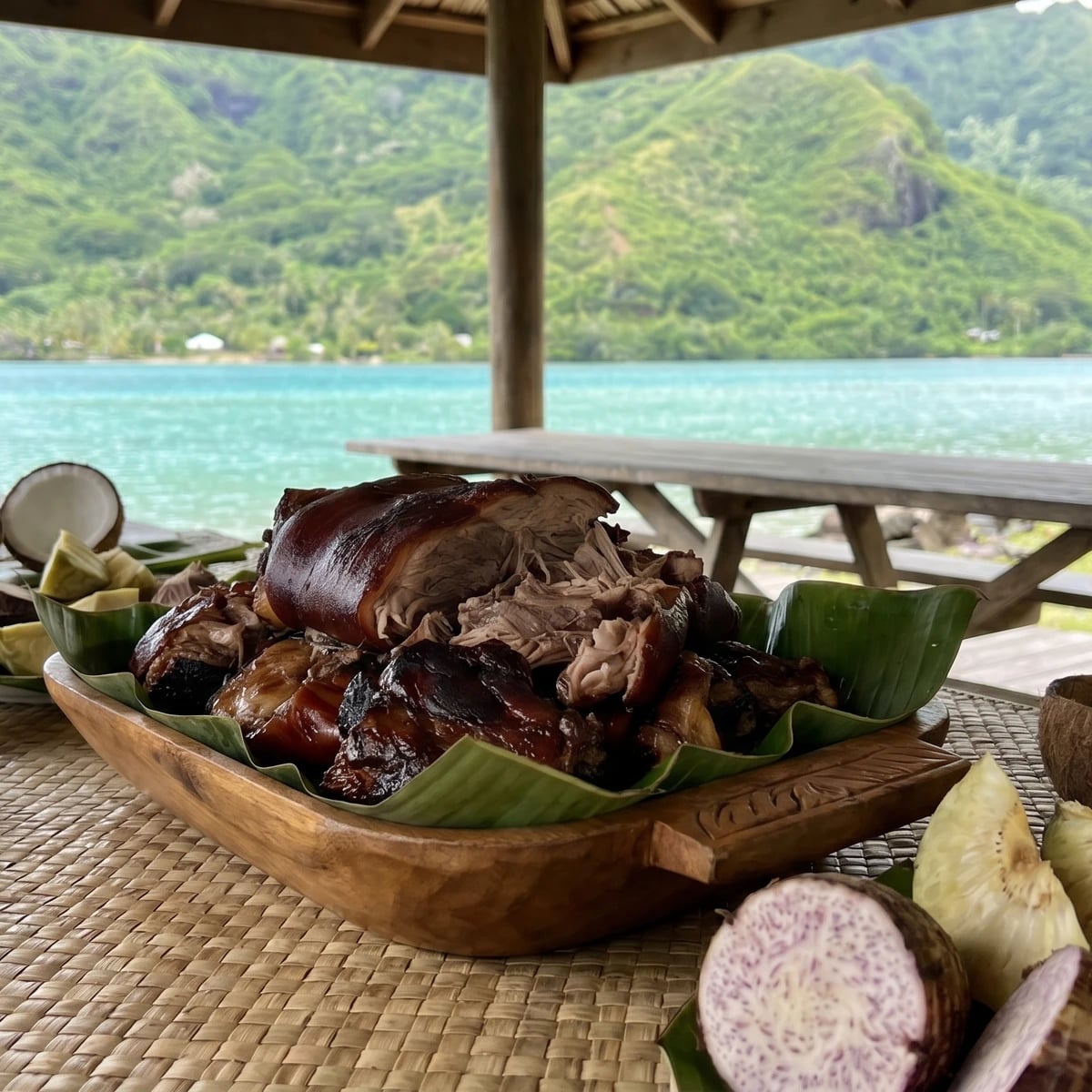
Tahitian puaʻa cooked in the spirit of the ahimaʻa, the earth oven of maʻa Tahiti, wrapped in banana leaf and held low and slow until the meat gives in two fingers.

Main Dishes
Polynesian, Tahitian
Celebration
Special Occasion
Outdoor Dining
40 min
Active Time
6 hr cook6 hr 40 min total
Yield8 to 10 servings

The first time I sat for maʻa Tahiti, the Tahitian feast, I watched the aunties look at the pit before they looked at the pork. That told me plenty. The ahimaʻa, the Tahitian earth oven, isn't just a cooking method. It's a place where fenua, the land, feeds the people back through fire, leaf, stone, and patience.

This is Tahiti's hand. Back home in Hawaiʻi we say imu, in Sāmoa and Tonga the cousins say umu, the Cook Islands say umukai, the Māori have the hāngī, and Rapa Nui keeps the umu pae. The umu by any name is one oven, but each island opens it with its own voice. Here the pork, the puaʻa, belongs to the Tahitian table, often beside ʻuru, breadfruit, taro, poisson cru, and coconut-rich dishes spread out for the whole family.

Most of us don't have volcanic stones and a pit ready in the yard, yeah? So this version carries the old shape into a real kitchen. Banana leaf against the meat. Salt enough to wake it up. A little smoke where the hot stones would have spoken. Long heat, tight cover, no rush. The point is not to fake the ceremony. The point is to cook open-handed, remember whose island this is, and send the deep parts of the ahimaʻa to Tahitian elders and families who carry it from the inside.

When the leaf folds back and the pork pulls glossy and soft, feed people. Not precious. Not tiny. Deep food is not fancy. It's kuleana, responsibility, and it likes a crowded table.

The ahimaʻa is Tahiti's earth oven, part of the same ancient hot-stone cooking family carried through the Polynesian voyaging world as imu, umu, umukai, hāngī, and umu pae. In maʻa Tahiti, pork cooked with banana leaf and hot stones sits beside canoe crops like taro and ʻuru, breadfruit, foods that long predate mission and plantation changes to island diets. The whole-pig oven remains a celebration food today, not because it is frozen in the past, but because Tahitian families still gather around the old fire and make it useful.

The technique, the tradition, and the story behind every dish.

Discover Culinary Explorer

Ingredients

bone-in pork shoulder or pork butt (puaʻa)

Quantity

1 (5 to 6 pounds)

coarse sea salt

Quantity

2 tablespoons

coconut oil

Quantity

1 tablespoon

liquid smoke

Quantity

1 tablespoon

preferably mild mesquite or kiawe-style

freshly cracked black pepper

Quantity

2 teaspoons

banana leaves

Quantity

6 to 8

thawed if frozen, thick ribs trimmed

sweet onion

Quantity

1 large

sliced thick

garlic cloves

Quantity

4

smashed

water

Quantity

1 cup

fresh coconut milk or thick canned coconut milk

Quantity

1/2 cup

for finishing

cooked ʻuru (breadfruit), taro, rice, or green banana (optional)

Quantity

for serving

Equipment Needed

  • Heavy 7-quart Dutch oven or deep roasting pan with tight lid
  • Heavy foil and parchment if the pan has no lid
  • Tongs for handling warmed banana leaves

Instructions

  1. 1

    Salt the puaʻa

    Pat the pork dry and score the fat cap in shallow cuts, about a quarter-inch deep. Rub the salt, coconut oil, liquid smoke, and black pepper all over the meat and into the cuts. The salt has to reach the inside before the long cook starts, so give it at least 30 minutes, or overnight if you planned ahead.

    If you salt it overnight, keep it covered in the fridge and let it sit at room temperature 45 minutes before cooking so the heat moves through more evenly.
  2. 2

    Wake the leaves

    Pass the banana leaves briefly over a gas flame, hot pan, or warm oven until they turn glossy and flexible. Don't scorch them black. You just want them soft enough to fold without cracking, the way leaf should behave around food.

  3. 3

    Build the bundle

    Heat the oven to 300F. Line a heavy Dutch oven or deep roasting pan with crossed banana leaves, leaving enough overhang to fold back over the pork. Scatter the onion and garlic underneath, set the puaʻa on top fat-side up, pour the water around it, then fold the leaves over tight.

  4. 4

    Seal it tight

    Cover the pot with a tight lid, or seal the roasting pan with parchment and heavy foil. In the ahimaʻa, earth and leaf hold the heat in. In your kitchen, the lid has to do that work. No need make it precious, but make it tight.

  5. 5

    Cook it slow

    Roast for 5 1/2 to 6 hours, until the bone twists loose and the meat pulls apart with two fingers. If it still grips, give it more time, not more heat. No blame the pork. You rushed the fire.

    A boneless roast may finish closer to 5 hours, but the same rule stands: it is ready when it gives, not when the clock says so.
  6. 6

    Pull and moisten

    Rest the covered pork for 20 minutes, then open the leaves and pull the meat into big glossy pieces. Skim off extra fat if needed, fold the pan juices through, and splash in the coconut milk just enough to round the salt and smoke. The meat should shine, not swim.

  7. 7

    Serve the maʻa

    Lay the pork on fresh banana leaf or in a wooden bowl and serve it family-style with cooked ʻuru, taro, rice, or green banana. If you have raw fish on the table too, name it properly: Tahiti's ʻia ota, not some nameless island fish. Same ocean. Different bowl.

Chef Tips

  • Bone-in shoulder is the move. The bone, fat, and connective tissue are what turn the long cook rich instead of dry.
  • Banana leaves from the freezer aisle are good kitchen sense. If you cannot find them, use parchment under foil and serve on banana leaf only if you can get it later.
  • This is an oven adaptation, not the sacred ahimaʻa itself. For the full pit, the order of stones, leaves, timing, and feast protocol, learn from Tahitian elders and families who carry that work.
  • Eat what you have. ʻUru and taro are the deep companions, but rice on the table does not offend me. The islands eat old food and new food together every day.

Advance Preparation

  • Salt and season the puaʻa up to 24 hours ahead; the flavor settles deeper and the meat cooks more evenly.
  • Thaw frozen banana leaves overnight in the fridge, then wipe them clean before warming and folding.
  • Cook the pork a day ahead if needed, store it in its juices, and rewarm covered at 300F until glossy and soft again.

Frequently Asked Questions

Nutrition Information

1 serving (about 185g)

Calories
475 calories
Total Fat
33 g
Saturated Fat
12 g
Trans Fat
0 g
Unsaturated Fat
19 g
Cholesterol
140 mg
Sodium
1580 mg
Total Carbohydrates
4 g
Dietary Fiber
1 g
Sugars
2 g
Protein
39 g

Note: Chef personas and recipes are created with AI assistance. Cook with care: follow safe food-handling practices, check doneness with a thermometer when needed, and adapt for allergies and your kitchen.

Where cooking meets culture.

Culinary guides, cultural storytelling, and the editorial depth that makes cooking meaningful.

Discover Culinary Explorer

More from The Earth Oven: One Oven, Many Names

Browse the full collection