Culinary Explorer

A cooking platform built around craft, culture, and the stories behind what we eat.
Discover Culinary Explorer
Ueong-jangajji (Soy-Pickled Burdock)

Ueong-jangajji (Soy-Pickled Burdock)

Created by

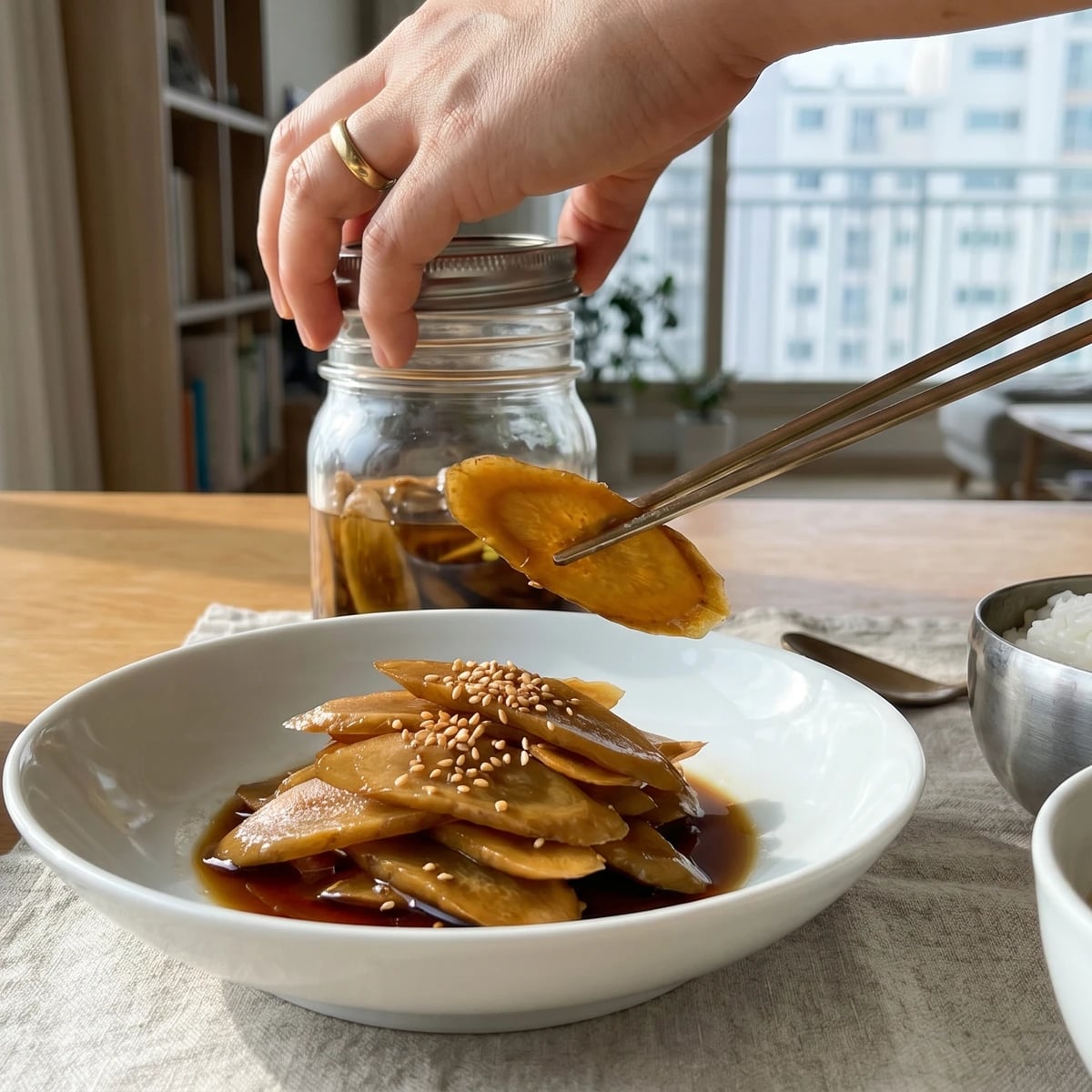
Earthy burdock root cut thin, held pale in vinegar water, then cured in a soy-vinegar brine until it stays crisp enough to snap beside rice.

Sauces & Condiments
Korean
Make Ahead
Batch Cooking
25 min
Active Time
8 min cook24 hr 33 min total
YieldAbout 3 cups, 8 to 10 banchan servings

Ueong points you to the market first. Buy it in late autumn and winter if you can, when the roots are firm, sandy, and not hollow in the center. This is not the soft, sweet ueong-jorim people tuck into gimbap. Jangajji (soy pickle) should keep its bite.

The dish lives or dies by the cutting and the first bowl of water. Burdock browns almost as soon as the knife opens it, so you hold the cut pieces in vinegar water while you work. Not because pale is prettier, though it is, but because it keeps the flavor clean and stops that muddy color from taking over the jar.

Notebook 31 says the brine must be strong enough to preserve but not so strong that the burdock only tastes of soy. For 500 grams of trimmed root, use 3/4 cup soy sauce, 3/4 cup water, 1/2 cup rice vinegar, and 1/3 cup sugar. That measure gives salt, sourness, and sweetness in balance, with the root still tasting like itself. Write it down. Memory is a borrowed bowl.

This is a make-ahead banchan, the kind that saves a tired dinner. Rice, soup, one egg, and a small dish of this, and the table has a backbone.

Jangajji is one of Korea's old preserving families, vegetables cured in soy sauce, doenjang (fermented soybean paste), gochujang (chili paste), vinegar, or salt so they could stretch beyond their season. Burdock root, ueong (우엉), became a common home and market ingredient in modern Korean banchan, often cooked as ueong-jorim for gimbap or pickled as a firmer rice companion. Soy-vinegar jangajji like this reflects the household pantry more than any court record, a practical preserve built for small dishes eaten over many meals.

The technique, the tradition, and the story behind every dish.

Discover Culinary Explorer

Ingredients

fresh burdock root (ueong)

Quantity

500g

scrubbed and trimmed

cold water

Quantity

4 cups

for soaking

rice vinegar

Quantity

2 tablespoons

for soaking

soy sauce (ganjang)

Quantity

3/4 cup

water

Quantity

3/4 cup

rice vinegar

Quantity

1/2 cup

sugar

Quantity

1/3 cup

rice wine or mirin

Quantity

2 tablespoons

dried kelp (dasima)

Quantity

1 piece, about 3 inches square

dried red chili (optional)

Quantity

1

split lengthwise

toasted sesame seeds (optional)

Quantity

1 teaspoon

to serve

Equipment Needed

  • Clean 1-quart heatproof glass jar or lidded container
  • Sharp knife or mandoline
  • Small saucepan
  • Small clean weight or parchment to keep burdock submerged

Instructions

  1. 1

    Prepare vinegar water

    Mix 4 cups cold water with 2 tablespoons rice vinegar in a wide bowl before you cut the burdock. Have it ready. Burdock browns quickly, and if you wait until after cutting, the first pieces will already have darkened.

  2. 2

    Cut the burdock

    Scrub the burdock well, then scrape off only the roughest skin with the back of a knife. Do not peel it white; much of the earthiness sits near the skin. Cut into thin diagonal slices, about 3mm thick, or into matchsticks 6cm long and 3mm wide. Drop each handful into the vinegar water as you cut.

    Keep the pieces even. Thick pieces cure slowly and stay woody; thin pieces cure cleanly and keep the snap that makes this jangajji.
  3. 3

    Rinse and drain

    Soak the cut burdock for 10 minutes, then drain and rinse once under cold water. This removes some harsh tannin without washing away the root's own flavor. Drain very well, because extra water weakens the brine.

  4. 4

    Pack the jar

    Pack the drained burdock into a clean heatproof glass jar or container. Do not crush it down. Leave enough room for the brine to move around the pieces, because a tight jar cures unevenly.

  5. 5

    Boil the brine

    Put the soy sauce, water, rice vinegar, sugar, rice wine, kelp, and dried chili if using into a small pot. Bring just to a boil, stirring to dissolve the sugar. Pull out the kelp as soon as the brine boils; leave it longer and it can turn slippery and bitter.

  6. 6

    Pour over hot

    Pour the hot brine over the burdock until fully covered. Press the pieces down with a small clean weight or a folded piece of parchment if they float. The hot brine lightly sets the surface so the root cures without losing all its bite.

  7. 7

    Cool and chill

    Let the jar cool uncovered until no longer warm, then cover and refrigerate. After 24 hours, taste one piece. It should be salty, lightly sweet, sour at the edge, and still crisp between your teeth. If your soy sauce is very mild, let it cure another day before serving.

  8. 8

    Serve small

    Lift out only what you need with clean chopsticks, slice smaller if the pieces are long, and finish with a few toasted sesame seeds if you like. Serve cold or cool as banchan beside rice. Keep the rest submerged in brine.

Chef Tips

  • Choose burdock roots that feel heavy and firm, with no hollow softness when you flex them. Very thick old roots can be woody, and no brine fixes bad texture.
  • Do not skip the vinegar water. It is not decoration. It slows browning and keeps the finished pickle clean-tasting instead of dull and muddy.
  • This is jangajji, not jorim (braise). If you simmer the burdock in the brine, you will make a softer dish. Good to eat, wrong texture for this one.
  • For a less sharp pickle, reduce the rice vinegar in the brine to 1/3 cup and add 2 tablespoons water. Do not reduce the soy sauce unless you plan to eat it within a week.

Advance Preparation

  • Make this at least 24 hours before serving. It is better on the second day, when the soy has reached the center of each slice.
  • Stored refrigerated and kept submerged with clean utensils, it keeps well for 3 to 4 weeks.
  • For longer keeping, boil the brine again after the first 24 hours, cool it completely, and pour it back over the burdock. This firms the preserve without cooking the root further.

Frequently Asked Questions

Nutrition Information

1 serving (about 75g)

Calories
100 calories
Total Fat
0 g
Saturated Fat
0 g
Trans Fat
0 g
Unsaturated Fat
0 g
Cholesterol
0 mg
Sodium
1330 mg
Total Carbohydrates
22 g
Dietary Fiber
5 g
Sugars
12 g
Protein
3 g

Note: Chef personas and recipes are created with AI assistance. Cook with care: follow safe food-handling practices, check doneness with a thermometer when needed, and adapt for allergies and your kitchen.

Where cooking meets culture.

Culinary guides, cultural storytelling, and the editorial depth that makes cooking meaningful.

Discover Culinary Explorer

More from Jangajji & Jeotgal: The Preserved Pantry

Browse the full collection