
Chef Jeong-sun
Albaechu-mul-kimchi (Baby Cabbage Water Kimchi)
Tender baby napa cabbage in a clear pear-garlic brine, lightly fermented until the broth turns clean and bright, the summer kimchi a beginner can make without a kimjang floor.
A cooking platform built around craft, culture, and the stories behind what we eat.
Created by
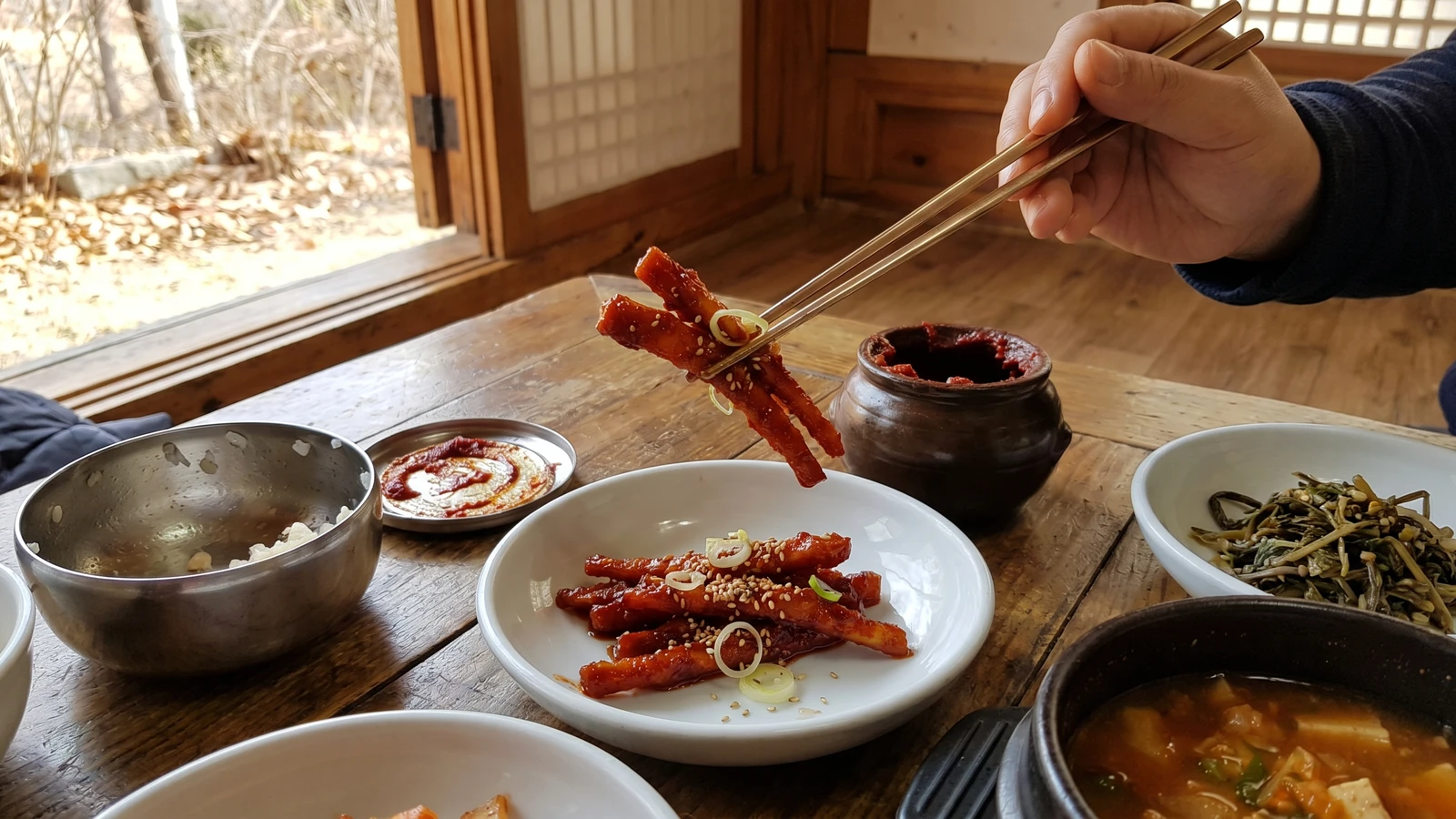
Mountain bellroot pounded flat, dried until tacky, then buried in a restrained gochujang cure; scrape away the old paste, dress with sesame, and serve a few aromatic strips with rice.
Deodeok belongs to the months when the air dries and the roots have worked hard underground. At the market I look for pieces as thick as a thumb, firm from end to end, not hollow and not limp. Cook the month you're standing in: late autumn through winter gives you the strongest root, and that is when this jangajji earns its place among the better banchan, served a few strips at a time with rice.
The dish lives or dies before the gochujang touches it. Peel the root cleanly, pound it flat without tearing it to paste, salt it lightly, then dry the surface until it feels tacky. Wet deodeok waters down the cure. Unpounded deodeok keeps its bitterness locked inside. This is not difficult work, but it does ask you to stand still and pay attention.
Master Seong-nyeo made me scrape off the old paste before serving. The paste has done its work; don't serve a red mound just to prove you used enough. Notebook 52 says: 1 teaspoon salt for about 350g peeled deodeok, 1 cup plus 2 tablespoons gochujang for the cure, and sesame oil only at the table. 손맛 is real; I measure it anyway, so the next cook can make the same good jar.
Jangajji is Korea's preserved banchan family, vegetables and roots kept in ganjang (soy sauce), doenjang (soybean paste), or gochujang (fermented chili paste) for months when fresh produce was scarce. Chili peppers reached Korea after the late sixteenth century, so gochujang-cured jangajji is younger than soy-based jangajji, even though preserving in jang is much older. Deodeok (Codonopsis lanceolata) is strongly tied to mountain regions, especially Gangwon and Hoengseong, where the root is gathered or cultivated and served grilled, seasoned, or cured.
Quantity
500g unpeeled, about 350g peeled
scrubbed
Quantity
1 teaspoon
Quantity
1 cup plus 2 tablespoons (about 300g)
Quantity
2 tablespoons
Quantity
1 tablespoon
Quantity
1 tablespoon, or 1 teaspoon sugar dissolved in 2 teaspoons water
Quantity
1 tablespoon
Quantity
1 teaspoon per 150g cured deodeok
Quantity
1 teaspoon per 150g cured deodeok
lightly crushed
Quantity
1 per 150g cured deodeok
white and pale green parts thinly sliced
| Ingredient | Quantity |
|---|---|
| fresh deodeok (lance-asiabell root)scrubbed | 500g unpeeled, about 350g peeled |
| fine sea salt | 1 teaspoon |
| gochujang (Korean fermented chili paste) | 1 cup plus 2 tablespoons (about 300g) |
| jocheong or rice syrup | 2 tablespoons |
| ganjang (Korean soy sauce) | 1 tablespoon |
| maesil-cheong (green plum syrup), or sugar water (optional) | 1 tablespoon, or 1 teaspoon sugar dissolved in 2 teaspoons water |
| soju or rice wine (optional) | 1 tablespoon |
| toasted sesame oil (optional) | 1 teaspoon per 150g cured deodeok |
| toasted sesame seeds (optional)lightly crushed | 1 teaspoon per 150g cured deodeok |
| scallion (optional)white and pale green parts thinly sliced | 1 per 150g cured deodeok |
Scrub the deodeok well, trim off the stem ends, and peel away the brown outer skin with a small knife or vegetable peeler. Wear thin gloves if you have them, because the sap is sticky and clings to your fingers. Rinse the peeled roots quickly and pat them dry; do not leave them soaking, or the mountain fragrance weakens before the cure even begins.
Split any root thicker than your thumb lengthwise. Lay the pieces between two sheets of parchment or inside a split food-safe bag, then pound gently with a rolling pin or flat meat pounder until each piece is about 5 mm thick. Pound from the center outward. You want opened fibers and a flexible strip, not mashed root.
Spread the pounded deodeok on a tray and sprinkle evenly with the 1 teaspoon salt. Let it sit 20 minutes, until the surface looks damp and the strips bend without cracking. Blot very well with a clean towel, then leave the pieces uncovered in the refrigerator or in a cool airy place for 2 hours, until the surface feels tacky. This drying is what keeps the gochujang thick instead of watery.
Stir together the gochujang, rice syrup, soy sauce, maesil-cheong if using, and soju if using. The cure should be thick enough to cling to a spoon and salty-sweet, not candy-sweet. Do not add sesame oil here. Oil belongs at serving, where it stays fresh and lets the deodeok still taste like itself.
Use a clean, fully dry 1-liter glass jar or small glazed onggi. Spread a spoonful of gochujang cure on the bottom, lay in a few deodeok strips, and smear cure over every surface. Keep layering until all the root is packed, pressing gently to remove air pockets. Finish with a solid 1 cm layer of paste on top, because exposed root dries and spoils first.
Cover tightly and refrigerate. After 24 hours, open the jar with a clean spoon, press the roots back under the paste, and close it again. The jangajji is ready after 5 to 7 days, when the deodeok has softened slightly but still has chew. Two weeks gives a deeper cure. Keep it cold; soju rounds the paste, but it does not make the jar shelf stable.
Lift out only what you will serve. For every 150g cured deodeok, scrape off the heavy old paste with the back of a spoon or chopsticks, but do not rinse it clean. Tear or cut the strips into bite-size lengths, then dress with 1 teaspoon sesame oil, 1 teaspoon crushed toasted sesame seeds, and the sliced scallion if using. Let it sit 10 minutes before serving with rice. Do not return dressed leftovers to the storage jar.
1 serving (about 55g)
Culinary guides, cultural storytelling, and the editorial depth that makes cooking meaningful.
Discover Culinary ExplorerChef Jeong-sun
Tender baby napa cabbage in a clear pear-garlic brine, lightly fermented until the broth turns clean and bright, the summer kimchi a beginner can make without a kimjang floor.

Chef Jeong-sun
The kimchi from before chili, salted napa cabbage packed with radish, pear, jujube, and pine nuts in a clear brine that turns quietly tart in the jar.

Chef Jeong-sun
A pale summer cucumber kimchi, split and stuffed with radish and chives, then held in a cool pear brine so the cucumber stays clean, crunchy, and plainly itself.

Chef Jeong-sun
Flat spring bomdong cabbage, lightly brined and tucked into a clear pear-radish kimchi broth, made without chili and eaten young while the leaves still taste like spring.