Culinary Explorer

A cooking platform built around craft, culture, and the stories behind what we eat.
Discover Culinary Explorer
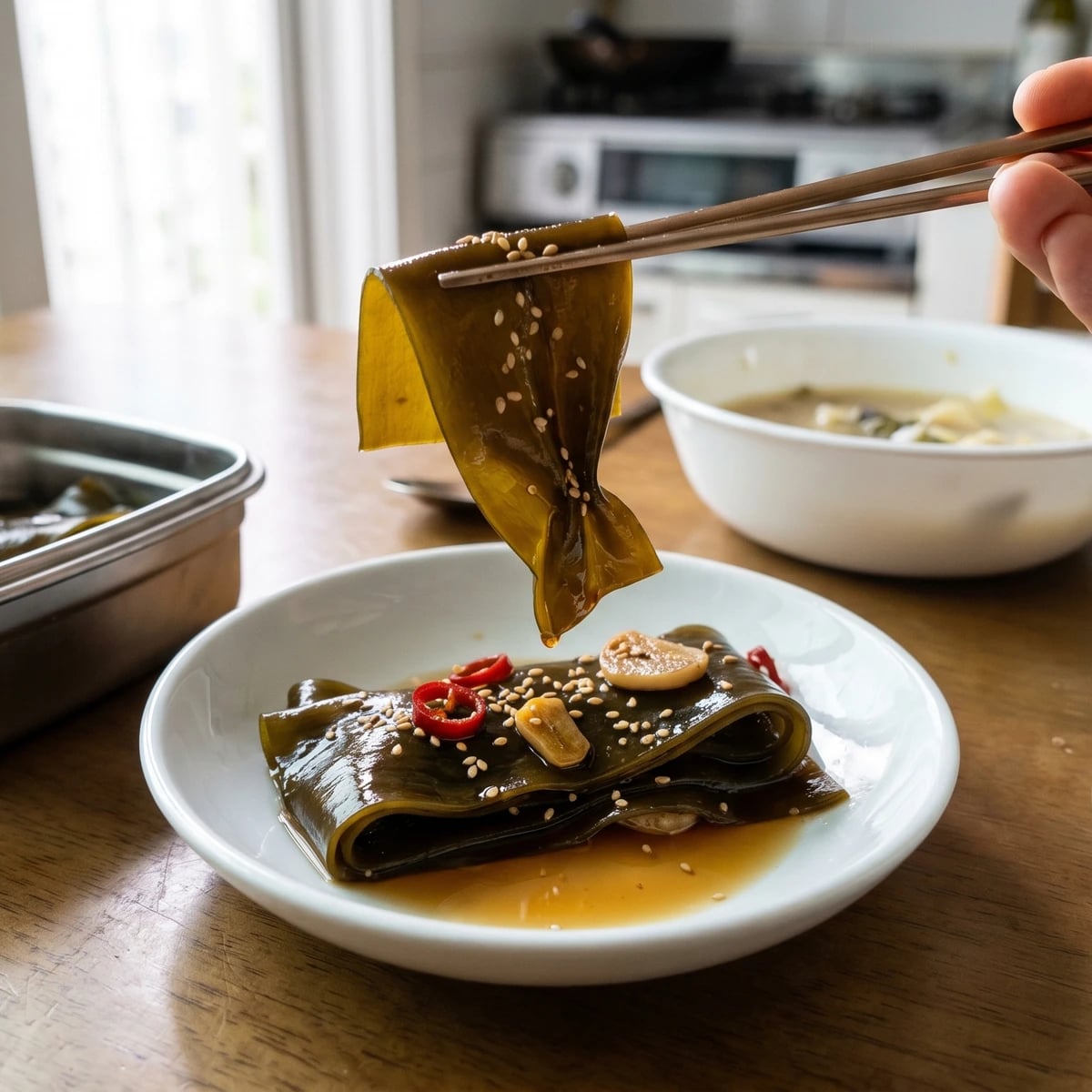
Dasima-jangajji (다시마장아찌, Soy-Pickled Kelp)

Dasima-jangajji (다시마장아찌, Soy-Pickled Kelp)

Created by

Soft strips of broth kelp cured in soy, vinegar, and a little sweetness, a quiet make-ahead banchan that teaches the stock pot not to waste what still has flavor.

Sauces & Condiments
Korean
Make Ahead
Budget Friendly
15 min
Active Time
15 min cook12 hr 30 min total
Yieldabout 2 cups, 8 banchan servings

The misunderstanding is that the kelp has given everything once the broth is done. No. Dasima still has chew, sea sweetness, and enough dignity to sit in its own banchan dish. My teacher Master Seong-nyeo would pull it from the stock before bitterness came in, lay it on the board, and say only this: feed people from the whole pot.

Dasima-jangajji asks for small work, not hard work. Cut the kelp evenly so the brine can reach every edge. Boil the soy brine long enough to dissolve the sugar and calm the raw garlic. Then let the refrigerator do what the old cool room once did. Twelve hours makes it edible; a full day makes it belong with rice.

Do not drown it in sugar or chili. Kelp should taste like kelp, dark and clean, with soy holding it steady underneath. Notebook 58 says the best batch came from kelp used for anchovy broth that morning, 200 grams after draining, cut into 2-centimeter squares. Write it down. Memory is a borrowed bowl.

Jangajji is the Korean family of soy-sauce pickles, made to keep vegetables, roots, garlic scapes, perilla leaves, and sea plants usable when markets thinned and before home refrigeration was ordinary. Late Joseon cookbooks such as Siuijeonseo record soy-preserved side dishes in this family, while dasima itself is tied to Korea's seaweed-producing coasts, especially Wando in South Jeolla today. Using the softened kelp left from broth is household thrift, not court grandeur: the stock takes the first flavor, and the pickle takes what remains.

The technique, the tradition, and the story behind every dish.

Discover Culinary Explorer

Ingredients

cooked dasima (kelp)

Quantity

200g

from 4 to 5 broth pieces about 10cm square each, or from 25g dried dasima simmered until pliable

water or unsalted kelp broth

Quantity

3/4 cup

Korean brewed soy sauce (jin-ganjang)

Quantity

1/2 cup

rice vinegar

Quantity

1/4 cup

sugar

Quantity

2 tablespoons

rice syrup (ssal-jocheong) or maesil-cheong (green plum syrup) (optional)

Quantity

1 tablespoon

mirim or rice wine

Quantity

2 tablespoons

garlic

Quantity

2 cloves

thinly sliced

fresh ginger

Quantity

3 thin slices

dried red chili or cheongyang chili (optional)

Quantity

1 dried chili or 1 small fresh chili

sliced

toasted sesame seeds (optional)

Quantity

1 teaspoon

toasted sesame oil (optional)

Quantity

1 teaspoon

Equipment Needed

  • 1-liter heatproof glass jar or ceramic container
  • Small saucepan
  • Kitchen scissors or sharp knife
  • Clean spoon or small plate to press kelp below the brine

Instructions

  1. 1

    Prepare the kelp

    Use kelp that was pulled from broth early, when the water first simmered and the piece had softened, usually 5 to 7 minutes. Rinse off anchovy crumbs, then pat it dry. If starting from dried dasima, wipe off grit with a damp cloth, soak 25g in 4 cups water for 20 minutes, then simmer 5 minutes until it bends easily. Do not scrub away the pale bloom; that is part of the kelp's sweetness.

    Kelp boiled hard for a long stock can still be pickled, but taste a corner. If it is bitter, do not force this dish. Make more broth and pull the next piece earlier.
  2. 2

    Cut for brine

    Trim away any tough, ragged edges, then stack the kelp and cut it into 2cm squares or 1cm-wide ribbons about 5cm long. Keep the pieces even. Brine salts the edges first, so uneven cuts give you raw middles and over-salty corners. If the kelp still feels leathery, simmer the cut pieces in plain water for 5 to 8 minutes, then drain hard.

  3. 3

    Boil the brine

    In a small saucepan, combine the water, soy sauce, rice vinegar, sugar, rice syrup if using, mirim, garlic, ginger, and chili if using. Bring it to a boil, stirring until the sugar dissolves, then simmer 2 minutes. Taste from a cooled spoon. It should be stronger, saltier, and sharper than a sauce you would sip, because it has to season the kelp and keep it safely in the refrigerator.

    Use jin-ganjang, brewed soy sauce, not guk-ganjang, soup soy sauce. Soup soy is too salty and sharp for a pickle brine this small.
  4. 4

    Pack and cover

    Pack the kelp into a clean 1-liter heatproof glass jar or ceramic container. Pour the hot brine over it, including the garlic, ginger, and chili, and press the kelp down with a clean spoon so every piece is covered. The hot brine helps the seasoning move into the folded edges and gives the kelp its glossy finish.

  5. 5

    Cure it cold

    Let the jar cool uncovered for about 30 minutes, then cover and refrigerate at least 12 hours, preferably 24. Turn the jar once if the kelp is packed tightly. The color will settle into glossy olive-brown, and the kelp should bend with a springy chew, not dissolve.

  6. 6

    Finish to serve

    Lift out only what you will serve. For every 1/2 cup of pickled kelp, toss with 1 teaspoon of its brine, 1/4 teaspoon toasted sesame oil, and 1/4 teaspoon toasted sesame seeds. Do this in the serving dish, not in the storage jar. Oil clouds the brine and shortens its keeping.

  7. 7

    Store the rest

    Keep the kelp submerged in brine and refrigerated, using clean chopsticks or a clean spoon each time. It keeps well for 2 weeks. If you plan to keep it longer than 1 week, pour off the brine on the second day, boil it for 1 minute, cool it completely, and pour it back over the kelp. Never pour hot brine into a chilled glass jar.

Chef Tips

  • The best batch starts before this recipe begins: pull dasima from anchovy-kelp broth when the water first simmers. Leave it in too long and both the broth and the kelp turn bitter. That is not thrift; that is punishment.
  • If your table is vegetarian, use kelp left from mushroom-dasima broth. The pickle works cleanly without anchovy, and the soy brine still has enough depth.
  • Fresh salted kelp from the market can stand in. Soak it in cold water for 20 minutes, taste it, and if it is still salty reduce the soy sauce to 6 tablespoons. Salted kelp brings its own brine with it.
  • Do not skip the vinegar if you want this to keep. If you prefer a softer sourness, reduce the vinegar to 3 tablespoons and eat the pickle within 1 week.

Advance Preparation

  • Cooked broth kelp can be refrigerated in a covered container for up to 2 days before pickling. Pat it dry before cutting so the brine is not diluted.
  • The pickle is ready after 12 hours, better after 24, and strongest after 2 days. Make it at night and it will be ready for the next day's rice.
  • For a larger batch, scale the brine by volume and keep the same ratio. Do not pack the jar so tightly that the brine cannot move between the pieces.

Frequently Asked Questions

Nutrition Information

1 serving (about 60g)

Calories
55 calories
Total Fat
1 g
Saturated Fat
0 g
Trans Fat
0 g
Unsaturated Fat
1 g
Cholesterol
0 mg
Sodium
960 mg
Total Carbohydrates
10 g
Dietary Fiber
1 g
Sugars
6 g
Protein
2 g

Note: Chef personas and recipes are created with AI assistance. Cook with care: follow safe food-handling practices, check doneness with a thermometer when needed, and adapt for allergies and your kitchen.

Where cooking meets culture.

Culinary guides, cultural storytelling, and the editorial depth that makes cooking meaningful.

Discover Culinary Explorer

More from Jangajji & Jeotgal: The Preserved Pantry

Browse the full collection