Culinary Explorer

A cooking platform built around craft, culture, and the stories behind what we eat.
Discover Culinary Explorer
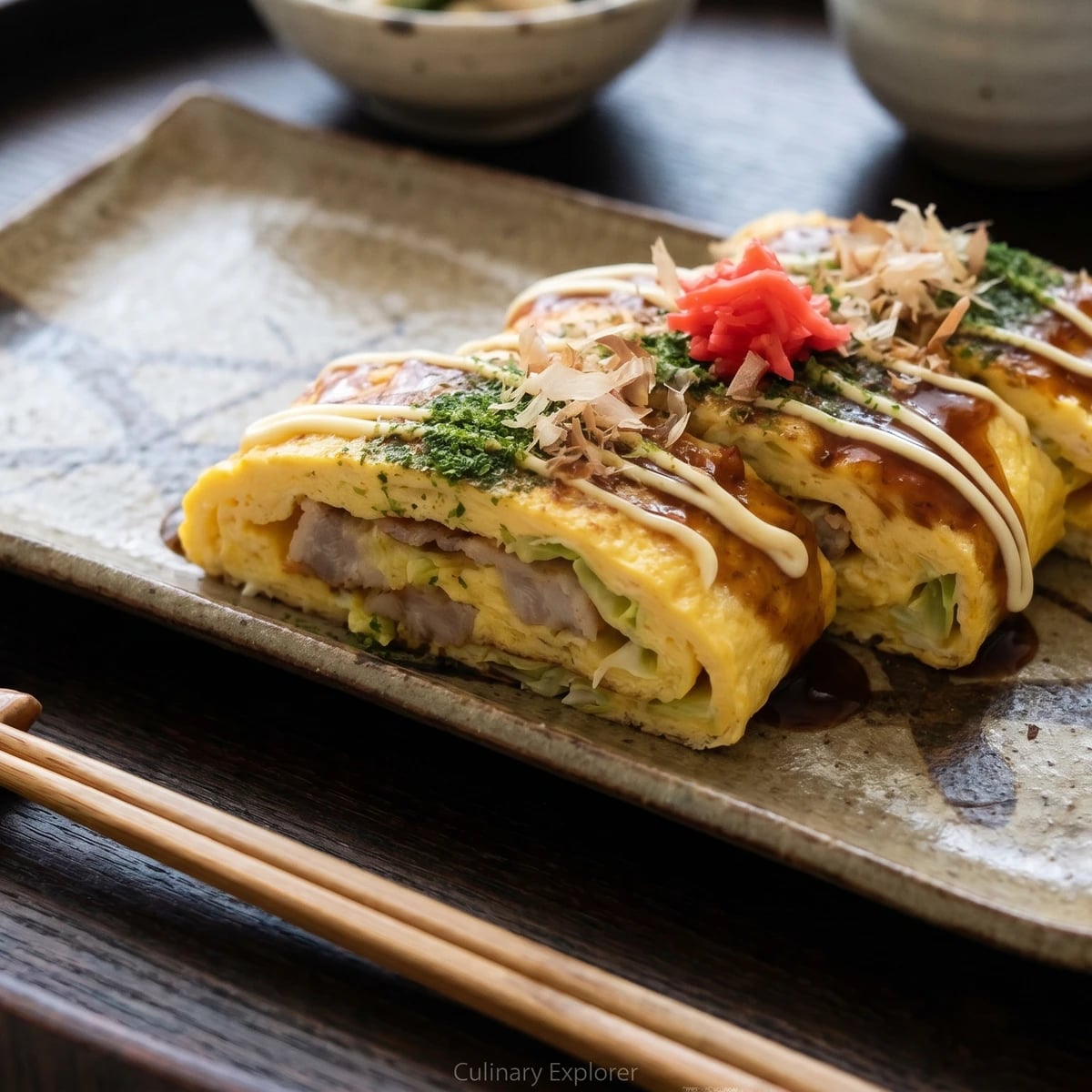
Tonpei-yaki (とん平焼き, Osaka pork omelette)

Tonpei-yaki (とん平焼き, Osaka pork omelette)

Created by

A quick Osaka griddle dish: browned pork belly, a little cabbage, and a thin omelette folded while still tender, then finished with sauce, mayo, aonori, and katsuobushi.

Main Dishes
Japanese
Weeknight
Quick Meal
10 min
Active Time
8 min cook18 min total
Yield2 servings

Tonpei-yaki looks like the hurried cousin of okonomiyaki, which is half true and a little unfair. There is no batter to mix, no round cake to manage, no brave flip required. You brown pork belly, fold it into a thin omelette, and dress it with the same sauce-and-aonori language of the Osaka griddle.

The deciding detail is the pork, not the egg. Pork belly needs direct heat long enough for the fat to render and the edges to take color. Wrap it too soon and the filling tastes heavy, no matter how neatly you paint the top. Sauce is a finish, not a disguise. Nothing hidden.

The egg is only a soft wrapper, so don't ask it to behave like armor. Loosen it with a spoonful of dashi, cook it until the surface is still glossy, then fold while it can bend. That is the first secret, and it is a small one.

Use a teppan, the flat iron griddle, if your kitchen has one. A hot skillet and a small nonstick pan do the same honest work. Set rice, miso soup, and pickles beside it and you have a weeknight meal carrying the konamono spirit, the Osaka griddle family around flour foods, even though the flour has politely stayed out of the room.

Tonpei-yaki is a Kansai teppan dish that became fixed in the postwar world of Osaka okonomiyaki shops and izakaya counters, where a heated iron plate could turn small amounts of pork and egg into a quick plate. Its name is written とん平焼き or 豚平焼き; ton means pork, yaki means grilled, and the character 平 points to the flat, folded form when cooks choose the kanji spelling. Unlike okonomiyaki, it uses little or no flour, but it shares the same counter grammar of sauce, mayonnaise, aonori, and katsuobushi.

The technique, the tradition, and the story behind every dish.

Discover Culinary Explorer

Ingredients

thinly sliced pork belly (butabara)

Quantity

150g

cut into 5cm pieces

sea salt

Quantity

1/8 teaspoon

white pepper

Quantity

1 pinch

green cabbage

Quantity

1 cup (about 70g)

finely shredded

shōyu (Japanese soy sauce)

Quantity

1 teaspoon

large eggs

Quantity

3

cooled dashi, or water

Quantity

1 tablespoon

neutral oil

Quantity

1 teaspoon, plus more as needed

okonomiyaki sauce

Quantity

2 tablespoons

Japanese mayonnaise

Quantity

1 tablespoon

aonori (green seaweed flakes)

Quantity

1 teaspoon

katsuobushi (bonito flakes)

Quantity

1 tablespoon

beni shōga (red pickled ginger) (optional)

Quantity

1 tablespoon

Equipment Needed

  • Teppan (flat iron griddle), or a cast-iron skillet
  • Small nonstick or well-seasoned carbon-steel frying pan
  • Wide spatula
  • Squeeze bottle for mayonnaise, or a small spoon

Instructions

  1. 1

    Prepare the filling

    Cut the pork belly into short pieces so each bite gets both meat and fat without dragging long strips out of the omelette. Season it with the salt and white pepper. Beat the eggs with the dashi until just blended, not foamy. The dashi loosens the egg so it folds without cracking, and it gives a quiet depth that water can only imitate.

  2. 2

    Brown the pork

    Heat a teppan or heavy skillet over medium-high heat and wipe it with a little oil. Lay the pork in one layer and leave it alone for a full minute before turning. You want the fat to render and the edges to brown, because pale pork belly tastes greasy under sauce. Add the cabbage and toss for 30 to 45 seconds, just until it softens. Splash the shōyu around the hot edge of the pan, toss once, and move the filling to a plate.

    Crowding the pan makes the pork gray and wet. Cook in one layer, even if that means two quick batches. The sauce on top can't repair a lazy sear.
  3. 3

    Make the egg sheet

    Set a small nonstick or well-seasoned pan over medium-low heat and wipe it lightly with oil. Pour in the beaten egg and tilt the pan to make a thin oval sheet. When the edges are set and the center is still glossy, stop. A fully dry egg will fold like old paper, which is not the joke we came to make.

    Lower heat gives you time. Tonpei-yaki wants a tender wrapper, not a browned omelette.
  4. 4

    Fold the omelette

    Spoon the pork and cabbage across the lower third of the egg. Use a wide spatula to fold the near side over the filling, then roll it once so the seam sits underneath. The egg will finish setting from its own heat, and the seam will hold if you give it a few seconds before moving it.

  5. 5

    Sauce and finish

    Slide the omelette seam-side down onto a plate. Brush or spoon the okonomiyaki sauce over the top, add fine lines of Japanese mayonnaise, then scatter with aonori and katsuobushi. Add beni shōga to the side if using. Serve at once, whole for the counter look or cut into three broad pieces for the table. The bonito fragrance fades as it sits, and the egg tightens, so this one is best eaten without ceremony.

Chef Tips

  • Ask for butabara, thinly sliced pork belly, at a Japanese or Korean market. If you're slicing it yourself, chill the pork belly in the freezer for 20 minutes first. Cold fat cuts cleanly, and clean slices brown evenly.
  • Spring cabbage is lovely here when it is at its shun, sweet and soft enough to wilt almost at once. In winter, ordinary green cabbage is better shredded very fine so it can soften before the pork overcooks.
  • Use okonomiyaki sauce if you can get it. Tonkatsu sauce is the closest stand-in, a little sharper and less round, so use it knowingly. Don't drown the omelette. The pork has already done its work.
  • If you don't have dashi ready, use water before reaching for instant powder here. The spoonful is there to loosen the egg. Powder brings salt and noise to a dish that should stay quick and clear.

Advance Preparation

  • Cut the pork and shred the cabbage up to one day ahead. Keep them covered and cold, then cook the dish at the last minute.
  • Dashi keeps two days refrigerated, and tablespoon portions freeze well. This is useful for quick egg dishes where a whole pot of stock would be a very serious way to spend a Tuesday.
  • Measure the sauce, mayonnaise, aonori, katsuobushi, and beni shōga before you start cooking. Once the egg goes into the pan, the dish moves quickly.
  • Tonpei-yaki does not hold well after cooking. Reheating toughens the egg and dulls the pork, so make it just before serving.

Frequently Asked Questions

Nutrition Information

1 serving (about 200g)

Calories
570 calories
Total Fat
51 g
Saturated Fat
17 g
Trans Fat
0 g
Unsaturated Fat
31 g
Cholesterol
340 mg
Sodium
900 mg
Total Carbohydrates
10 g
Dietary Fiber
1 g
Sugars
7 g
Protein
18 g

Note: Chef personas and recipes are created with AI assistance. Cook with care: follow safe food-handling practices, check doneness with a thermometer when needed, and adapt for allergies and your kitchen.

Where cooking meets culture.

Culinary guides, cultural storytelling, and the editorial depth that makes cooking meaningful.

Discover Culinary Explorer

More from Konamono: Okonomiyaki, Takoyaki, Monjayaki

Browse the full collection