
Chef Jeong-sun
Aehobak-guk (애호박국, Korean Zucchini Soup)
A clean summer soup of Korean zucchini and salted shrimp, built on quick anchovy-kelp broth and finished before the half-moons lose their shape on a weeknight table.
A cooking platform built around craft, culture, and the stories behind what we eat.

Created by
A southern market beef soup built from brisket broth, sweet Korean radish, and rice in the bowl; plain food, carefully seasoned, meant to feed you well.
At the five-day market, gukbap is not polite food. It is work food. A bowl lands in front of you with rice already waiting underneath, beef torn by hand, radish gone sweet in the broth, and enough gochugaru (Korean chili flakes) to warm the chest without making the whole bowl taste only of chili.
This dish lives or dies by the broth and the tearing of the meat. Boil the brisket gently until it gives up its strength, then pull it along the grain so each strand carries broth. Cut the radish thick enough to stay itself. If you slice it thin, it disappears and leaves only sweetness behind.
My teacher would taste this soup before she salted it, every time. Beef, radish, soy sauce, garlic, and gochugaru do not behave the same in every kitchen. 손맛 is real. I still measure it, so it can be handed on. Tonight this dish asks for patience at the pot, restraint with the seasoning, and rice ready before the soup is finished.
Gukbap, rice served in or with hot soup, grew as practical market and tavern food across Korea, especially around jangteo (marketplaces) where travelers and workers needed one filling bowl. In the southern provinces, beef-and-radish versions often took on a redder broth with gochugaru and soup soy sauce, close in spirit to Gyeongsang-style spicy sogogi-muguk (beef radish soup). It is not palace food; its record belongs to markets, lunch counters, and home pots that stretched a modest cut of beef into a full meal.
Quantity
450g
Quantity
10 cups
Quantity
1 piece, about 4 inches square
Quantity
350g
peeled and cut into 1/2-inch thick bite-size slabs
Quantity
200g
rinsed
Quantity
1 medium
halved
Quantity
5 cloves
3 smashed and 2 minced
Quantity
2 tablespoons
Quantity
1 tablespoon
Quantity
2 tablespoons
Quantity
1 tablespoon
Quantity
1/2 teaspoon, plus more to adjust
Quantity
1/4 teaspoon
Quantity
3
cut into 2-inch lengths
Quantity
4 cups
hot
Quantity
1 teaspoon
Quantity
1
sliced
| Ingredient | Quantity |
|---|---|
| beef brisket or beef shank | 450g |
| water | 10 cups |
| dried kelp (dasima) | 1 piece, about 4 inches square |
| Korean radish (mu)peeled and cut into 1/2-inch thick bite-size slabs | 350g |
| soybean sprouts (kongnamul)rinsed | 200g |
| onionhalved | 1 medium |
| garlic3 smashed and 2 minced | 5 cloves |
| soup soy sauce (guk-ganjang) | 2 tablespoons |
| regular soy sauce | 1 tablespoon |
| gochugaru (Korean chili flakes) | 2 tablespoons |
| toasted sesame oil | 1 tablespoon |
| fine sea salt | 1/2 teaspoon, plus more to adjust |
| black pepper | 1/4 teaspoon |
| scallionscut into 2-inch lengths | 3 |
| cooked short-grain ricehot | 4 cups |
| toasted sesame seeds (optional) | 1 teaspoon |
| green chili (optional)sliced | 1 |
Put the brisket in a bowl of cold water for 20 minutes, then drain. This pulls out excess blood so the broth tastes clean instead of muddy. If your beef is very fresh and well trimmed, 10 minutes is enough.
Put the beef, 10 cups water, kelp, onion, and 3 smashed garlic cloves in a heavy pot. Bring it just to a boil over medium heat, skim the foam, then pull out the kelp after 10 minutes. Kelp left too long gives the broth a slick bitterness, and this soup needs a clean beef spine.
Lower the heat and simmer, partly covered, for 1 hour 15 minutes, until the beef can be pierced easily but has not collapsed. Keep the surface moving quietly. A hard boil makes the broth cloudy and toughens the outside of the meat before the inside is tender.
Lift out the beef and rest it until cool enough to handle. Strain the broth, discard the onion and smashed garlic, and return about 7 cups broth to the pot. Tear the beef along the grain into long bite-size strands. Cutting cubes is faster, but torn beef drinks the seasoning better and eats like gukbap should.
In a bowl, mix the torn beef with the soup soy sauce, regular soy sauce, gochugaru, sesame oil, minced garlic, salt, and black pepper. Massage it with your hand for 30 seconds. Seasoning the meat first, instead of dumping everything into the pot, gives the broth depth without burying the radish.
Bring the strained broth back to a simmer. Add the radish and cook 12 to 15 minutes, until the edges turn slightly translucent and a chopstick slides in with a little resistance. The radish should sweeten the soup but still hold its shape.
Add the seasoned beef and soybean sprouts. Simmer with the lid off for 8 minutes, then add the scallions and simmer 2 minutes more. Do not keep opening and closing the lid if you cover the pot for the sprouts; half-cooked soybean sprouts can turn unpleasant. Lid off the whole time is the simpler, safer rule here.
Taste the broth before serving. Add salt in 1/8-teaspoon pinches only if it tastes flat; soup soy sauce gives aroma but can darken the broth fast. Put 1 cup hot rice in each bowl and ladle the soup over it, with beef, radish, and sprouts divided evenly. Finish with sesame seeds or sliced green chili if you use them, and serve at once.
1 serving (about 900g)
Culinary guides, cultural storytelling, and the editorial depth that makes cooking meaningful.
Discover Culinary ExplorerChef Jeong-sun
A clean summer soup of Korean zucchini and salted shrimp, built on quick anchovy-kelp broth and finished before the half-moons lose their shape on a weeknight table.
Chef Jeong-sun
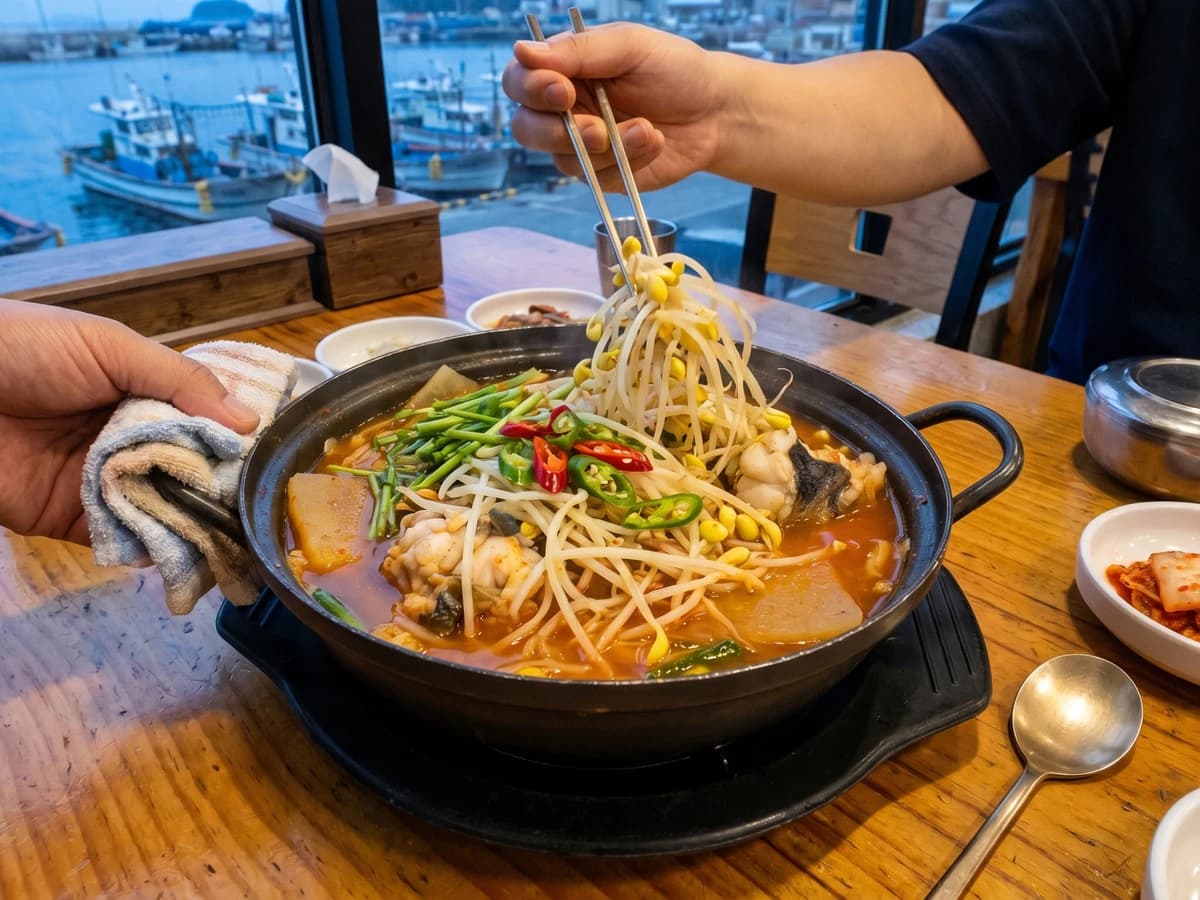
A Masan coast monkfish stew with firm white meat, gelatin at the bones, soybean sprouts for crunch, and a red broth seasoned to carry the fish, not bury it.

Chef Jeong-sun
A weeknight fish roe stew with radish and crown daisy in a clean spicy broth, where the whole success depends on adding the roe late enough that it sets tender, not chalky.

Chef Jeong-sun
Late-summer mallow leaves rubbed with salt until the bitter green water runs off, then simmered in a clean doenjang broth with dried shrimp, the quiet soup a Korean weeknight deserves.