
Chef Jeong-sun
Aehobak-guk (애호박국, Korean Zucchini Soup)
A clean summer soup of Korean zucchini and salted shrimp, built on quick anchovy-kelp broth and finished before the half-moons lose their shape on a weeknight table.
A cooking platform built around craft, culture, and the stories behind what we eat.

Created by
A clear, nourishing Korean hangover soup made by tearing dried pollock, toasting it in sesame oil, then simmering it with bean sprouts until the broth turns pale and sweet.
Hwangtae-haejangguk lives or dies in the first five minutes, before it looks like soup at all. Tear the dried pollock with your hands, moisten it, then toast it in sesame oil with garlic until the fish relaxes and the pan smells nutty. Only then do you add water or broth. Skip that step and you get fish in hot water. Do it properly and the soup turns pale, almost milky, with a sweetness that dried fish keeps hidden until you coax it out.
This is haejangguk (hangover soup), but not the fierce kind that tries to wake you by force. It is the morning-after bowl for people who need steadiness: hwangtae (dried pollock), kongnamul (soybean sprouts), radish, scallion, and egg if the house wants it richer. The bean sprouts must cook with one rule: lid on the whole time or lid off the whole time. My teacher would tap the pot lid with her spoon if a student reached for it. Half-cooked sprouts meeting cold air make a smell no seasoning can repair.
Notebook 41 says 60 grams of torn hwangtae to 6 cups of liquid feeds four people generously. That looks like too much fish when it is dry and too little once it softens, which is why we write it down. Season lightly with guk-ganjang (soup soy sauce) and salt at the end. Let it taste like itself, clean fish, sprout, radish, and a little sesame oil holding the bowl together.
Hwangtae is pollock dried through repeated freezing and thawing in winter wind, a method now strongly associated with Gangwon-do mountain villages such as Yongdae-ri in Inje and the Daegwallyeong area. Haejangguk means hangover soup, but it is a category rather than one fixed recipe: Seoul has its ox-blood and cabbage versions, Jeonju is known for kongnamul-gukbap, and hwangtae-haejangguk earned its place as the gentler dried-fish branch of that morning table.
Quantity
60g
checked for bones and tough skin
Quantity
2 cups
rinsed and picked over
Quantity
150g
cut into thin matchsticks
Quantity
200g
cut into small cubes
Quantity
2
thinly sliced
Quantity
2 large
lightly beaten
Quantity
1 tablespoon
Quantity
1 teaspoon
Quantity
3 cloves
minced
Quantity
6 cups
Quantity
1 tablespoon
Quantity
1 teaspoon
Quantity
1/2 teaspoon, plus more as needed
Quantity
1/4 teaspoon
freshly ground
Quantity
1/2 teaspoon
Quantity
1 small
thinly sliced
| Ingredient | Quantity |
|---|---|
| dried pollock strips (hwangtaechae)checked for bones and tough skin | 60g |
| soybean sprouts (kongnamul)rinsed and picked over | 2 cups |
| Korean radish (mu)cut into thin matchsticks | 150g |
| medium-firm tofu (optional)cut into small cubes | 200g |
| scallionsthinly sliced | 2 |
| eggs (optional)lightly beaten | 2 large |
| toasted sesame oil | 1 tablespoon |
| neutral oil | 1 teaspoon |
| garlicminced | 3 cloves |
| water, anchovy-kelp broth, or rice-rinsing water | 6 cups |
| guk-ganjang (Korean soup soy sauce) | 1 tablespoon |
| fish sauce or saeujeot brine (optional) | 1 teaspoon |
| fine sea salt | 1/2 teaspoon, plus more as needed |
| black pepperfreshly ground | 1/4 teaspoon |
| toasted sesame seeds (optional) | 1/2 teaspoon |
| green chili (optional)thinly sliced | 1 small |
Tear the hwangtae into bite-size strips, removing any sharp bones or hard skin. Put it in a bowl, sprinkle with 3 tablespoons of water, and turn it with your hands until it bends instead of snapping. Let it sit 5 minutes. Dry pollock thrown straight into the pot stays stringy; a little moisture lets it toast evenly and give itself to the broth.
Set a heavy pot over medium heat. Add the sesame oil and neutral oil, then the softened pollock and minced garlic. Stir for 3 to 4 minutes, until the strips curl slightly, the garlic loses its raw bite, and the bottom of the pot looks lightly creamy from the fish. Do not brown the garlic. This toasting is the reason the broth turns pale and sweet.
Add the radish and stir for 1 minute so it takes on the oil. Pour in 6 cups of water, anchovy-kelp broth, or rice-rinsing water, scraping the bottom of the pot. Bring it to a steady boil, then lower to a lively simmer for 12 minutes. The radish should turn translucent at the edges, and the broth should look cloudy rather than clear.
Add the soybean sprouts. Either keep the lid on for 6 minutes, or leave it off the whole time. Pick one and don't peek. The sprouts should stay crisp at the stem and lose their raw smell. This rule is not superstition; uneven cooling is what gives half-cooked kongnamul that unpleasant odor.
Stir in the guk-ganjang, fish sauce or saeujeot brine if using, 1/2 teaspoon salt, and black pepper. Taste the broth after 1 minute, when the seasoning has settled. Add more salt only 1/8 teaspoon at a time. Hwangtae varies from sweet to quite salty, so the final measure belongs at the end, not the beginning.
Add the tofu, if using, and simmer 2 minutes to warm it through. Turn the heat low and pour in the beaten eggs in a thin circle. Wait 10 seconds, then draw one gentle line through the pot with chopsticks so the egg sets in soft ribbons instead of clouding the whole soup. Scatter in the scallions and green chili if using, then turn off the heat.
Ladle the soup into bowls while the sprouts are still lively. Finish with sesame seeds if you like, and serve with hot rice and one or two sharp banchan, such as kkakdugi (radish kimchi) or oi-muchim (seasoned cucumber). This is not a soup that wants a crowded table of strong flavors. Let the broth do its quiet work.
1 serving (about 500g)
Culinary guides, cultural storytelling, and the editorial depth that makes cooking meaningful.
Discover Culinary ExplorerChef Jeong-sun
A clean summer soup of Korean zucchini and salted shrimp, built on quick anchovy-kelp broth and finished before the half-moons lose their shape on a weeknight table.
Chef Jeong-sun
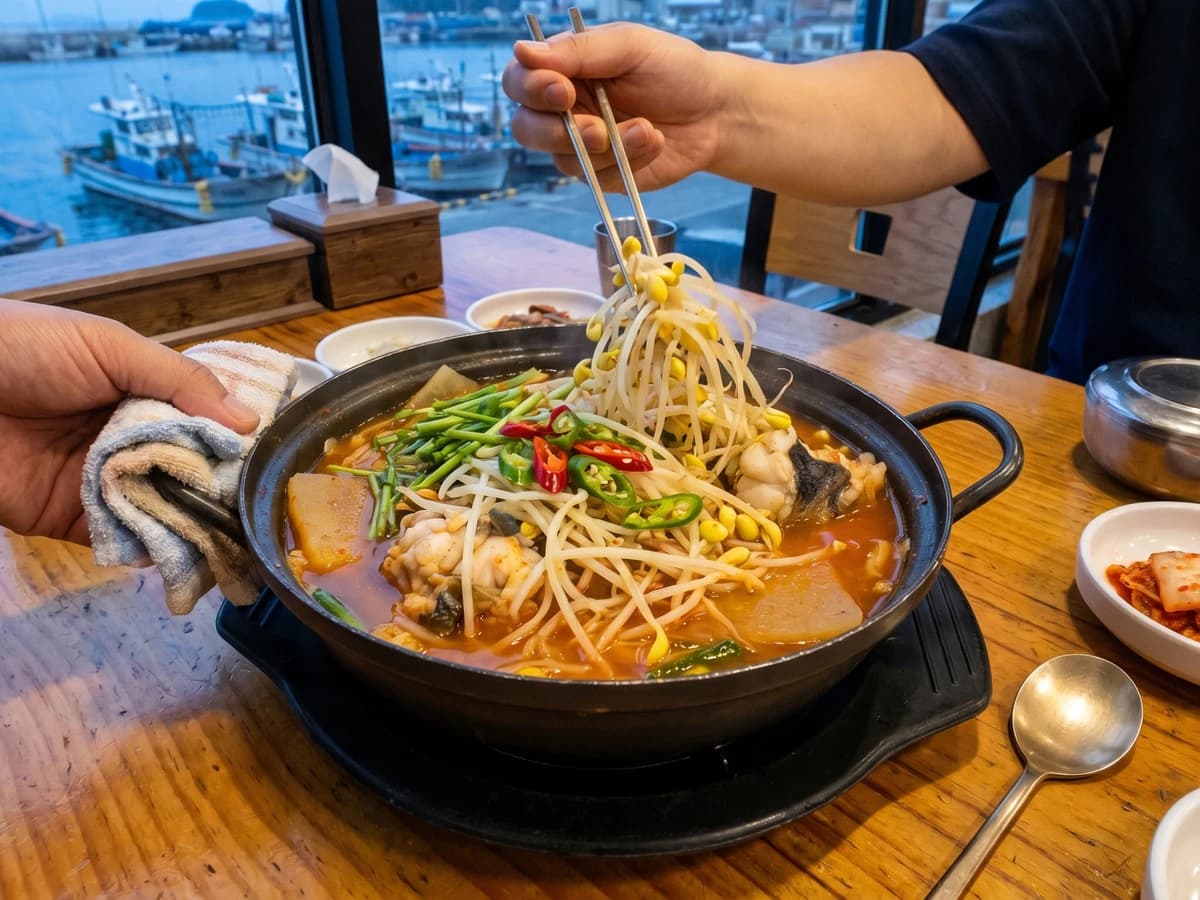
A Masan coast monkfish stew with firm white meat, gelatin at the bones, soybean sprouts for crunch, and a red broth seasoned to carry the fish, not bury it.

Chef Jeong-sun
A weeknight fish roe stew with radish and crown daisy in a clean spicy broth, where the whole success depends on adding the roe late enough that it sets tender, not chalky.

Chef Jeong-sun
Late-summer mallow leaves rubbed with salt until the bitter green water runs off, then simmered in a clean doenjang broth with dried shrimp, the quiet soup a Korean weeknight deserves.