
Chef Jeong-sun
Aehobak-guk (애호박국, Korean Zucchini Soup)
A clean summer soup of Korean zucchini and salted shrimp, built on quick anchovy-kelp broth and finished before the half-moons lose their shape on a weeknight table.
A cooking platform built around craft, culture, and the stories behind what we eat.

Created by
The court jeongol called yeolguja-tang, built in a chimney pot with clear beef broth, meatballs, fish jeon, seafood, mushrooms, and five-color vegetables arranged before the table sees the first simmer.
Sinseollo lives or dies before the fire is lit. My teacher Master Seong-nyeo would make us line up the egg yellow, egg white, mushroom brown, minari green, beef, fish, and carrot red on trays first, then she would stand back and say nothing. If the colors were muddy, the broth would not fix them. If the cuts were uneven, the court pot would show every lazy hand.
This is jeongol (arranged hot pot), not jjigae (stew). A jjigae often follows one main ingredient; a jeongol carries several prepared things arranged together and cooked at the table. Sinseollo is the court's most formal version, called yeolguja-tang in the records, with a brass vessel and central chimney once fed by embers. At home, use a shallow jeongol pan, a shabu pot, or a wide skillet on a portable burner. 시대가 바뀌면 음식도 바뀌어야 해요. When times change, food must change too. The vessel may change; the knife work and restraint do not.
I won't tell you this is easy. You will make a clear broth, season beef and mushrooms lightly, pan-fry little meatballs and fish jeon, cut jidan (egg garnish) into neat diamonds, and blanch seafood just enough. Then you arrange everything by color before the broth goes in, because the table should see abundance made orderly. Season with a careful hand. The broth should carry the ingredients, not bury them.
This is celebration food, but not museum food. People should reach into the pot, fill bowls, refill broth, and talk while it simmers. Write it down. Memory is a borrowed bowl, and a dish with this many parts deserves a firm record.
Sinseollo is both vessel and dish: a lidded brass brazier with a central chimney, and the court name yeolguja-tang (悅口子湯), a soup that pleases the mouth, appears in the records of Joseon royal cuisine. It belonged to royal banquets and yangban (scholar-official) feast tables, not ordinary weeknight cooking. The dish is part of the Korean royal court cuisine lineage protected as Important Intangible Cultural Property No. 38, transmitted through cooks such as Han Hui-sun and Hwang Hye-seong.
Quantity
450g
cut into 2 large pieces
Quantity
10 cups
Quantity
1/2 medium
peeled
Quantity
1 large leek or 2 scallions
cut in half
Quantity
4 cloves
crushed
Quantity
1 tablespoon
Quantity
1 teaspoon, divided, plus 1/4 teaspoon only if needed after tasting
Quantity
6
Quantity
1 cup
Quantity
150g
Quantity
100g
pressed dry and crumbled
Quantity
2
minced, divided
Quantity
2 cloves
minced, divided
Quantity
1 tablespoon
Quantity
1 teaspoon
Quantity
1 1/2 teaspoons
divided
Quantity
1/2 teaspoon
Quantity
1/4 teaspoon
divided
Quantity
1 teaspoon
Quantity
4 large
2 separated for jidan, 2 beaten for coating
Quantity
1/2 cup
for dusting
Quantity
200g
cut into 4cm pieces
Quantity
3 tablespoons
for pan-frying
Quantity
200g
cut into 5cm matchsticks
Quantity
1 small (about 100g)
cut into 5cm matchsticks or diamonds
Quantity
80g
trimmed and cut into 5cm lengths
Quantity
8
peeled and deveined
Quantity
200g
Quantity
8
Quantity
1 tablespoon
Quantity
2
quartered
Quantity
1 chili or 1 pinch
seeded and sliced thin if using fresh chili
Quantity
3 tablespoons soy sauce, 1 tablespoon rice vinegar, 1 tablespoon broth, 1/2 teaspoon Korean mustard
| Ingredient | Quantity |
|---|---|
| beef brisket or shankcut into 2 large pieces | 450g |
| cold water | 10 cups |
| onionpeeled | 1/2 medium |
| Korean leek (daepa) or scallionscut in half | 1 large leek or 2 scallions |
| garlic, for brothcrushed | 4 cloves |
| soup soy sauce (guk-ganjang) | 1 tablespoon |
| kosher salt | 1 teaspoon, divided, plus 1/4 teaspoon only if needed after tasting |
| dried shiitake mushrooms | 6 |
| warm water, for soaking mushrooms | 1 cup |
| lean ground beef | 150g |
| firm tofupressed dry and crumbled | 100g |
| scallionsminced, divided | 2 |
| garlic, for seasoningminced, divided | 2 cloves |
| soy sauce, for beef and mushrooms | 1 tablespoon |
| soy sauce, for meatballs | 1 teaspoon |
| toasted sesame oildivided | 1 1/2 teaspoons |
| sugar | 1/2 teaspoon |
| freshly ground black pepperdivided | 1/4 teaspoon |
| toasted sesame seeds | 1 teaspoon |
| eggs2 separated for jidan, 2 beaten for coating | 4 large |
| all-purpose flour or fine rice flourfor dusting | 1/2 cup |
| firm white fish filletcut into 4cm pieces | 200g |
| neutral oilfor pan-frying | 3 tablespoons |
| Korean radish (mu)cut into 5cm matchsticks | 200g |
| carrotcut into 5cm matchsticks or diamonds | 1 small (about 100g) |
| minari or watercresstrimmed and cut into 5cm lengths | 80g |
| large shrimppeeled and deveined | 8 |
| cleaned baby octopus or small octopus (optional) | 200g |
| cooked ginkgo nuts (optional) | 8 |
| pine nuts | 1 tablespoon |
| walnuts (optional)quartered | 2 |
| fresh red chili or silgochu (Korean chili threads) (optional)seeded and sliced thin if using fresh chili | 1 chili or 1 pinch |
| cho-ganjang dipping sauce (optional) | 3 tablespoons soy sauce, 1 tablespoon rice vinegar, 1 tablespoon broth, 1/2 teaspoon Korean mustard |
Put the beef and 10 cups cold water in a large pot and bring it slowly to a boil over medium heat. Skim the gray foam for 5 minutes, because clear broth begins with patient skimming, not with straining at the end. Add the onion, daepa or scallions, and crushed garlic, then lower the heat and simmer 1 hour 15 minutes, until the beef is tender but not falling apart. Strain through a fine sieve and reserve the beef. Measure 6 cups broth: if you have less, add hot water; if you have more, simmer it down. Season the 6 cups broth with the soup soy sauce and 1/2 teaspoon kosher salt. It should taste clean and savory, a little lighter than soup you would eat alone, because the seasoned ingredients will add their own salt.
Soak the dried shiitakes in 1 cup warm water for 30 minutes while the broth cooks. Squeeze them dry, remove the stems, and slice the caps 5mm thick. Strain the soaking water through a fine sieve and add only 1/2 cup to the broth if it smells clean and sweet; more than that can darken the pot. Slice the reserved cooked beef into 5cm strips. Toss the beef and shiitakes with 1 tablespoon soy sauce, 1 teaspoon sesame oil, 1/2 teaspoon sugar, 1 minced scallion, 1 minced garlic clove, and half the black pepper. Let them stand 15 minutes. This seasons the pieces themselves, so you don't have to make the whole broth salty.
Mix the ground beef, pressed tofu, 1 teaspoon soy sauce, 1/2 teaspoon sesame oil, the remaining minced scallion, the remaining minced garlic clove, toasted sesame seeds, 1/8 teaspoon kosher salt, and the remaining black pepper. Knead for 1 minute, until the mixture holds together. Shape into 18 small wanja (meatballs), each about 2cm wide. Dust lightly with flour, dip in the beaten eggs, and pan-fry in a thin film of oil over medium heat until pale gold, 2 to 3 minutes total. Keep them small. Large meatballs make the pot look generous for one minute and then cook unevenly.
Sprinkle the fish with 1/4 teaspoon kosher salt and let it stand 10 minutes, then pat it dry. Dust each piece lightly with flour, dip in the beaten eggs, and pan-fry over medium heat until just set, about 1 minute per side. The coating should be thin and neat, not thick like batter, because heavy coating clouds the broth. Cut the pieces into tidy rectangles or diamonds that can sit flat in the pot.
Beat the 2 egg yolks with a tiny pinch of salt, and beat the 2 whites separately with another tiny pinch. Wipe a skillet with oil, cook each into a very thin sheet over low heat, and keep the color gentle. Cut both sheets into 4cm diamonds or narrow strips. Yellow and white are kept separate here because obangsaek (five-color balance) should read clearly before anyone takes the first bite.
Bring a small pot of water to a boil. Blanch the radish for 2 minutes, the carrot for 1 minute, and the minari for 10 seconds, draining each separately. Blanch the shrimp for 45 seconds, just until barely opaque. If using octopus, lower it into the water and lift it out the moment the legs curl, usually 45 to 60 seconds, because one extra minute turns it tough. Keep every ingredient in its own pile. The order matters because the final simmer at the table is short, and the pot should not wait while raw carrot catches up.
Set a sinseollo brazier, shabu pot, or 30cm shallow jeongol pan on the unlit burner. Put the radish and the seasoned beef and shiitakes across the bottom, where they can flavor the broth. Arrange the meatballs, fish jeon, shrimp, octopus if using, carrot, minari, and egg jidan in radiating sections by color. Tuck in the ginkgo nuts and walnuts if using. Arrange before the broth goes in, not after, because this is jeongol: the table sees the order, and the ingredients cook together without stirring.
Heat the broth until hot, then pour about 5 cups around the side of the arranged pot, not straight over the egg and fish. The broth should come just below the top layer so the colors remain visible. Bring to a gentle simmer at the table and cook 8 to 10 minutes. Do not boil hard. A hard boil breaks the jeon, toughens the seafood, and muddies the broth you worked to keep clear.
Scatter the pine nuts and red chili or silgochu over the top just before serving. Stir together the optional cho-ganjang dipping sauce in a small bowl. Let people take a little of everything, then add the reserved hot broth around the edge as the pot lowers. After the first round, taste the broth. If it tastes flat, dissolve exactly 1/4 teaspoon kosher salt in 2 tablespoons hot broth and pour it around the side. If it tastes strong, add 1/2 cup hot water. That is measuring, not fussiness; it is how the second round eats as well as the first.
1 serving (about 620g)
Culinary guides, cultural storytelling, and the editorial depth that makes cooking meaningful.
Discover Culinary ExplorerChef Jeong-sun
A clean summer soup of Korean zucchini and salted shrimp, built on quick anchovy-kelp broth and finished before the half-moons lose their shape on a weeknight table.
Chef Jeong-sun
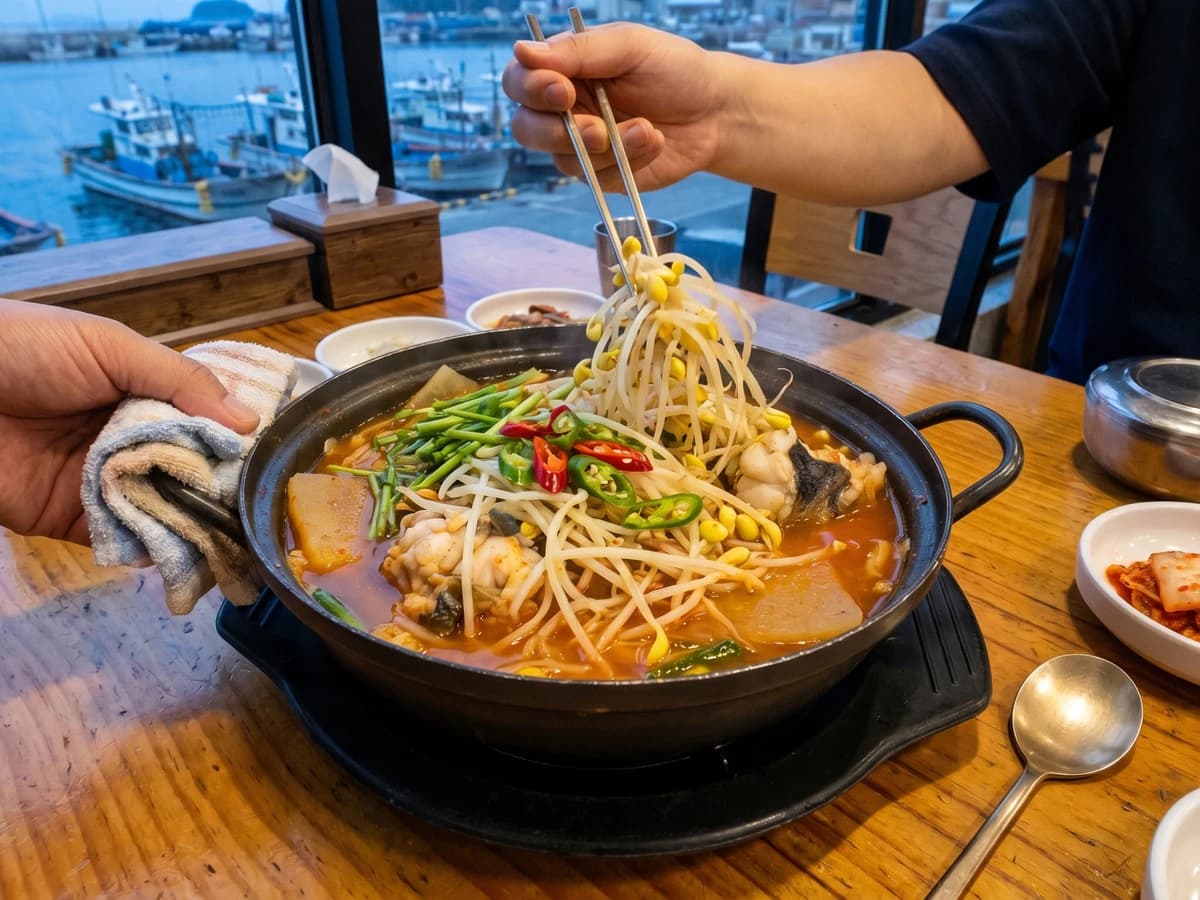
A Masan coast monkfish stew with firm white meat, gelatin at the bones, soybean sprouts for crunch, and a red broth seasoned to carry the fish, not bury it.

Chef Jeong-sun
A weeknight fish roe stew with radish and crown daisy in a clean spicy broth, where the whole success depends on adding the roe late enough that it sets tender, not chalky.

Chef Jeong-sun
Late-summer mallow leaves rubbed with salt until the bitter green water runs off, then simmered in a clean doenjang broth with dried shrimp, the quiet soup a Korean weeknight deserves.