
Chef Jeong-sun
Aehobak-guk (애호박국, Korean Zucchini Soup)
A clean summer soup of Korean zucchini and salted shrimp, built on quick anchovy-kelp broth and finished before the half-moons lose their shape on a weeknight table.
A cooking platform built around craft, culture, and the stories behind what we eat.
Created by
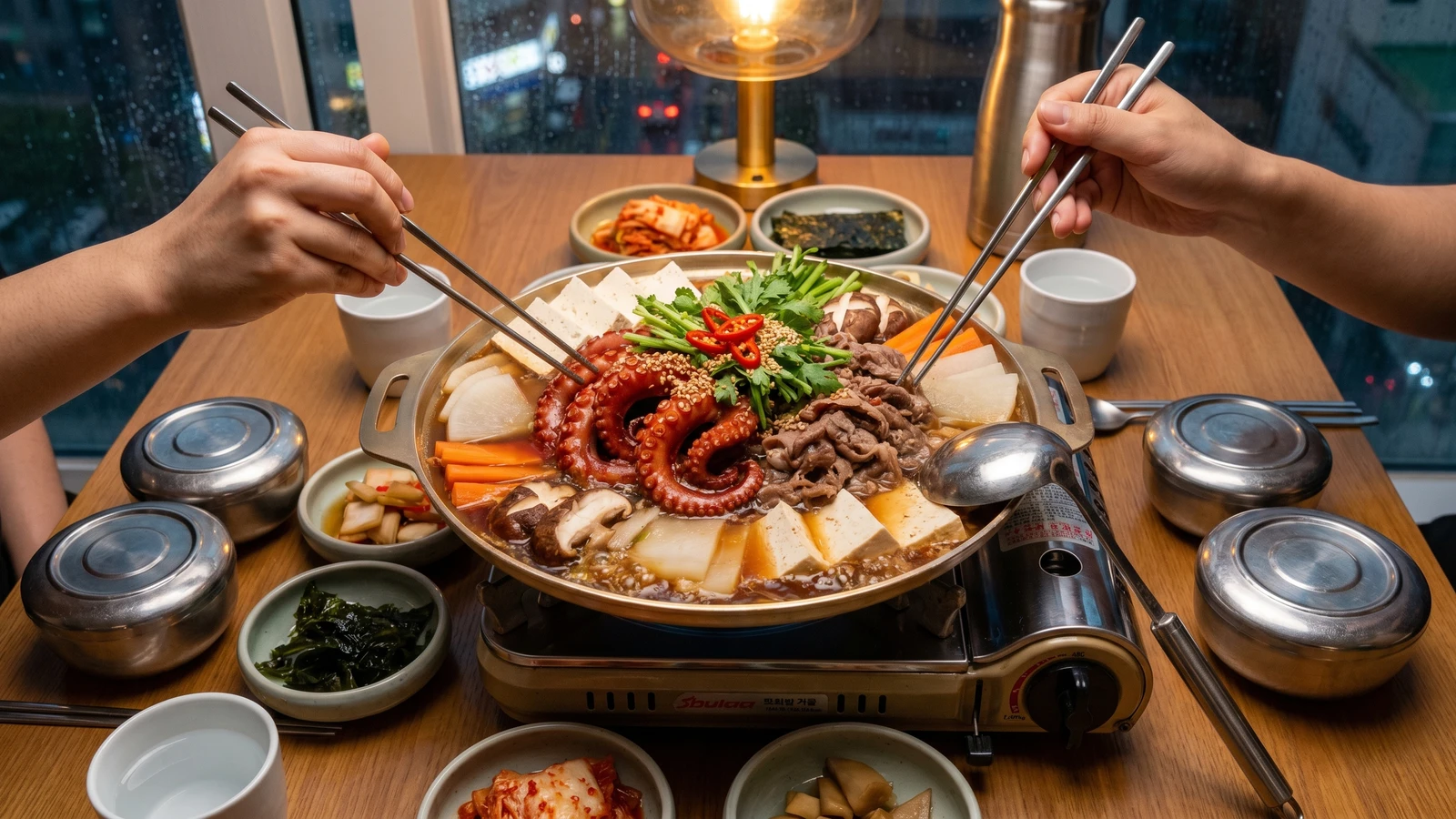
Sweet marinated bulgogi and quick-cooked nakji meet in a shallow jeongol pan, arranged by color, simmered at the table, and kept honest with a clean anchovy-kelp broth.
Bulnak-jeongol is decided before the fire is lit. If you throw everything into the pot like jjigae (stew), you will still have dinner, but you will not have jeongol (arranged hot pot). A jjigae leans on one main ingredient and comes to the table already finished. A jeongol carries several things together, laid out in the pan so the table sees the order before the broth goes in.
Master Seong-nyeo made us arrange one pan three times before she allowed a ladle near it. I was young enough to think she cared only about prettiness. She cared about cooking order. Radish and cabbage under the broth sweeten it, beef at the center loosens into the liquid, mushrooms give their brown depth, and the nakji (small octopus) waits until the end because it turns tough the moment you forget it. Notebook 42 says the circle is not decoration. It is the instruction sheet.
Tonight this dish asks for restraint. The beef is sweet in the bulgogi (marinated beef) way, the octopus is red with gochugaru (Korean chili flakes), and the broth has to stay clean enough that both can be tasted. Pull the dasima (dried kelp) before it turns bitter. Use one tablespoon of gochujang (chili paste), not a fistful. Lift the octopus the moment it curls. 손맛 is real; I measure it anyway, because the next cook deserves more than a guess.
A charcoal brazier is not required. 시대가 바뀌면 음식도 바뀌어야 해요. When times change, food must change too. A wide shallow pan on a portable burner is honest, and it may even be kinder to the cook. Put rice on the table, set the pan where everyone can reach, and let the pot do what jeongol is meant to do: gather hands toward the same center.
Jeongol is a Korean table hot pot cooked in a wide, shallow vessel, distinct from jjigae because several ingredients are arranged together and cooked in front of the diners. The category has late Joseon roots, and courtly yeolguja-tang, later called sinseollo, appears in records such as the 19th-century Siuijeonseo, but bulnak-jeongol itself is modern restaurant and home dinner-party food, not a court dish. Its name joins bulgogi (marinated beef) and nakji (small octopus), a twentieth-century pairing made practical by portable tabletop burners.
Quantity
5 cups
Quantity
1 piece, about 4 inches square
Quantity
12
heads and guts removed
Quantity
100g
sliced 1/4 inch thick
Quantity
2
Quantity
1 tablespoon
Quantity
1/2 teaspoon, plus more if needed
Quantity
400g
sliced for bulgogi
Quantity
3 tablespoons
Quantity
3 tablespoons
grated
Quantity
2 tablespoons
grated
Quantity
1 tablespoon
Quantity
2 teaspoons
Quantity
2 teaspoons
minced
Quantity
1 tablespoon
Quantity
1/4 teaspoon
freshly ground
Quantity
450g
fresh or thawed
Quantity
2 tablespoons
for cleaning octopus
Quantity
1 tablespoon
for cleaning octopus
Quantity
2 tablespoons
Quantity
1 tablespoon
Quantity
1 tablespoon
Quantity
1 tablespoon
Quantity
2 teaspoons
minced
Quantity
1 teaspoon
minced
Quantity
1 teaspoon
Quantity
1 teaspoon
Quantity
150g
cut into 2-inch pieces
Quantity
120g
cut into thin half-moons
Quantity
1/2 medium
sliced
Quantity
1 small
cut into thin matchsticks
Quantity
100g
trimmed
Quantity
200g
cut into 1/2-inch slabs
Quantity
50g
soaked 20 minutes and drained
Quantity
80g
cut into 3-inch lengths
Quantity
3
cut into 2-inch lengths
Quantity
1
sliced on the diagonal
Quantity
1
sliced on the diagonal
Quantity
1 teaspoon
for finishing
| Ingredient | Quantity |
|---|---|
| water | 5 cups |
| dried kelp (dasima) | 1 piece, about 4 inches square |
| large dried anchovies (myeolchi)heads and guts removed | 12 |
| Korean radish for brothsliced 1/4 inch thick | 100g |
| dried shiitake mushrooms (optional) | 2 |
| Korean soup soy sauce (guk-ganjang), for broth | 1 tablespoon |
| kosher salt | 1/2 teaspoon, plus more if needed |
| thin-sliced beef ribeye or sirloinsliced for bulgogi | 400g |
| soy sauce, for beef marinade | 3 tablespoons |
| Korean pear or Asian peargrated | 3 tablespoons |
| onion, for beef marinadegrated | 2 tablespoons |
| mirin or rice wine, for beef marinade | 1 tablespoon |
| sugar, for beef marinade | 2 teaspoons |
| garlic, for beef marinademinced | 2 teaspoons |
| toasted sesame oil, for beef marinade | 1 tablespoon |
| black pepperfreshly ground | 1/4 teaspoon |
| small octopus (nakji)fresh or thawed | 450g |
| all-purpose flourfor cleaning octopus | 2 tablespoons |
| coarse saltfor cleaning octopus | 1 tablespoon |
| gochugaru (Korean chili flakes) | 2 tablespoons |
| gochujang (Korean chili paste) | 1 tablespoon |
| Korean soup soy sauce (guk-ganjang), for octopus sauce | 1 tablespoon |
| mirin or rice wine, for octopus sauce | 1 tablespoon |
| garlic, for octopus sauceminced | 2 teaspoons |
| gingerminced | 1 teaspoon |
| maesil-cheong (green plum syrup) or sugar | 1 teaspoon |
| toasted sesame oil, for octopus sauce | 1 teaspoon |
| napa cabbage leavescut into 2-inch pieces | 150g |
| Korean radish for the potcut into thin half-moons | 120g |
| onionsliced | 1/2 medium |
| carrotcut into thin matchsticks | 1 small |
| mixed mushroomstrimmed | 100g |
| medium-firm tofucut into 1/2-inch slabs | 200g |
| dangmyeon (sweet potato glass noodles)soaked 20 minutes and drained | 50g |
| minari (water dropwort) or ssukgat (crown daisy)cut into 3-inch lengths | 80g |
| scallionscut into 2-inch lengths | 3 |
| red chilisliced on the diagonal | 1 |
| green chilisliced on the diagonal | 1 |
| toasted sesame seedsfor finishing | 1 teaspoon |
Put the nakji in a bowl with the flour and coarse salt. Rub it firmly for 1 minute, especially along the tentacles, then rinse under cold running water until it no longer feels slippery. Remove the beak and eyes if your fishmonger has not done it. Cut the tentacles into 2-inch lengths and the head into bite-size strips, then keep it cold. Clean octopus cooks cleanly; poorly rinsed octopus muddies the broth before you have even begun.
Put the water, dasima, anchovies, 100g radish, and dried shiitakes if using in a pot over medium heat. When small bubbles gather at the edge and the kelp softens, lift the dasima out at once. Leave it longer and it gives bitterness and a slick texture. Simmer the anchovies, radish, and shiitakes for 10 minutes more, then strain. Season the broth with 1 tablespoon guk-ganjang and 1/2 teaspoon salt. It should taste clean and a little underseasoned, because the beef marinade and octopus sauce will join it later.
Mix the soy sauce, grated pear, grated onion, mirin, sugar, 2 teaspoons minced garlic, 1 tablespoon sesame oil, and black pepper. Add the beef and turn it gently with your hands until every slice is coated. Let it sit 20 minutes at room temperature, or up to 4 hours in the refrigerator. Thin beef does not need a long soak; too much time turns it salty and soft.
Mix the gochugaru, gochujang, guk-ganjang, mirin, 2 teaspoons minced garlic, ginger, maesil-cheong or sugar, and 1 teaspoon sesame oil. Spoon two-thirds of this sauce over the octopus and keep the remaining sauce for adjusting the pot. One tablespoon of gochujang is enough. The red color should come mostly from gochugaru, so the broth stays bright and the octopus still tastes like the sea.
Drain the soaked dangmyeon. Cut the cabbage into pieces that can be picked up with chopsticks, slice the pot radish thin so it softens quickly, and keep the carrot narrow enough to cook with the mushrooms. Trim the minari or ssukgat but do not chop it small. Jeongol is eaten from the shared pan, so every piece should be easy to lift without tearing the whole arrangement apart.
In a wide 12-inch jeongol pan, lay the radish, cabbage, and onion across the bottom. Arrange the carrot, mushrooms, tofu, scallions, chilies, minari, and drained dangmyeon in separate bands by color. Set the marinated beef in the center. Keep the seasoned octopus in its bowl beside the burner for now. This is not fussiness: the lower vegetables sweeten the broth, the beef can be loosened as it cooks, and the octopus waits so it stays tender.
Set the pan on a portable burner at the table. Pour in 4 cups of hot broth around the edges, keeping 1 cup back for later. Bring it to a steady simmer and cook 5 to 6 minutes, loosening the beef with chopsticks as it firms and letting the vegetables settle. Taste the broth. If it is flat, add a teaspoon or two of the reserved octopus sauce. If it is strong, add a splash of the reserved broth. Adjust in small amounts, because a shared pot concentrates as it cooks.
Add the seasoned octopus to the center of the active simmer and spread the pieces so they touch the broth. Cook 90 seconds to 2 minutes, just until the tentacles curl and the flesh turns opaque. Lift the first cooked pieces into bowls or to the cooler edge of the pan. Do not let octopus sit there while everyone talks. That is how tender becomes rubber.
Scatter the sesame seeds over the top and tuck in any remaining minari for a fresh green finish. Keep the burner low as you eat, adding the reserved broth when the pan reduces. Serve with hot rice, kimchi, and a few clean banchan. The broth should taste of beef, octopus, mushrooms, and vegetables in balance, not of sugar and chili paste alone. This is bap doduk, a rice thief, but a well-mannered one.
1 serving (about 650g)
Culinary guides, cultural storytelling, and the editorial depth that makes cooking meaningful.
Discover Culinary ExplorerChef Jeong-sun
A clean summer soup of Korean zucchini and salted shrimp, built on quick anchovy-kelp broth and finished before the half-moons lose their shape on a weeknight table.
Chef Jeong-sun
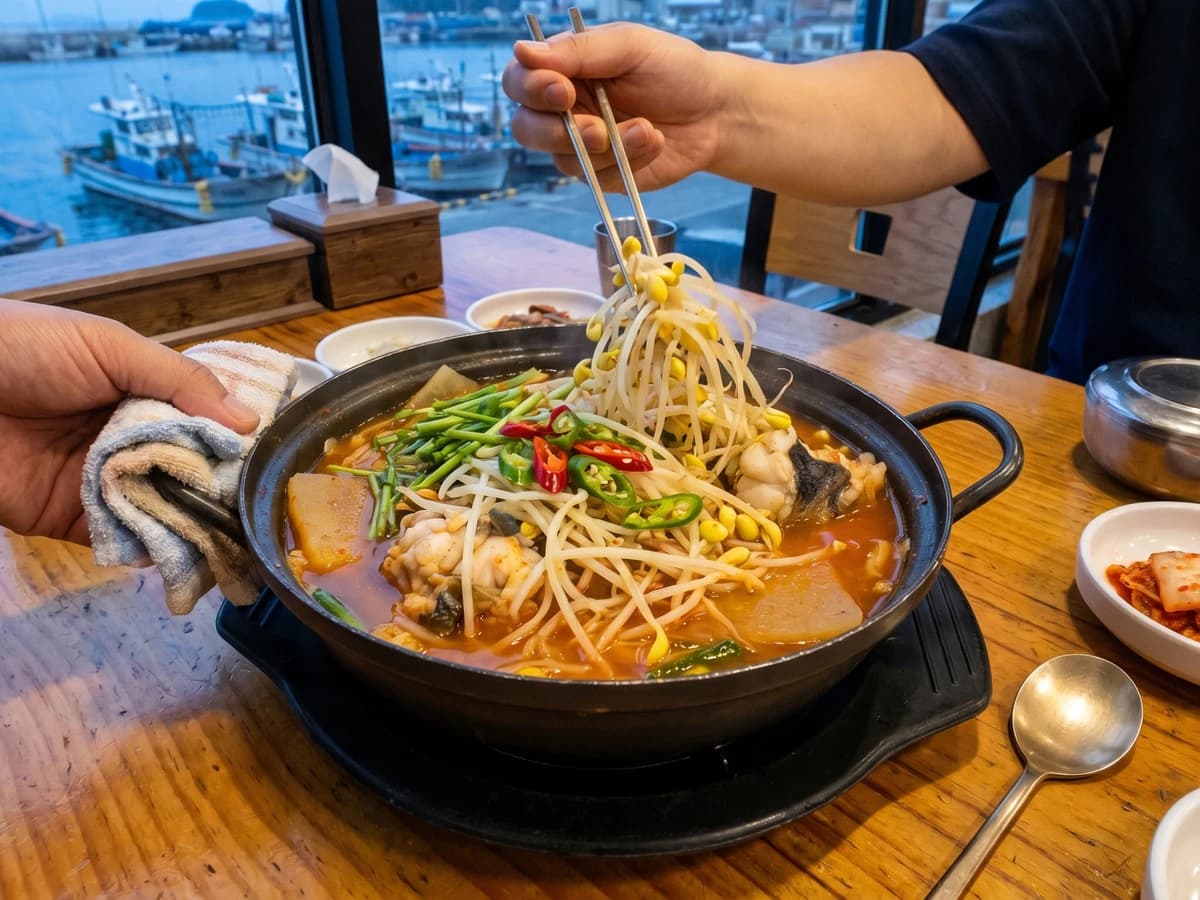
A Masan coast monkfish stew with firm white meat, gelatin at the bones, soybean sprouts for crunch, and a red broth seasoned to carry the fish, not bury it.

Chef Jeong-sun
A weeknight fish roe stew with radish and crown daisy in a clean spicy broth, where the whole success depends on adding the roe late enough that it sets tender, not chalky.

Chef Jeong-sun
Late-summer mallow leaves rubbed with salt until the bitter green water runs off, then simmered in a clean doenjang broth with dried shrimp, the quiet soup a Korean weeknight deserves.