Culinary Explorer

A cooking platform built around craft, culture, and the stories behind what we eat.
Discover Culinary Explorer
Domimyeon (도미면, Court Sea Bream Noodle Hot Pot)

Domimyeon (도미면, Court Sea Bream Noodle Hot Pot)

Created by

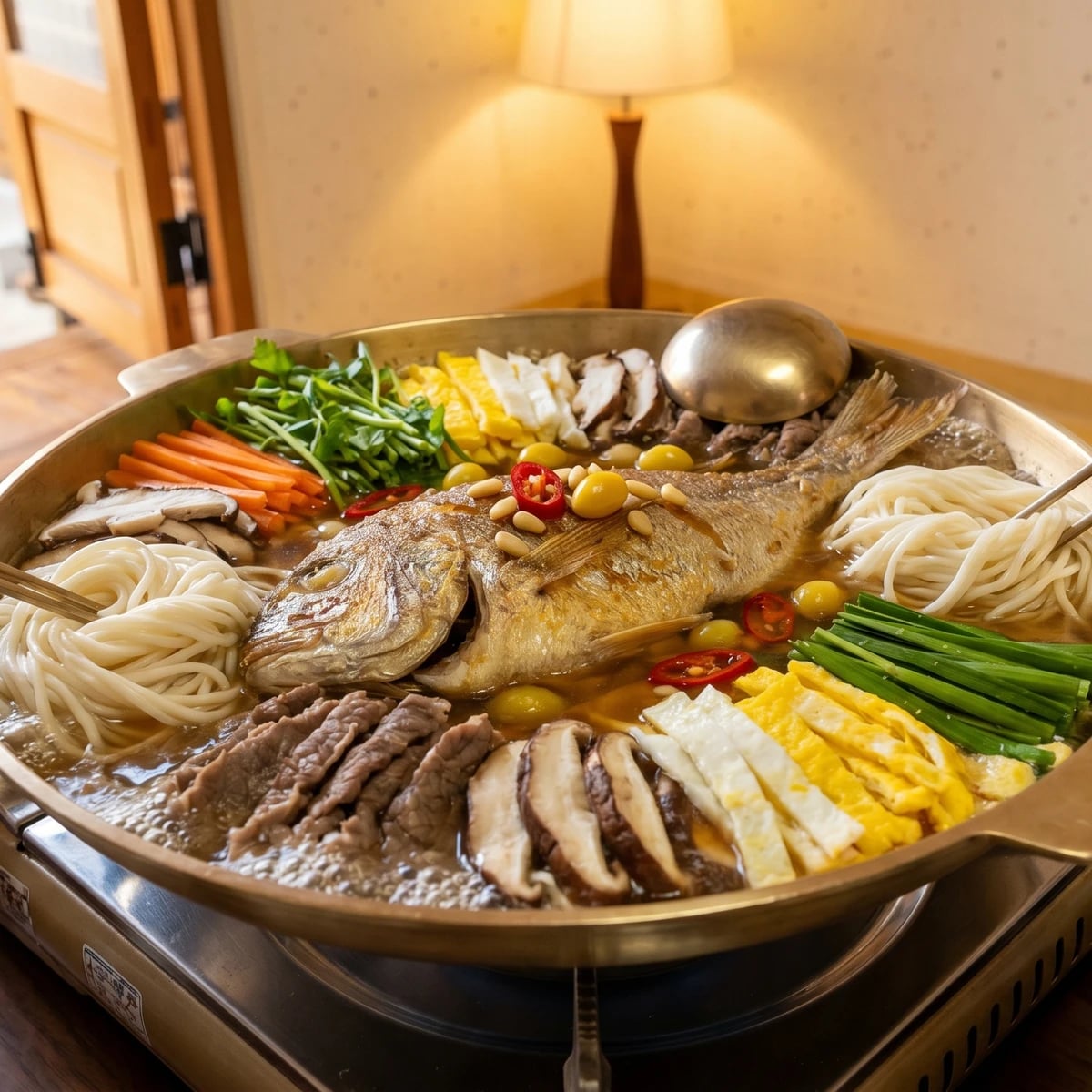
A Joseon court jeongol from the 1795 banquet records, with pan-fried sea bream, seasoned beef, mushrooms, egg garnish, and noodles arranged by color before clear broth meets the pot.

Soups & Stews
Korean
Special Occasion
Celebration
Dinner Party
55 min
Active Time
50 min cook1 hr 45 min total
Yield4 to 6 servings

Domimyeon lives or dies before the broth is poured. You can buy a fine sea bream and still ruin the pot if you let the noodles shed starch into the broth, if the kelp sits too long, or if the egg garnish goes in early and turns ragged. This is a jeongol (tableside hot pot), not a jjigae (stew). A jjigae usually carries one name and one center; a jeongol asks several prepared things to sit together clearly, then finish in front of the table.

Master Seong-nyeo made us arrange the ingredients twice: once on the board, once in the pan. Yellow egg, green minari, white noodle, brown mushroom, red chili, the fish holding the center because celebration needs a center. She would tap the side of the pan if a carrot crossed into the mushrooms. I thought that was severity. Later I understood. The arrangement is the cooking map. It tells you what is raw, what is tender, what must be lifted quickly, and what can simmer.

I won't tell you this is easy. Tonight it asks for a good fishmonger, a patient knife, a broth kept clear, and a table ready to eat from the pot as it changes. A sinseollo (royal brazier) is beautiful, but a wide jeongol pan on a portable burner does the work honestly. 시대가 바뀌면 음식도 바뀌어야 해요. When times change, food must change too. Keep the order and the restraint, and the dish will still know its own name.

Domimyeon is recorded as seunggiaktang in the Wonhaeng Eulmyo Jeongri Uigwe, the royal protocol for King Jeongjo's 1795 procession to Hwaseong and the sixtieth-birthday feasts for his mother, Lady Hyegyeong. The name domimyeon came to foreground the sea bream, domi, and noodles, myeon, while the older banquet name marks it as a Joseon court hot pot rather than an everyday stew. It belongs to the jeongol family: several prepared meats, seafood, vegetables, and garnishes arranged together and finished at the table, unlike jjigae, which usually names one main ingredient and comes to the table already cooked.

The technique, the tradition, and the story behind every dish.

Discover Culinary Explorer

Ingredients

whole sea bream (domi, preferably chamdom)

Quantity

1 fish, 800g to 1kg

scaled and gutted, head and tail on

fine sea salt

Quantity

1 teaspoon

for the fish

clear rice wine or cheongju

Quantity

1 tablespoon

for the fish

grated ginger

Quantity

1 teaspoon

all-purpose flour or potato starch

Quantity

3 tablespoons

for dusting

neutral oil

Quantity

2 tablespoons

for pan-frying

dried shiitake mushrooms

Quantity

6

warm water

Quantity

1 1/2 cups

for soaking mushrooms

water

Quantity

7 1/2 cups

large dried anchovies (myeolchi)

Quantity

12

heads and guts removed

dried kelp (dasima)

Quantity

1 piece, about 5 inches square

Korean radish (mu)

Quantity

200g

peeled and cut into 1/2-inch slices

soup soy sauce (guk-ganjang)

Quantity

2 tablespoons

clear rice wine or cheongju

Quantity

1 tablespoon

for the broth

kosher salt

Quantity

3/4 teaspoon, plus more as needed

beef sirloin or tenderloin

Quantity

200g

sliced paper-thin against the grain

soy sauce

Quantity

1 tablespoon

toasted sesame oil

Quantity

2 teaspoons

divided

minced scallion

Quantity

1 teaspoon

minced garlic

Quantity

1 teaspoon

sugar

Quantity

1/2 teaspoon

freshly ground black pepper

Quantity

1/8 teaspoon

somyeon (thin wheat noodles)

Quantity

180g

large eggs

Quantity

2

yolks and whites separated

fine sea salt

Quantity

1/8 teaspoon

for the eggs

neutral oil

Quantity

1 teaspoon

for the egg garnish

oyster or beech mushrooms

Quantity

100g

separated into small clusters

carrot

Quantity

1 small (80g)

cut into 2-inch matchsticks

onion

Quantity

1/2 medium (100g)

thinly sliced

minari (Korean water parsley) or crown daisy

Quantity

80g

cut into 2-inch lengths

scallions

Quantity

2

cut into 2-inch lengths

red chili

Quantity

1

thinly sliced on the diagonal

green chili

Quantity

1

thinly sliced on the diagonal

cleaned small octopus (nakji) or baby octopus (optional)

Quantity

200g

cut into 2-inch pieces

kosher salt (optional)

Quantity

1 teaspoon

for blanching the octopus

peeled ginkgo nuts (optional)

Quantity

12

toasted

pine nuts (optional)

Quantity

1 tablespoon

Equipment Needed

  • Wide shallow jeongol pan or shabu pot, 30 to 32 cm
  • Portable tabletop burner
  • Large 30 cm skillet or fish pan
  • Fine-mesh strainer
  • Fish spatula
  • Small nonstick skillet for jidan

Instructions

  1. 1

    Season the fish

    Rinse the sea bream quickly, then dry it very well, including the belly cavity. Score each side with 3 diagonal cuts down to the bone. Rub the fish with 1 teaspoon fine sea salt, 1 tablespoon rice wine, and the grated ginger, then let it stand 20 minutes. The salt firms the flesh so the fish holds its shape in the pot; the rice wine and ginger clean up the raw smell without covering the fish.

    Ask the fishmonger to scale, gut, and remove the gills. Keep the head and tail for a celebration table, but check the belly yourself. A dark blood line left inside will muddy the broth.
  2. 2

    Build the broth

    Soak the dried shiitake mushrooms in 1 1/2 cups warm water for 20 minutes. Lift out the mushrooms, strain the soaking liquid through a fine sieve, and save both. Put the mushroom liquid, 7 1/2 cups water, anchovies, kelp, radish, and shiitake stems in a pot. Bring it slowly to a simmer over medium heat. Pull the kelp out as soon as the first steady bubbles appear, because kelp left too long turns the broth slick and bitter. Simmer the anchovies 10 minutes more, lift them out, then simmer the radish and mushroom stems another 8 minutes. Strain. Season with soup soy sauce, 1 tablespoon rice wine, and 3/4 teaspoon kosher salt. You should have about 6 to 7 cups clear broth.

    Do not skip removing the anchovy heads and guts. That small black line is where much of the bitterness sits, and people blame the whole fish for one careless pinch.
  3. 3

    Season the beef

    Mix the sliced beef with soy sauce, 1 teaspoon sesame oil, minced scallion, minced garlic, sugar, and black pepper. Let it sit 20 minutes while you prepare the garnish. The sugar is only 1/2 teaspoon. In this pot the beef supports the broth; it should not turn the whole pan sweet.

  4. 4

    Make the jidan

    Beat the egg yolks with a tiny pinch of the egg salt, and beat the whites separately with the remaining salt. Wipe a small skillet with 1 teaspoon oil and cook the yolks and whites separately over low heat into thin sheets, with no browning if your hand can manage it. Cool, then cut into fine strips or small diamonds. This is jidan (egg garnish), and it goes on at the end so it stays clean and bright.

  5. 5

    Cook the noodles

    Boil the somyeon in plenty of water 1 minute less than the package says, usually about 2 minutes. Rinse under cold running water, rubbing lightly with your hands until the surface starch is gone, then drain hard and toss with 1 teaspoon sesame oil. Cooked noodles thrown straight into the hot pot make the broth cloudy. Rinsing and oiling them keeps each coil separate until the last simmer.

  6. 6

    Blanch the octopus

    If using octopus, bring 4 cups water with 1 teaspoon kosher salt to a boil in a small pot. Drop in the octopus pieces and lift them out the moment they curl, usually 20 to 30 seconds. Put them on a plate. They will finish in the hot pot; cook them longer now and they toughen before the table sees them.

  7. 7

    Pan-fry the bream

    Pat the seasoned bream dry again, dust it lightly with flour or potato starch, and shake off every excess patch. Heat 2 tablespoons neutral oil in a large skillet over medium-high heat. Fry the fish 4 to 5 minutes on the first side and 3 to 4 minutes on the second, just until the skin is golden and the flesh is mostly opaque. It should not be cooked dry. The pan-frying sets the skin and bones so the fish can sit in broth without falling apart.

  8. 8

    Arrange the pan

    Set a wide jeongol pan on the table burner, still turned off. Spread the onion and a few cooked radish slices from the broth on the bottom to keep the fish from catching. Lay the pan-fried bream in the center. Around it, arrange the seasoned raw beef, soaked shiitake caps, oyster mushrooms, carrot, scallions, chilis, ginkgo nuts, and the blanched octopus if using, keeping each color in its own place. Hold back the noodles, minari, jidan, and pine nuts. The arrangement is not vanity. It lets the table see what is cooking and lets you move quickly when one ingredient is done before another.

  9. 9

    Simmer at table

    Pour 5 cups hot broth around the side of the pan, not directly over the fish. Turn the burner to medium and bring the broth to a steady simmer. Spoon broth over the bream a few times, gently, and skim any foam that rises. Cook 6 to 8 minutes, until the beef is no longer pink, the mushrooms soften, and the thickest part of the fish reaches 63C / 145F or flakes cleanly from the bone. Add more broth from the reserved cup if the pan looks shallow.

  10. 10

    Finish and serve

    Slide the cooked noodles into one side of the pan for the last 60 to 90 seconds, just long enough to warm them. Add the minari, jidan, pine nuts, and any reserved chili slices, then turn the heat low. Taste the broth now. If it is flat, add salt 1/4 teaspoon at a time; if it needs depth, add soup soy sauce 1 teaspoon at a time. 손맛 (hand-taste) is real; measure the correction so you can make the same pot again. Serve from the pan with rice and small banchan, warning the table that the fish is bone-in.

Chef Tips

  • Sea bream is best in spring, but a well-raised farmed domi can be good outside that month. Look for clear eyes, red gills, firm flesh, and a clean sea smell. If the fish is tired, buy black sea bass or red snapper instead and keep the technique.
  • Use somyeon (thin wheat noodles), not dangmyeon (glass noodles), for this dish. Glass noodles are welcome in many jeongol pots, but here they make the pot heavier and pull it toward another dish.
  • Soup soy sauce is saltier and lighter than regular soy sauce, which is why it seasons the broth without staining it dark. Start with the measured amount, then adjust in small increments at the table.
  • The safe corner to cut is the vessel. A sinseollo brazier may become a shabu pot, a wide skillet, or a jeongol pan on a portable burner. The unsafe corners are cloudy broth, overcooked noodles, and careless fish handling.
  • Octopus is optional. If your market has beautiful small nakji, use it and lift it the moment it curls. If the octopus looks dull or smells strong, leave it out. Technique first, shopping pride second.

Advance Preparation

  • The broth can be made up to 2 days ahead, chilled, and skimmed before using. Reheat it before pouring it into the jeongol pan so the table cooking stays quick.
  • The jidan can be made 1 day ahead and kept between sheets of parchment in the refrigerator. Cut it after chilling if you want cleaner strips.
  • Vegetables can be cut up to 6 hours ahead and refrigerated in separate covered containers. Keep minari wrapped in a barely damp towel so it stays crisp.
  • The fish can be cleaned and salted up to 2 hours ahead in the refrigerator. Pan-fry it close to serving; if you must do it earlier, keep it no longer than 1 hour at cool room temperature, or refrigerate it and let the hot pot finish warming it through.
  • Boil the noodles no more than 30 minutes ahead. Rinse well, drain hard, toss with sesame oil, and cover. Older noodles swell and lose their clean bite.

Frequently Asked Questions

Nutrition Information

1 serving (about 610g)

Calories
555 calories
Total Fat
17 g
Saturated Fat
4 g
Trans Fat
0 g
Unsaturated Fat
12 g
Cholesterol
215 mg
Sodium
1630 mg
Total Carbohydrates
55 g
Dietary Fiber
5 g
Sugars
6 g
Protein
50 g

Note: Chef personas and recipes are created with AI assistance. Cook with care: follow safe food-handling practices, check doneness with a thermometer when needed, and adapt for allergies and your kitchen.

Where cooking meets culture.

Culinary guides, cultural storytelling, and the editorial depth that makes cooking meaningful.

Discover Culinary Explorer

More from Jeongol: The Tabletop Hot Pot

Browse the full collection