
Chef Joost
Bavarois met Frambozensaus
A French-Bavarian name, a Dutch party mould, and the quiet trick of gelatine: custard cooled just enough, cream folded gently, and a dessert made ahead like a host with sense.
A cooking platform built around craft, culture, and the stories behind what we eat.
Created by
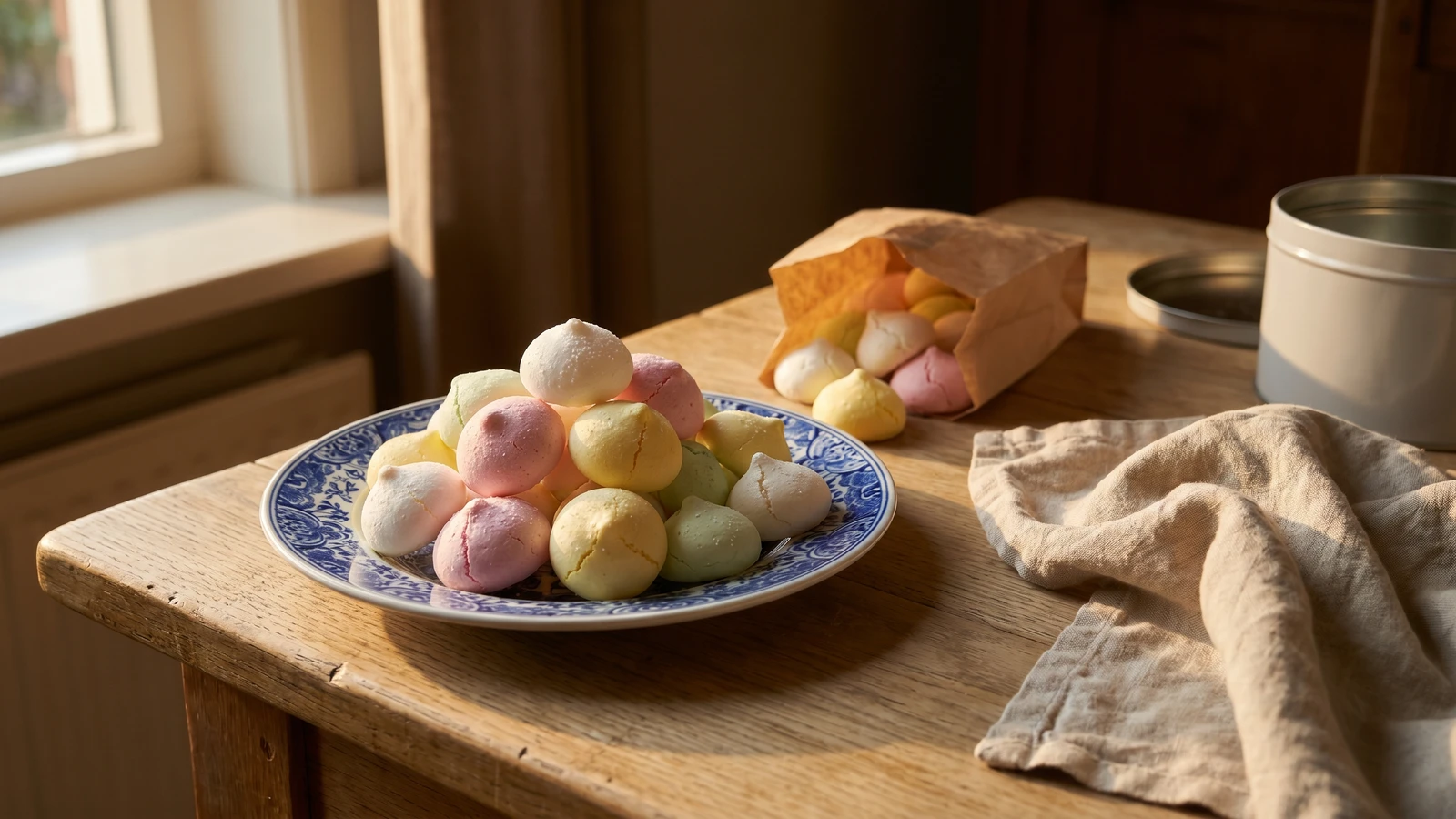
The name means little foams, and that is the whole Dutch trick: egg white, sugar, patience, and a sweet so light it almost denies being food.
The name already tells you almost everything. Schuim is foam, and schuimpjes are the little foams: pale pink, white, yellow, sometimes mint green, sitting among the Sinterklaas sweets as if a spoonful of cloud had been caught behaving badly. Children understand them at once. Scholars, for obvious reasons, require longer.
But let me tell you a secret. Schuimpjes belong to that clever Dutch family of sweets where thrift dresses itself as abundance. Like Haagse bluf, that grand bowl of whipped egg white and berry syrup, they make a feast out of air. Egg whites left from richer baking did not go to waste. Sugar, once expensive enough to announce prosperity, turned the leftovers into little festive coins for the sweet bowl.
The cooking is nearly nothing, which means the method matters. You are not really baking these; you are drying them. A hot oven browns the sugar and makes them sulk. A low oven coaxes the outside crisp while the middle stays dry and light, with that small chalky snap under the teeth that every Dutch child remembers from the Sinterklaas paper bag. Hou het altijd simpel: clean bowl, patient whipping, slow heat, and then leave them alone until they are ready to lift from the paper without argument.
Schuimpjes are part of the Dutch Sinterklaas and winter sweet tradition, sold with kruidnoten, pepernoten, taaitaai, and suikergoed in mixed bags for children. Their name comes plainly from Dutch schuim, foam, describing the beaten egg white that gives the candy its body; no grander etymology is needed. Meringue techniques spread through European confectionery in the seventeenth and eighteenth centuries as refined sugar became more available, and the Dutch home version kept the idea practical: small drops, coloured lightly, dried slowly, and stored for the feast days.
Quantity
3, about 90g
at room temperature
Quantity
1/4 teaspoon
Quantity
1/2 teaspoon
Quantity
150g
Quantity
75g
sifted
Quantity
1 teaspoon vanilla sugar or 1/2 teaspoon extract
Quantity
a few drops
| Ingredient | Quantity |
|---|---|
| large egg whitesat room temperature | 3, about 90g |
| fine salt | 1/4 teaspoon |
| lemon juice or white vinegar | 1/2 teaspoon |
| fine caster sugar | 150g |
| icing sugarsifted | 75g |
| vanilla sugar or vanilla extract (optional) | 1 teaspoon vanilla sugar or 1/2 teaspoon extract |
| red, yellow, or green food colouring (optional) | a few drops |
Heat the oven to 90C. Line two baking trays with baking paper. If your oven runs hot, choose 80C; schuimpjes should dry pale, not tan. Sugar remembers every degree.
Put the egg whites, salt, and lemon juice into a spotless bowl and whisk until they hold soft peaks. The bowl must be free of fat, because fat collapses foam with scholarly efficiency. When the peaks bend gently at the tip, you are ready for the sugar.
Add the caster sugar one tablespoon at a time, whisking well after each addition, until the meringue is thick, glossy, and holds stiff peaks. Rub a little between your fingers; if it feels gritty, whisk another minute. The sugar must dissolve enough to give a crisp shell rather than a sandy bite.
Sift the icing sugar over the meringue and fold it in gently with the vanilla. If you want the old sweet-shop colours, divide the mixture and fold a few drops of colour through each bowl. Stop while the colour is still a little streaked if you like; perfect uniformity is for factory sweets.
Spoon the meringue into a piping bag fitted with a small star or plain nozzle. Pipe little drops, about 2 to 3 centimetres wide, leaving a little space between them. No piping bag? Use two teaspoons. A home kitchen is allowed to look like one.
Bake for 1 hour 15 minutes to 1 hour 30 minutes, rotating the trays halfway through, until the schuimpjes lift cleanly from the paper and feel dry and light. Turn off the oven, prop the door open slightly, and leave them inside for 30 minutes more. This slow cooling keeps them crisp instead of sticky.
Let the schuimpjes cool completely, then store them in an airtight tin. They are ready when they click softly against each other, dry as little shells. Humidity is their enemy, so do not store them beside a boiling kettle or in a damp kitchen.
1 serving (about 6g)
Culinary guides, cultural storytelling, and the editorial depth that makes cooking meaningful.
Discover Culinary ExplorerChef Joost
A French-Bavarian name, a Dutch party mould, and the quiet trick of gelatine: custard cooled just enough, cream folded gently, and a dessert made ahead like a host with sense.

Chef Joost
An old Dutch moulded toetje, where bitter-almond macaroons soften into milk pudding and turn thrift, patience, and one good puddingvorm into celebration.

Chef Joost
A bowl of vanillevla with bitterkoekjes folded through it is the quiet Dutch trick that turns milk, eggs, sugar, and a few almond biscuits into a proper toetje.

Chef Joost
Goat-hoof biscuits made into a whole taart: almond meringue, chocolate, advocaat, and cream, the Dutch bakery counter quietly becoming a dinner-party secret.