
Chef Jeong-sun
Agwi-jjim (Braised Monkfish with Bean Sprouts)
Firm monkfish buried under crisp soybean sprouts, minari, and a red gochugaru sauce thickened at the end; Masan's market dish asks for heat, timing, and a steady hand.
A cooking platform built around craft, culture, and the stories behind what we eat.
Created by
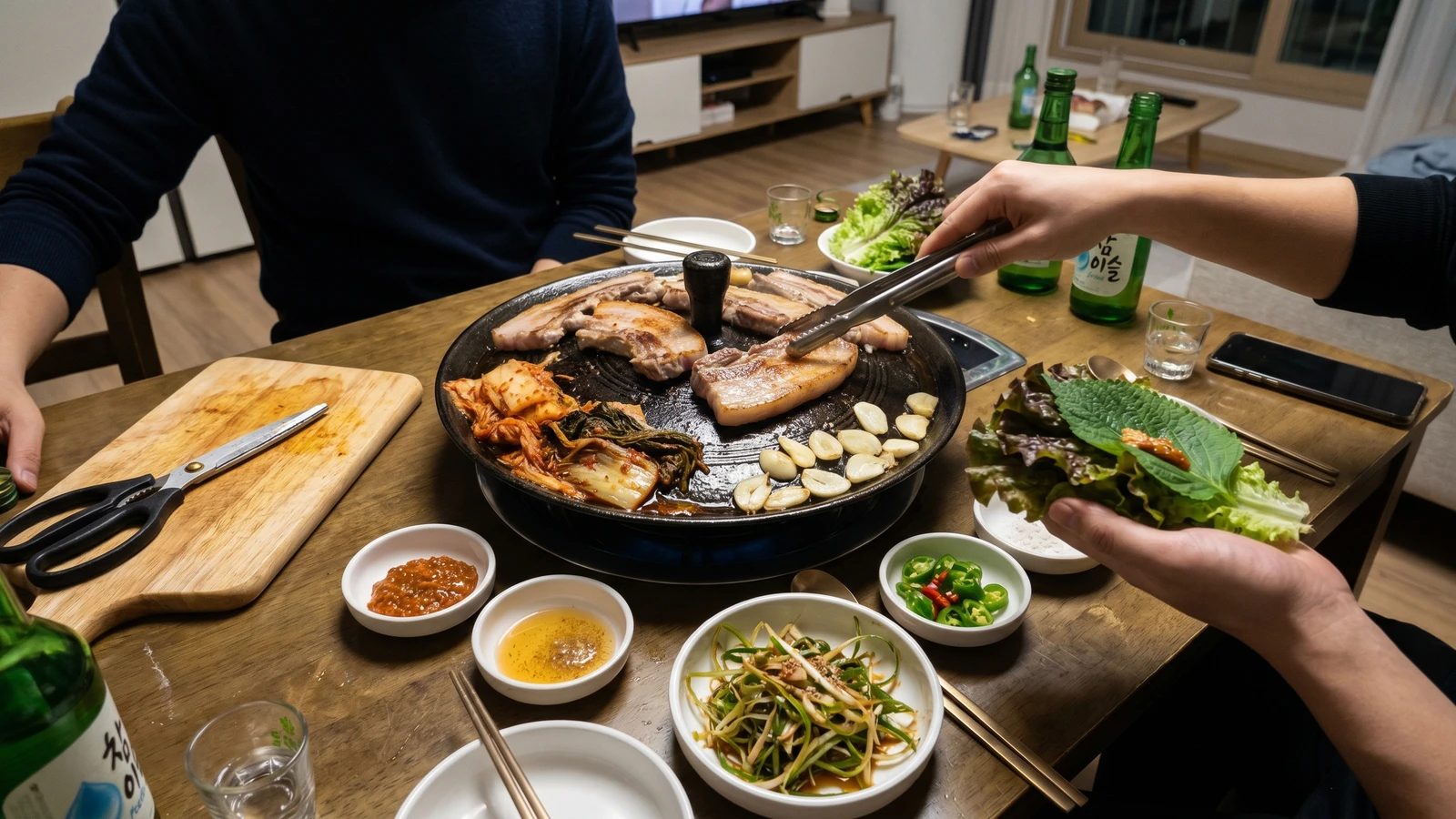
Thick-cut pork belly grilled plain until the fat turns crisp at the edges, then wrapped at the table with lettuce, ssamjang, garlic, and whatever banchan came out tonight.
Not every Korean grill begins in a bowl of marinade. Samgyeopsal-gui is pork belly trusted to be pork belly: three layers of meat and fat, cut thick, salted lightly, grilled at the table, and eaten before the edges lose their crispness. If you bury it in sauce before it meets the heat, you have missed the dish.
The work tonight is simple, but it is not careless. Buy pork belly with clear stripes of meat and fat, not a block of white fat with one tired line of lean. Cut it 6 to 8 mm thick if you are using a pan, or 10 mm if you have a tabletop grill. Too thin and it dries before the fat has time to render; too thick and the outside burns while the center stays heavy. Technique first. Let it taste like itself.
My teacher would set the lettuce, perilla, sliced garlic, green chilies, ssamjang, and a small dish of sesame oil salt on the table before the pork touched the pan. She said a cook who makes people wait while the meat cools has already lost half the meal. Grill, turn, cut, wrap, eat. 음식을 나누면서 정도 나눕니다. When we share food, we share affection, and samgyeopsal is built for that kind of table.
Samgyeopsal-gui is not an old court dish; it is a modern South Korean tabletop grilling habit that grew with urban restaurant culture and the wider availability of pork in the late twentieth century. The name means three-layer meat, referring to the visible stripes of lean and fat in pork belly, and its plain, unmarinated style distinguishes it from older seasoned grilled meats such as bulgogi and galbi. South Korea even marks March 3 as Samgyeopsal Day, a modern promotion tied to the number three and domestic pork consumption.
Quantity
800g
cut 6 to 10 mm thick
Quantity
1/2 teaspoon
Quantity
1/4 teaspoon
Quantity
1 tablespoon
only if using a stainless steel pan
Quantity
16
washed and dried
Quantity
16
washed and dried
Quantity
8 cloves
thinly sliced
Quantity
2
sliced on the diagonal
Quantity
1 cup
for grilling beside the pork
Quantity
8 large
halved or thickly sliced
Quantity
1/2 cup
to serve
Quantity
2 tablespoons
Quantity
1/2 teaspoon
for sesame oil salt dip
Quantity
6
very thinly shredded
Quantity
1 tablespoon
Quantity
1 tablespoon
Quantity
1 teaspoon
Quantity
1 teaspoon
for pa muchim
Quantity
1 teaspoon
Quantity
1/2 teaspoon
| Ingredient | Quantity |
|---|---|
| fresh skinless pork bellycut 6 to 10 mm thick | 800g |
| fine sea salt | 1/2 teaspoon |
| freshly ground black pepper (optional) | 1/4 teaspoon |
| neutral oil (optional)only if using a stainless steel pan | 1 tablespoon |
| lettuce leaveswashed and dried | 16 |
| perilla leaveswashed and dried | 16 |
| garlicthinly sliced | 8 cloves |
| green Korean chiliessliced on the diagonal | 2 |
| napa cabbage kimchi (optional)for grilling beside the pork | 1 cup |
| king oyster or button mushrooms (optional)halved or thickly sliced | 8 large |
| ssamjang (seasoned soybean and chili paste)to serve | 1/2 cup |
| toasted sesame oil | 2 tablespoons |
| fine sea saltfor sesame oil salt dip | 1/2 teaspoon |
| scallionsvery thinly shredded | 6 |
| soy sauce | 1 tablespoon |
| rice vinegar | 1 tablespoon |
| gochugaru (Korean chili flakes) | 1 teaspoon |
| toasted sesame oilfor pa muchim | 1 teaspoon |
| toasted sesame seeds | 1 teaspoon |
| sugar | 1/2 teaspoon |
Wash the lettuce and perilla leaves, then dry them well so the ssam wraps do not turn watery. Slice the garlic and chilies, set out the ssamjang, and mix 2 tablespoons toasted sesame oil with 1/2 teaspoon salt in a small dish. Have rice and banchan ready before you grill. Samgyeopsal waits for no one once it leaves the heat.
Put the shredded scallions in cold water for 10 minutes to calm their bite, then drain and spin or pat them dry. Toss with soy sauce, rice vinegar, gochugaru, sesame oil, sesame seeds, and sugar just before eating. Dress them too early and they collapse; dress them at the table and they stay sharp against the pork fat.
Pat the pork belly dry and sprinkle both sides with 1/2 teaspoon salt and the black pepper if using. Do this 5 minutes before grilling, not an hour ahead, because salt sitting too long pulls moisture to the surface. There is no marinade here. The seasoning is a nudge, not a mask.
Heat a tabletop grill, cast-iron grill pan, or wide heavy skillet over medium-high heat. If using stainless steel, wipe the surface with 1 tablespoon neutral oil; cast iron or a nonstick grill plate usually needs none because the pork will release its own fat. The pan is ready when a piece of pork gives a clear sizzle the moment it touches.
Lay the pork belly in a single layer with a little space between pieces. Grill 3 to 4 minutes on the first side, until the underside is browned and the fat has begun to turn clear at the edges. Turn once and cook 2 to 3 minutes more. If the pan fills with too much rendered fat, spoon some off into a heatproof bowl so the pork grills instead of frying heavily.
Use kitchen scissors and tongs to cut the strips into bite-size pieces, about 4 cm long. Stand fatty pieces briefly on their edge with the tongs so the thick fat cap browns. The best piece has a crisp edge, a juicy center, and enough fat left to carry the wrap. Cook the pork to at least 63 C, then rest briefly on the grill surface while the next pieces finish.
If using kimchi or mushrooms, grill them in the pork fat at the side of the pan after the first batch of meat has rendered. Kimchi should darken at the edges and turn glossy, not burn black. Mushrooms need 2 to 3 minutes per side, just until browned and juicy.
Make each ssam with one lettuce leaf, one perilla leaf if you like its herbal bite, one piece of pork, a dab of ssamjang, one slice of garlic, a little chili, and a pinch of dressed scallion. Fold it into one bite. Do not build a tower you cannot eat neatly. The first wrap belongs to the cook, while it is still at its best.
1 serving (about 345g)
Culinary guides, cultural storytelling, and the editorial depth that makes cooking meaningful.
Discover Culinary ExplorerChef Jeong-sun
Firm monkfish buried under crisp soybean sprouts, minari, and a red gochugaru sauce thickened at the end; Masan's market dish asks for heat, timing, and a steady hand.

Chef Jeong-sun
A quick Korean rice bowl built on contrast: warm rice, cold popping flying-fish roe, chopped vegetables, gim, sesame oil, and the crisp rice bottom a hot stone bowl gives you.
Chef Jeong-sun
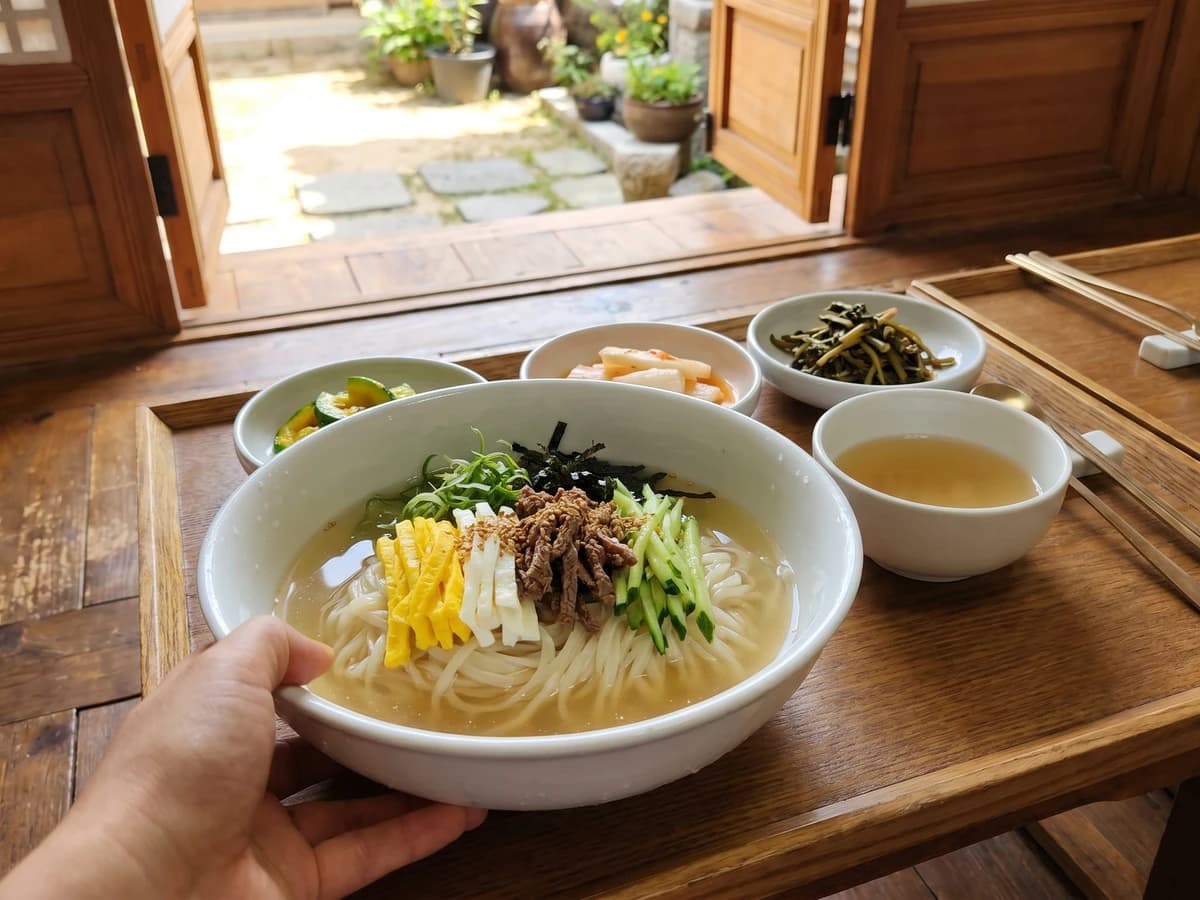
Andong's guest noodles, wheat and roasted soybean flour rolled thin, boiled and rinsed cold, then set in a clear chilled anchovy broth with careful strips of beef, egg, and cucumber.

Chef Jeong-sun
Andong's ritual-table rice served on an ordinary day: separate soy-sesame namul, warm rice, and clear radish soup, mixed without gochujang so every vegetable keeps its own voice.