
Chef Lupita
Aceite de Chiltepin Bajacaliforniano
Baja California's wild chiltepin steeped in olive oil with garlic, orejon, and lime peel, until the oil turns ruby-amber and carries the slow, sneaky burn of the desert coast.
A cooking platform built around craft, culture, and the stories behind what we eat.

Created by
Querétaro's creamy enchilada salsa, chile ancho softened in milk, blended with egg, and fried in manteca until it coats warm corn tortillas in a quiet red sauce.
Querétaro, in the Bajío, is where this salsa belongs. In Santiago de Querétaro, especially around Mercado de La Cruz, enchiladas can arrive with corn tortillas, potatoes, carrots, queso fresco, and a red sauce that tastes of chile ancho and milk, not tomato and not heat for its own sake.
The version documented by Fundación Casa de México is disciplined: chile ancho, leche, huevo, sal, manteca. That is enough when the ingredients are right. The ancho gives color and dried-fruit depth. The milk softens the chile without washing it thin. The egg gives the sauce body. This is not cream sauce. This is not canned enchilada sauce. No me vengas con atajos.
I learned to treat this kind of sauce gently from a Querétaro cook who stood over the cazuela with a wooden spoon and did not stop moving it until the egg had disappeared into the chile. Too much heat and it curdles. Too little frying and it tastes raw. The women who perfected it knew the balance: low flame, steady hand, corn tortillas ready beside the comal. Saber cocinar es saber vivir.
Querétaro's cooking sits inside the Bajío corridor, a central Mexican region shaped by Otomí, Chichimeca Jonaz, and Spanish colonial settlement after Santiago de Querétaro was founded in 1531. Milk, eggs, and pork lard entered central Mexican kitchens through 16th-century livestock economies, while chile ancho, the dried form of chile poblano, kept the sauce anchored in the older chile-and-corn table. Fundación Casa de México documents this ancho-milk-egg sauce as a traditional variant for enchiladas queretanas, a reminder that enchiladas in central Mexico are not one formula.
Quantity
6 large
wiped clean, stemmed, seeded, and torn open
Quantity
2 cups, plus 1/4 cup more if needed
warmed
Quantity
1
at room temperature
Quantity
3/4 teaspoon, plus more to taste
Quantity
2 tablespoons
Quantity
12
for making enchiladas
Quantity
1 cup
cut into small pieces
Quantity
1/2 cup
crumbled
Quantity
1/4 cup
thinly sliced
| Ingredient | Quantity |
|---|---|
| dried chile anchowiped clean, stemmed, seeded, and torn open | 6 large |
| whole milkwarmed | 2 cups, plus 1/4 cup more if needed |
| large eggat room temperature | 1 |
| fine sea salt | 3/4 teaspoon, plus more to taste |
| manteca de cerdo | 2 tablespoons |
| warm corn tortillas (optional)for making enchiladas | 12 |
| boiled potatoes and carrots (optional)cut into small pieces | 1 cup |
| queso fresco (optional)crumbled | 1/2 cup |
| white onion (optional)thinly sliced | 1/4 cup |
Wipe each chile ancho with a damp cloth. Split it open, shake out the seeds, and pull away the pale veins. Do not rinse the chiles under running water. The dried flesh holds that raisin-dark flavor, and water takes it away before the milk gets its turn.
Pour the whole milk into a small saucepan or clay cazuela and warm it over low heat until it is hot to the touch but not boiling. Turn off the heat. Add the chile ancho pieces and press them under the milk with a spoon or a small plate. Let them soak for 20 minutes, until the skins relax and the milk turns pale brick red.
Let the chile and milk mixture cool for 5 minutes so it is warm, not hot. Transfer the softened chiles and milk to a blender. Add the egg and salt. Blend on high for 60 to 90 seconds, until the sauce looks smooth and creamy.
Set a fine-mesh strainer over a bowl and pour the blended salsa through it. Press with a spoon to extract every bit of chile. Discard the papery skins left behind. For enchiladas queretanas, the sauce needs to bathe the tortilla smoothly. This is not the place for rough chile skin.
Melt the manteca de cerdo in a heavy skillet or small cazuela over medium-low heat. Pour in the strained salsa in a steady stream, stirring constantly with a wooden spoon. Cook for 7 to 9 minutes, until it darkens to a soft brick red, thickens enough to coat the spoon, and loses any raw egg smell. Keep the heat controlled. A hard boil breaks the milk and egg. La manteca es el sabor.
Taste for salt. The sauce should taste first of chile ancho, then milk, with the manteca rounding the edges. If it is too thick, whisk in a little warm milk until it has the consistency of light atole: thick enough to cling to a tortilla, loose enough to pool on the plate.
Use the salsa while warm. Dip warm corn tortillas through the sauce, fold or roll them with potatoes, carrots, or queso fresco, then spoon more sauce over the top. Flour tortillas belong to another region. This plate is from Querétaro. Cada estado, su propia cocina.
1 serving (about 105g)
Culinary guides, cultural storytelling, and the editorial depth that makes cooking meaningful.
Discover Culinary ExplorerChef Lupita
Baja California's wild chiltepin steeped in olive oil with garlic, orejon, and lime peel, until the oil turns ruby-amber and carries the slow, sneaky burn of the desert coast.

Chef Lupita
Puebla's Lenten convent adobo, a brick-red vinegar chile paste of ancho, guajillo, garlic, oregano, and comino made to dress fish for the meatless calendar.
Chef Lupita
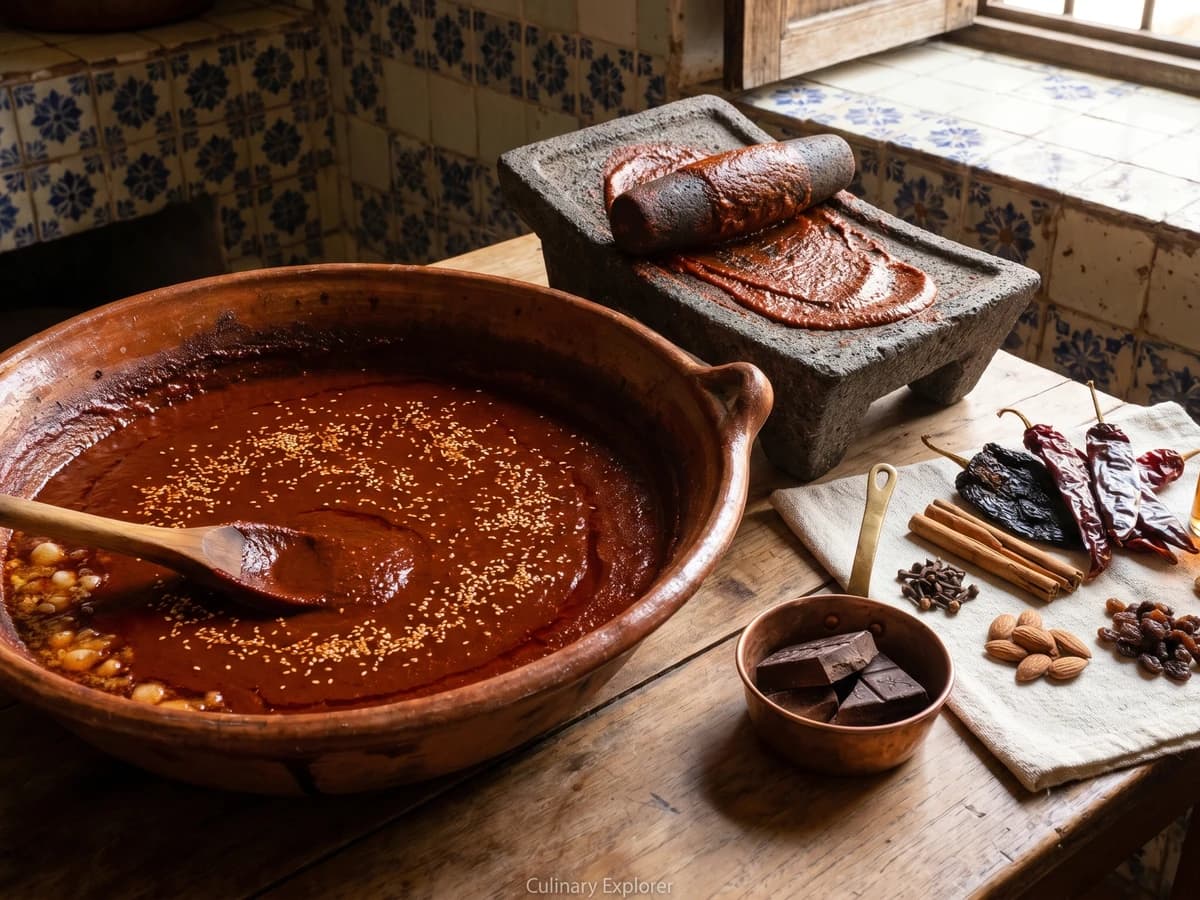
Zacatecas' wedding-table adobo, built from toasted guajillo and ancho, piloncillo, sour orange, chocolate, canela, clavo, almonds, sesame, and lard.

Chef Lupita
Puebla's convent kitchens built this adobo with ancho, guajillo, jerez, almonds, raisins, clove, and lard, a baroque marinade that stains pork loin and finishes as the sauce.