Chef Fai
Crispy Rice with Coconut Dip (Khao Tang Na Tang)
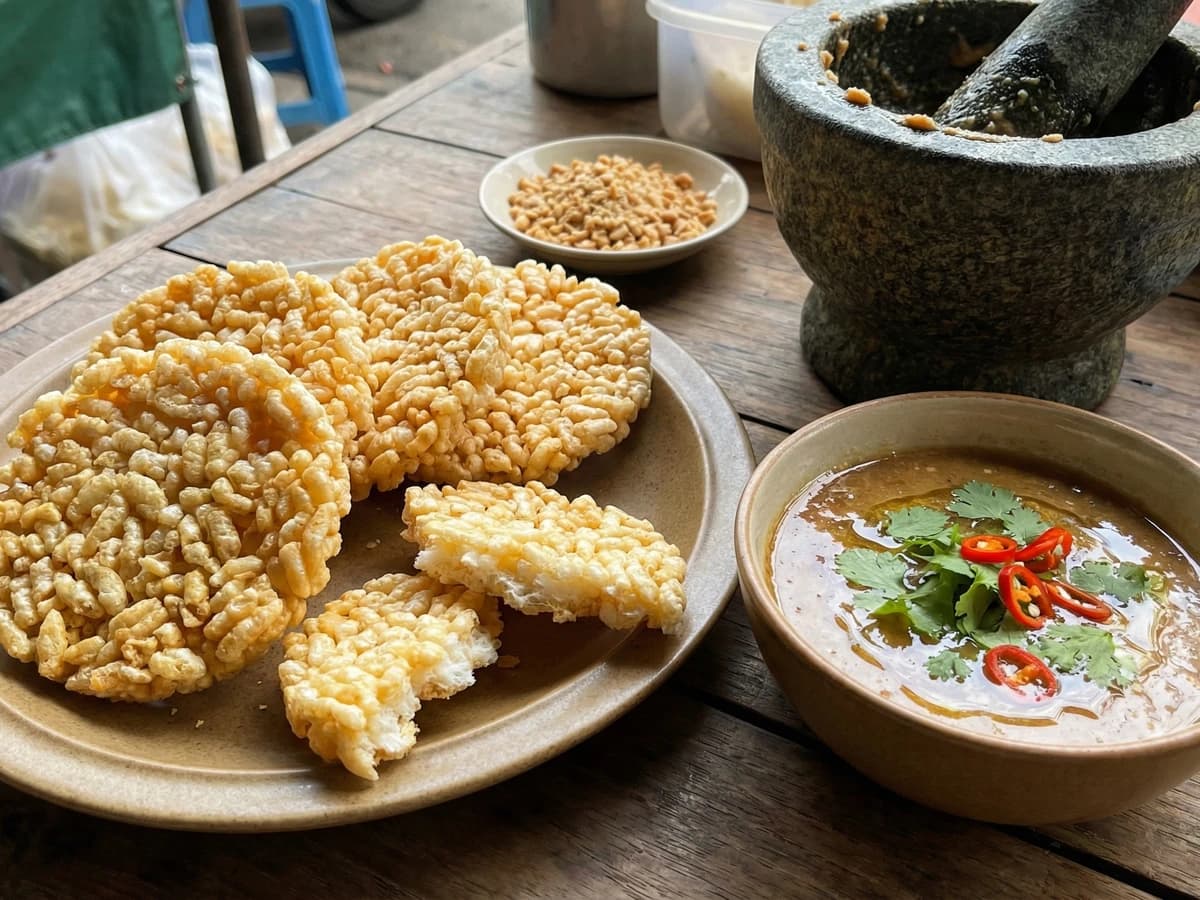
The kreung tam doesn't rest, not even for a snack. Pounded paste cracked into coconut cream, spooned over golden rice that shatters on contact. Four pillars in every bite.
A cooking platform built around craft, culture, and the stories behind what we eat.

Created by
The deep south's kreung tam lives in spice, not mortar: cumin, coriander, turmeric, garlic pounded into beef, wrapped in dough stretched so thin you can read through it, fried on a flat griddle until shattering-crisp. Pattani street food, Thai principles.
The kreung tam doesn't always come from a granite mortar. In the deep south of Thailand, where Islamic communities in Pattani, Yala, Narathiwat, and Songkhla have been cooking for centuries, the spice mixture that seasons the meat filling of roti mataba functions exactly like a kreung tam. Cumin, coriander, turmeric, garlic: pounded or ground into a cohesive aromatic base, then built into a dish. Different tradition. Same governing principle. Ajarn always said: understand the paste, understand Thai food. The paste just looks different down south.
The technique is everything. Roti dough, enriched with egg and ghee, rested until silky, then stretched by hand until it's paper-thin. Translucent. You should see the work surface through it. The roti vendors of Songkhla and Hat Yai do this in seconds: pulling, slapping, spinning the dough on an oiled surface until it's a sheet so thin it barely exists. Then onto a hot flat griddle, an egg cracked on top and smeared across the surface, a line of spiced beef laid down the center, edges folded into a tight square, fried in oil until golden and shattering. Their hands move like they're playing an instrument they've known since childhood. You won't match their speed. You will match their principles.
The four pillars adapt but hold. Fish sauce (nam pla) seasons the filling: salt pillar. Palm sugar sweetens the ajad (cucumber relish) served alongside. And here's the exception worth knowing: ajad uses vinegar for its sour note, not lime. This is one of the rare Thai dishes where that substitution is correct and intentional. The Southern table has its own rules within the system. Chili runs through both the filling (white pepper's quiet heat) and the ajad (bird's eye slices floating in the sweet-sour brine). Four pillars, different instruments.
The deep south's cooking doesn't get enough love from Bangkok food media. It's Thai food through a lens shaped by Islam, by proximity to Malaysia, by centuries of trade and intermarriage. Roti mataba is proof that the Thai culinary system is bigger than any single region. It absorbs. It adapts. It holds. Thai food is a system, not a menu.
Roti mataba is the Thai phonetic rendering of murtabak (from Arabic mutabbaq, مطبق, meaning 'folded'), a stuffed flatbread found across the Muslim world from Saudi Arabia to Southeast Asia. The dish arrived in Thailand's deep south through centuries of trade and cultural exchange between the Malay-Muslim communities of Pattani, Yala, and Narathiwat and the broader Islamic culinary world. In Thailand, mataba became firmly associated with the roti vendors of Southern provinces and eventually migrated to Bangkok's Muslim neighborhoods around Charoen Krung Road, though it remains most deeply rooted in the border provinces where Thai-Malay identity is inseparable from the food.
Quantity
300g
Quantity
1
Quantity
1/2 teaspoon
Quantity
1 teaspoon
Quantity
150ml
Quantity
4 tablespoons, plus extra for stretching and frying
Quantity
250g
Quantity
1 medium
diced fine
Quantity
3 cloves
minced
Quantity
1 1/2 tablespoons
Quantity
1 tablespoon
Quantity
1/2 teaspoon
Quantity
small handful
chopped
Quantity
4
Quantity
1
quartered lengthwise and sliced thin
Quantity
3
sliced thin
Quantity
2
sliced into rounds
Quantity
4 tablespoons
Quantity
3 tablespoons
Quantity
1/2 teaspoon
| Ingredient | Quantity |
|---|---|
| all-purpose flour | 300g |
| egg (for dough) | 1 |
| salt (for dough) | 1/2 teaspoon |
| sugar (for dough) | 1 teaspoon |
| warm water | 150ml |
| ghee or vegetable oil | 4 tablespoons, plus extra for stretching and frying |
| minced beef | 250g |
| yellow oniondiced fine | 1 medium |
| garlicminced | 3 cloves |
| curry powder | 1 1/2 tablespoons |
| fish sauce (nam pla) | 1 tablespoon |
| ground white pepper | 1/2 teaspoon |
| fresh cilantro (pak chi)chopped | small handful |
| eggs (for filling) | 4 |
| cucumberquartered lengthwise and sliced thin | 1 |
| shallots (hom daeng)sliced thin | 3 |
| bird's eye chilies (prik khi nu)sliced into rounds | 2 |
| white vinegar | 4 tablespoons |
| palm sugar (nam tan pip) | 3 tablespoons |
| salt (for ajad) | 1/2 teaspoon |
Combine the flour, salt, and sugar in a large bowl. Make a well in the center. Crack in the egg, add the warm water and two tablespoons of ghee. Mix with your hand until a shaggy dough forms, then turn it out and knead for 8 to 10 minutes. The dough should go from rough and sticky to smooth, elastic, and slightly tacky. It should bounce back when you press it. Divide into 4 equal balls, coat each lightly with ghee, cover with a damp cloth or plastic wrap, and rest for at least 30 minutes. An hour is better. The gluten needs to relax completely or the dough will fight you when you stretch it.
While the dough rests, make the cucumber relish. Dissolve the palm sugar and salt in the vinegar over low heat, stirring until clear. Let it cool to room temperature. Toss in the sliced cucumber, shallots (hom daeng), and sliced chilies (prik khi nu). Set aside. The ajad should be sweet first, sour second, with chili heat floating through it. Taste the brine before you add the vegetables. Adjust.
Heat a tablespoon of oil in a pan over medium-high heat. Add the garlic and onion and cook until the onion is soft and just starting to turn golden, about 3 minutes. Add the curry powder and stir for 30 seconds. The spices should bloom immediately: the kitchen will smell like a Southern Thai market. Add the minced beef, breaking it up with your spatula, pressing it against the pan to get some color. Cook until no pink remains, about 4 minutes. Season with the fish sauce and white pepper. Stir in the chopped cilantro (pak chi). Remove from heat and let the filling cool slightly. Warm filling is fine. Hot filling will cook the egg too early when you assemble.
Oil a smooth, clean work surface generously. Take one dough ball and press it flat with your palm. Now stretch. Use the backs of your hands, knuckles up, and gently pull the dough outward from the center, working in a circle, letting gravity help. Rotate and stretch. The goal is a sheet so thin you can see the surface beneath it. Translucent. The vendors in Pattani and Songkhla stretch it to the size of a small table. You're aiming for roughly 30 centimeters across, thin enough that light passes through. A few small tears are fine. They'll fold away. Thick dough makes chewy roti. Thin dough makes shattering, crispy layers.
Heat a large flat pan or griddle over medium heat with a generous slick of ghee or oil. Carefully lift the stretched dough and lay it on the hot surface. It should start to set and turn opaque within seconds. Immediately crack one egg onto the center of the dough and smear it across the surface with the back of a spoon. Work fast. Spoon a quarter of the beef filling in a line down the center. Now fold: bring the top edge down to the center, the bottom edge up, then fold the left and right sides in to form a square or rectangle. Press gently. Flip the parcel and cook until the bottom is deep golden and crisp, about 2 minutes per side. The surface should be blistered and crackling. Repeat with the remaining dough balls.
Transfer each roti mataba to a cutting board and slice into quarters with a sharp knife. The cross-section should show layers of crispy dough, set egg, and spiced beef. Arrange on a plate and serve immediately with the ajad alongside. The contrast is the point: rich, meaty, crispy roti against cold, sharp, sweet-sour cucumber relish. That's the balance. Four pillars, two dishes, one plate.
1 serving (about 350g)
Culinary guides, cultural storytelling, and the editorial depth that makes cooking meaningful.
Discover Culinary ExplorerChef Fai
The kreung tam doesn't rest, not even for a snack. Pounded paste cracked into coconut cream, spooned over golden rice that shatters on contact. Four pillars in every bite.
Chef Fai
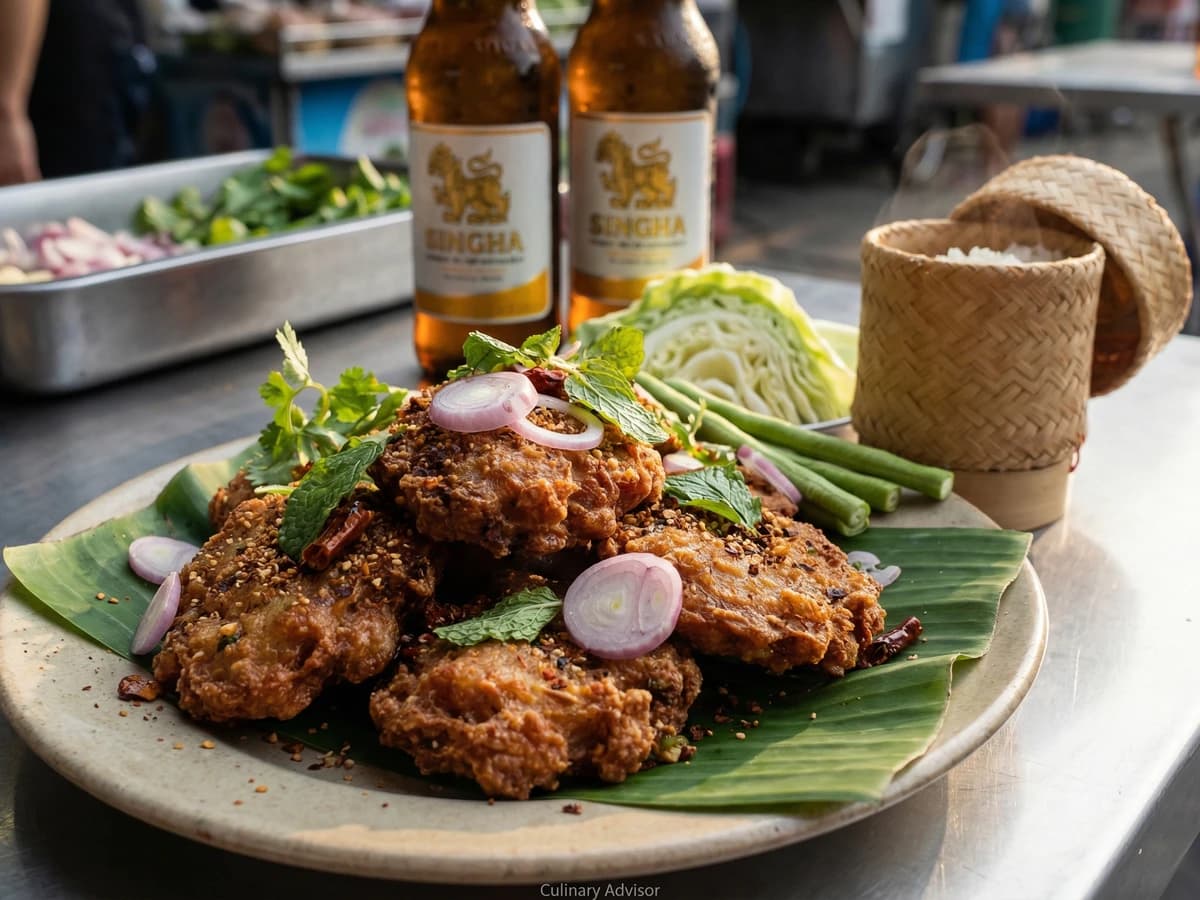
Isan's larb principles pressed into patties and fried golden: fish sauce for salt, lime for sour, khao khua for structure and crunch, prik pon for heat. No sugar. That's the rule that separates Isan from everything else.
Chef Fai
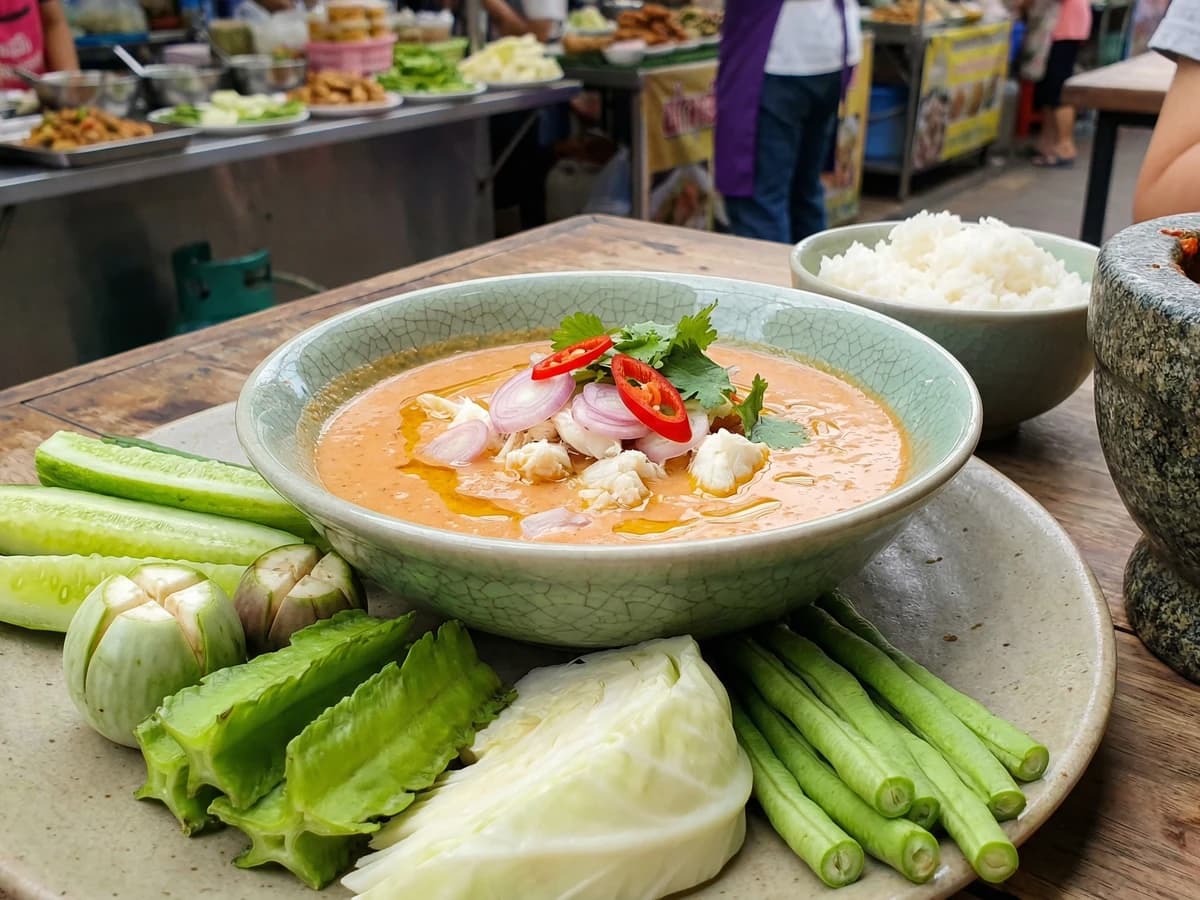
A kreung tam pounded in the krok, dissolved into cracked coconut cream, sweet crab folded through at the end. All four pillars balanced in a dip so silky you'll forget it started in a granite mortar. Central Thai home cooking at its most principled.

Chef Fai
Twenty-four meatballs, eight bamboo skewers, a charcoal grill the size of a shoebox, and one pot of nam jim built on the four pillars. The simplest vendor setup in Thailand proves the system works everywhere.