Chef Fai
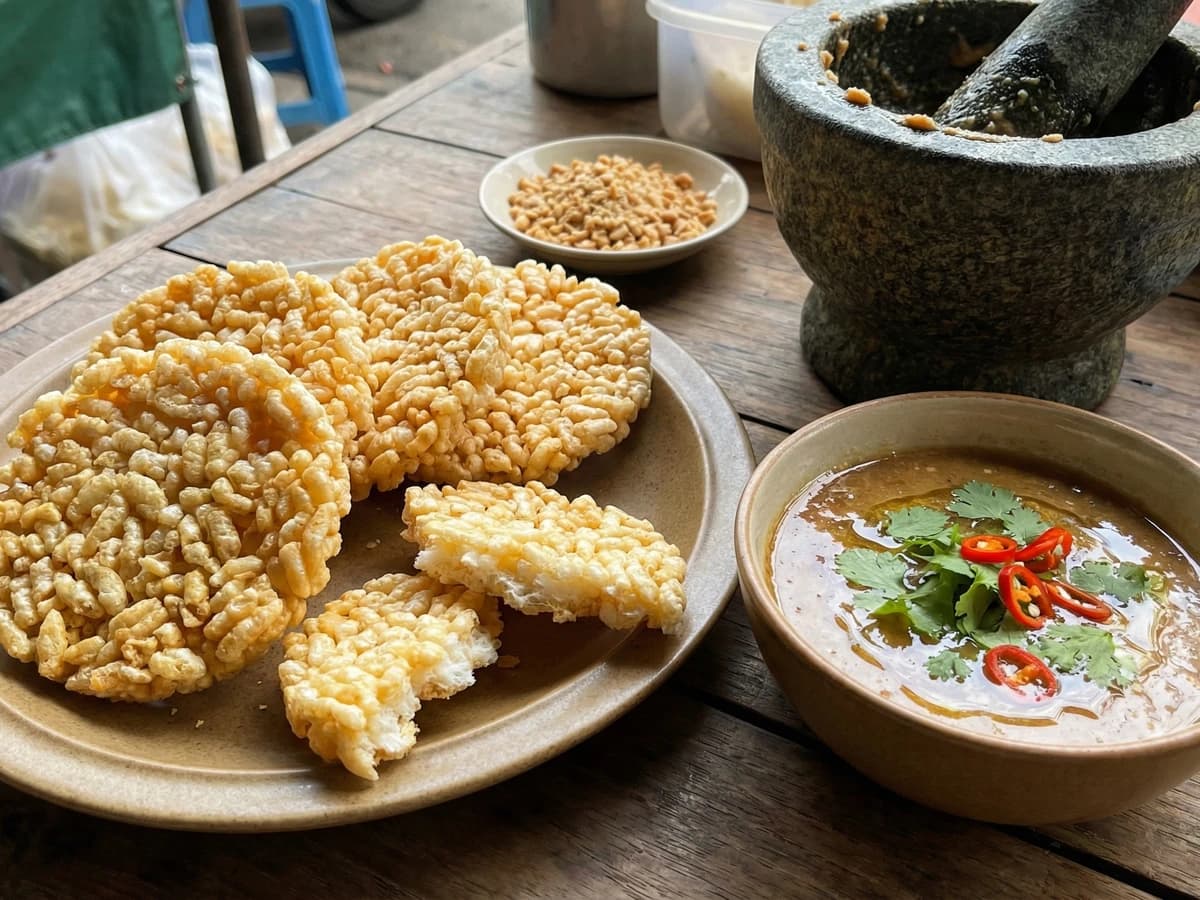
Crispy Rice with Coconut Dip (Khao Tang Na Tang)
The kreung tam doesn't rest, not even for a snack. Pounded paste cracked into coconut cream, spooned over golden rice that shatters on contact. Four pillars in every bite.
A cooking platform built around craft, culture, and the stories behind what we eat.
Created by
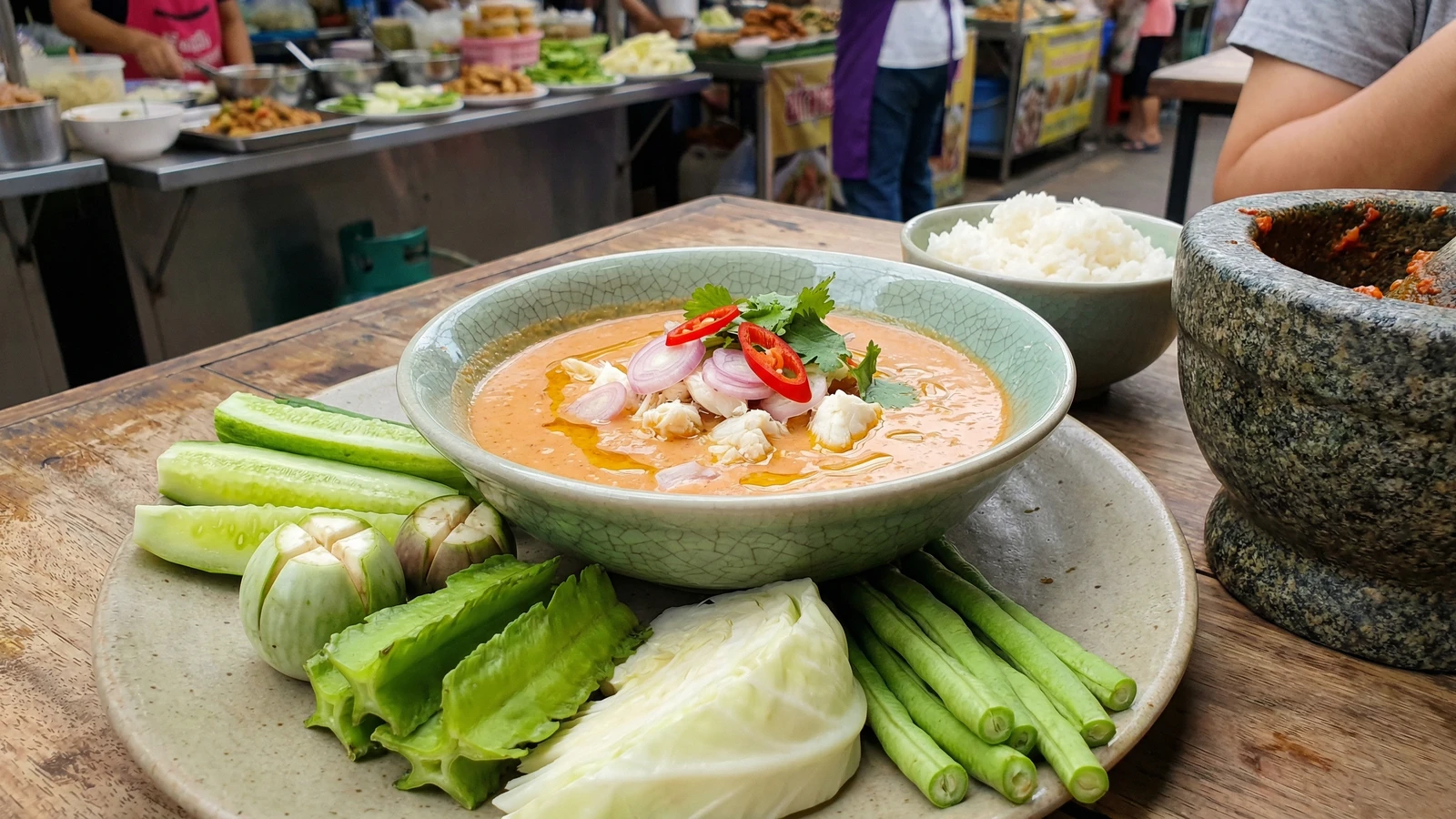
A kreung tam pounded in the krok, dissolved into cracked coconut cream, sweet crab folded through at the end. All four pillars balanced in a dip so silky you'll forget it started in a granite mortar. Central Thai home cooking at its most principled.
Lon is the proof that the kreung tam is everything. Take a handful of dried chilies, shallots, garlic, and kapi (shrimp paste). Pound them in a granite mortar until the paste is smooth and the aroma hits you across the room. Then dissolve that paste into cracked coconut cream. That's the technique. The kreung tam does the work. The coconut cream is the vehicle. Every spoonful carries the full architecture of the paste.
This is Central Thai home cooking at its most principled. Lon is an entire category of dips built on this single method: paste dissolved in coconut cream, seasoned with the four pillars. Fish sauce for salt. Palm sugar for sweet. Tamarind water for sour, not lime, because lon simmers gently and lime juice turns bitter with sustained heat. Tamarind holds. Tamarind deepens. That's why it's the right acid for this dish. Dried chilies provide the warmth from inside the paste itself, a slow burn woven into the cream rather than a sharp hit on top.
Ajarn always said that understanding the kreung tam means understanding that the paste is a delivery system. It concentrates flavor, emulsifies into liquid, and distributes aromatics evenly through whatever medium you dissolve it in. In a gaeng, that medium is thin coconut milk and stock. In lon, it's pure, rich, cracked coconut cream. Same principle. Different vehicle. Once you see it that way, you stop thinking of lon as a "dip" and start seeing it as a kreung tam expression.
The crab goes in at the end. Sweet, delicate, barely warmed. You fold it through the cream so it absorbs the paste flavors without losing its own identity. This is the dish I use in my Fai Thai workshops to teach students that the kreung tam isn't just about curries. The paste is the foundation of everything. Curries, stir-fries, soups, dips. Once you understand that, you stop memorizing recipes and start cooking Thai food. Principles, not recipes.
Lon (หลน) is a Central Thai category of coconut cream dips that appears in some of the earliest Thai household recipe manuscripts, predating the widespread documentation of nam prik. Unlike nam prik, which are paste-based dips pounded and served directly, lon dissolves the kreung tam into simmered coconut cream, creating a richer, milder preparation suited to communal rice meals. Lon pu, made with fresh crab, is associated with Central Plains and coastal Bangkok cooking, where blue swimming crabs (pu ma) have been a market staple for generations. The dish sits at the intersection of everyday home cooking and special-occasion entertaining, simple enough for a weeknight but impressive enough for a dinner party spread.
Quantity
5
soaked in warm water for 15 minutes, drained
Quantity
pinch
Quantity
4 cloves
roughly sliced
Quantity
5
roughly sliced
Quantity
1 tablespoon
Quantity
400ml
Quantity
200g
picked clean of shell fragments
Quantity
2 tablespoons
Quantity
1½ tablespoons
shaved or grated
Quantity
2 tablespoons
Quantity
2
thinly sliced lengthwise
Quantity
2
sliced on the bias
Quantity
small handful
Quantity
1-2
cut into spears, for serving
Quantity
3-4
quartered, for serving
Quantity
100g
cut into 2-inch pieces, for serving
Quantity
¼ head
cut into wedges, for serving
Quantity
4-5
cut into 3-inch lengths, for serving
| Ingredient | Quantity |
|---|---|
| dried red chilies (prik haeng)soaked in warm water for 15 minutes, drained | 5 |
| salt | pinch |
| garlic (kratiem)roughly sliced | 4 cloves |
| shallots (hom daeng)roughly sliced | 5 |
| shrimp paste (kapi) | 1 tablespoon |
| coconut cream (hua kathi), thick first-press | 400ml |
| fresh crab meat (neua pu)picked clean of shell fragments | 200g |
| fish sauce (nam pla) | 2 tablespoons |
| palm sugar (nam tan pip)shaved or grated | 1½ tablespoons |
| tamarind water (nam makham piak) | 2 tablespoons |
| shallots (hom daeng), for garnishthinly sliced lengthwise | 2 |
| fresh red spur chilies (prik chi fa daeng), for garnishsliced on the bias | 2 |
| fresh cilantro leaves (pak chi) (optional) | small handful |
| cucumberscut into spears, for serving | 1-2 |
| Thai round eggplant (makhuea pro)quartered, for serving | 3-4 |
| wing beans (thua phuu)cut into 2-inch pieces, for serving | 100g |
| white cabbagecut into wedges, for serving | ¼ head |
| long beans (thua fak yao)cut into 3-inch lengths, for serving | 4-5 |
Place the dried red chilies (prik haeng) in a small bowl and cover with warm water. Let them soak for 15 minutes until they're pliable and softened. Drain them and squeeze out the excess water. Dried chilies are the backbone of this kreung tam. They give the lon its warmth and its reddish tint, a slow, distributed heat that's completely different from fresh chili. That's why they go in first: they're the hardest ingredient, and hardest goes into the mortar first.
Drop the drained chilies into your granite mortar (krok hin) with a pinch of salt. The salt acts as an abrasive, it grips the chilies against the stone and helps break them down. Pound with firm, direct strokes. Rotate the pestle. The chilies should break into rough fibers first, then gradually become a coarse paste. You'll feel the resistance change as the cell walls collapse. Keep pounding until there are no large chunks, just a rough, fibrous mass. This takes two to three minutes of real work.
Add the roughly sliced garlic to the mortar. Garlic goes second because it's firm but not as tough as dried chilies. Pound it into the chili paste until the garlic breaks down and integrates. You should see the paste becoming wetter, more cohesive. The garlic releases its juices and helps bind the whole mass together. Another minute or two of steady pounding.
Add the roughly sliced shallots. They carry the most moisture, which is exactly why they go in last among the aromatics. If you added them first, the mortar would be wet and slippery before you'd broken down the chilies. Pound the shallots into the paste until smooth. The paste should now be a uniform, fragrant mass with a reddish hue. The aroma shifts here: sharp garlic and chili give way to something rounder, sweeter. That's the shallot doing its work.
Add the tablespoon of kapi (shrimp paste) and pound it into the paste. Kapi goes last in this kreung tam. It's already soft, so it doesn't need force to break down. What it needs is integration: you're pounding it into the aromatics so its funky, fermented depth gets woven into every fiber of the paste. The final kreung tam should be smooth, cohesive, and deeply fragrant. Brick-red from the chilies, pungent from the kapi, with garlic and shallot supporting underneath. If the aroma fills the kitchen, you're there.
Pour the thick coconut cream (hua kathi) into a wok or heavy-bottomed saucepan over medium heat. Stir occasionally. After 5 to 7 minutes, the cream will begin to separate: pools of clear coconut oil will appear on the surface, and the white solids will start looking grainy and broken. That's the crack. That's the signal. If you skip this step and just heat the cream without cracking it, the lon will taste flat and one-dimensional. The separated oil is what fries the paste in the next step. This is the same technique you use for every coconut curry. Learn it once, use it forever.
Add all of the pounded kreung tam to the cracked coconut cream. Stir it in and let it fry in the coconut oil for 2 to 3 minutes over medium heat. The paste should dissolve into the cream, tinting it a warm orange-pink. The aroma will bloom: you'll smell the dried chilies releasing their capsaicin into the oil, the kapi deepening, the shallots sweetening. This is the kreung tam doing exactly what Ajarn said it does. It's a delivery system. It concentrates flavor and distributes it evenly through the coconut cream.
Add the fish sauce (nam pla), palm sugar (nam tan pip), and tamarind water (nam makham piak). Stir to dissolve the sugar. Now taste. This is where the four pillars come alive. Salty from the fish sauce. Sweet from the palm sugar. Sour from the tamarind. Heat already built into the paste. The balance you're looking for: the sweetness of the coconut cream should be the canvas, with salt and sour playing equally against it, and the chili warmth arriving gently at the back of your throat. Adjust. More fish sauce if it's flat. More tamarind if it's too sweet. More palm sugar if the tamarind is aggressive. Taste, adjust, taste again. That's the method.
Reduce the heat to low. Gently fold the picked crab meat into the seasoned cream. Stir once or twice, no more. The crab should warm through in the residual heat, about 1 to 2 minutes. Don't cook it aggressively. You're not making a crab stew. The crab is sweet and delicate, and the cream is rich and savory. The contrast is the whole point. If you overcook the crab, it turns stringy and tough, and you lose that sweetness. Taste one more time. The crab changes the balance slightly, adding natural sweetness, so you may want a tiny splash more fish sauce to compensate.
Transfer the lon to a serving bowl. Scatter the thinly sliced raw shallots and sliced red spur chilies (prik chi fa) across the top. Add a few cilantro leaves if you like. Arrange the raw vegetables on a plate alongside: cucumber spears, quartered Thai eggplant, wing bean pieces, cabbage wedges, long bean lengths. The vegetables are not decoration. They're the eating utensils. You scoop the lon with a piece of cucumber, a wedge of cabbage, a crisp wing bean. The cold crunch of the raw vegetable against the warm, silky cream is the textural design of the dish. Serve with steamed jasmine rice to make it a full meal.
1 serving (about 250g)
Culinary guides, cultural storytelling, and the editorial depth that makes cooking meaningful.
Discover Culinary ExplorerChef Fai
The kreung tam doesn't rest, not even for a snack. Pounded paste cracked into coconut cream, spooned over golden rice that shatters on contact. Four pillars in every bite.
Chef Fai
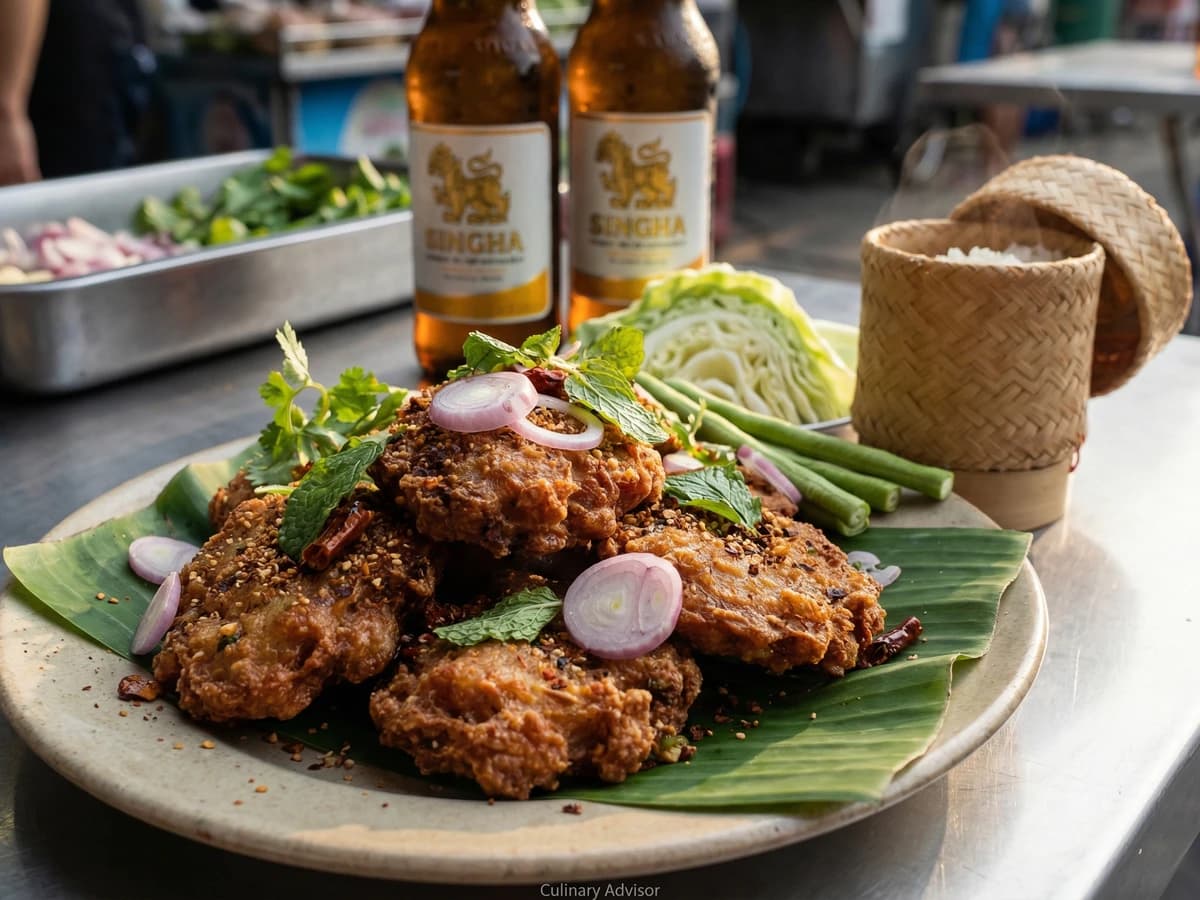
Isan's larb principles pressed into patties and fried golden: fish sauce for salt, lime for sour, khao khua for structure and crunch, prik pon for heat. No sugar. That's the rule that separates Isan from everything else.

Chef Fai
Twenty-four meatballs, eight bamboo skewers, a charcoal grill the size of a shoebox, and one pot of nam jim built on the four pillars. The simplest vendor setup in Thailand proves the system works everywhere.
Chef Fai
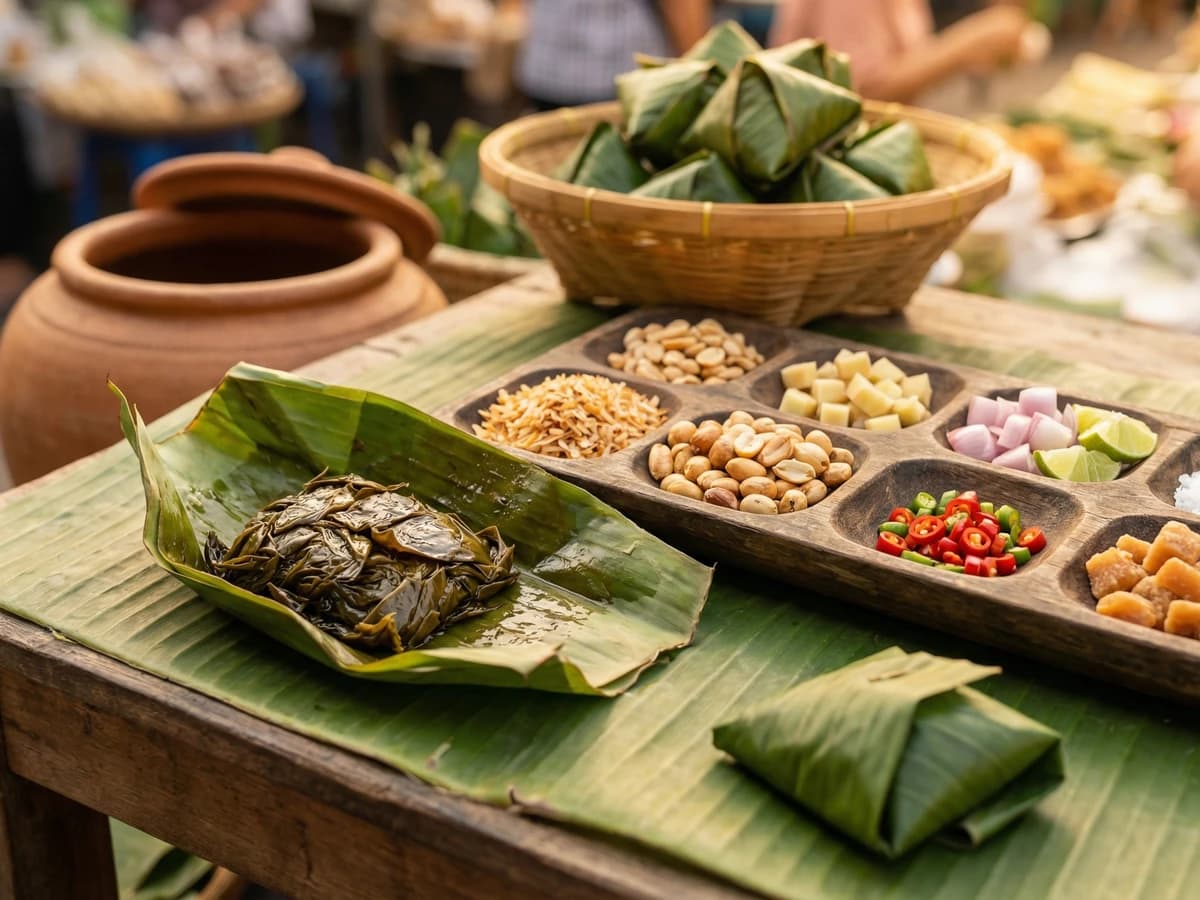
Lanna's oldest fermented tradition: wild tea leaves steamed, packed tight in banana leaf, and transformed by lactic acid bacteria over months. Time is the ingredient no one can skip.