Chef Fai
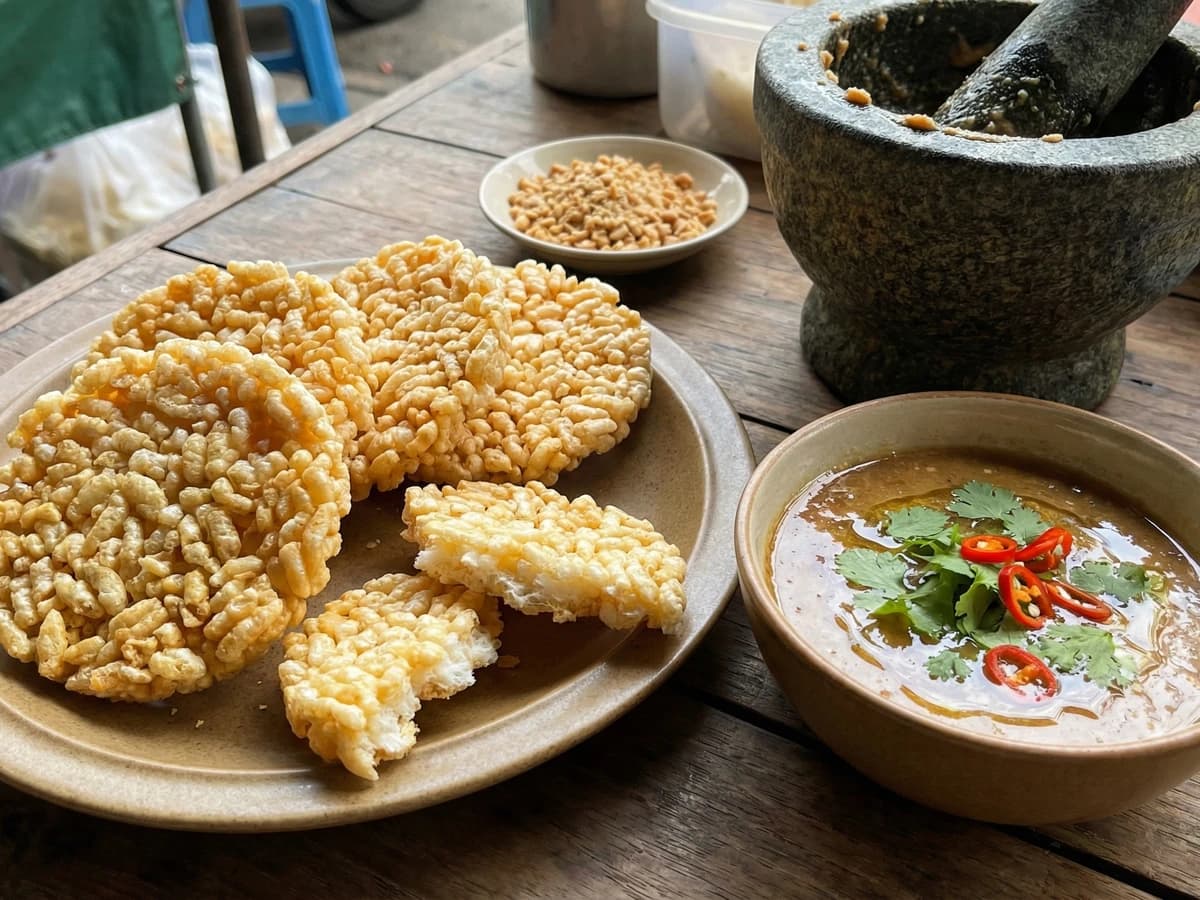
Crispy Rice with Coconut Dip (Khao Tang Na Tang)
The kreung tam doesn't rest, not even for a snack. Pounded paste cracked into coconut cream, spooned over golden rice that shatters on contact. Four pillars in every bite.
A cooking platform built around craft, culture, and the stories behind what we eat.

Created by
Isan's larb principles pressed into patties and fried golden: fish sauce for salt, lime for sour, khao khua for structure and crunch, prik pon for heat. No sugar. That's the rule that separates Isan from everything else.
No sugar. That's the first thing you need to understand about Isan larb, and it's the first thing most people outside the northeast get wrong. Central Thai cooking uses palm sugar as one of the four pillars. Isan cooking takes that pillar and removes it. The absence of sweet is not a gap. It's a principle. It defines the entire flavor system of the Isan table.
Larb moo tod is the proof that a principled system can change form without losing its identity. You take the classic larb mixture, fish sauce for salt, lime juice for sour, prik pon (roasted dried chili) for heat, khao khua (toasted sticky rice powder) for that smoky, nutty backbone, and you press it into patties and drop them in hot oil. The medium changes. The principles don't.
Ajarn always said: "If you understand the why, the how takes care of itself." Khao khua is the perfect example. In a raw larb, it provides texture and nuttiness. In a fried larb cake, it becomes the binder. The toasted rice powder absorbs moisture from the pork and creates structure when it hits the oil. One ingredient, two functions. That's what happens when you understand the system instead of following a recipe.
The herbs go in two places. Kaffir lime leaves and green onions go into the patty mixture, where frying transforms them into something aromatic and almost crispy. Mint, cilantro, sawtooth coriander, and raw shallots stay on the side, fresh and sharp, eaten alongside each bite the way you'd eat larb at a roadside restaurant near the Mekong. The fresh herbs aren't garnish. They're structural. They complete each bite the same way sticky rice does. Leave them out and you're eating half a dish.
Larb tod emerged from Isan's drinking food (gab klaem) culture, where dishes are designed to be eaten communally alongside cold beer and lao khao (rice whisky). The fried format likely evolved in the late 20th century as Isan street vendors adapted the classic larb for portability and shelf stability at market stalls. While larb itself predates written Thai recipes, the tod (fried) version represents a pragmatic Isan innovation: same principles, new medium, longer holding time at the stall without the raw herbs wilting into the dressing.
Quantity
500g
not lean, 15-20% fat content
Quantity
3 tablespoons uncooked
Quantity
2 tablespoons
Quantity
2 tablespoons (about 2 limes)
Quantity
1 tablespoon
Quantity
4
2 thinly sliced for mixture, 2 thinly sliced for serving
Quantity
3
thinly sliced
Quantity
4
center vein removed, very finely sliced
Quantity
1
Quantity
for deep frying
Quantity
1 large handful
for serving
Quantity
1 small bunch
for serving
Quantity
4-5 leaves
sliced, for serving
Quantity
for serving
Quantity
4-5
cut into 4-inch pieces, for serving
Quantity
for serving
| Ingredient | Quantity |
|---|---|
| minced porknot lean, 15-20% fat content | 500g |
| sticky rice (khao niew) for khao khua | 3 tablespoons uncooked |
| fish sauce (nam pla) | 2 tablespoons |
| lime juice (nam manao) | 2 tablespoons (about 2 limes) |
| prik pon (dried roasted chili flakes) | 1 tablespoon |
| shallots (hom daeng)2 thinly sliced for mixture, 2 thinly sliced for serving | 4 |
| green onions (ton hom)thinly sliced | 3 |
| kaffir lime leaves (bai makrut)center vein removed, very finely sliced | 4 |
| egg | 1 |
| vegetable oil | for deep frying |
| fresh mint leaves (bai saranae)for serving | 1 large handful |
| fresh cilantro sprigs (pak chi)for serving | 1 small bunch |
| sawtooth coriander (pak chi farang)sliced, for serving | 4-5 leaves |
| raw cabbage wedges | for serving |
| long beans (thua fak yao)cut into 4-inch pieces, for serving | 4-5 |
| sticky rice (khao niew) | for serving |
Put the uncooked sticky rice in a dry wok or skillet over medium heat. No oil. Shake the pan constantly. The grains will start to turn golden, then deep amber. You'll smell it before you see it: toasty, nutty, almost like popcorn. This takes 5-7 minutes. Don't walk away. The rice goes from golden to burnt in about fifteen seconds. When the grains are uniformly deep golden-brown, pull them off the heat and let them cool completely.
Once cooled, pound the toasted rice in your mortar. You're going for a coarse powder, not flour. Some pieces should still be visible, cracked but not obliterated. That uneven texture is what gives larb its signature crunch. In the fried cakes, this powder does double duty: flavor and binder. The toasted rice absorbs moisture from the pork and creates the structure that holds the patty together in the oil. One ingredient, two functions. That's the system at work.
In a large bowl, combine the minced pork with the khao khua, fish sauce, lime juice, prik pon, sliced shallots (two of them, save the other two for serving), sliced green onions, and finely sliced kaffir lime leaves. Crack the egg in. Now work the mixture with your hands. Not gently. You need everything evenly distributed and the mixture slightly sticky so the patties hold together. Mix for a full minute. The egg and khao khua will absorb the liquid and bind the meat. If it feels too wet, add another tablespoon of khao khua. Too dry won't happen if your pork has enough fat.
Wet your hands slightly to prevent sticking. Take about two tablespoons of the mixture and press it into a flat patty, roughly 6 centimeters across and 1 centimeter thick. Not too thick or the center won't cook through before the outside burns. Not too thin or they'll fall apart. Set them on a plate or tray. You should get about 16 patties. Let them rest for 5 minutes while the oil heats. The khao khua continues absorbing moisture during this rest, making the patties firmer.
Pour oil into your wok to a depth of about 3 centimeters. Heat over medium-high until the oil reaches 170°C (340°F). No thermometer? Drop a small piece of the mixture into the oil. It should sizzle immediately and float to the surface within a few seconds. If it sinks and sits, the oil isn't hot enough. If it sizzles violently and darkens immediately, too hot. Pull it back.
Slide the patties into the oil in batches of four or five. Don't crowd the wok. Each cake needs space or the temperature drops and you get greasy, pale results instead of crispy, golden ones. Fry for 3-4 minutes per side. Flip once. The cakes should be deep golden-brown with a crust that crackles when you tap it. The kaffir lime leaves embedded in the surface will have turned dark and crispy, almost like chips. That's exactly right. Drain on a wire rack, not paper towels. Paper towels trap steam on the bottom and make the crust soggy. Wire rack lets air circulate.
Pile the fried larb cakes on a plate. Scatter the remaining raw sliced shallots over the top. Arrange the fresh herbs alongside: whole mint leaves, cilantro sprigs, sliced sawtooth coriander. Add the cabbage wedges and long bean pieces. Put sticky rice in a kratip basket. Everything goes on the table at the same time. The way you eat this: tear off a piece of sticky rice, pick up a larb cake, grab a mint leaf and a slice of shallot. One bite. Crunch from the cake, freshness from the herbs, stickiness from the rice, sharp bite of raw shallot. Each component is necessary. Leave one out and the bite is incomplete.
1 serving (about 180g)
Culinary guides, cultural storytelling, and the editorial depth that makes cooking meaningful.
Discover Culinary ExplorerChef Fai
The kreung tam doesn't rest, not even for a snack. Pounded paste cracked into coconut cream, spooned over golden rice that shatters on contact. Four pillars in every bite.
Chef Fai
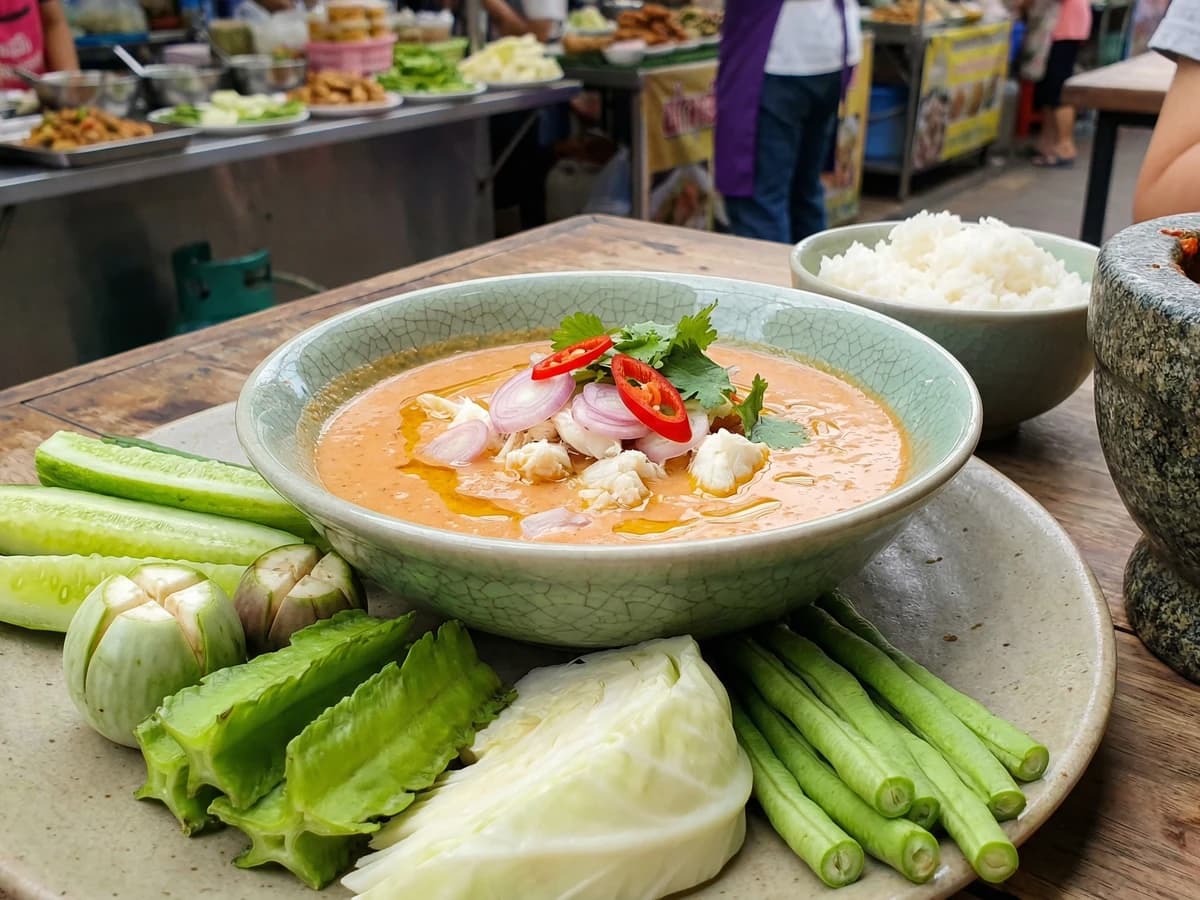
A kreung tam pounded in the krok, dissolved into cracked coconut cream, sweet crab folded through at the end. All four pillars balanced in a dip so silky you'll forget it started in a granite mortar. Central Thai home cooking at its most principled.

Chef Fai
Twenty-four meatballs, eight bamboo skewers, a charcoal grill the size of a shoebox, and one pot of nam jim built on the four pillars. The simplest vendor setup in Thailand proves the system works everywhere.
Chef Fai
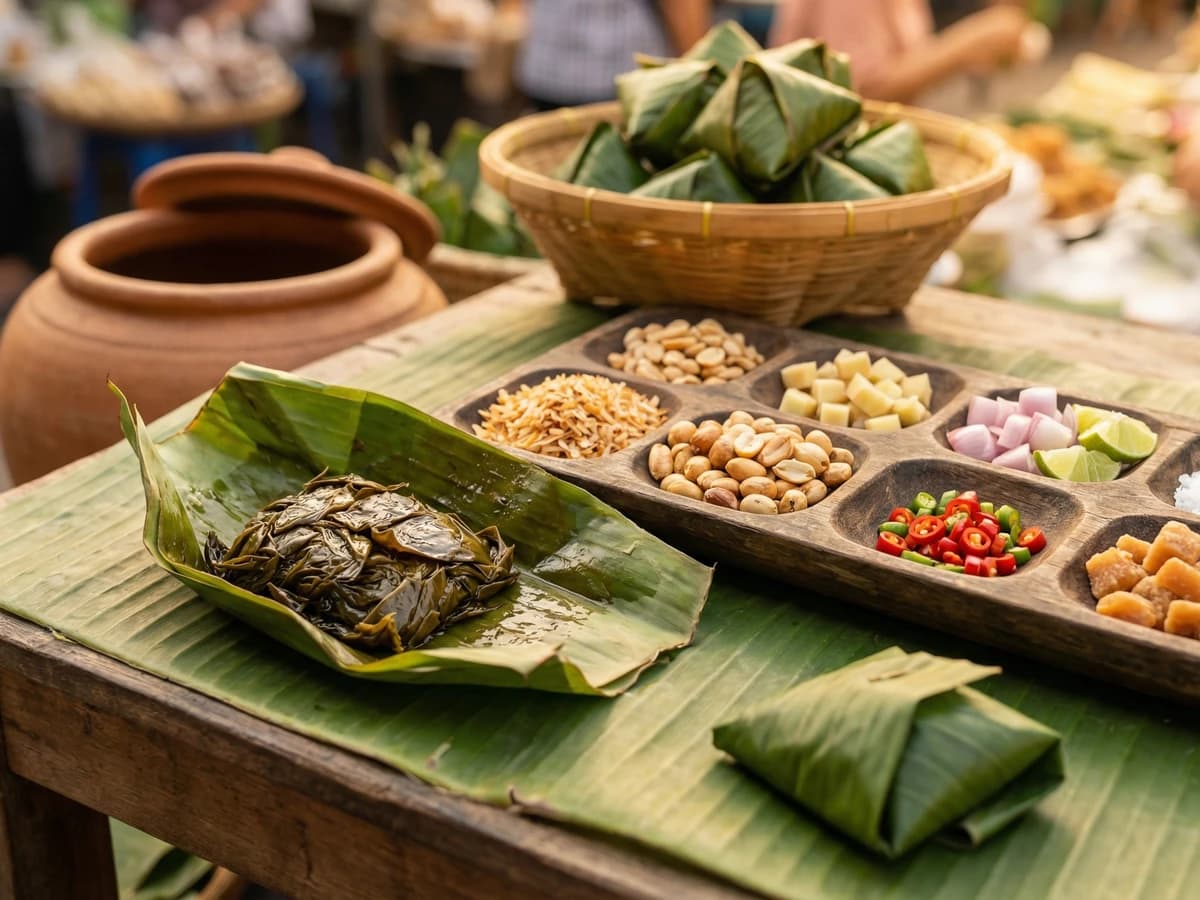
Lanna's oldest fermented tradition: wild tea leaves steamed, packed tight in banana leaf, and transformed by lactic acid bacteria over months. Time is the ingredient no one can skip.