Culinary Explorer

A cooking platform built around craft, culture, and the stories behind what we eat.
Discover Culinary Explorer
Isan Catfish Larb (Larb Pla Duk)

Isan Catfish Larb (Larb Pla Duk)

Created by

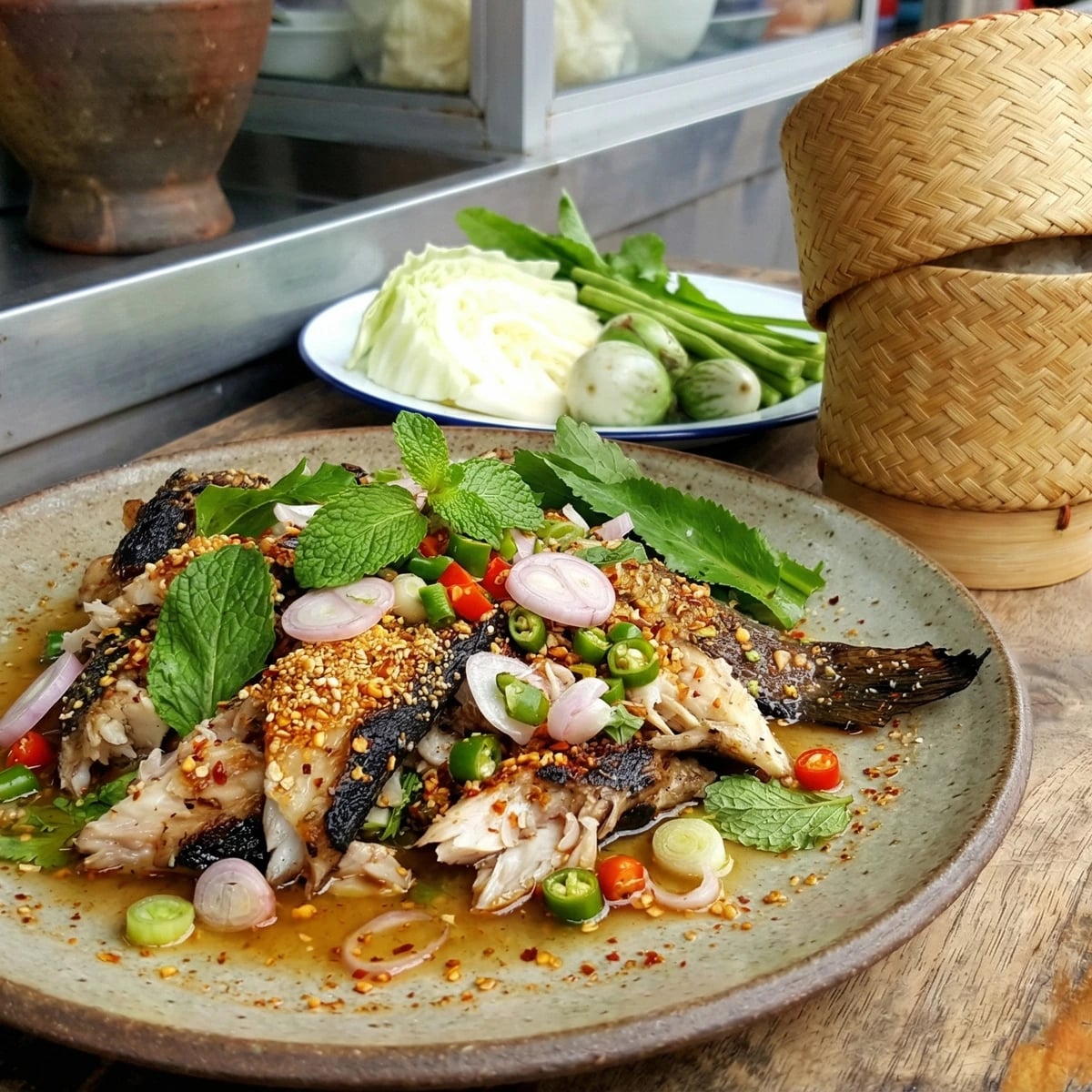
No sugar. That's the line between Isan and Central Thai larb. Grilled catfish flaked while warm, dressed with nam pla, manao, khao khua, prik pon, and a storm of fresh herbs. The plateau on a plate.

Salads
Thai
Weeknight
Comfort Food
25 min
Active Time
20 min cook45 min total
Yield4 servings

No sugar. That's the rule. That's the principle that separates Isan larb from every Central Thai version you've ever tasted.

Ajarn always said the four pillars of Thai cuisine are fish sauce for salt, palm sugar for sweet, tropical fruit acids for sour, and chili for heat. In Isan, they looked at that system and said: we don't need the sweet. And they were right. Isan larb runs on three pillars, not four. Nam pla for salt. Manao for sour. Prik pon for heat. The fourth pillar isn't missing. It was never invited. The absence of sugar is what makes the flavors hit harder: the fish sauce is more direct, the lime is sharper, the chili has nowhere to hide. That's Isan. Nothing softened, nothing rounded off.

Now, catfish. Pla duk. This is the fish of the Isan plateau, pulled from rice paddies, irrigation canals, and the slow rivers that feed the Mekong basin. It's a muddy fish. People say that like it's a problem. It's not a problem. It's a flavor. The earthiness of pla duk is what makes this larb different from chicken larb or pork larb. You grill it whole over charcoal until the skin blisters and chars, the fat renders into the flesh, and the smokiness penetrates every layer. Then you flake it while it's still warm. Warm fish absorbs the dressing. Cold fish sits in it. That's the science.

This isn't a kreung tam dish. There's no paste. Larb is a technique: protein plus dressing plus khao khua plus herbs. But the principles still hold. The balance of sour, salty, and hot is governed by the same framework Ajarn taught me. You taste. You adjust. More lime if it needs edge. More nam pla if it needs depth. More prik pon if it needs fire. The khao khua ties everything together, that smoky, nutty crunch that is the signature of the Isan table. Without it, you have a salad. With it, you have larb.

My mother would eat this at the end of a long day at the stall. Sticky rice from the kratip, a pinch of warm larb, a leaf of mint. One bite. That's how it's designed. Not on a plate with a fork. In your hand, with the rice, with the herbs. The combination is the point.

Larb is the foundational meat preparation of Isan (northeastern Thailand) and Laos, predating written recipes by centuries. Freshwater catfish (pla duk) thrives in the rice paddies and irrigation canals of the Khorat Plateau, making it one of the most accessible proteins in the region. The Isan larb tradition deliberately excludes sugar from its dressing, a stark departure from Central Thai adaptations that add palm sugar for balance. This austerity of flavor, sour-salty-hot without sweetness, defines the Isan palate and reflects a cuisine shaped by scarcity, heat, and the bold flavors of fermentation.

The technique, the tradition, and the story behind every dish.

Discover Culinary Explorer

Ingredients

whole freshwater catfish (pla duk)

Quantity

1 fish, about 500-600g

gutted and cleaned

fish sauce (nam pla)

Quantity

3 tablespoons

fresh lime juice (nam manao)

Quantity

4 tablespoons (about 3-4 limes)

raw sticky rice (khao niew)

Quantity

1/3 cup

for making khao khua

roasted dried chili flakes (prik pon)

Quantity

1-2 tablespoons

shallots (hom daeng)

Quantity

5

thinly sliced

green onions (ton hom)

Quantity

4

sliced into thin rounds

fresh mint leaves (bai saranae)

Quantity

1 large handful

sawtooth coriander (pak chi farang)

Quantity

5 sprigs

sliced thin crosswise

cilantro (pak chi)

Quantity

3 sprigs

roughly chopped

sticky rice (khao niew)

Quantity

for serving

raw vegetables for serving

Quantity

assorted

white cabbage wedges, long beans, Thai eggplant, fresh mint sprigs

Equipment Needed

  • Charcoal grill or gas grill
  • Heavy granite mortar and pestle (krok hin) for pounding the khao khua
  • Dry wok or cast-iron skillet for toasting rice
  • Large mixing bowl

Instructions

  1. 1

    Make the khao khua

    Set a dry wok or skillet over medium heat. Add the raw sticky rice grains and toast them, shaking the pan constantly. No oil. No butter. Just dry heat and patience. The grains will turn from white to pale gold to deep amber over about 8-10 minutes. You want the color of a monk's robe: that rich golden-brown, with a few darker grains in the mix. The kitchen should smell nutty and toasty, like popcorn crossed with woodsmoke. Pull them off the heat the moment they're there. They go from perfect to burnt in seconds. Let them cool for a minute, then pound in a mortar to a coarse powder. Not fine. You want texture, grit, crunch. Some half-crushed grains, some powder. That's khao khua.

    Never use store-bought rice powder. It's stale. It tastes like dust. Khao khua must be freshly toasted and freshly pounded. The oils in the toasted grain go rancid fast. Make it the day you use it. This takes ten minutes and it's the backbone of every Isan larb.
  2. 2

    Grill the catfish

    Get your charcoal grill hot, or crank a gas grill to high. Score the catfish three times on each side, deep enough to hit the bone. This lets the heat reach the thick flesh and the fat render out. Grill the whole fish directly over the coals. Don't touch it for the first 5 minutes. Let the skin blister and char. The fat under the skin will start to bubble and spit. That's good. That fat is carrying smoke flavor into the flesh. Flip once, grill another 5-7 minutes. The skin should be blackened in spots, pulling away from the flesh. The meat should flake easily when you press it with a fork. Pull it off the heat.

    Charcoal is the ideal heat source. The smokiness is part of the dish's identity. If you're using a broiler or gas flame, you'll get cooked fish but you won't get that charcoal depth. Do what you can with what you have, but know what you're giving up.
  3. 3

    Flake the fish

    Let the catfish rest for just 2 minutes, no longer. You want the fish warm, not hot enough to wilt the herbs on contact, but warm enough to absorb the dressing. Peel away the charred skin (discard it or eat it as a cook's snack, your call). Use a fork and your fingers to flake the flesh off the bones into a large mixing bowl. Go carefully around the spine and the pin bones. Catfish has a simple bone structure, so this goes fast. You want rough flakes, not mush. Some pieces the size of your thumbnail, some smaller. Break apart any large chunks but don't shred it into nothing.

  4. 4

    Dress the larb

    This is where the dish lives or dies. Add the fish sauce to the warm flaked catfish first. Toss gently. The salt penetrates the warm flesh immediately. Then the lime juice. Toss again. Then the prik pon and the khao khua. Toss. Now taste. Right now. Before the herbs go in. The dressing should be sour first, salty second, with heat building at the back of your throat and the khao khua giving it body and crunch. No sweetness. None. If your instinct is to add sugar, fight it. This is Isan. The sharpness is the point.

    Ajarn always said: "Add sour last, add sour slowly." With larb, the lime goes in after the fish sauce because you need to taste the salt level first. Lime changes everything the moment it hits. You can always add more. You can't pull it back.
  5. 5

    Add the herbs and shallots

    Scatter the sliced shallots, green onions, sawtooth coriander, cilantro, and mint over the dressed fish. Toss gently with your hands or two spoons, folding from the bottom. The herbs are not garnish. They're structural. The raw shallots bring sharpness. The mint brings a cooling counterpoint to the chili heat. The sawtooth coriander (pak chi farang) adds a grassy, almost citrus note that regular cilantro can't provide. Every element has a job. Taste one more time. Adjust the lime or fish sauce if needed. The larb should taste bright, sharp, fiery, earthy from the catfish, and crunchy from the khao khua.

  6. 6

    Serve with sticky rice

    Transfer the larb to a plate or shallow bowl. Don't pile it high, spread it so the herbs are visible. Serve at room temperature alongside a kratip of sticky rice and a plate of raw vegetables: cabbage wedges, long beans, Thai eggplant, extra mint sprigs. The way to eat this: tear off a small piece of sticky rice, press it flat between your fingers, pinch some larb on top, add a leaf of mint or a bite of cabbage. That's one bite. The sticky rice is the vehicle, the raw vegetables are the contrast, and the larb is the engine. Never jasmine rice. Sticky rice is the only accompaniment. That's non-negotiable in Isan.

Chef Tips

  • The governing rule of Isan larb: no sugar. This is not a suggestion or a regional quirk. It's the principle that defines the entire Isan flavor system. Central Thai larb adds palm sugar to soften the dressing. Isan does not. The result is a dressing that hits harder: sour, salty, and hot with nothing to cushion the blow. If you add sugar, you've made Central Thai larb. It might taste good. But it's not Isan.
  • Catfish (pla duk) has a distinctive earthy, muddy flavor that comes from its bottom-feeding life in rice paddies and canals. Don't fight it. That earthiness is the point of this dish. The charcoal grill, the khao khua, the aggressive lime and fish sauce: they all work with the muddiness, not against it. If you want a clean, delicate fish larb, use pla nin (tilapia). But then call it what it is.
  • Khao khua is the soul of every Isan larb. Toast sticky rice (not jasmine, not basmati, sticky rice specifically) in a dry pan until it's the color of a monk's robe. Pound it coarse. The nuttiness, the smokiness, the gritty crunch: it's what binds the dressing to the protein and gives larb its signature texture. Stale khao khua from a bag tastes like sawdust. Fresh khao khua tastes like the Isan plateau. There's no comparison.
  • Sawtooth coriander (pak chi farang) is not the same as regular cilantro. It has long, serrated leaves and a more intense, almost metallic herbaceousness. In Isan cooking, it appears in nearly every larb and nam tok. If you can't find it, increase the mint and cilantro. But know that you're missing a layer.

Advance Preparation

  • Khao khua can be toasted and pounded a few hours ahead. Store in a sealed container at room temperature. Do not refrigerate. Do not make it the day before; the oils in toasted sticky rice go stale overnight.
  • Shallots, green onions, and herbs can be prepped and sliced up to an hour ahead. Keep them covered with a damp cloth.
  • The catfish must be grilled and dressed fresh. The dressing penetrates warm fish; cold fish rejects it. Do not make larb ahead and refrigerate. It's a room-temperature dish that's assembled and eaten within minutes.

Frequently Asked Questions

Nutrition Information

1 serving (about 180g)

Calories
215 calories
Total Fat
5 g
Saturated Fat
1 g
Trans Fat
0 g
Unsaturated Fat
3 g
Cholesterol
45 mg
Sodium
1100 mg
Total Carbohydrates
23 g
Dietary Fiber
3 g
Sugars
4 g
Protein
17 g

Note: Chef personas and recipes are created with AI assistance. Cook with care: follow safe food-handling practices, check doneness with a thermometer when needed, and adapt for allergies and your kitchen.

Where cooking meets culture.

Culinary guides, cultural storytelling, and the editorial depth that makes cooking meaningful.

Discover Culinary Explorer

More from Isan Larb, Nam Tok & Meat Salads

Browse the full collection