Culinary Explorer

A cooking platform built around craft, culture, and the stories behind what we eat.
Discover Culinary Explorer
Rollo de Guayaba de Calvillo

Rollo de Guayaba de Calvillo

Created by

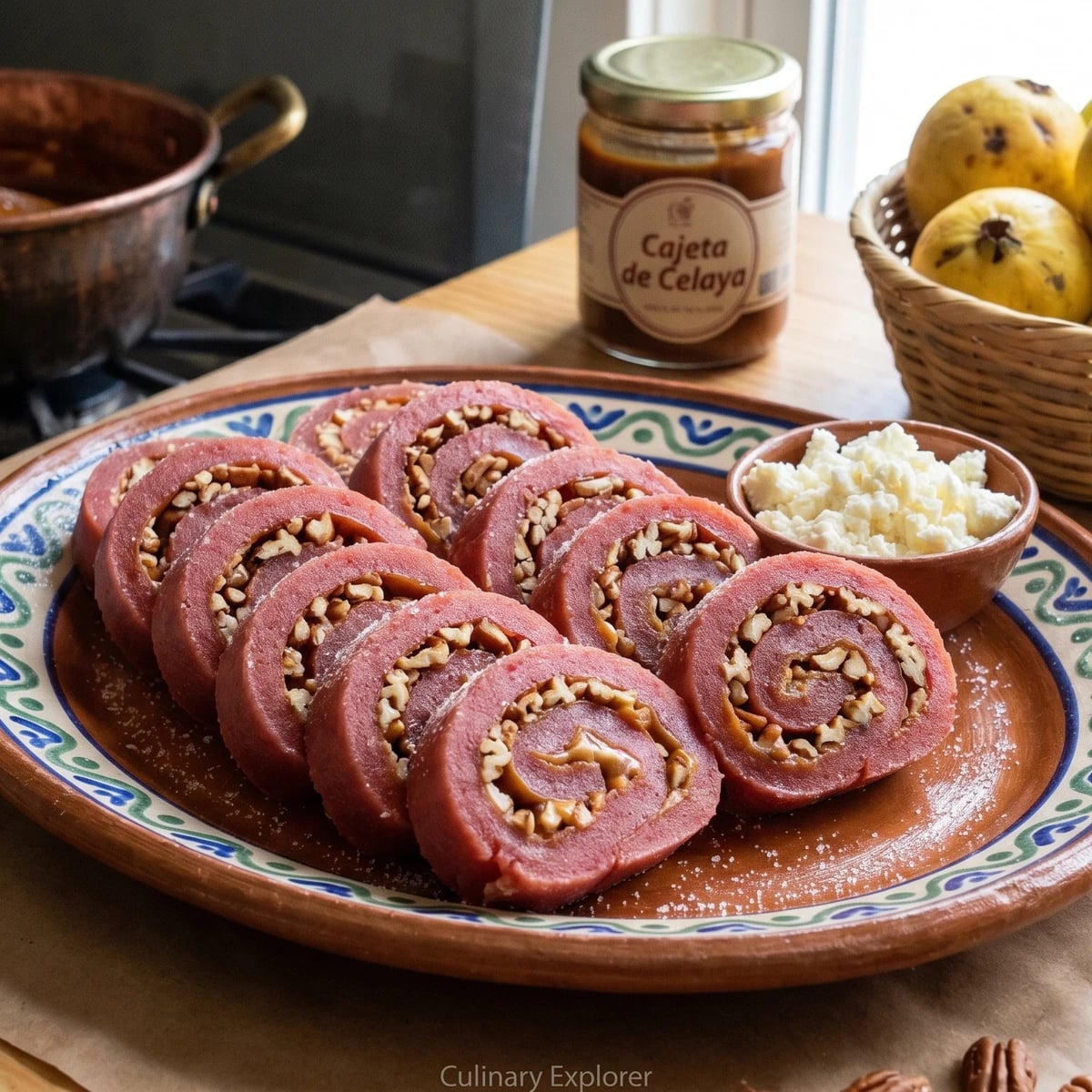
Aguascalientes guava country gives you this feria dulce: Calvillo guava ate rolled around cajeta de leche de cabra and toasted nuez pecanera until every slice shows the Bajio.

Desserts
Mexican
Holiday
Celebration
Make Ahead
45 min
Active Time
1 hr 20 min cook2 hr 5 min total
Yield2 rolls, about 20 slices

Aguascalientes, the valley of Calvillo, is where this roll belongs. The guavas there have perfume before you cut them open, and that matters. If the fruit smells like nothing, cook something else today. Si no conoces el mercado, no conoces la cocina.

This dulce lives between the feria table and the family kitchen. You see it at the Feria de San Marcos, wrapped in clear paper, stacked beside charamuscas and other sweets from the Bajio. But the good ones are not only sweet. The guava paste has acidity, the cajeta has the deep cooked flavor of leche de cabra, and the nuez pecanera gives the roll its bite. No me vengas con atajos: this is not jelly rolled around caramel sauce.

I learned a version from a woman at Mercado Teran who sold guava sweets in small boxes tied with ribbon. She cooked the paste until the spoon stood up in it, then said, "Now it will roll. Before that, it only dreams." She was right. You cook the fruit until it becomes structure. La cocina no es decoración, es trabajo.

Use Cajeta de Celaya from the dulceros, Salgado, La Tradicional, Coronel Sanchez if you can find them. This is the hacienda and mercado register of the Bajio, not convent cajeta quemada pretending to be the same thing. Saber cocinar es saber vivir.

Calvillo, Aguascalientes became one of Mexico's best-known guava-producing regions in the 20th century, when commercial orchards expanded around the valley and guava sweets became a practical way to preserve ripe fruit beyond the harvest. Ate, a firm fruit paste, descends from Spanish membrillo techniques adapted in Mexico to local fruits including guayaba, tejocote, and tuna cardona. The pairing with cajeta de leche de cabra connects Calvillo to the wider Bajio sweet-making corridor, especially Celaya, where goat-milk cajeta became a commercial specialty in the 19th century.

The technique, the tradition, and the story behind every dish.

Discover Culinary Explorer

Ingredients

ripe guayaba de Calvillo

Quantity

2 pounds

washed and trimmed

water

Quantity

3 cups

granulated sugar

Quantity

3 cups, plus more for dusting

fresh lime juice

Quantity

2 tablespoons

fine sea salt

Quantity

1 pinch

cajeta de leche de cabra

Quantity

1 cup

preferably Cajeta de Celaya

nuez pecanera

Quantity

1 cup

toasted and finely chopped

granulated sugar for rolling

Quantity

1/4 cup

Equipment Needed

  • Cazo de cobre or heavy wide pot
  • Wooden spoon worn smooth at the edge
  • Food mill or medium-mesh sieve
  • Rimmed sheet pan
  • Parchment paper
  • Offset spatula

Instructions

  1. 1

    Cook the guavas

    Put the guayabas in a heavy pot with the water. Bring to a gentle boil and cook 20 to 25 minutes, until the fruit is soft enough to crush with a spoon and the kitchen smells floral, like a crate of guavas at Mercado Teran. Do not peel them. The skin carries pectin and flavor.

  2. 2

    Strain the pulp

    Pass the cooked guavas and their liquid through a food mill or press them through a medium-mesh sieve. Discard the hard seeds. You should have about 4 cups of thick guava pulp. If you leave seeds in the paste, every slice will tell on you.

  3. 3

    Cook the ate

    Pour the guava pulp into a cazo de cobre or a heavy wide pot. Add the sugar, lime juice, and salt. Cook over medium-low heat, stirring with a wooden spoon, 45 to 55 minutes. The paste is ready when it pulls away from the bottom in a clean path and falls from the spoon in a heavy sheet. This is not jam. This is ate, and ate has body.

    If the paste spits, lower the heat and keep stirring. Guava burns fast once the sugar tightens. Burned guava tastes bitter and there is no polite way to hide it.
  4. 4

    Spread the sheet

    Line a rimmed sheet pan with parchment and dust it lightly with sugar. Scrape the hot guava paste onto the parchment and spread it into a rectangle about 1/4 inch thick. Use an oiled offset spatula or the back of a spoon. Let it cool until firm but still flexible, about 45 minutes.

  5. 5

    Fill the roll

    Spread the cajeta de leche de cabra over the cooled guava sheet, leaving a 1-inch border along one long side. Scatter the toasted nuez pecanera evenly over the cajeta. This is Bajio work: fruit from Calvillo, goat-milk cajeta from the Celaya dulceros, pecans from the northern orchards. Cada estado, su propia cocina, and every ingredient knows where it came from.

  6. 6

    Roll it tight

    Starting from the long side opposite the clean border, use the parchment to lift and roll the guava sheet over itself. Keep the roll snug but do not crush it. The cajeta should stay inside, not smear across the table. Roll the outside in sugar until lightly coated.

  7. 7

    Rest and slice

    Wrap the roll in parchment and let it rest at room temperature for at least 4 hours, or overnight. Slice with a lightly oiled knife into 1/2-inch rounds. Serve on a clay platón with coffee de olla or a small glass of rompope. Recetas probadas y garantizadas.

Chef Tips

  • Buy guayabas that smell ripe before they look perfect. A few bruises are fine. Hard green guavas will give you a stiff paste with no perfume.
  • A cazo de cobre gives even heat and helps the paste tighten cleanly. If you do not have one, use a heavy wide pot and stir constantly. That is a compromise, not an upgrade.
  • Use cajeta de leche de cabra, not canned dulce de leche. Goat milk is the point. It has the slight tang and depth that stand up to the guava.
  • Toast the nuez pecanera before chopping. Raw pecans taste flat inside all that fruit and milk sugar.

Advance Preparation

  • The guava ate sheet can be cooked and spread one day ahead. Cover it loosely with parchment once cool so it stays flexible.
  • The finished roll keeps 7 days at room temperature, wrapped in parchment and stored in a tin or glass container.
  • Slice only what you need. Whole rolls hold their shape better than pre-cut slices.

Frequently Asked Questions

Nutrition Information

1 serving (about 75g)

Calories
250 calories
Total Fat
5 g
Saturated Fat
1 g
Trans Fat
0 g
Unsaturated Fat
4 g
Cholesterol
2 mg
Sodium
30 mg
Total Carbohydrates
51 g
Dietary Fiber
2 g
Sugars
48 g
Protein
2 g

Note: Chef personas and recipes are created with AI assistance. Cook with care: follow safe food-handling practices, check doneness with a thermometer when needed, and adapt for allergies and your kitchen.

Where cooking meets culture.

Culinary guides, cultural storytelling, and the editorial depth that makes cooking meaningful.

Discover Culinary Explorer

More from Bajío Desserts

Browse the full collection